
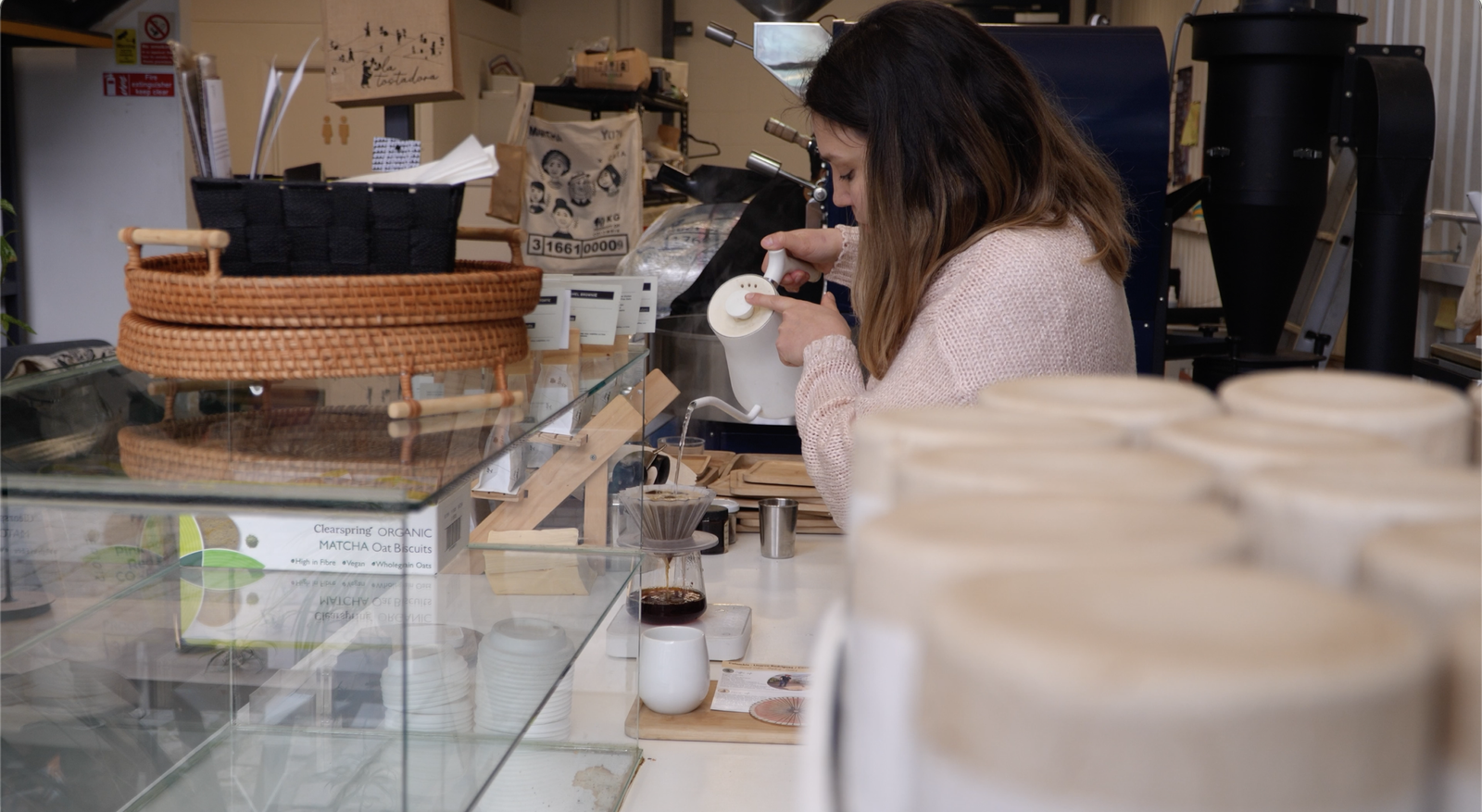
Dora’s farm visits, former barista work and the people behind La Tostadora
Dora learned to roast in Colombia. I met her in Bethnal Green, where she showed me the work and told me about the farmers she wanted her customers to meet.
Why did Colombia change the way Dora wanted to work with coffee?
I asked Dora how she chose her farmers. Her La Tostadora story begins with farm visits too.
What made Dora want to represent the Colombian coffee farmers?
I visited lots of farms. I traveled by myself and I wrote to different people.
Colombians in general are very hospitable. They connect you with the right people.
And I had the chance to visit some of the best farmers, to be honest, kind of accidentally, but still intentionally.
But I think I was very lucky for them to welcome me in their homes and showing me different coffees.
As a token of appreciation and kind of like seeing that sparkle in their eyes, that really moved me.
To be honest, at that time I wasn’t even marketing coffee, but that really, really moved me.
And that’s when I decided that I’m going to support them. I’m going to not just support them, but like represent them.
I want people when they drink their coffee to see them as well.
How did Dora’s barista work and coffee conversations help her learn?
Personally myself, I just didn’t feel that my office work was fulfilling enough and I was traveling a lot as well, and I was trying to, I think, find myself eventually or find what I’m passionate about, but also something that I feel like I can use to give back to others.
And I was a barista before, so I kind of like appreciate what my baristas have to go through every day and what the challenges are.
But again, I think if you’re passionate about something, you will ask around and you’ll learn it through your own sources.
So what I did, I went to volunteer at the big coffee festivals, and I just started conversations with everyone around.
I think I tried, like any kind of aspect of the world of coffee, and that’s what I did when I went to Colombia as well.
Dora described her Q Grader training. The SCA’s current programme uses Coffee Value Assessment.
How does La Tostadora make the coffee farmer visible to customers?
La Tostadora shares grower stories and holds coffee conversations. Dora’s founder page names connecting customers with farmers as her aim.
Why did Dora want more detail than bean to cup on a coffee bag?
Dora wanted customers to see the grower’s story and processing details.
You can read actually his story. You can see how he processed the beans.
And you can absolutely be like super transparent with that, because I think when you just say bean to cup, it’s not enough. It’s not enough.
You need to see the truth. You need to know a bit more about that.
Because unless you’re in the industry, you don’t know a lot, to be honest.
They appreciate the transparency as well as the quality of coffee. I think that the trust is there.
So I feel like they trust us with the selection of beans, with the roasting process, with how we make the coffee. So it is a combination of all.
When the farmers are here, they represent their own coffees.
They talk about their own challenges, their own stories, their own varieties, their own terms, like what goes in there.
And they feel appreciated as well, a bit more.
And that’s kind of like my aim in that the big corporate might not do the same job as the small ones, let’s just say that.
What did La Tostadora’s learn and cup sessions cover?
La Tostadora’s sessions covered roasting, processing, varieties and farmers’ coffees.
We always have like different subjects around coffee.
We had actually someone from Brazil representing, sorry, from Colombia, representing one of the farms that we work with that we have all year round.
We tasted their coffees, different coffees as well.
We did one about varieties because I always say it’s like apples. There are different varieties.
They taste very, very different. And the same with coffee.
It’s the very, very same. Different things can taste very, very, very different.
Those were sessions Dora recalled. Check La Tostadora for current arrangements.
How does Dora keep La Tostadora connected to changing coffee harvests?
Dora revisits growers and buys successive harvests. Coffee Value Assessment also distinguishes sensory assessment from information about a coffee’s origin.
Why did Dora keep visiting Colombian coffee farms?
Dora wanted to visit growers, see their work and exchange knowledge.
Obviously it didn’t happen overnight, but it took some time at first.
But that convinced me one hundred percent, and I try to go back every other year or so to get more farmers on board, to visit them, to see what they’re doing, kind of like to exchange that knowledge and have that knowledge sharing that I was talking about earlier as well, that I think is very, very important.
And I just really like their culture of sharing that knowledge, to be hungry for that knowledge. And they kind of like appreciate that you’re the market.
So they want to learn more about the market. And they’re businessmen at the end of the day.
So they need to know like what they need to supply as well to me, to the whole market.
Why does La Tostadora check coffee from each new harvest?
La Tostadora checks new harvests because growing conditions and flavour change.
We try to work with a few farms that we’re contracted to. That gives them the stability, that gives them the demand, and they know how to plan as well on the farms.
So we have a few of the coffees that are kind of like all year round, but that doesn’t mean it’s the same bean. It’s maybe from the same tree, but it’s a different crop.
So maybe, you know, as here in the UK as well, like maybe one crop is better than the other because the temperature is different each summer and the sunlight is different.
It’s the same with coffee.
So not every coffee tastes the same. And that’s why we always need to ensure that the quality is there, the consistency is there.
Ask about the bag you are buying, my loves. Meet more makers in our food stories, or Explore My Ideal World