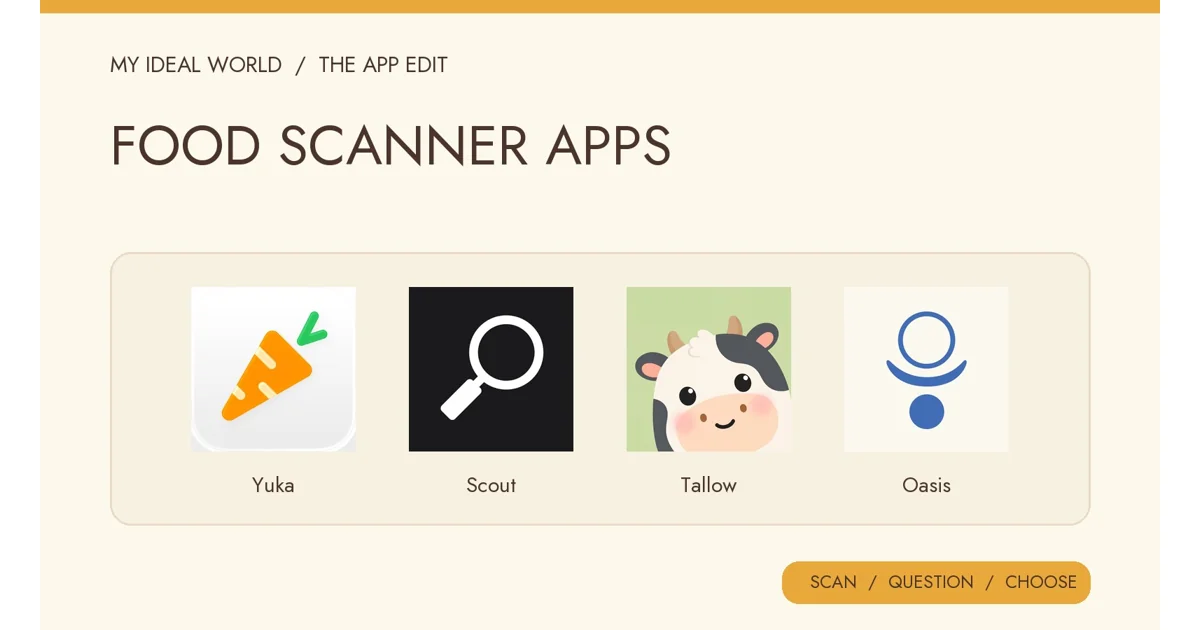
The best food scanner apps in 2026 depend on whether you need nutrition information, ingredient research, a dietary match or evidence about the maker. One score cannot answer every shopping question.
Two apps can give different answers for the same food because they apply different rules. That disagreement needs an explanation before it becomes a claim that one app found the truth.
This guide compares published methods and the product information behind the results. Yuka, Scout, Oasis and My Ideal World do not measure identical things.
A barcode record may be incomplete or refer to another formulation. No general score guarantees that a product suits an allergy or another individual medical need.
Identify the question, check the current pack and follow the source. Then choose the scanner that helps you do that job.
The score is a decision somebody made
Yuka’s food formula considers nutrition, additives and organic status. Scout has a category specific framework involving processing and ingredient concerns. Oasis emphasises independent laboratory data. Tallow publishes its own approach to oils and additives. They can all look at one snack and disagree without the label itself being in dispute.
The interesting disagreement begins when somebody describes a preference rule as though it were a measured contaminant. A seed oil appearing on a label is a composition fact. A lead concentration from a tested batch is an analytical result. A warning about exposure requires a valid conversion and a reference value.
That’s why the Oasis and LMNT dispute matters. The complaint alleges a mistake translating a laboratory result into a consumer claim. The founder acknowledges errors but disputes parts of the timeline. The original documents should lead the story, not the most dramatic social post.
For readers, the question worth saving is almost boring in its simplicity. Where did this number come from, and is it measuring the thing I care about?
What we would score and what we would not
The Throne Standard’s Food pack (version 1.0.0 under Standard 2.2) checks a complete, attributable ingredient declaration against explicitly named processing-marker preference rules. A missing, partial or unmatched declaration remains unresolved. This is a composition-preference assessment, not a laboratory health-and-safety verdict.
What we will not score as if it were composition. We do not turn processing markers into claims of poisoning, prove the presence of contaminants from a label, or grade an entire multinational’s labour conduct from one soft drink. Natural flavourings are not proof of purity or danger. We do not score an incomplete ingredient list as zero.
Read the standard version named in the individual report, together with its metric, evidence dates, eligible products and coverage. Category specific methods can answer different questions, and the live report may use a later version than an older explanatory page.
A missing or conflicting declaration is unresolved, not proof of a bad composition. Read the exact standard; challenge an incorrect record.
The one number problem
A score is easy to understand and difficult to interrogate. When I pick up something unfamiliar on a trip, I want the composition first: ingredients or materials, where the information came from, when it was updated and which conclusions are measured versus inferred. Broader sustainability questions matter too, but should not be disguised as laboratory measurements.
Compare the job, not the marketing
| Service | Core focus | What to check |
|---|---|---|
| Yuka | Food and cosmetic product ratings | Ingredient and nutritional data; published rating criteria |
| Open Food Facts | Open collaborative food product data | Contributor data quality, date and coverage |
| Good On You | Fashion brand people, planet and animals assessment | Scope and public rating methodology |
| Scout | Check its current published brand-scanning scope and methodology | Sources and what each result actually evaluates |
| My Ideal World | Brand research and composition-first transparency ambition | Provenance, score framework and data gaps |
Android and Apple downloads, what is actually public?
Android downloads are published by Google Play as rounded minimum thresholds; Apple does not publicly provide cumulative app downloads. The Apple figures below are marked undisclosed rather than guessed. These figures do not measure monthly active users, product-scanning accuracy or retention. Checked in November 2026.
| App | Android downloads | Apple iPhone downloads | Source or next step |
|---|---|---|---|
| Yuka | 10M+ | Not publicly disclosed | Google Play installation threshold |
| Oasis | 100K+ | Not publicly disclosed | Google Play installation threshold |
| Scout | 10K+ | Not publicly disclosed | Google Play installation threshold |
| Tallow | 10K+ | Not publicly disclosed | Google Play installation threshold |
| Bobby Approved | 1M+ | Not publicly disclosed | Google Play installation threshold |
| Fig | 500K+ | Not publicly disclosed | Google Play installation threshold |
| My Ideal World (MIW) | Not publicly disclosed | Not publicly disclosed | Explore the app and sign up |
How My Ideal World would score the brands, and what we refuse to score
Our score is a test against the Throne Standard, not a prize for whichever app has the most downloads. The relevant published standard is versioned, and category results must keep their own meaning.
An ingredient preference, laboratory result, animal-welfare policy and nutritional profile are not interchangeable evidence.
The live reports checked on 17 November 2026 show Picture at 1/5 and Gray Label at 3/5 under the report’s Throne Standard 3.0.0 composition assessment. Picture has 37.18% verified plant evidence across 971 complete declarations from 1,116 eligible products, with 39 missing declarations and 106 technical gaps.
Gray Label has 85.67% verified plant evidence across 305 complete declarations from 394 eligible products, with no missing declarations and 89 technical gaps. Coverage is 87.01% for Picture and 77.41% for Gray Label. Both reports describe these as provisional results with incomplete coverage, rather than final whole brand assessments.
These numbers demonstrate our composition method; they are not a head-to-head benchmark against Scout, Oasis, Tallow or Yuka.
| Brand checked in HTT | Current score | Why | Read the evidence |
|---|---|---|---|
| Picture, clothing | 1/5 | 37.18% verified plant evidence; 971 of 1,116 eligible declarations complete. Provisional result with 87.01% coverage. Checked 17 November 2026. | Picture report |
| Gray Label, clothing | 3/5 | 85.67% verified plant evidence; 305 of 394 eligible declarations complete. Provisional result with 77.41% coverage. Checked 17 November 2026. | Gray Label report |
| Coca-Cola, example raised in this comparison | Not verified in the accessible current HTT report | The ingredient declaration can be checked, but it does not establish a current HTT product score. | Awaiting exact report and version |
The Coca-Cola example is unscored here. Its ingredient declaration can support a description of the formula, but this article does not establish a current HTT product result.
We do not award or deduct purity points for downloads, App Store reviews, subscriptions, celebrity endorsements or online arguments. Nor is a composition score a calorie score, a personal medical risk score, a laboratory contaminant test or an automatic judgement on labour conditions.
The current Throne Standard makes different categories and assessment limits explicit. Where no current assessment exists, we say so rather than borrowing another scanner’s score.
Explore My Ideal World and sign up for the underlying research, rather than treating another app’s numerical score as our result.
Google Play figures are lower-bound installation bands. Apple provides actual download statistics to each publisher through App Store Connect, not as a comparable public leaderboard. An App Store rating count is not a download count.
My Ideal World is listed last because it is our app, and no unverified install figures are claimed. Apple developer explanation of download reports.
What people have disputed about food-scanning scores
Yuka has been involved in French litigation concerning its treatment of nitrites in processed meat. The fact of litigation is not proof that all its data is inaccurate.
Early decisions were overturned on appeal; the specific history and final procedural status should be checked from court records before stronger conclusions are drawn. Likewise, allegations or online arguments about other apps are not equivalent to findings.
We will not turn a competitor dispute into an unsupported accusation.
What metrology actually requires. Metrology is the discipline of measurement. It demands identifiable quantities, appropriate methods, traceability and uncertainty where applicable. A public database field or proprietary score does not become a direct laboratory measurement merely because it is numerical. That distinction should be clear in any consumer report.
Purity of composition, properly framed. For our editorial approach, purity of composition means examining what is actually present and what is missing from the evidence. It is not a promise that every natural ingredient is safe or every additive harmful.
Product identity, dose, exposure, intended use and source quality can change the interpretation. Other dimensions labour, environment, ownership should be presented transparently alongside composition, not buried inside an unexplained total.
A worked example. Compare two face creams. Look at the package’s actual INCI ingredient lists. Check whether the app has the exact formulation and whether any rating is based on disclosed criteria. Save the evidence you trust and a note about what remains unknown. For a broader investigation, read how to check a brand and the label guide.
Published methods. Read Yuka’s own explanations, Open Food Facts and Good On You’s published approach. These sources document what each service says it does; they are not an independent head-to-head test.
Scanner apps are competing to define a good product
Yuka, Scout, Oasis, Tallow, Fig, Bobby Approved and other tools all ask consumers to trust information on a small screen. But their questions differ.
Some weight nutrition and additives, some focus on ingredient preferences, some publish laboratory measurements, and others specialise in dietary restrictions. My Ideal World is built around category-specific purity of composition and connected brand research.
Comparing their numbers without first explaining the rules is meaningless.
The most useful buying guide doesn’t declare a universal winner from a screenshot. It tells the reader which product category, source type and scoring method the service actually covers. If an app doesn’t recognise a particular product, that’s a coverage gap.
If it displays an old ingredient list, that’s a data problem. If it penalises a different attribute, that’s a scoring difference. A trustworthy comparison separates all three.
The Scout, Oasis and Tallow argument shows why units matter
The public comparison articles between scanner rivals are commercial documents. They can reveal genuine differences, but each company has an incentive to make its own method look stronger.
The LMNT lawsuit against Oasis introduces a distinct legal dispute over alleged presentation of lead measurements. The complaint isn’t a court verdict, but it provides an instructive example of how a concentration and an exposure-per-serving figure must not be confused.
A properly reported laboratory result has a substance, tested sample, unit, method, date and any applicable detection limit. A scanner score is the interpretation applied to evidence.
If the interpretation uses the wrong unit or threshold, the visible conclusion can become seriously misleading even when the original laboratory work was accurate. That is precisely why I want corrections and scoring versions accessible.
Download counts are not a test of scientific accuracy. Google Play displays rounded installation thresholds: Yuka above ten million Android downloads, Oasis above one hundred thousand, and Scout and Tallow above ten thousand each in the current listings.
Other apps such as Bobby Approved and Fig have their own bands. A company’s self-reported worldwide users are not the same thing as Android downloads, and Apple doesn’t disclose per-app lifetime totals publicly.
These figures are useful for understanding market scale and reader interest. They do not tell us which product was labelled correctly or which calculation is valid. A new app can be accurate with a small audience, and a popular one can still need corrections.
My Ideal World’s unverified totals should remain undisclosed in the table rather than be replaced with its database size or scan count.
A food label cannot tell you every contaminant
An ingredients panel is a declaration of deliberately used components. It does not independently test a batch for heavy metals or other contamination.
A scanner claiming laboratory findings needs to show the relevant actual report. A general product score drawn from labelled ingredients should not be described as a contaminant analysis unless the method explicitly supports that conclusion.
A contaminant report also cannot automatically describe all future batches. Sampling, dates, production and analytical uncertainty matter. If a result is compared to a health threshold, explain the jurisdiction, unit and exposure assumption.
A scary headline without that context can damage a brand and mislead shoppers toward another product that has not been tested at all.
Why My Ideal World scores composition differently
I built the standard around how I live. I want to understand what is actually inside the food, clothing, cosmetics and places I engage with.
A natural-fibre clothing threshold or a whole-food composition standard is a deliberate preference that should be documented and applied consistently. It isn’t an allegation that every synthetic ingredient is toxic or that a low-scoring owner is dishonest.
I have had uncomfortable moments seeing friends’ businesses receive results they don’t like. But an automatic rule needs to be the same for my friends and strangers. What I owe them is accuracy, clear sources and a fair way to challenge a mistake. A score that depends on relationships or commercial payments is not trustworthy.
A head-to-head method worth more than a popularity list
Preselect a small sample of exact products across food, supplements, cosmetics and materials. Photograph the barcode and current label in the same country.
Test the apps where they support that category on the same date, recording which recognise the exact item, which show source data and which display an independently documented laboratory result. Compare the correction routes and costs separately.
Then explain where the services are making a different judgement about the same facts. A favourite brand may score differently under two methods without a data error. A mislabeled ingredient or incorrect unit is another matter. That separation makes an investigative comparison useful for readers, competitors and the businesses being rated.
Which food scanner do you actually need?
For a parent checking allergens, the starting point is a current label and trusted allergy information. For someone tracking a diet, a food diary app may answer the real question. For people investigating product composition, the Ingredient Decoder and Food Label Decoder offer another approach.
We explain these distinctions in our ingredient-conscious shopping guide for families. The best app for scanning food labels depends on what you need to verify, not which score appears most dramatic.
Further reading and primary sources
Keep the evidence close. Explore the related research and create your My Ideal World account. Check the app page for current web and mobile availability.
On this story
Comments, questions and answers from signed-in readers. Community contributions are not verified editorial findings.
Contribute evidence
Reviews share first-hand experience. Observations can include opinions and objections. Evidence is checked against its sources before publication. Community contributions do not change MIW scores.
More long reads