

Eco lodges, resorts and family stays graded on the food, the water, the power and who owns the land. One stay in St. Lucia scores 4.8 out of 5. Most of the famous names never show their meters.
What makes a hotel in the Caribbean sustainable?
Most “eco” hotels in the Caribbean are a towel card and a straw made of paper. That is the bar most of them are proud of.
A sustainable hotel in the Caribbean does four things you can check. It grows or buys its food close to home. It makes or saves its own power and water. It keeps its waste on the island in a form that feeds something. And it leaves the land, the jobs and the money with the people who live there.
One of you asked me this, and it sits under every list like this one.
What brands are proven to be the best? I can’t keep up anymore.
Proven is the word. So this list only counts what a stay can prove, on its own website, in its own report, or in front of me. I have walked the land at four of these places (Frangipani on Barbuda, Lamblion in Antigua, the farm behind Charela Inn in Jamaica and Mount Kailash in St. Lucia). The other ten I checked line by line for My Ideal World, our eco directory, between 27 and 30 October 2026, against each stay’s own pages.
Why be this strict? Because an island is small. St. Lucia makes 97.5 percent of its electricity from fossil fuel, almost all of it imported diesel, and has no formal recycling. Every air conditioner and every imported steak in a resort lands on that island. A hotel either carries some of that weight itself or it hands the bill to the island.
Sustainable isn’t a badge on the door. It’s what’s on your plate, in your tap and on the deed.

These are the 14 best sustainable hotels in the Caribbean, at a glance
The 14 best sustainable hotels in the Caribbean sit on eight islands, from a two unit solar lodge on Barbuda to a cliffside villa resort in Dominica. Pick by what matters most to you, then read the card.
| Stay | Island | Type | Best for |
|---|---|---|---|
| Mount Kailash | St. Lucia | Healing retreat | Plant based healing, river water, off grid |
| Secret Bay | Dominica | Villa resort | Certified luxury with coral restoration |
| Anse Chastanet | St. Lucia | Resort | Snorkelling a marine reserve, a resort that publishes its numbers |
| Fond Doux Eco Resort | St. Lucia | Cocoa estate resort | Certified organic land, St. Lucian owned |
| Balenbouche Estate | St. Lucia | Heritage cottages | Self catering in the quiet south, no air conditioning |
| Lamblion Apartments | Antigua | Apartments | Families, cooking for yourself, Green Globe certified |
| Frangipani Eco Lodge | Barbuda | Eco lodge | Solitude on a solar powered beach |
| Cooper Island Beach Club | British Virgin Islands | Beach hotel | Solar power, sailing, snorkelling |
| Rosalie Bay Eco Resort | Dominica | Eco resort | Sea turtles and river power |
| Coulibri Ridge | Dominica | Mountain retreat | Off grid luxury above the sea |
| Charela Inn | Jamaica | Beach inn | Seven Mile Beach with a family farm behind the kitchen |
| Jungle Bay | Dominica | Wellness resort | Money that stays in the village |
| Small Hope Bay Lodge | Bahamas | Dive lodge | Divers, all inclusive, no bottled water |
| Tubagua Eco Lodge | Dominican Republic | Mountain lodge | The lowest price on this list |
Already know your priority? We split the Caribbean list by feature too. Read the eco hotels that publish their numbers, the solar powered stays, the water saving stays, the wildlife stays and the green heritage stays.
How we decide the best sustainable hotels in the Caribbean
We decide the best sustainable hotels in the Caribbean on six things, and a different stay on this list sets the bar for each one.
Power. Cooper Island Beach Club runs on more than 303 solar panels on a small island in the British Virgin Islands. Power you make yourself is power no tanker has to bring.
Water. Mount Kailash drinks and bathes from the river where it rises on its own mountain, with no chlorine and no public supply. That is the gold standard. A filter on the mains is not a water source.
Food. Fond Doux sends bananas, fruit, vegetables and spices from its 135 acre cocoa estate straight to its restaurant, on land it says is certified organic.
Ownership. Lamblion is owned by Lionel and Lorilyn Walker, an Antiguan husband and wife. When the owners live on the island, the profit does too.
Nature. Rosalie Bay has released more than 15,000 sea turtle hatchlings from its black sand beach.
Proof. Secret Bay lets an outside auditor in every year for Green Globe. Self reported is a start. Audited is a receipt.
How the Caribbean’s sustainable hotels are rated
Every stay carries three ratings. The Throne Standard is our independent eco score out of 5, built from dated, cited evidence on nature, energy, water, waste and food. Pending means there isn’t yet enough dated evidence to score it, and missing evidence is not proof of poor practice. The Google and TripAdvisor ratings show what guests felt. Ratings were checked between 27 and 30 October 2026, so tap through for today’s numbers.
| Stay | Throne Standard | Google rating | TripAdvisor rating |
|---|---|---|---|
| Mount Kailash | 4.8/5 | 4.9 (16) | Not yet checked |
| Secret Bay | 3.4/5 | 4.7 (131) | Read the reviews |
| Anse Chastanet | 3.9/5 | 4.6 (368) | 4.5 (1,718) |
| Fond Doux Eco Resort | 3.4/5 | 4.4 (403) | 4.6 (1,326) |
| Balenbouche Estate | 3.3/5 | 4.9 (67) | 4.7 (166) |
| Lamblion Apartments | 2.8/5 | 4.6 (49) | Not yet checked |
| Frangipani Eco Lodge | 2.4/5 | 4.9 (19) | Not yet checked |
| Cooper Island Beach Club | Pending | 4.6 (370) | Not yet checked |
| Rosalie Bay Eco Resort | Pending | 4.5 (175) | 4.0 |
| Coulibri Ridge | Pending | 4.9 (35) | 5.0 (20) |
| Charela Inn | Pending | 4.5 (359) | Read the reviews |
| Jungle Bay | Pending | 4.6 (399) | Not yet checked |
| Small Hope Bay Lodge | Pending | 4.8 (142) | Read the reviews |
| Tubagua Eco Lodge | Pending | 4.7 (412) | Not yet checked |
Food and land at the Caribbean’s sustainable hotels
✓ means they clearly do it. ◐ means partly, or only in one corner. ✗ means they don’t. ○ means they don’t say, and silence is an answer too. Every symbol links to its source, so tap it and read it yourself.
| Stay | Grows its own food | No chemical sprays | Plant based menu | Caribbean owned | Protects nature on site |
|---|---|---|---|---|---|
| Mount Kailash | ✓ | ✓ | ✓ | ✓ | ✓ |
| Secret Bay | ◐ | ◐ | ✗ | ○ | ✓ |
| Anse Chastanet | ✓ | ✓ | ✗ | ○ | ✓ |
| Fond Doux | ✓ | ✓ | ✗ | ✓ | ◐ |
| Balenbouche | ✗ | ◐ | ✗ | ○ | ✓ |
| Lamblion | ◐ | ◐ | ○ | ✓ | ◐ |
| Frangipani | ○ | ○ | ○ | ✓ | ◐ |
| Cooper Island | ✗ | ○ | ✗ | ○ | ○ |
| Rosalie Bay | ◐ | ◐ | ✗ | ✓ | ✓ |
| Coulibri Ridge | ✓ | ◐ | ○ | ✗ | ○ |
| Charela Inn | ✓ | ✗ | ✗ | ✓ | ○ |
| Jungle Bay | ○ | ◐ | ○ | ✓ | ○ |
| Small Hope Bay | ✗ | ○ | ✗ | ○ | ○ |
| Tubagua | ○ | ○ | ○ | ◐ | ◐ |
Power, water and waste at the Caribbean’s sustainable hotels
Natural water means the stay’s own river, spring, well or mountain source. Rain counts as part. A filter on the public supply doesn’t count at all.
| Stay | Renewable electricity | Own natural water | Composts | Cuts single use plastic | Independent certification |
|---|---|---|---|---|---|
| Mount Kailash | ✓ | ✓ | ✓ | ✓ | ✗ |
| Secret Bay | ○ | ○ | ✓ | ✓ | ✓ |
| Anse Chastanet | ✗ | ◐ | ✓ | ◐ | ✗ |
| Fond Doux | ◐ | ◐ | ○ | ◐ | ✓ |
| Balenbouche | ◐ | ✗ | ✓ | ◐ | ✗ |
| Lamblion | ◐ | ◐ | ✓ | ○ | ✓ |
| Frangipani | ✓ | ✓ | ○ | ○ | ✗ |
| Cooper Island | ✓ | ◐ | ◐ | ✓ | ✗ |
| Rosalie Bay | ✓ | ○ | ○ | ○ | ✗ |
| Coulibri Ridge | ✓ | ◐ | ○ | ○ | ✗ |
| Charela Inn | ○ | ○ | ○ | ○ | ✗ |
| Jungle Bay | ○ | ○ | ○ | ○ | ◐ |
| Small Hope Bay | ◐ | ◐ | ○ | ✓ | ✗ |
| Tubagua | ○ | ○ | ○ | ○ | ✗ |
Mount Kailash in St. Lucia is the most sustainable stay we have scored in the Caribbean
Past Marc, central St. Lucia. Healing retreat. Private retreats from US$500 a night, five night minimum.
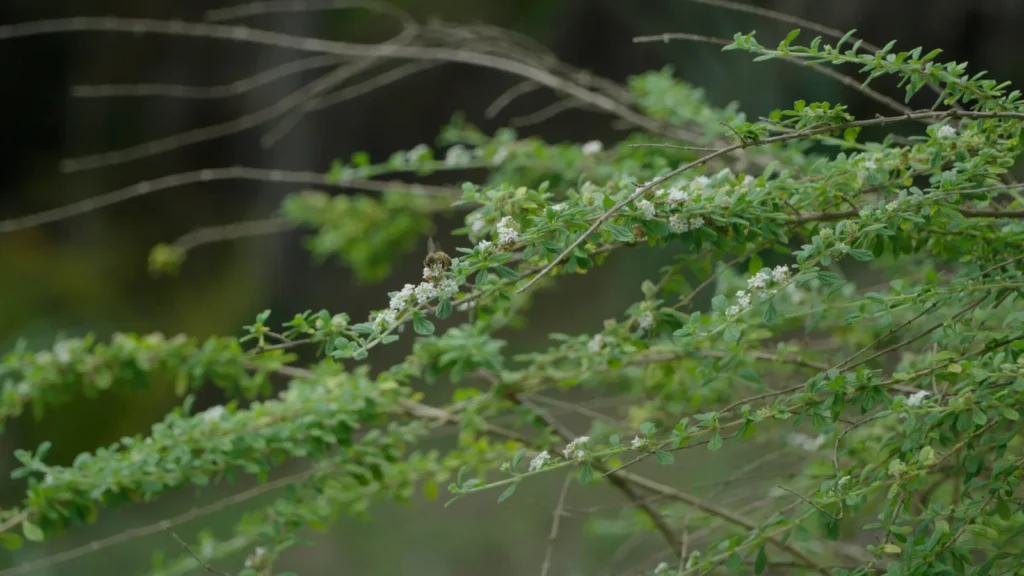
Mount Kailash Rejuvenation Centre is the highest scoring stay in the Caribbean, at 4.8 out of 5 on the Throne Standard. It is fully off grid on its own solar, it drinks from the river where it rises, every scrap of organic waste goes into the growing beds, and every meal is plant based and grown on the peak.
I verified all of it in person in October 2026. The road up past Marc is steep and rocky. Then the forest closes over you and the island’s diesel hum disappears.
Priest Kailash, a St. Lucian herbal physician, leads it. The medicine is Caribbean bush medicine with its roots in African knowledge, not yoga borrowed from somewhere else. National Geographic Traveller walked the same botanical trail in 2025.
I wrote the full story of my stay in the best wellness retreat in St. Lucia grows its own food, river baths and bush tea included. One honest note. The centre says its consultations are herbal practice and don’t replace a licensed doctor.
Secret Bay in Dominica is the most sustainable luxury villa resort in the Caribbean
Tibay, near Portsmouth, Dominica. Clifftop villas. Top of the island’s price range.

Secret Bay is a Green Globe certified villa resort in Dominica, recertified for 2025, and it scores 3.4 out of 5 on the Throne Standard. Guests plant coral on its restoration programme, a local fisherman takes guests out to hunt invasive lionfish for the menu, and the villas compost in place (sustainability page).
Natural forest is kept across the 40 acre clifftop (sustainability page), and Secret Bay was founded by Gregor Nassief with his wife, the artist Sandra Vivas (their story).
Here is the gap. Secret Bay lists energy and water as “covenants” and publishes no system for either. For a resort at this price, I want the meter, not the promise. Read our certified stays in Dominica next to it.
Anse Chastanet in St. Lucia is the Caribbean resort that publishes its own numbers
Soufrière, St. Lucia. Hillside resort above two marine reserve bays. From about US$550 a night room only, plus 20 percent VAT and fees.
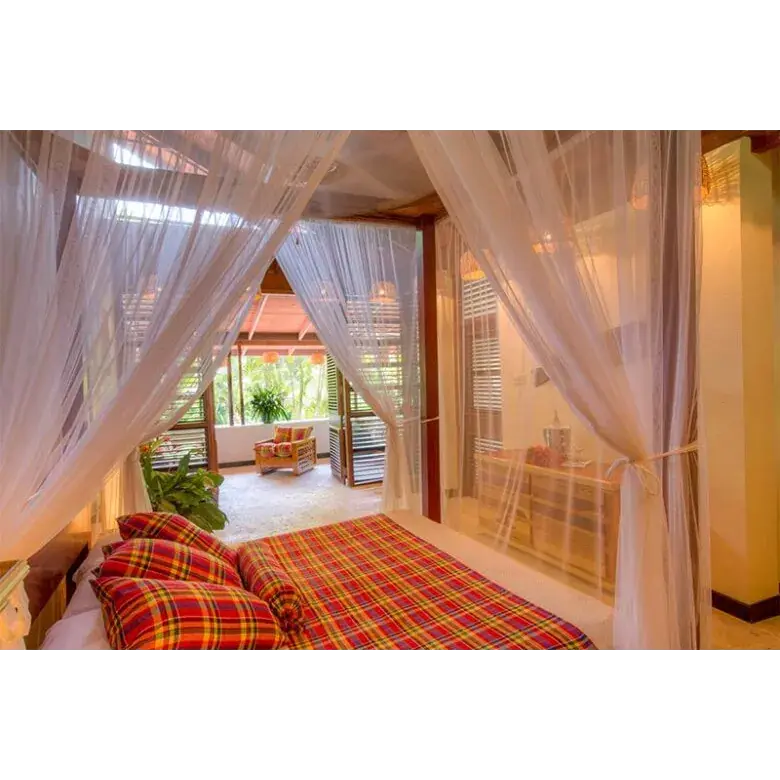
Anse Chastanet is a 600 acre hillside resort near the Pitons that scores 3.9 out of 5 on the Throne Standard, and it is one of very few in the region to publish a yearly sustainability report with real numbers in it.
The good. It helped create the Soufrière Marine Management Area, keeps a zero tree removal rule, uses turtle safe yellow lighting and runs a coral nursery (environment page). Its own Emerald Estate, about 20 minutes away in the Soufrière hills, has grown organic produce for its kitchens since 2007, with more than 1,000 cocoa trees.
The honest part. The same report shows about 262 kWh of electricity per guest night, almost all of it from the island’s fossil grid, and about 202 kg of CO2e per guest night. Transparency doesn’t make those numbers small. It makes them real, and real is where change starts.
If you want the farm without the footprint, read the farm to table stays in St. Lucia. If you want the reef, check Anse Chastanet for your dates.
Fond Doux in St. Lucia is a certified organic cocoa estate that is St. Lucian owned
Soufrière, St. Lucia. Cottages on a working cocoa estate. From about US$168 a night.

Fond Doux Eco Resort is a 135 acre working cocoa estate near the Pitons, Green Globe certified, and 100 percent St. Lucian owned by Eroline and Lyton Lamontagne. It scores 3.4 out of 5 on the Throne Standard.
Bananas, fruit, vegetables and spices from the estate go straight to the restaurant (about page). The estate says it is certified organic but doesn’t name the certifier, so ask which body before you book on that word.
Hot water comes from solar panels, toilets are low flow, and plastic is reduced (refill dispensers, cloth bags, biodegradable cups), not yet gone. The menu is Creole with seafood and meat, so plant based guests should ask ahead.
Book Fond Doux if you want to sleep inside the cocoa and eat what grows around you, then compare it with the rest of the best sustainable hotels in St. Lucia.
Balenbouche Estate in St. Lucia is the quiet heritage stay in the south
Near Laborie, south coast of St. Lucia. Six self catering cottages. The Waterlily cottage is listed at about US$220 a night for two.

Balenbouche Estate is a family run heritage estate near Laborie with six cottages, and it scores 3.3 out of 5 on the Throne Standard. No chemical fertilisers or pesticides have touched the land since 1987, about 60 acres are left as largely undisturbed habitat, hot water is solar and the laundry dries on the line (mission page).
Two things the brochure won’t lead with. Since the early 1990s the estate has kept only a small family plot and some livestock, so it is not a working farm, and the water is the public mains (FAQ). There is no air conditioning either, only fans and nets. I count that as a plus. Some guests won’t.
Read where to stay in the south of St. Lucia for the full Balenbouche story, the petroglyphs and the pottery village down the road, then check the cottages on the estate’s own site.
Lamblion Apartments in Antigua is the Green Globe certified stay where you cook for yourself
Sea View Farm, Antigua. Eleven self catering apartments. Mid range.
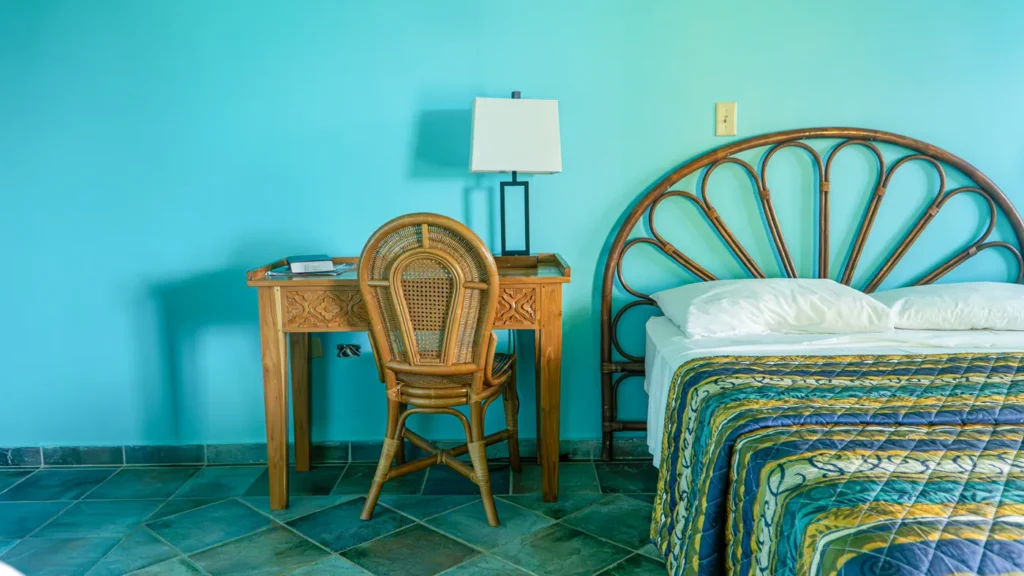
Lamblion Apartments is a Green Globe certified, Black and female owned apartment stay in the green centre of Antigua, run by Lionel and Lorilyn Walker, and it scores 2.8 out of 5 on the Throne Standard.
Its sustainability page lists grid tied solar for up to half of daily power, solar water heaters, rainwater harvesting, wastewater recycling and a compost tumbler that feeds the organic garden.
I have walked that garden with Lionel and Lorilyn. It is the reason to go. You pick herbs and fruit for your own breakfast, and I wrote up everything you can pick at Lamblion. The beaches are a 15 to 20 minute drive, so budget for a car.
Book Lamblion if you want a kitchen, a garden and owners who live on the island. Families, this is your pick.
Frangipani Eco Lodge on Barbuda is the solar powered lodge for real solitude
Two Foot Bay, Barbuda. Two units, a guesthouse and a cabana. Rates on request.
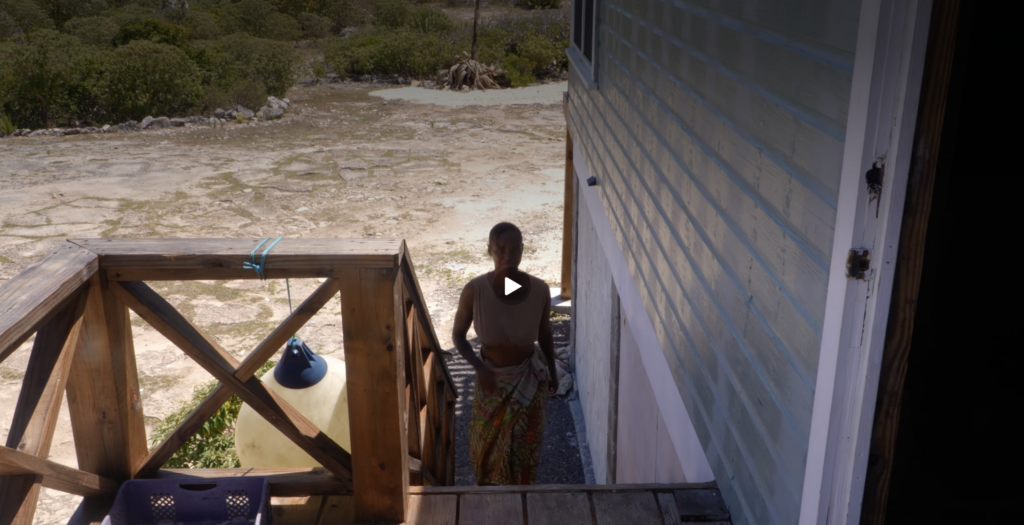
Frangipani Eco Lodge is a two unit lodge on Barbuda’s Atlantic coast owned by Barbudan sisters Asha and Afiya Frank, and both units run fully on solar with no grid connection. Water comes from the lodge’s own well and harvested rain. It scores 2.4 out of 5 on the Throne Standard, because nature and waste aren’t yet documented.
I stayed there and filmed it (watch the tour). The store is a twenty minute drive, so rent a car. Getting to Barbuda means a ferry or a small plane from Antigua. Read the story of the two sisters who built it before you go.
Check Frangipani for your dates if you want a beach and nobody on it.
Cooper Island Beach Club in the British Virgin Islands runs on more than 300 solar panels
Manchioneel Bay, Cooper Island, British Virgin Islands. Eight beachfront rooms. Boat access from Tortola.
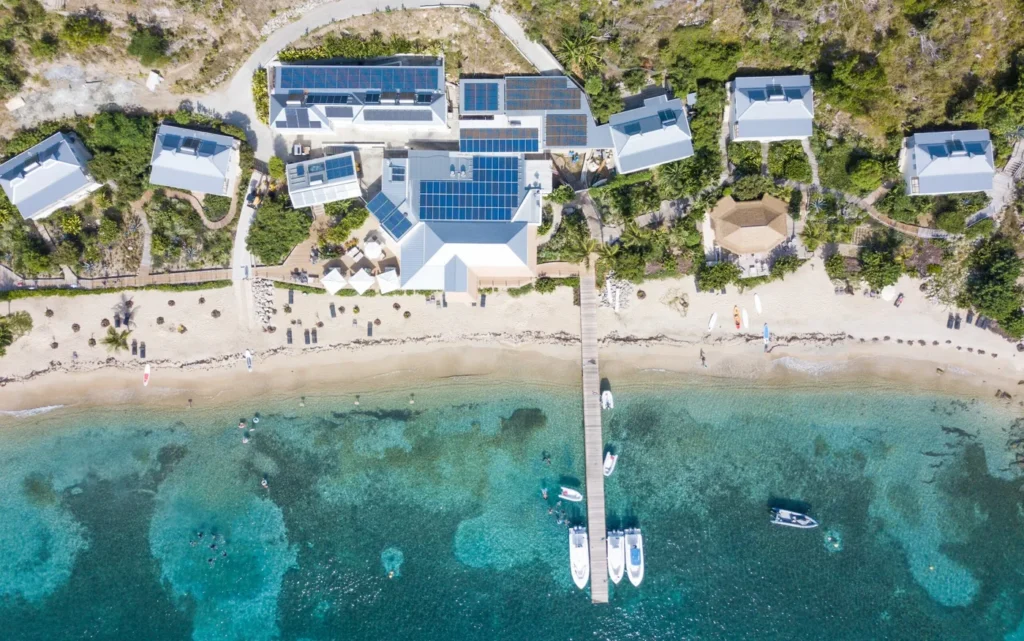
Cooper Island Beach Club is a family owned eight room beach hotel that says it makes all its electricity and water from more than 303 solar panels, with a generator kept in reserve. Since 2013 a membrane bioreactor has treated its grey and black water for irrigation (history page).
Food waste goes to local farmers as livestock feed, takeaway packaging is compostable, and there are no plastic water bottles. Drinking water is triple filtered from its own solar desalination. The beer is brewed on site with solar power too.
The gaps. Its Throne Standard is pending and no independent certification was found, so every claim is the hotel’s own. The bay has around 40 moorings, so daytime is lively with yachts. Its stay page lists a seasonal closure from 25 July to 7 November 2026. Plan the island with our British Virgin Islands guide.
Rosalie Bay in Dominica runs on its river and protects sea turtles
Rosalie, east coast of Dominica. Eco resort on a black sand beach. Mid range.
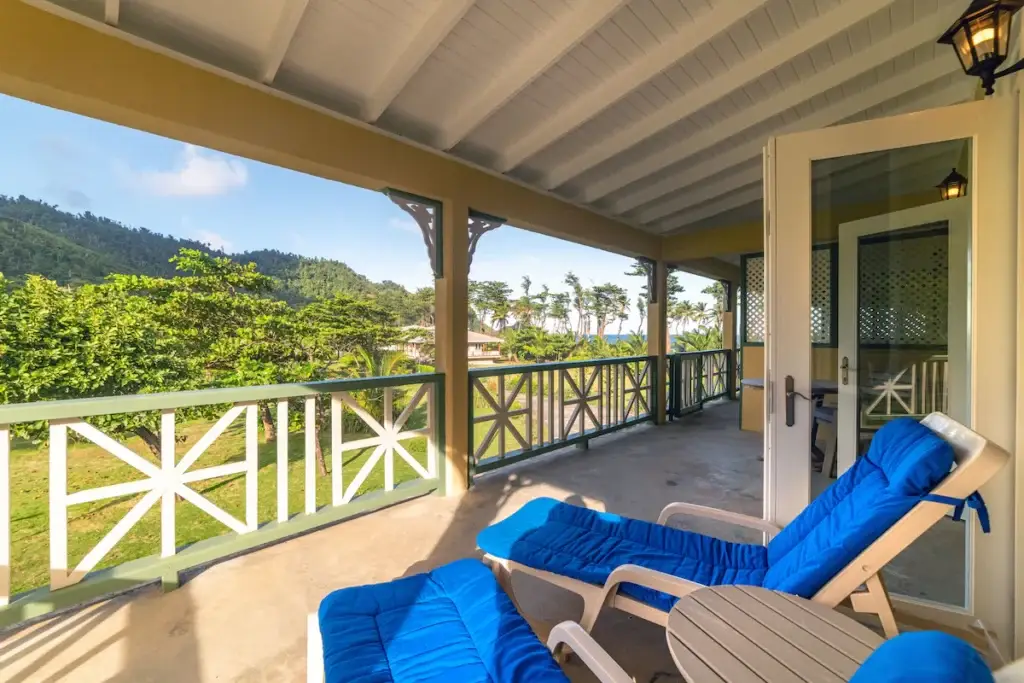
Rosalie Bay Eco Resort generates all of its electricity from a Rosalie River micro hydro system and solar panels, fully off grid. It sits in a 28 acre private nature reserve and reports more than 15,000 sea turtle hatchlings released since its programme began. In 2026 it worked on seven leatherback nests that produced 331 hatchlings.
It is owned by Patris Oscar, a native of Dominica, sole owner since the resort reopened in 2020. The organic garden is claimed without detail, and waste and plastic aren’t published, so its Throne Standard is still pending.
Strong rip currents make the beach unsafe for swimming. Swim in the pool, watch the turtles from the sand.
Book Rosalie Bay for nesting season, and read the wildlife stays in the Caribbean if turtles are the point.
Coulibri Ridge in Dominica makes all its own electricity from sun and wind
Soufrière, south Dominica. 14 suites on a 200 acre estate. Luxury.

Coulibri Ridge is an off grid retreat in Dominica’s far south that generates all of its electricity on site from solar and other renewables, and The Globe and Mail reported wind turbines and solar roofs there in 2024. It harvests rainwater, fills its pools with it, and lists an orchard and a farm on its 200 acre estate.
Waste, composting and plastic aren’t published, which is why the Throne Standard is pending. The ridge is a long, winding drive from the main airport, so book the transfer.
Check Coulibri Ridge and compare it with the off grid stays in Dominica.
Charela Inn in Jamaica cooks from its own family farm
Seven Mile Beach, Negril, Jamaica. 59 rooms. Mid range.

Charela Inn is a Black Jamaican owned family inn on Seven Mile Beach whose kitchen takes much of its produce and eggs from the family’s farm. I spent a day on that farm at Haddon Hall, Green Island, planting cabbage and walking the banana rows after Hurricane Melissa (read the farm day).
I asked if the land makes you feel grounded. The answer came straight away.
I always says other people goes to the psychiatrist. I come to the farm.
Then, looking at a cedar shooting again after the storm, the bigger point.
They says that man destroy the planet.
We can’t destroy the planet.
It will destroy us, but it will come back.
As we want, right?
So we are not destroying the planet.
We are destroying ourselves.
Now the honesty you’d want from me. The cabbage gets sprayed, and so do the bananas. This is a working Jamaican farm, not an organic one (watch the farm video). Energy, water and waste aren’t published, so the Throne Standard is pending.
Book Charela Inn for the beach and the farm breakfast, and read the best hotels in Negril, ranked.
Jungle Bay in Dominica puts the money into the villages around it
Soufrière, Dominica, above the Soufrière Scotts Head Marine Reserve. Wellness resort.
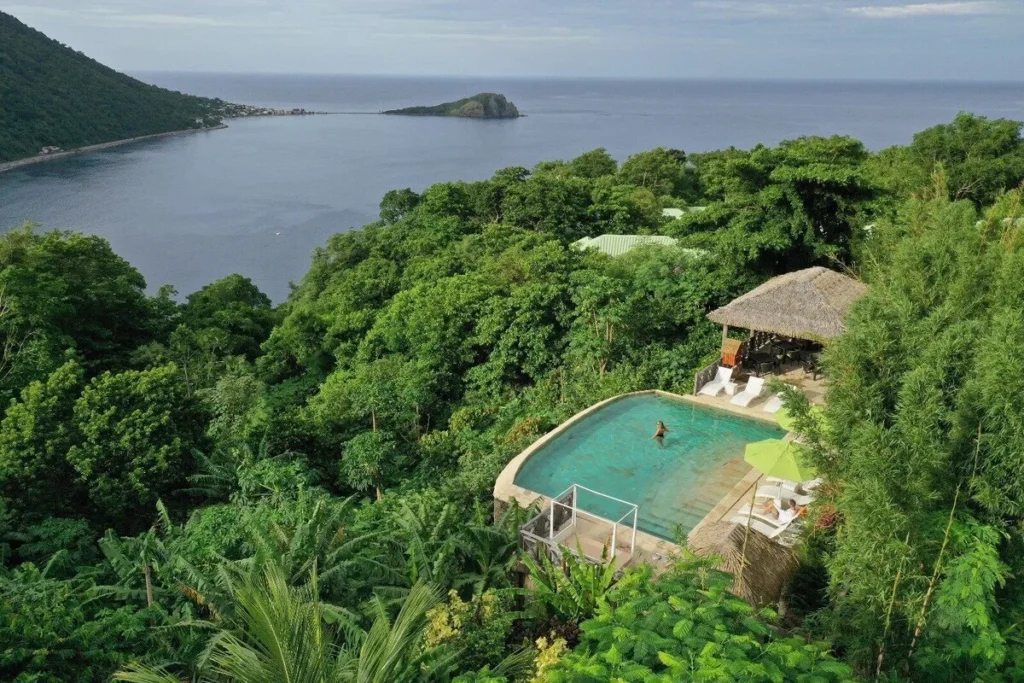
Jungle Bay is a wellness resort in southern Dominica owned by Samuel Raphael, who was born in Dominica, and its community fund is the reason it is here. The fund is a registered Dominican charity for early education, healthcare, small business and literacy. Staff give 10 percent of their tips to it and the owners match.
The resort buys from organic farmers and local fisheries and states a Nature Island Standards of Excellence certification that we couldn’t confirm in a public directory. No energy, water or waste systems are published. So this is a community pick, not an engineering one.
Book Jungle Bay if you want your money to build a preschool, and plan Dominica with our Dominica area guide.
Small Hope Bay Lodge in the Bahamas replaced bottled water on a remote island
Fresh Creek, Andros, Bahamas. 22 beachfront cabins. All inclusive.

Small Hope Bay Lodge is a family run all inclusive dive lodge on Andros, open since 1960, with beachfront cabins built from coral rock and Andros pine. It installed a reverse osmosis system so the water at the bar and in the rooms replaces bottled water, and guests get a keepsake bottle to refill (rooms page). Hot water is solar.
Beyond that, little is published on energy, waste or conservation. The lodge closes for all of September and October.
Book Small Hope Bay direct for the reef, and read our Bahamas guide for the islands around it.
Tubagua Eco Lodge in the Dominican Republic is the budget pick on this list
Tubagua, above Puerto Plata, Dominican Republic. About ten palapas and casitas. Budget.
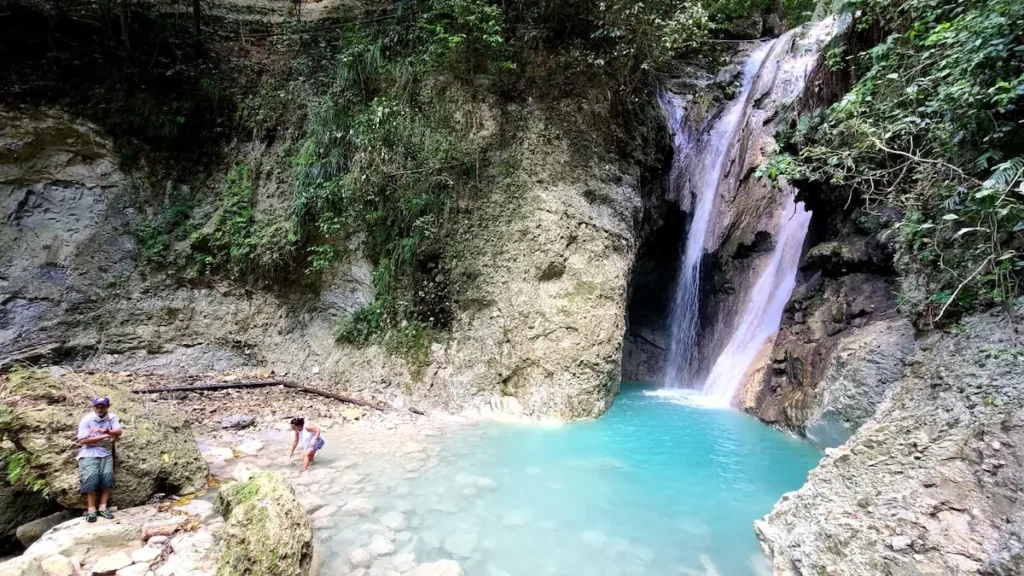
Tubagua Eco Lodge is a small mountaintop lodge above Puerto Plata that began as a social enterprise and works with a nearby coffee village where more than 40,000 coffee trees have been replanted. Meals are home cooked by local women (rooms page).
The current website no longer mentions the rainwater harvesting older articles praised, so we grade only what it says today. Palapas share a bathroom a few steps away. Book a casita if you want your own.
Check Tubagua if your budget is tight and your boots are ready, then see the Dominican Republic area guide.
These Caribbean stays didn’t make the list, and here is why
Four stays used to sit on this list. They don’t publish enough to stay.
- Geejam in Port Antonio, Jamaica, donates US$1 a room night to a nearby marine sanctuary run by others, but publishes nothing on energy, water or waste, and the rooms are air conditioned. A beautiful hotel. Not a sustainable one yet.
- Pine Cay in Turks and Caicos is car free and has installed reef balls offshore. That is all it publishes.
- Camp Cabarita in Jamaica collects rainwater and composts, but its solar is listed as a future plan, and the owner is a Wisconsin real estate professional, not Jamaican (listing).
- Serafina in the Dominican Republic describes organic farmland and a horse sanctuary on three rooms, with no named certifier and no published systems (listing).
When they publish more, they come in. That is how the Throne Standard works. It rewards proof, not photographs.
Are eco resorts in the Caribbean expensive?
Eco resorts in the Caribbean run from budget to the top of the market, and price tells you nothing about how sustainable a stay is. On this list a Tubagua palapa is the cheapest bed, Fond Doux starts around US$168 a night, a Balenbouche cottage for two is about US$220, and Anse Chastanet starts around US$550 before 20 percent VAT and fees.
The cheapest stays here are often the most honest ones, because a small family lodge has no marketing team to write the brochure. Lamblion and Balenbouche cost less than one dinner at some all inclusives and grade higher than most of them.
Which Caribbean island has the most sustainable hotels?
St. Lucia and Dominica tie, with four stays each on this list. St. Lucia runs from Mount Kailash in the mountains to the cocoa estates around Soufrière. Read where to stay in St. Lucia by area to choose a side of the island.
Dominica has the most stays running fully off grid (Rosalie Bay on its river, Coulibri Ridge on sun and wind). Start with the best sustainable hotels in Dominica. For the whole region island by island, read where to stay in the Caribbean.
Ask these questions before you book a sustainable hotel in the Caribbean
Ask these six questions before you book any hotel that calls itself eco. Screenshot them.
- Where does your electricity come from, and how many kWh do you use per guest night?
- Where does the water in my tap come from, the mains, rain, a well, a river, or the sea?
- What share of the food on my plate is grown by you or by farmers on this island?
- Who owns the hotel, and do they live here?
- Which certification do you hold, who audits it, and when was the last audit?
- What happens to the food we leave on the plate?
A hotel that can answer all six with numbers is a hotel that measures. A hotel that sends you a photo of a hammock is a hotel that markets.
Your questions about sustainable hotels in the Caribbean, answered
What is the most sustainable hotel in the Caribbean?
Mount Kailash Rejuvenation Centre in St. Lucia is the most sustainable stay the Throne Standard has scored in the Caribbean, at 4.8 out of 5. It is off grid on solar, drinks from its own river, composts everything and serves only plant based food from its own gardens. Read the full review.
What are the best eco resorts in the Caribbean?
Secret Bay in Dominica, Anse Chastanet and Fond Doux in St. Lucia, Rosalie Bay and Coulibri Ridge in Dominica and Cooper Island Beach Club in the British Virgin Islands are the strongest eco resorts on our list. Secret Bay and Anse Chastanet score 3.4 and 3.9 out of 5 on the Throne Standard.
What is the best eco lodge in the Caribbean?
Frangipani Eco Lodge on Barbuda is the best small eco lodge for solitude, fully solar and owned by two Barbudan sisters. Tubagua Eco Lodge in the Dominican Republic is the best budget eco lodge, and Mount Kailash is the best for healing.
What makes a hotel sustainable?
A sustainable hotel grows or buys its food close to home, makes or saves its own power and water, composts or reuses its waste and keeps ownership and jobs local. It can show you the numbers, not just the policy.
Are eco resorts in the Caribbean expensive?
No, not all of them. Fond Doux in St. Lucia starts around US$168 a night and a Balenbouche cottage for two is about US$220, while Secret Bay and Anse Chastanet sit at the top of the market. Price and sustainability are not linked.
Are there Black owned eco hotels in the Caribbean?
Yes. Fond Doux in St. Lucia is 100 percent St. Lucian and Black owned, Lamblion in Antigua is owned by Lionel and Lorilyn Walker, Charela Inn in Jamaica is Black Jamaican owned and Frangipani on Barbuda is owned by two Barbudan sisters. See all the Black owned eco stays in the Caribbean.
Are there plant based or vegan eco resorts in the Caribbean?
Mount Kailash in St. Lucia is the only stay on this list where every meal is plant based. Most other eco resorts here serve meat and fish and offer vegan meals on request, and Anse Chastanet has a separate vegan menu.
Which Caribbean hotels are fully off grid?
Mount Kailash in St. Lucia, Frangipani on Barbuda, Rosalie Bay and Coulibri Ridge in Dominica and Cooper Island Beach Club in the British Virgin Islands all say they make their own electricity without the public grid. Read the off grid stays in the Caribbean.
Is eco tourism good for the Caribbean?
Eco tourism is good for the Caribbean when the money, the land and the jobs stay on the island. Jungle Bay’s community fund and the St. Lucian owned Fond Doux show how it works. A foreign owned resort with a recycling bin does not.
What is the difference between Green Globe, Green Key and EarthCheck?
Green Globe audits a hotel on site every year against 44 criteria and more than 400 indicators. Green Key is run by the Foundation for Environmental Education, and EarthCheck benchmarks measured energy, water and waste. We compare all three in our eco hotels guide.
Do eco hotels in the Caribbean have air conditioning?
Many don’t, by design. Balenbouche Estate uses fans and mosquito nets, Cooper Island’s rooms are cooled by fans and sea breezes, and most rooms at Anse Chastanet rely on natural airflow. Ask before you book if you need it.
Can you drink the water at Caribbean eco hotels?
At most eco hotels on this list, yes. Cooper Island serves triple filtered water from its own solar desalination, Small Hope Bay uses reverse osmosis, and Mount Kailash drinks from its river at the source. Always ask what the tap is connected to.
When is the best time to stay at a Caribbean eco resort?
December to April is the driest and busiest time in most of the Caribbean, and the Atlantic hurricane season runs from June to November. Check closures too, since Small Hope Bay closes in September and October and Cooper Island closes from late July to early November.
How do I know if a Caribbean hotel is greenwashing?
A Caribbean hotel is likely greenwashing if it can’t tell you where its power and water come from, what share of its food is local or who audits it. Real sustainability comes with numbers, a named certifier and a date.
What is the Throne Standard?
The Throne Standard is our independent eco score out of 5 for each stay, built from dated, cited evidence on nature, energy, water, waste and food. A pending score means there isn’t yet enough dated evidence to grade it fairly.
My pick for a sustainable stay in the Caribbean
For healing, it is Mount Kailash. Nothing else in the region grows your food, holds its own river and keeps the chemicals out of both.
For a family, it is Lamblion. A kitchen, a garden and owners who live down the road. For the land itself, it is Fond Doux.
Everything else on this list is doing something real, and every one of them could show more. The best hotel is the one that tells you the truth about itself. Book the ones that show their meters. Leave the ones that only show their pools.