
Their own reports since the first one in 2012, the grinder that makes the bar, and the bean to bar option that already exists
Tony’s Chocolonely uses child labour. Not as a rumour I heard in a comment thread. As a number the company prints, seasons in a row, in the reports it asks you to trust.
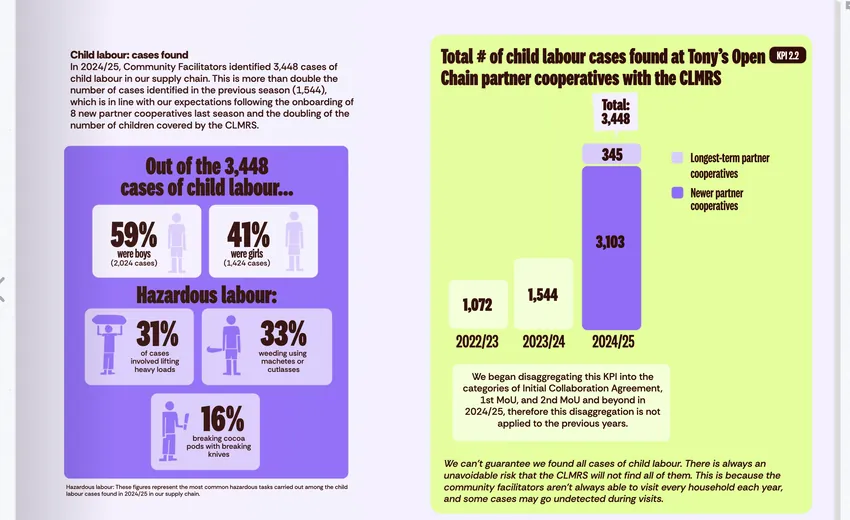
The newest one I opened is the Tony’s Open Chain Impact Report 2024/25. Page 90. Community facilitators found 3,448 cases of child labour in that supply chain. The same page says they cannot promise they found them all.
One of you wrote this under a post of mine, and it picked up 670 likes.
“I’m in shambles, fucking Tony chocolonely?!”
“I bought them specifically because I thought they were doing good!!”
“I’m so fed up of companies lying to us ffs!”
The comment calls it lying. Lying is too small. Tony’s prints 3,448 children and still sells the wrapper as the ethics. They did not hide the number. They priced the confusion. The report is there for the argument in the comments. The colour is there for the aisle. You were supposed to buy the colour. I did, in an earlier year. A lot of decent people did. The campaign spent the money so you would not open page 90.
This is a document read. I sat with the FAIR reports and with Barry Callebaut’s social and environmental impact reports, and I photographed the pages where the case counts sit. I was not in the Wieze factory. I do grow cacao. From the room I sleep in I can see about 25 acres of organic cacao, on land that has hundreds of acres of food around it. A bar in a supermarket is not a crop you are required to buy. It is a treat with a supply chain attached, and the supply chain has a page number.
Does Tony's Chocolonely use child labour?
Yes. Tony's Chocolonely uses child labour, and the company prints the case count in its own reports.
A case, in Tony’s own definition, is a child. In the 2021/22 Open Chain report the KPI is the number of children aged 5 to 17 found in child labour on a cocoa farm in the previous 12 months. I am not going to add the seasons into one lifetime total. A child found two years running would be counted twice, and the number of cooperatives inside the system keeps changing. Each season stands on its own. Each season still has children in it.
The monitoring system is the Child Labour Monitoring and Remediation System, the CLMRS. Tony’s did not invent it. The International Cocoa Initiative adapted it for cocoa with Nestlé. Tony’s rolled it out in February 2017. The 2019/20 FAIR report calls that the fourth year of the system. The 2024/25 report is still counting children.
The reports themselves start earlier. The first jaarFAIRslag is 2012/13. There is no annual FAIR report for the years 2006 through 2011. The bars were already on sale. The paperwork starts in 2012, and it does not start with a zero.
The community facilitators are hired through the cooperatives. Tony’s has written that the data sits with the cooperatives. These are not outside inspectors arriving unannounced with a clipboard the company does not pay for. They are the monitoring system of the supply chain, counting the supply chain.
This is every season I could pin to a page. A company that had ended child labour would not have a last row like this.
| Season | Cases | What that same report prints |
|---|---|---|
| 2012/13 | No count of children on their own farms | First jaarFAIRslag. The chapter describes slavery in the cocoa trade. Their own farms are not a number yet. |
| 2013 | At least 2 | Dutch report, pages 48 and 49. Dangerous work. The parents, they write, did not know. |
| 2014/15 | 11 | Dutch report. 12.5 percent of the interviewed children had used a machete. The English edition of that year does not print the 11. |
| 2016/17 | 30, and the count was not finished | Printed page 90. CLMRS had just started. PwC had not reviewed this figure. |
| 2017/18 | 268 | First full monitoring year on the later chart. Cases they closed that year, 0. |
| 2018/19 | 259 | Printed page 31. Total since 2017, 527. The footnote says these are not all the cases. Cases closed, 56, on the next chart. |
| 2019/20 | 387 | Printed page 18. Cases closed, 221. 5.0 percent of children known to the CLMRS, from 6.6 the season before. PwC, page 161, says the real number may be higher. |
| 2020/21 | 1,701 | Pages 62 and 63. 1,426 at two new cooperatives. 275 at the longer term ones. 50.5 percent against 3.9 percent. Socoopacdi stayed in the figures after Tony's stopped buying its beans. |
| 2021/22 | No single total I will stitch into this column | The International Cocoa Initiative's note gives 4.4 percent at the longest partnerships and 52.8 percent at the newer ones. |
| 2022/23 | 1,072 | Page 26. 31,358 children in the communities they counted. 10.5 percent overall. 4.4 percent at the longer term partners. The figure includes the Mission Allies, not only the Tony's wrapper. |
| 2023/24 | 1,544 | Printed on page 90 of the next report. |
| 2024/25 | 3,448 | Page 90. 345 at the longest term cooperatives. 3,103 at the newer ones. 2,024 boys. 1,424 girls. They write that they cannot guarantee they found them all. |
Read the last cell again. 3,448. The row above it is 1,544. The row above that is 1,072. Where they printed a season total, the newest total is the worst total. That is the record. The notes under the table are the pages. Do not add the column into one lifetime number. A child found in two seasons is two rows. The rows are already enough.
2012/13, no child labour case count found in the Tony's Chocolonely report
Tony’s Dutch jaarFAIRslag 2012/13, the first report.
The cover line is “better.” The chapter on the industry describes slavery in the cocoa trade in 2012. I read that Dutch report for a number of children on Tony’s own farms. It does not print one. The industry is the subject. Their own farms are not yet a case count.
2013, at least 2 child labour cases found in the Tony's Chocolonely report
Tony’s Dutch jaarFAIRslag 2013/14, printed pages 48 and 49.
The report with “wooow” on the cover is where their own count begins. Under the heading for abuses they had found, the Dutch text says at least two cases of illegal child labour were encountered. The children were doing dangerous work. The parents, the report says, honestly did not know that this work put their children’s development at risk. End of 2013 was also their first data collection in Ghana. Two is a small number. It is not a rumour, and it is not zero.
2014/15, 11 child labour cases found in the Tony's Chocolonely report
Dutch jaarFAIRslag 2014/15, around printed page 20.
The Dutch report says child labour still sometimes occurs in their chain. Their own research found it in at least 11 cases, and the same passage says those 11 cases were actually signalled. In the interviews for that research, 12.5 percent of the children said they had at some point worked with a machete. The report also says they can speak with near certainty that slavery is not present at the partner cooperative. Hold both sentences. They are clearing one category and counting the other.
I read the English edition of that same 2014/15 report page by page. It lists “uncovered cases of illegal child labor” as one of the indicators they track. I could not find the number 11 in the English text. The Dutch report is the one that prints it.
2016/17, 30 child labour cases found in the Tony's Chocolonely report
Tony’s annual FAIR report 2016/17, printed page 90.
CLMRS starts in this season. They set it up in February at the partner cooperatives in Ghana and Côte d’Ivoire. Data collection began in the summer and was not finished when they wrote the report. PwC reviewed nine impact indicators that year and did not yet review the child labour count, because the data was too new.
On printed page 90 they say they have come across 30 cases of child labour on the farms so far. Most of those children go to school and also do dangerous work for the family. Machetes, heavy loads, pesticides. They write that they are glad to have identified the children, because otherwise they could not do anything about the illegal labour, and that more complete data would follow in a few months.
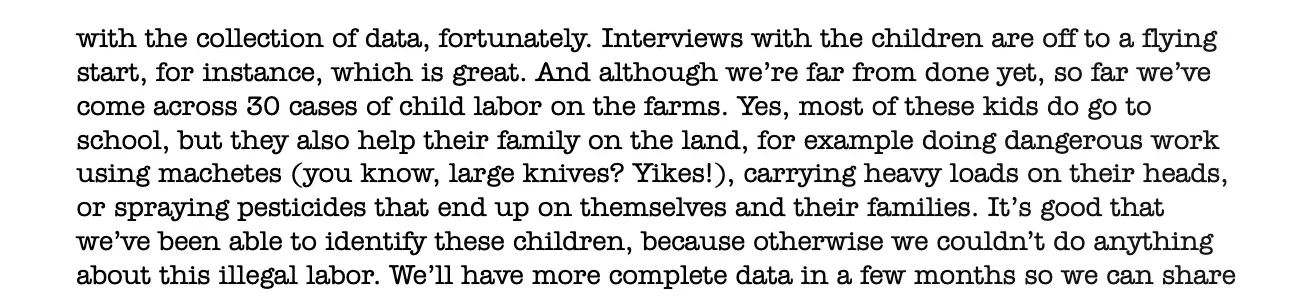
Do not drop this 30 onto the later chart as if it were the same full year total. The 2018/19 report says the total since the start of monitoring in 2017 is 527. That 527 is 268 plus 259. The 30 sits outside it. It is a partial count from a system that had only just opened, and it is still 30 children.
2017/18, 268 child labour cases found in the Tony's Chocolonely report
Tony’s annual FAIR report 2019/20, printed page 18.
The chart on that page is where the 268 first sits beside the two seasons after it. The files they closed that year are 0.
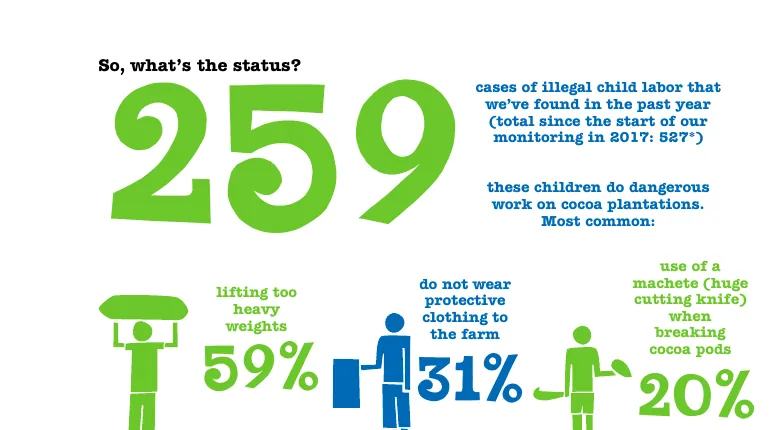
2018/19, 259 child labour cases found in the Tony's Chocolonely report
Tony’s annual FAIR report 2018/19, printed page 31.
The 259 on that chart has its own page. The 2018/19 report prints 259 cases of illegal child labour found in the past year, and a total of 527 since the start of monitoring in 2017. Of those children, 59 percent were lifting loads that were too heavy, 31 percent were working without protective clothing, and 20 percent were using a machete to break cocoa pods.
The footnote on the same page says these are not all the cases. Not every household is in the CLMRS yet. A facilitator is not always able to visit every household, and a visit can miss a child. The company printed the caveat in 2019. Page 90 of the 2024/25 report is still printing a version of it.
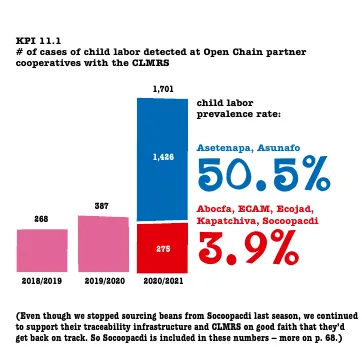
2019/20, 387 child labour cases found in the Tony's Chocolonely report
Tony’s annual FAIR report 2019/20, printed page 18.
The chart puts three seasons together. Illegal child labour cases detected at Tony’s partner cooperatives. 268 in 2017/18. 259 in 2018/19. 387 in 2019/20.
The remediated cases beside them are 0, then 56, then 221. Finding a child and closing a file are not the same event. In that same report Tony’s wrote that 5.0 percent of the children known to the CLMRS were in illegal child labour, down from 6.6 percent the season before. The chart does not reach zero. It never has.

The most common work in that year’s writeup was a machete for weeding, a knife for breaking pods, loads that were too heavy, and farm work without protective clothing. That is the company’s category, not a loose insult. Illegal child labour, in their pages, means hazardous work.
PwC, PricewaterhouseCoopers Accountants N.V., gave that year’s FAIR report limited assurance. Limited assurance is a review of whether the report was prepared against the company’s own criteria. It is not a walk of the farms that certifies a clean bar. On printed page 161 of the same report, the emphasis of matter says there are inherent circumstances that cause the real number of illegal child labour cases to be possibly higher than the number registered in the CLMRS. PwC did not change its conclusion because of that. Read it again. The auditor’s own letter says the published count may be a floor.
2020/21, 1,701 child labour cases found in the Tony's Chocolonely report
Tony’s annual FAIR report 2020/21, printed pages 62 and 63.
The next annual FAIR report stops pretending the line is gently falling. New cases found, 1,701. Of those, 1,426 were at two cooperatives they had just brought in, and 275 were at the longer term partners. Prevalence at the new cooperatives, 50.5 percent. At the longer term ones, 3.9 percent.
Tony’s treats that gap as the proof the method works. I can read a gap. I can also read 275. The farms they had already been in for years still put 275 children into the illegal work category in a single season. And the report’s own footnote on that chart says they had stopped buying beans from Socoopacdi and still kept that cooperative inside the numbers.
The prose next to the chart is the marketing line in a single breath. Tony’s chocolate sales are increasing, so the bean count is increasing, so more cooperatives come in, so more children are potentially involved in labour on the farms they source from. Growth and the case count travel together. They say the only way to resolve a case is to find it. That sentence is the idiocy, and it is printed. Finding a child is not a child leaving the farm. If the file were a cure, the season table would end at zero. It ends at 3,448. The longest partnerships, the entire boast, still contributed 345 of those in one season.
They also draw a line I want you to hold in your hand while you stand in the aisle. Modern slavery and child labour are not the same thing in their glossary. They write that they have not found modern slavery in the chain, and that they do find child labour, and that finding it means change is happening. The shopper hears slave free. The report is talking about a second category, and then congratulating itself for detecting it.
2021/22, no single child labour case total found in the Tony's Chocolonely report
The International Cocoa Initiative’s summary of the 2021/22 report.
That summary gives 4.4 percent at the longest partnerships and 52.8 percent at the newer ones. I am not dropping a second hand retailer total into this column. That note uses a different cut of the year. Stitching two calendars together and calling it a trend would be a fake number.
2022/23, 1,072 child labour cases found in the Tony's Chocolonely report
Tony’s annual FAIR report 2022/23, page 26.
Page 26 of the 2022/23 annual FAIR report says they identified 1,072 cases of child labour out of 31,358 children in the cocoa communities of Tony’s and the Mission Allies. They put the rate for all partner cooperatives at 10.5 percent, and the longer term partners at 4.4 percent. Industry prevalence, on that page, is given as 46.7 percent and credited to NORC.
The same spread prints a red poster. “The numbers prove that the longer we collaborate with a partner coop, the more we see child labor decline.” A woman holds the bars up to the camera. The 1,072 sits in the next column. The poster lost. Longer term cooperatives still had 275 cases in 2020/21, a 4.4 percent rate in 2022/23, and 345 cases in 2024/25. A decline that never reaches zero is a slogan with a camera.
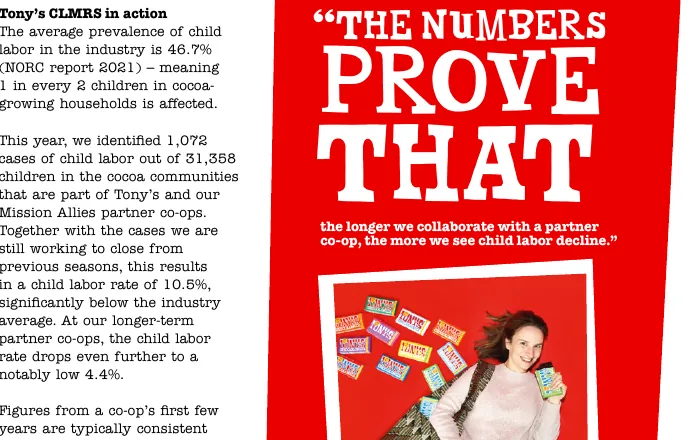
A decline against a horrific industry average is not a clean bar. 4.4 percent of the children in the longer term communities, on their own arithmetic, were still in child labour. The poster needs you to feel the direction. The page needs you to skip the remainder.
This 1,072 is not a sealed Tony’s only figure. The sentence includes the Mission Allies, the other brands buying through Tony’s Open Chain. Albert Heijn’s Delicata and ALDI’s Choco Changer are named as allies in the Open Chain materials. When the report says “our supply chain” it is often the chain, not one wrapper. The wrapper in your hand is still made from that chain.
2023/24, 1,544 child labour cases found in the Tony's Chocolonely report
Tony’s Open Chain Impact Report 2024/25, page 90, the bar for 2023/24.
1,544 is the middle bar on that page. It was the latest number when I wrote about it in January. It is not the latest number now.
2024/25, 3,448 child labour cases found in the Tony's Chocolonely report
Tony’s Open Chain Impact Report 2024/25, page 90.
Page 90 draws the recent line. 1,072 in 2022/23. 1,544 in 2023/24. 3,448 in 2024/25.
Of the 3,448, 345 were at the longest term partner cooperatives and 3,103 were at newer ones. 2,024 of the children were boys. 1,424 were girls. The most common hazardous tasks among the cases were weeding with machetes or cutlasses, 33 percent, lifting heavy loads, 31 percent, and breaking cocoa pods with knives, 16 percent.
Tony’s says the jump is what they expected. Eight new partner cooperatives, and the number of children covered by the CLMRS going from 41,933 to 66,775. Scope is the business model. The supermarket brand gets bigger, the net gets wider, and the net keeps coming up with children. The longest term cooperatives, the ones the poster is about, still produced 345 cases in that one season.
What those 3,448 children were doing, in the company’s own categories. A child can be in more than one, so the shares are not a pie.
| Hazardous task among the 3,448 | Share of the cases |
|---|---|
| Weeding with machetes or cutlasses | 33 percent |
| Lifting heavy loads | 31 percent |
| Breaking cocoa pods with knives | 16 percent |
Under the chart, in their words, they can’t guarantee they found all the cases. Facilitators are not always able to visit every household, and some cases go undetected during the visits. The 3,448 is the number they caught. PwC already told you, years earlier, to treat that kind of number as possibly short.
That page is also where my January comment needs a correction, and I would rather make it than leave a loose number in a post this long.
Under a video in January I wrote this.
“1544 cases found in their lastest report.”
“They find cases every year.”
“Their impact reports are on their own website.”
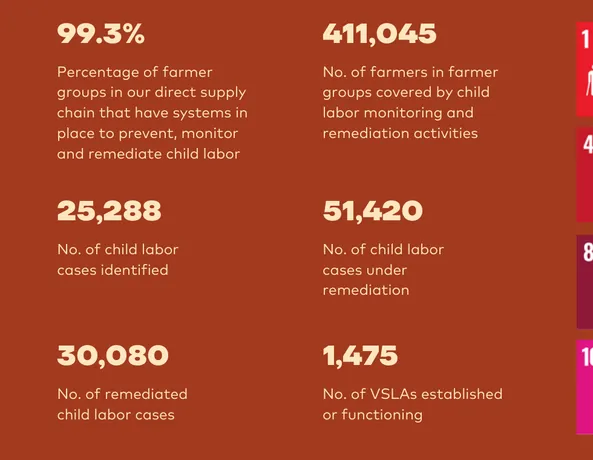
“They source from Barry Callbeaut who found 51,420 cases in their entire supply chain, reported in November.”
“Tony’s claim to just segregate their beans from Barry’s.”
“But still find cases, and worse of all still use the same supplier that finds over 51k cases, an increase of 24.8%.”
“they don’t have to, they could have a bean to bar supply chain.”
“That’s their choice.”
“Check their website for their impact reports.”
“Cases every year”
The 1,544 was the 2023/24 season. It was the latest when I typed it. Page 90 has since doubled the Open Chain total to 3,448. And the 51,420 was real, and the verb was loose. Barry Callebaut’s 2024/25 report does not say it found 51,420 children that year. It says 25,288 cases were identified that year, up 30.4 percent, and 51,420 cases were under remediation, up 24.8 percent, with 30,080 counted as remediated. The pile of 51,420 includes children found in earlier years who are still in the process. I had the scale and the direction. I did not have the label tight enough. The label matters, because Tony’s own defence is that critics cannot read a report. So here is the report, with the categories separated.
The comment I will stand on is the shorter one, from the summer.
“just read their own reports where they report every single year for 10+ years that they find child labour in their fields.”
“They admit it.”
“Their thing isn’t child labour free, it’s transparency.”
“Bold marketing!”
Yes. That one does not need a footnote.
Is Tony's Chocolonely really slave free?
No. The slave free line is a glossary trick sitting on top of a report full of illegal child labour.
Slave Free Chocolate took Tony’s off its list in February 2021. Ayn Riggs, who runs that list, told FoodNavigator the chocolate is made by Barry Callebaut, and that this ties the bar to the worst of the cocoa trade. Paul Schoenmakers, then Tony’s impact director, said they were disappointed, that the point of the partnership was to change the whole sector, and that Tony’s was considering a factory of its own.
They did not leave.
On 28 January 2022 Tony’s published a post titled as a yes. Yes, Tony’s works with Barry Callebaut. The three points in it are the whole faith. The beans are kept apart from other brands’ beans, in Tony’s own storage and on Tony’s own production lanes, because Tony’s pays extra for that separation. The beans are traceable, so premiums can be paid and cases can be remediated. And the partnership is “vital”, their word, because Barry Callebaut is one of the biggest processors in the world, so a clean line inside that building will prove the model at scale. In the same post they call the result bean to bar.
It is traceable. It is not bean to bar.
| The line they sell | The figure that kills it |
|---|---|
| Slave free, on the road to 100 percent | Illegal child labour in every counted season since 2013. The latest total is 3,448. |
| Finding the child proves the change | Page 90 says they cannot guarantee they found them all. PwC wrote in 2019/20 that the published count may be a floor. |
| The longer the partnership, the more child labour declines | 275 cases at longer term cooperatives in 2020/21. 4.4 percent in 2022/23. 345 cases at the longest term cooperatives in 2024/25. |
| Bean to bar | Barry Callebaut has made the chocolate since 2005. Traceable liquor from 2012. Traceable butter from 2016. In February 2023 Tony's said the bar still comes from Barry Callebaut. |
| A separate tank is a separate company | The grinder identified 25,288 cases in 2024/25 and still had 51,420 under remediation. |
| Pay a premium and the problem ends | The premium years are the same years as the season table. The longest partnerships still produced 345 cases. |
| A paid face makes the bar fine | 175 creator posts in the Walmart push. Tony's claimed 80 million views. A paycheck is not a farm inspection. |
Bean to bar means the company that sells you the chocolate makes the chocolate from the bean. Tony’s pays a grinder to make it. In February 2023 Tony’s announced Baronie and Cémoi as a second processor for Open Chain allies, and the same release said Tony’s chocolate would continue to be produced with Barry Callebaut, where the bean flow had been traceable and segregated since 2012 and the traceable butter since 2016. The separate tank is a plumbing fact. The building, the company, the purchasing power and the political cover still belong to the grinder.
The marketing is built to make that distinction feel mean.
The bars are uneven on purpose, a little sermon about inequality you can eat. The wrappers are loud. The line the brand has spent twenty years on is that it is crazy about chocolate and serious about people, on the road to 100 percent slave free. If you are tired, and the bar is at eye level, serious means the work is already finished. Then a behaviour agency gets hired because, as Tom Laranjo of Total Mediaplus told The Drum, half of chocolate purchases are impulsive, so the job is to nudge you at the moment you want a treat. The Netherlands got a salted caramel campaign about the flavour being irresistible. The UK social posts started showing the chocolate itself, with food creators. The mission is the brand story. The impulse is the sales plan. They are not embarrassed to run both.
In 2024 the Walmart push, which Tony’s wrote up for the Shorty Awards, used 175 creator posts and claimed 80 million views. The Everything Bar became a top three item for them in that retailer. One named partnership in that writeup is Jools Lebron. I am using Tony’s own campaign report here, not an outside audit of the view count. The useful fact is the structure. A roster of paid creators was hired to carry the mission into a mass market aisle.
If a Black creator is in that roster, or a Ghanaian farmer is in the impact video, you are looking at a paid placement or a brand asset. The paycheck is the explanation. It is not a vote from the children on page 90, and it is not a reason to decide the bar is fine. A face on a brief does not walk a farm. Anyone who takes the money and lets you use their face as a moral receipt has sold you a costume. Do not wear it. Do not let them put it on you.
The Drum piece is unusually frank about the shift. Tony’s, the article says, does not talk about its chocolate enough, and the fix being bought is more chocolate in the frame. You cannot sell a treatise at the impulse shelf. So the treatise becomes a colour, and the colour becomes a flavour post. The report stays on a website for the people who argue in the comments. I have watched that split in my own replies. Tony’s has come under the posts, many times, to defend the transparency. The transparency is the product they are defending. The chocolate is the thing they need you to grab without opening page 90.
What does Barry Callebaut actually count?
Barry Callebaut makes Tony's chocolate, and in 2024/25 it identified 25,288 child labour cases, with 51,420 still under remediation.
Barry Callebaut is not a quirky Belgian chocolatier with a shop you can choose to avoid. It is one of the two grinders, with Cargill, that sit under a huge share of the world’s cocoa. The brands it owns and sells under its own name include Callebaut, Cacao Barry, Carma, Mona Lisa, Sicao, Van Houten and Cacaofruit. Those are the house brands. They are not the whole story.
The customers are the story. Barry Callebaut manufactures for the industrial market. Nestlé, Mars, Mondelēz, Hershey and the rest are not subsidiaries I am pretending Barry owns. They are the trade. Tony’s is in that trade as a client with a segregated lane. When you buy the rainbow bar you are still inside the building.
The 2024/25 Annual Social and Environmental Impact Report, printed page 29, is the page my January comment was pointing at, read properly.
25,288 child labour cases identified, up 30.4 percent on the year before. 51,420 cases under remediation, up 24.8 percent. 30,080 cases counted as remediated, up 13.4 percent. 411,045 farmers in groups covered by the monitoring. 99.3 percent of farmer groups in the direct supply chain with a system in place.
| Report | Identified | Still in the process | Counted as remediated | Coverage |
|---|---|---|---|---|
| 2024/25, printed page 29 | 25,288, up 30.4 percent | 51,420, up 24.8 percent | 30,080, up 13.4 percent | 411,045 farmers. 99.3 percent of farmer groups had a system. |
| 2025/26, printed page 32 | 15,271, down 39.6 percent | 42,702 | 35,277 | 345,196 farmers. The report says the fall is less monitoring, not less child labour. |
PwC UK gives limited assurance on a selection of Forever Chocolate KPIs. Barry says the Forever Chocolate numbers have been third party assured since 2016/17. Same distinction as Tony’s. An assurance letter on a reported KPI is not an independent audit that the farms are free of child labour. The cooperatives and the customer programs are still the eyes on the ground.
Then the newest report arrived, dated in the file as early November 2026. Printed page 32 of the 2025/26 impact report.
15,271 child labour cases identified. 42,702 still under active remediation. 35,277 counted as remediated. Farmers in the monitored groups, 345,196, down from 411,045 the year before.
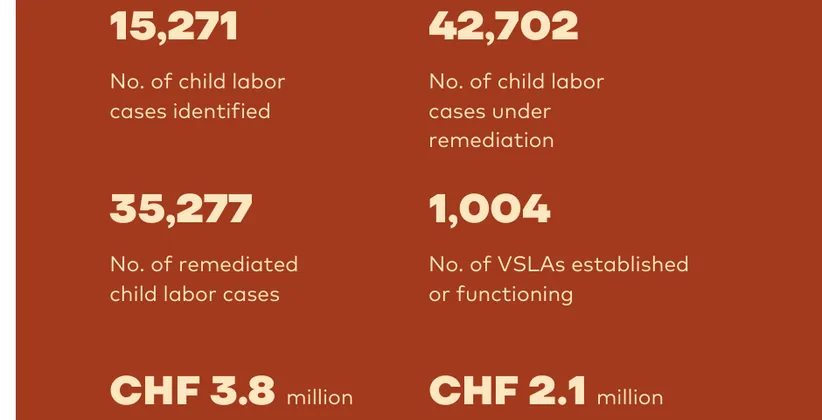
I want that warning in the company’s words, because it is the whole scam of a falling number. Barry writes that the 15,271 is 39.6 percent fewer identified cases than the prior year, that the decrease primarily reflects lower CLMRS coverage across customer programs, and that it should not be interpreted as evidence of a corresponding reduction in the prevalence of child labour. They looked at fewer programs. They found fewer children. They are telling you not to call that success. I will not call it success for them, and I will not let Tony’s borrow it either. A monitor that searches less is not a farm that got cleaner.
This is the supplier Tony’s still uses for the bar with its name on it. Segregated beans do not segregate the company. You cannot stand in a man’s factory, pay him to pour your chocolate, and tell me you have nothing to do with the 25,288.
Is Tony's Chocolonely fair trade, and do the farmers need you to keep buying it?
A higher price is not a finding of zero children, and the farmer does not need a Dutch brand in order to sell cacao.
Someone always arrives here with a kind voice.
“Got to say, they are of my knowledge the only company who is commited to fight human rights issues in the supply chain for real and they were founded to fight modern slavery.”
“The child labour (CL) is in their supply chain, riight? and not their own workers .. of course they do have responsibility.”
“It does seem wrong to me to completely dismiss their efforts.”
“But I might miss some facts here so please correct me!”
The correction is in the reports above. The children are not a rumour about a distant subcontractor Tony’s has never met. They are in the cooperatives Tony’s chose, under a monitoring system Tony’s funds, on farms whose beans go into Tony’s chocolate. “Not our own workers” is a legal mood, not a moral one. If the bar cannot be made without those children, the bar is using the children.
The other kind voice says the farmers need the money, so a boycott only hurts the poor. I hear it every time this subject comes up, often from people who would never speak to a farmer, only for one.
Tony’s does pay more than the government farm gate price. The company says so, and a premium on a commodity can be a real sum in a household. It has not produced a season with no children in the illegal work. The 2024/25 page is the long term cooperatives as well as the new ones. The method that was supposed to make poverty pack up and leave has had a decade. The children are still weeding with machetes in the case notes.
Calling that arrangement the farmers’ only hope is the saviour story, and the saviour story needs the wound. A company in Amsterdam pays a little over the colonial price, publishes the children it still finds, and asks to be loved for the publishing. The West built the commodity market that made a child’s labour the arithmetic of a cocoa household. The same West then sells you the premium as the repair. You are not rescuing anyone in the aisle. You are buying a treatise printed on a foil wrapper.
The repair that does not need you as a rescuer already exists. A bean to bar maker buys the bean and makes the bar. Fairafric makes chocolate in Ghana. The Grenada Chocolate Company makes it on the island where the cacao grows. Pacari makes it in Ecuador. Omanhene is a Ghanaian cocoa company selling into the US. I am not handing any of them a gold medal in this post. You do not get a medal for clearing a bar Tony’s failed. You read each one. On this site, start with Antigua House of Chocolate, a bean to bar maker, and with the people who grow the cacao. The point is smaller and harder. The direct model is a real object in the market. Tony’s looked at that object and chose a segregated tank inside Barry Callebaut, because a tank scales to Walmart and a single farm does not.
If you want the longer read on what a bar actually is, taste it as a crop, not as a mission statement. The scores and the record behind the brands sit in the My Ideal World app. Download it if you want the notes, not a slogan.
Catherine, under the post where Tony’s answered us in five parts, had already reached the ten year question. 135 likes.
“Just curious, after a 10 relationship between Tony’s and BC. Has anything changed?”
“Is BC a better company with better practices?”
“If the reason for Tony’s to partner with this company is to create change in the big industry, and nothing has improved in 10 years, maybe it’s time to go back to their more ethical and sustainable roots?”
“Or maybe they partnered with BC because they took on investors and the only way to make them silly money quick quick is to partner with unethical companies?”
“I’ve had long chats with Tony’s insta rep and it’s a lot of parroting their playbook and not a lot of actually answering questions 🙃 thanks for your work and research on this topic!”
The playbook is still the playbook. Barry Callebaut’s identified cases were higher in 2024/25 than the year before. Tony’s Open Chain cases were higher too. The long conversations with the brand account are the marketing department reading the FAQ. Page 90 is the answer they do not lead with.
Why can't Tony's just do what the small makers do?
Tony's cannot run a bean to bar bar and a Walmart bar at the same time, and it chose Walmart.
There is a real constraint here. It is not a pardon.
A supermarket chocolate brand at Tony’s size is an industrial object. In 2022/23 the company reported revenue of €150.2 million and an Open Chain bean volume of 14,826 metric tons. The same year’s report is the one with 1,072 child labour cases. The money and the children are in one document.
| 2022/23, their report | The number |
|---|---|
| Revenue | €150.2 million |
| Beans through Open Chain | 14,826 metric tons |
| Child labour cases, Tony's plus the Mission Allies | 1,072 |
That volume does not fit in a kitchen behind a shop. It fits in Wieze. €150.2 million did not buy a season with zero children. The company has known that since 2005, which is when Barry Callebaut’s own history of the partnership says the grinding relationship started. The 2016 butter tank, the 2022 defence, the 2023 confirmation that Barry Callebaut remains the producer of Tony’s chocolate. This is not a youthful compromise they are aging out of. It is the business.
So when someone says Tony’s is “trying”, I want the trying located. They are trying to prove that a segregated lane inside the biggest grinder can be called traceable. They are not trying to be the Grenada Chocolate Company. Those are different jobs. The first job can be done while children are still in the case notes, because the success metric is the monitoring. The second job does not need a 3,448.
People do not switch for ordinary reasons, and some of them are allowed to be ordinary. The bar is in Sainsbury’s and in Walmart. The moral work appears, falsely, to be finished on the pack. Bean to bar often costs more and sits in a smaller shop, a market stall, a grocer who already bothers with this. If you live in a city in the UK, the US or Europe, that smaller shop is a high street fact, not a fantasy for the rich. If you live nowhere near one, the other option is older and simpler. Chocolate is not a necessity. You can skip the treat. Skipping is not a hunger strike. It is a sweet you do not require.
The lab is the part that makes the saviour story rot.
The same industrial chocolate world that spent decades missing its own deadlines on child labour is now funding cocoa that never sees a farm. ESM Magazine has reported Mondelēz, the owner of Cadbury and Toblerone, investing in the Israeli cell culture company Celleste Bio, Lindt investing in the Zurich company Food Brewer, and Meiji signing a ten year commercial agreement with California Cultured. AP has reported California Cultured growing cocoa from cells in vats in West Sacramento, a process its chief executive described as cells in sugar water, ready in about a week instead of a harvest. The pitch is climate, deforestation, and the labour problem. The result, if it works, is a factory that does not need the farmer the brands claim they must not abandon.
That is the self inflicted exit. First you build a price that puts a machete in a child’s hand. Then you sell the monitoring of the machete as care. Then you fund a vat so you can leave the household when the household becomes inconvenient. The sentence “farmers need the industry’s commitment” and the sentence “we are growing cocoa in a reactor” come out of the same mouth. Tony’s own 2024/25 essay to customers is already titled as a plea that farmers need the industry. The industry is preparing a world in which the farmer is optional.
I don’t want the vat. I can see cacao from the window. The people who know how to ferment it are not a problem for a laboratory to route around. They are the supply, and the supply was arranged against them.
Why do people still buy it when they know?
A lot of people buy it because the wrapper flatters them, and some of them buy it because they know.
Another comment, 417 likes, from the lab grown post.
“Also I thought Tony was all about non slavery? What happened?”
Nothing sudden happened. The reports were already on the website. What happened is that the marketing was louder than page 18, and then louder than page 90. You were meant to feel the mission and never meet the chart. When the chart arrives, it feels like a betrayal. It is worse than a betrayal. It is a brochure you didn’t open.
Hold the two buyers apart, because they are not the same person.
One buyer was had. The uneven squares, the Fairtrade feeling, the friend who said it was the ethical one. That buyer is allowed to be furious. The fury in that 670 like comment is clean. Companies in this aisle train you to outsource your conscience to a wrapper, and then the wrapper’s own PDF disagrees with the wrapper.
Just because you were easy to sell to does not mean the choice is over. The aisle is built to get the bar into your hand before you think. You can make a better decision than the one the colour made. Open the report. Use the My Ideal World app and check the brand evidence, the score, and the record behind the bar. Then buy a different chocolate, or buy none. The wrapper spent the money. The next decision is yours.
The other buyer has read the PDF, or has sat in the comments while the PDF was spelled out, and still wants the bar. I am not interested in a soft diagnosis for that. Chocolate is a treat. Bean to bar is available on an ordinary street, and the Antigua House of Chocolate page linked above is free to read. Nobody is trapped. The remaining reason is want. You want the sweet, you want it cheap enough and close enough, and you want it with the knowledge still in the room, because the knowledge makes the purchase feel like a private win. You got it. Someone else paid. You knew, and you were not stopped.
Harm, in that small moment, is power. Not a theory I need a university to bless. A pattern you can watch in the aisle, and in the companies that publish 25,288 and keep the factory, and in a culture that has been very relaxed lately about who gets hurt as long as the hurt is far away and the treat is near. The subconscious alignment is not mysterious. The ethical bar and the knowing bar are sold in the same wrapper, so your conscience and your appetite never have to fight in public. You can feel good, or you can feel above it. Both of those feelings spend the same money.
I don’t buy the product. I have said that on the posts. Unlimited cacao outside does not make me hungry for a bar that has to come through Wieze to reach a shelf. It makes the shelf look strange. If it feels tainted, you are allowed to leave it there. Tainted is information.
My pick
Leave Tony's, because the children are still in the illegal work.
Not as a personality clash. The practice failed the only test that matters, which is whether the children are out of the illegal work. The first report is 2012. The last page I photographed is the biggest Open Chain count in the set.
If you want chocolate, buy it from a maker who buys the bean and makes the bar. Antigua House of Chocolate is one place to start on this site. Check it, and the others, in the app, where the evidence and the score sit next to the name. If you don’t want to do that reading tonight, skip the treat. You will not become malnourished. Tell me in the comments which defence you still hear from people, especially the one about the farmers needing you. I will keep the pages open.
Where are the page numbers?
On the printed pages of Tony's own reports, and of Barry Callebaut's.
Tony’s Open Chain Impact Report 2024/25, page 90, the 3,448. The report index, 2012/13 through the latest season, is on Tony’s annual FAIR report page.
Tony’s Dutch jaarFAIRslag 2012/13, the first report, which prints no case count. Tony’s Dutch jaarFAIRslag 2013/14, printed pages 48 and 49, for the two cases. Dutch jaarFAIRslag 2014/15, around printed page 20, for the 11 cases and the 12.5 percent who had used a machete. The English 2014/15 edition does not print the 11. Tony’s annual FAIR report 2016/17, printed page 90, for the 30 cases. The 2018/19 report, printed page 31, for the 259 and the 527.
Tony’s annual FAIR report 2019/20, printed page 18, for the 268, 259 and 387, and printed page 161 for PwC’s emphasis of matter. Tony’s annual FAIR report 2020/21, printed pages 62 and 63, for the 1,701. Tony’s annual FAIR report 2022/23, page 26, for the 1,072. The 2021/22 report is Tony’s annual FAIR report 2021/22. The prevalence note is the International Cocoa Initiative’s summary.
Tony’s, Yes, Tony’s works with Barry Callebaut, 28 January 2022. Tony’s, the February 2023 processor release, which keeps Barry Callebaut as the producer of Tony’s chocolate. Barry Callebaut’s own partnership announcement is on its news site.
Barry Callebaut, Annual Social and Environmental Impact Report 2024/25, printed page 29. The PDF. The 2025/26 report, printed page 32. The PDF. House brands on Barry Callebaut’s brand page.
Slave Free Chocolate’s current “who is not on the list”, which still names Tony’s and Barry Callebaut. The list. The removal, as reported by FoodNavigator in February 2021.
The Drum on the impulse buy and the flavour campaigns. Tony’s doesn’t talk about its chocolate enough. Tony’s own Shorty Awards entry for the Walmart creator push. Deliciously Different.
Lab grown cocoa as reported by AP and ESM Magazine. The 1.56 million figure is the 2020 NORC study that Tony’s cites in its own reports. I am not using a second hand blog for any case count in the timeline.
The tin beside the bar
Give me one good reason to buy Quality Street is the December version of the same habit. It goes through the palm oil and the Ivory Coast cocoa in the tin. Nestlé does not market that tin as slave free. Tony’s markets the bar that way, and the reports above are the company’s own count.
The app lists 40 chocolate brands in the USA, 12 in the UK, and 418 worldwide. 37 of those listings are tagged organic. I am not handing any of them a child labour free medal from this page, and the directory does not score who regenerates the land. Sign up on the site and that account is your membership in the app.