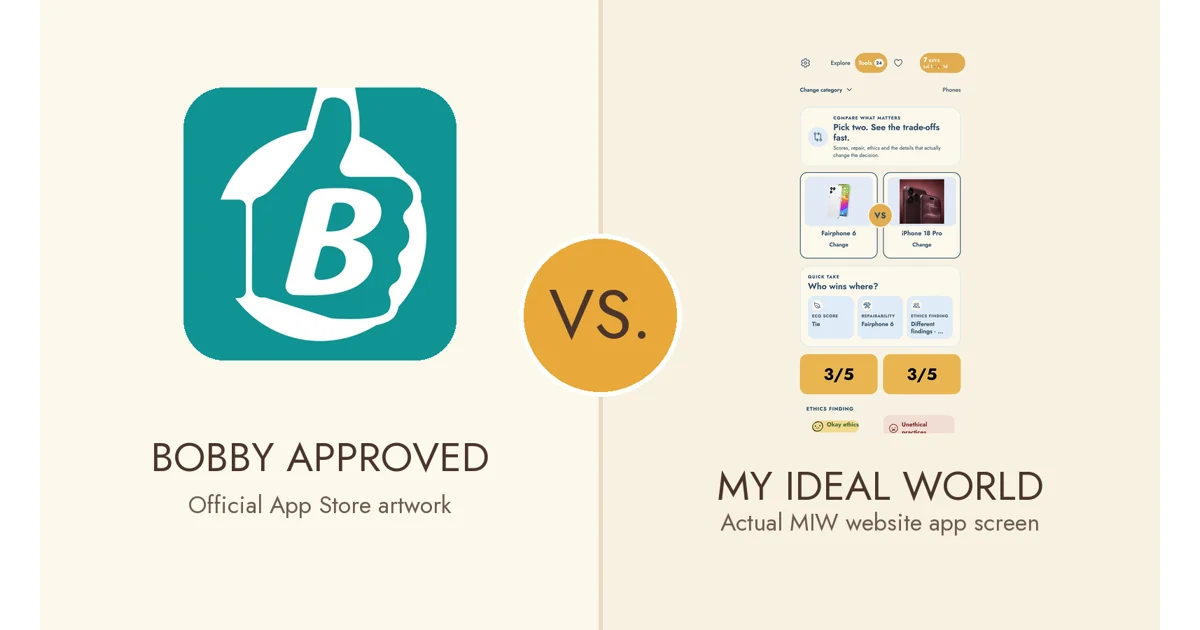
Bobby Approved vs My Ideal World begins with the word approved. It sounds final, but I still want to know which rule the product passed.
An ingredient preference does not answer every question about a food or the company selling it. A product can fit one shopping rule while leaving sourcing questions open.
The useful evidence is the declared method, the exact ingredient list and the reason given for the result. This comparison follows those records rather than treating two app labels as equivalent.
My Ideal World’s own preference based assessments have limits too. They do not establish a person’s exposure, diagnose a problem or prove that a whole company is ethical.
Before choosing either tool, decide which question you need answered. Then check whether the result gives you enough information to act on it.
Bobby Approved is honest about being Bobby’s filter
Bobby Parrish built an audience around ingredient preferences and shopping guidance. His app gives people a way to apply those rules quickly in the aisle. It has a public Android download threshold in the millions, which shows a real audience for a simple answer.
But simplicity has a cost. A product can pass someone’s ingredient list preferences and still leave questions about farming, labour and ownership. A product can fail a personal rule without being shown to cause harm in the form and amount somebody consumes.
That’s the space I care about. Not taking another creator’s approval stamp away. Showing the full composition and what the rule does and does not claim. If the same food appears twice with different records, the fix is product identification and correction, not a louder verdict.
The approval stamp belongs to the person who made the rules
Bobby Approved gives grocery shoppers a practical answer based on Bobby Parrish’s ingredient criteria. There is genuine value in being able to scan a product and find out whether it meets a set of preferences you already share.
But the word approved is not a medical certificate. It doesn’t automatically tell us where the cocoa was grown, what happened in a factory or whether a company paid its suppliers well.
An item can pass Bobby’s test and leave all those questions unanswered. It can fail a particular additive preference without being shown unsafe at the amount used.
The scale of its Android installations tells us people appreciate the convenience. It doesn’t prove that every database entry is correct.
Product duplicates and reformulations are practical issues in any large catalogue. A familiar name on a box doesn’t mean every package contains the same ingredients in every market.
I am not trying to replace Bobby’s taste with mine. My Ideal World has a different purpose.
I want to know the composition, the origin where it is documented and what the brand is actually doing. The reader should know which part of that is measured, declared or inferred.
Two nearly identical snacks can tell completely different stories
Take two snacks with virtually the same declared ingredients. A rule based only on the ingredient list may treat them alike.
One company might disclose its growers and suppliers, while the other may not. That difference is relevant to a shopper concerned about farming and labour, but it is not an ingredient purity difference.
Now imagine one product changes its recipe and the other doesn’t. The scanning database needs to connect a new label to the correct item.
If the record has not been updated, the problem is bad product data, not the creator’s ingredient philosophy.
That separation is what our tables need to show. Ingredients first.
Brand sourcing separately. An unresolved field marked unresolved.
No brand should be rewarded or publicly accused because the software guessed which variant it was looking at.
A million installs cannot tell you whether an ingredient rule is right
Bobby Approved’s public Android installation threshold says something about demand for a quick supermarket opinion. It does not establish that every individual ingredient judgement is an independent safety finding.
The exact rule and whether it is based on nutrition, dietary preference or a specific safety standard must remain visible.
The United States Food and Drug Administration regulates food ingredients and requires certain product information. Its legal requirements are not the same thing as a creator’s shopping preferences.
A shopper can choose to avoid a permitted ingredient, but the app should say the exclusion reflects that choice rather than reporting a regulatory breach that did not occur.
That distinction helps the reader interpret the scan. I would keep the original label and the creator’s published criterion beside each other.
The label tells us what the maker declared. The app tells us how a creator’s rule interprets it.
The wider brand story requires additional evidence. Read the FDA’s food ingredient guidance before treating any third party stamp as a government finding.
The food label is still the receipt
I have no problem with somebody having strict ingredient preferences. I have them myself. The issue starts when a personal approval rule is presented as though it were the only defensible way to eat.
When I’m travelling, a familiar label can mean something different in another market. I want to check the exact declaration and then ask where the ingredients came from. Our Yuka comparison explains another scoring approach, while the Martinique local food guide is about meeting producers rather than selecting the best barcode.
MIW is for the person who wants both conversations to continue. Sign up to examine the product and its supporting brand research rather than relying on an approval stamp alone.
What we would score and what we would not
The Throne Standard’s Food pack (version 1.0.0 under Standard 2.2) checks a complete, attributable ingredient declaration against explicitly named processing-marker preference rules. A missing, partial or unmatched declaration remains unresolved. This is a composition-preference assessment, not a laboratory health-and-safety verdict.
What we will not score as if it were composition. We do not turn processing markers into claims of poisoning, prove the presence of contaminants from a label, or grade an entire multinational’s labour conduct from one soft drink. Natural flavourings are not proof of purity or danger. We do not score an incomplete ingredient list as zero.
Read the standard version named in the individual report, together with its metric, evidence dates, eligible products and coverage. Category specific methods can answer different questions, and the live report may use a later version than an older explanatory page.
A missing or conflicting declaration is unresolved, not proof of a bad composition. Read the exact standard; challenge an incorrect record.
What the comparison actually shows
These are different kinds of evidence. Before choosing an app, distinguish a label-derived ingredient, a scoring rule, a measured quantity and a brand policy. The table names the limits rather than declaring an unsupported winner.
| Question | First tool or evidence | Important limit |
|---|---|---|
| Bobby Approved | Creator-led ingredient approval | Check the actual exclusion criteria |
| My Ideal World | Product composition plus associated brand research | Check provenance and current live category |
| Physical label | Exact packaged-product declaration | May omit ingredient origin and exposure details |
How My Ideal World would score the brands, and what we refuse to score
Our score is a test against the Throne Standard, not a prize for whichever app has the most downloads. The relevant published standard is versioned, and category results must keep their own meaning.
An ingredient preference, laboratory result, animal-welfare policy and nutritional profile are not interchangeable evidence.
The live reports checked on 17 November 2026 show Picture at 1/5 and Gray Label at 3/5 under the report’s Throne Standard 3.0.0 composition assessment. Picture has 37.18% verified plant evidence across 971 complete declarations from 1,116 eligible products, with 39 missing declarations and 106 technical gaps.
Gray Label has 85.67% verified plant evidence across 305 complete declarations from 394 eligible products, with no missing declarations and 89 technical gaps. Coverage is 87.01% for Picture and 77.41% for Gray Label. Both reports describe these as provisional results with incomplete coverage, rather than final whole brand assessments.
These numbers demonstrate our composition method; they are not a head-to-head benchmark against Scout, Oasis, Tallow or Yuka.
| Brand checked in HTT | Current score | Why | Read the evidence |
|---|---|---|---|
| Picture, clothing | 1/5 | 37.18% verified plant evidence; 971 of 1,116 eligible declarations complete. Provisional result with 87.01% coverage. Checked 17 November 2026. | Picture report |
| Gray Label, clothing | 3/5 | 85.67% verified plant evidence; 305 of 394 eligible declarations complete. Provisional result with 77.41% coverage. Checked 17 November 2026. | Gray Label report |
| Coca-Cola, example raised in this comparison | Not verified in the accessible current HTT report | The ingredient declaration can be checked, but it does not establish a current HTT product score. | Awaiting exact report and version |
The Coca-Cola example is unscored here. Its ingredient declaration can support a description of the formula, but this article does not establish a current HTT product result.
We do not award or deduct purity points for downloads, App Store reviews, subscriptions, celebrity endorsements or online arguments. Nor is a composition score a calorie score, a personal medical risk score, a laboratory contaminant test or an automatic judgement on labour conditions.
The current Throne Standard makes different categories and assessment limits explicit. Where no current assessment exists, we say so rather than borrowing another scanner’s score.
Explore My Ideal World and sign up for the underlying research, rather than treating another app’s numerical score as our result.
Android and Apple downloads, what is actually public?
Android downloads are published by Google Play as rounded minimum thresholds; Apple does not publicly provide cumulative app downloads. The Apple figures below are marked undisclosed rather than guessed. These figures do not measure monthly active users, product-scanning accuracy or retention. Checked in November 2026.
| App | Android downloads | Apple iPhone downloads | Source or next step |
|---|---|---|---|
| Bobby Approved | 1M+ | Not publicly disclosed | Google Play installation threshold |
| My Ideal World (MIW) | Not publicly disclosed | Not publicly disclosed | Explore the app and sign up |
Google Play figures are lower-bound installation bands. Apple provides actual download statistics to each publisher through App Store Connect, not as a comparable public leaderboard. An App Store rating count is not a download count.
My Ideal World is listed last because it is our app, and no unverified install figures are claimed. Apple developer explanation of download reports.
Who sets the ingredient rule
Identify Bobby Parrish’s current published standards and whether they distinguish category and dose. Attribute every rule as his framework, not an established medical consensus.
What the scanner cannot see on the pack
The barcode rarely tells shoppers where all the ingredients were grown, whether the workers were paid fairly or how claims about farms were verified.
When the two approaches complement each other
A shopper can use an ingredient-rules app to avoid a chosen substance, then use a transparent brand report to investigate ownership and production claims.
Where the comparison can go wrong
Check the exact product and Bobby’s actual published ingredient rule. His approval is useful to people who share that preference. It does not, by itself, establish the farming conditions or moral worth of the company, and it cannot replace an allergy warning.
Approval is personal until the evidence makes it universal
Bobby’s ingredient rules are a clear shopping preference. If those are your rules too, his app can be convenient. My own composition threshold is different, and I won’t pretend either choice is a laboratory finding about every serving. I want the label and the reason in full.
Popularity is not the same as an ingredient rule
The Google Play listing for Bobby Approved displays one million or more downloads and a high average user rating. Those are genuine signs that people use or respond positively to the service.
They do not establish the scientific validity of each ingredient rule. The app’s description says products are reviewed against Bobby’s criteria, so its central promise is personal curation.
The advantage of a simple answer
At a supermarket shelf, an approved or not-approved decision can save time. That is useful if your priorities align with the person who set the rules.
If you want to understand why an ingredient failed, open the explanation and read the original evidence. A binary conclusion is a shortcut, not the result of an individual laboratory test on every package.
What users actually flag
A Google Play review published in May 2025 praised the service but reported duplicate entries for the same products. A complaint like that is not a statistical assessment of the whole database; it is an excellent test case. Can a user distinguish flavours, package sizes, old formulas and true duplicates, then get a correction made quickly?
The question that remains after approval
A snack can match a creator’s dietary rules and still leave its sugar sourcing, worker conditions, packaging and ownership unexplored. MIW is relevant to a person who needs that second layer. Likewise, MIW cannot declare a product suitable for a food allergy merely because its source or composition meets a purity criterion.
Why user reports of duplicates deserve attention
A public Google Play review of Bobby Approved described finding duplicate records for the same products. One review cannot establish the prevalence of a fault, but the issue is easy to understand.
Two records for a reformulated cereal may be legitimate if they have distinct dates and packaging. Two conflicting scores for the same exact barcode on the same day would require explanation. A scanner should show the reason for a difference.
An investigation should test a fixed list of product identifiers and record screenshots. If the same item appears twice, check whether one listing is a variant, older formula or separate pack size before calling it duplication. That is what fact-checking means when the product is software: look past the complaint and reproduce the underlying behaviour.
What happens after a product is approved
A snack can meet someone’s rules about oils, sweeteners and additives while its chocolate or coffee ingredients come from a supply chain with unresolved labour questions. A food can be minimally processed and still be inappropriate for a particular allergy.
A product can be organic without being locally grown. Approval under one decision framework doesn’t answer the next question, and it should not be asked to.
This is where my app has a different purpose. I want to follow a product from the printed composition into the producer’s story, the brand’s public documents and the relevant hub. I don’t want to hide that link behind a moral verdict. If a field isn’t known, the lack of evidence needs to be visible, especially when a wrong score might damage someone’s livelihood.
A supermarket comparison that doesn’t manufacture a winner
Choose a real jar of pasta sauce from each of three brands and record the exact ingredients, nutrition panels, labels and product identifiers. Check whether Bobby Approved recognises each, then evaluate the same products using MIW’s actual live categories.
Name where the apps agree, where they differ by design and which records do not exist. Include a source date and avoid product images that disguise a different formula.
The winner isn’t necessarily the product with fewer ingredients. A shopper may need low sodium, an allergy-safe formula, a particular origin or a strict whole-food composition. A rigorous article tells readers exactly how to decide for their own purpose. That is a far more persuasive argument for using the app than a declaration that one score is the truth.
Why food scanner scores can disagree on the same product
People searching for the best app for scanning food labels often assume different scanners are measuring one universal thing. They aren’t. Our food scanner app comparison separates composition rules, nutrition judgements and evidence from laboratory testing.
My Ideal World’s Ingredient Decoder and Food Label Decoder are useful for examining the declaration itself. If you want to record daily meals instead, see the separate food tracking apps guide.
Further reading and primary sources
Use My Ideal World for the next question
Follow a product assessment into the maker’s sourcing and brand evidence. Take the evidence you can see, note the gap you cannot, and continue through the relevant brand or product research. Explore My Ideal World and create an account.
Continue the investigation. best brand scanner apps · how to spot greenwashing
On this story
Comments, questions and answers from signed-in readers. Community contributions are not verified editorial findings.
Contribute evidence
Reviews share first-hand experience. Observations can include opinions and objections. Evidence is checked against its sources before publication. Community contributions do not change MIW scores.
More long reads