
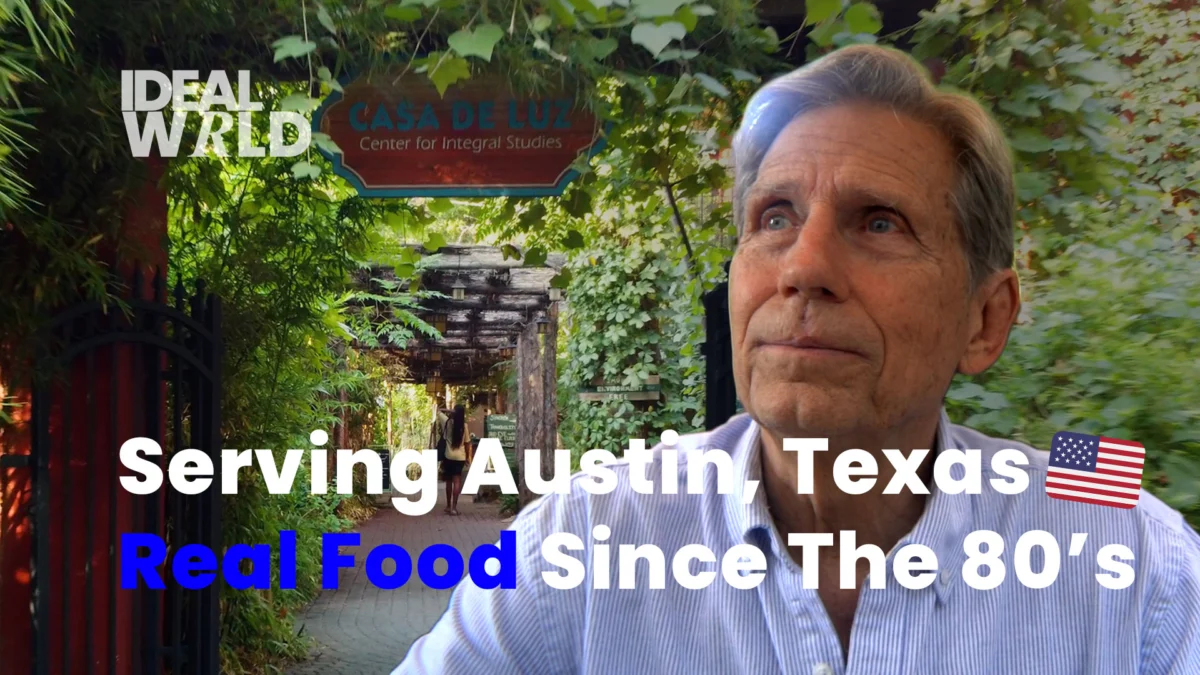
Casa De Luz Austin
I went to Austin to sit at a table where you do not choose your food, you do not get a bill that feels like a bill, and you do not know who you will be eating next to. That table has been set, in some form, for 40 years.
A couple of years back I sat with Eduardo “Wayo” Longoria at Casa de Luz, the man the place puts forward as its co founder and designated speaker, and he was clear with me that the title means almost nothing on purpose. Everything here is his, in his words, from the afternoon we spent on site at 1701 Toomey Road. He told me who he is before he told me anything else.
> “So I’m not one of those one name type of people. But I do go by my nickname. My name is Longoria, and we’re here at Casa de Luz in Austin, Texas. An organization that’s been around for 40 years. It’s a nonprofit, a community wellness center.”
Then the reason he agreed to talk at all.
> “My hope in talking to you about it is to inspire others to create places like this in their hometown.”
Hold onto that line. The whole place runs on it.
Casa de Luz is a nonprofit plant based community wellness center in Austin, Texas. Wayo described shared whole-food, plant-based meals as the centre of the community. The current Casa de Luz website lists breakfast, lunch and dinner; everyone sharing a meal does not mean there is only one service each day.
One word you will hear around the place is macrobiotic. If that sounds like a diet fad, it is not. Think of it the way you would think of eating with the seasons in a Japanese farmhouse: whole grains, beans, vegetables, sea vegetables, whole-food ingredients as Wayo described them. That is his approach to the food; the interview does not establish how a particular meal affects every person’s blood sugar or health.
What Casa de Luz actually is, in his words
Forget the word restaurant. He does, deliberately.
> “We never close because this is more like your mother’s kitchen and living room and a place to hang out than anything else. I’m an enemy of the R word, and that would be restaurant. So there’s a lot that happens here that is non restaurant.”
I asked him who runs it, expecting a founder story.
> “There’s no owners. Sometimes I get to be the designated speaker because I’ve been around since the beginning, but my job is to keep the center of the wheel empty.”
I had not heard a job described that way before, so I asked what he meant.
> “No one gets to say that they’re the one that did it or say that they own it, because it really does belong to all those participants that come on a daily basis. And the newcomers.”
Picture a bike wheel. The strength is not in the hub, it is in all the spokes pulling evenly. His job is to make sure no single person becomes the hub. That is the thing the place protects above everything. His emphasis was on participants sharing the work and direction of the place.
We go deeper into the no menu, no owner design in the post on how Casa de Luz built community around whole food, because it deserves its own room.
Why everyone eats the same meal
This is the part people trip on, so he said it plainly.
> “One of the characteristics about community building is that everybody’s eating the same meal. There’s no menu. Again, that’s one of the items that keeps us from being the R word restaurant.”
Then the money side, which is unusual enough that I made him repeat it.
> “It’s very affordable and there’s never any money left over. It gets spread amongst the cooks and the host and the maintenance people. And it’s worked really well for, well, here 32 years, but the whole endeavor is 40 years old.”
That is how Wayo described the way money was shared at the time of our conversation. It is his account, rather than an audit of the organisation’s accounts. Whole food plant based eating and real community arriving at the same table is the thing he kept circling back to.
> “I do want to underpin the importance of community and eating whole plant based food is kind of a wonderful mixture. It’s so, so symbiotic and powerful when they come together. People sitting at these community tables, many of our tables here are round and it works so well.”
We pull that thread all the way through in the post on why whole plant based food and real community are so powerful together.
The food is not for taste first, and he wants you to know that
Most plant based pitches lead with how good it tastes. He does the opposite, on purpose.
> “We don’t have our plants for taste. We have our plants for health. The taste comes after you eat this way.”
He compared it to taking up running, which is fair and a little brutal.
> “It’s like jogging. If you go out jogging the first time, it’s going to be painful, and the second time you’re going to be sore. Well, the same thing happens here. The first whole meals, especially depending on where you’re coming from, won’t be that much fun. The wonderful thing is that the more you do it, the more you love it. I guarantee it.”
This is a man who eats only whole plant foods and means it.
> “When I see the plants on my plate, the legumes, the vegetables, the grains, the nuts, seeds and pickles, I don’t think of how many calories I’m having.”
If you eat that way too, that is our plant based food guide and our pages on ethical legumes and grains and nuts, for sourcing the same building blocks at home.
How it started, and where he thinks it goes
The origin is not romantic. It is a fire and an abandoned factory.
> “There’s been two locations. The first one was called the East-West center, also in South Austin, and it burned down to the ground. It was gone. A friend and I started cooking out of her house, wanted to keep the community together. We found this place, which was an abandoned meatpacking factory. The irony about that. And we served our first meal in January of 1991, and it’s been open every day since.”
(He places the fire in 1988. The Austin record puts it around 1989, so I would hedge the exact year, but the meatpacking factory and the January 1991 first meal are his and they hold.) The full arc is in the Casa de Luz origin story.
I asked where he sees it going. He refused the question in the most Casa de Luz way possible.
> “Where I see it going is not where I see it going. It’s where the community sees it going. When issues come up, we bring them up at a table. We don’t know who’s going to be sitting at the table. So our solutions come from community. Our projections, our direction, comes from community thought.”
When travelling, I would use a plant-based restaurant finder to reach a place like this, then ask the questions an app listing cannot settle: how the meals are planned, who prepares them and what happens around the table. The Casa de Luz story is about those people and their choices, not simply a vegan pin on a map.
What we take from a place with no owner
We are conscious travellers. We chase the secluded eco lodge, the off grid villa, the place that feels exclusive. Casa de Luz is the opposite instinct, and it is just as radical. The luxury here is that it belongs to no one, so it belongs to everyone. You cannot buy your way to the front of that table. You sit down, and the community decides what happens next.
That is a model worth carrying home. Not the macrobiotic plate specifically, but the structure. A place that nobody owns, that never closes, that feeds whoever shows up, supported, in Wayo’s account, by the meals and the people taking part. He says you can build one. He means it, and he will help, which is the whole point of his open invitation to build one in your town.
If you are heading to Texas, do not let the brunch spots swallow your trip. Go sit at a round table at Casa de Luz instead, the way we lay out in the Austin visitor angle. And if you want the whole man in seven lines, read the seven lessons from a sledgehammer to a vegan kitchen.
Casa de Luz is at 1701 Toomey Road, Austin, TX 78704, open every day, and you can reach them on (512) 476-2535 or at casadeluz.org. There is no sign up, no membership fee. You just show up.
For more of the people and place behind this story, watch our original Casa de Luz film.
On this story
Comments, questions and answers from signed-in paid members. The conversation will also be available in the app when it launches. Community contributions are not verified editorial findings.
Contribute evidence
Reviews share first-hand experience. Observations can include opinions and objections. Evidence is checked against its sources before publication. Community contributions do not change MIW scores.
Article discussions and evidence contributions are for paid members. They will also be available in the app when it launches.
Sign in to contribute or join the discussion Read this next
Zero Waste and Refill Shops Work Best With a Useful Shopping List
Find zero waste and refill shops using current store details, container rules and a real basket. Compare in person refill, bulk delivery and the price per use.Read the story Keep exploring
Ethical Wildlife and Community Led Tours Need Clear Boundaries
Choose ethical wildlife and community led tours through clear viewing rules, local roles and access. Compare Barbuda, Samaná and a Guyanese community lodge.Read the story Keep exploring