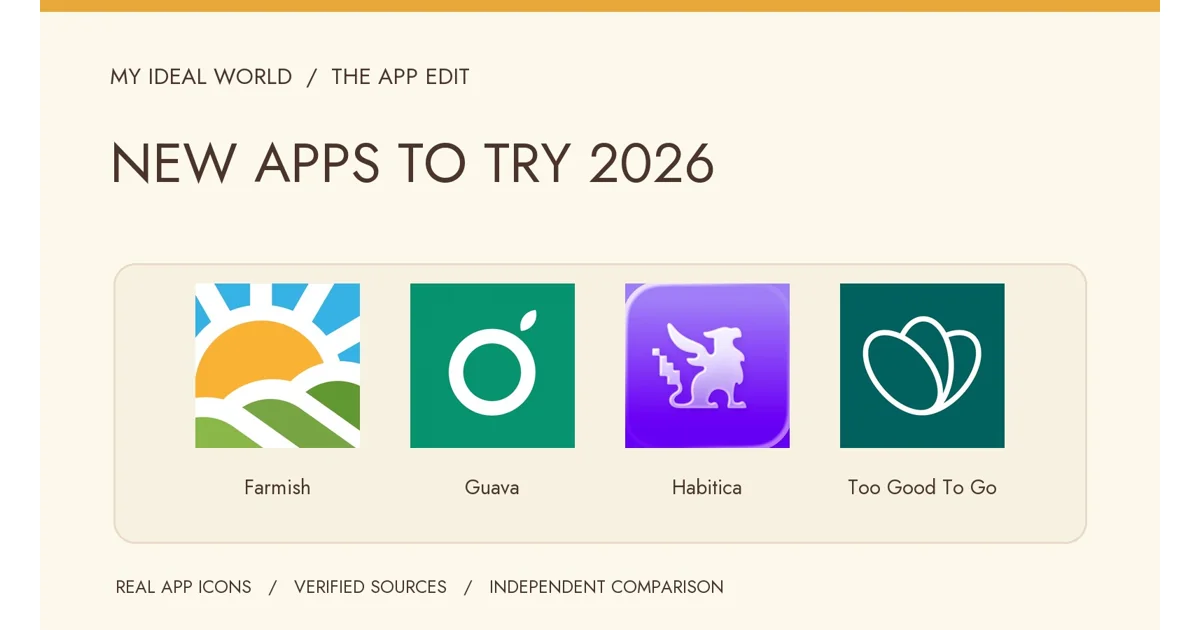
The best new apps in 2026 are not necessarily the ones that launched this year. An app can be new to your phone and several years old. That distinction matters when a roundup calls an entire catalogue new simply because it has updated the year in the headline.
Apple has an editorial collection of apps for 2026, while technology writers publish their own monthly discoveries. Those are useful places to look, but the word best needs to be connected to a job. Does the service save you time, connect you with someone useful or help you inspect a claim?
I would rather download one app that helps me find a real farmer than ten that send notifications about vague personal improvement. That is my editorial preference, not an independent laboratory ranking.
Farm Shop Drive’s Google Play listing records a September 2026 date, making it a genuinely relevant recent addition to the farm-shop discovery discussion. Other apps in this guide are established services worth trying in 2026, not necessarily 2026 launches. I will say which is which.
Here are the app categories I would pay attention to this year, why each matters, and when My Ideal World adds a different layer of brand research. I am not inventing a hands on review of software I haven’t personally used.
Which app actually answers your question?
The useful comparison starts with the job the app is designed to do. The table shows the categories rather than pretending every service has been laboratory tested against the same task.
| App | Reason to try it in 2026 | Newly launched in 2026? |
|---|---|---|
| Farm Shop Drive | Finding UK farm shops along a route | 2026 Play listing date |
| Guava | Organising compatible health sources | No, established service |
| Too Good To Go | Rescuing participating stores’ surplus food | No, established service |
| Habitica | Motivation through gamified tasks | No, established service |
| Yuka | Food and cosmetic product information | No, established service |
| My Ideal World | Product composition, brands and habits | Check the current release details |
The important part is the limitation in the final column. A feature mentioned on a developer page is not proof that every user, country or device receives it.
Which new apps are worth trying in 2026 for everyday living?
A useful app earns its place by solving a specific repeated problem. Food rescue, local farm discovery, document organisation and habit reminders are concrete tasks. A beautifully branded service that duplicates five other subscriptions may only make the phone harder to manage.
Look first at what you already use. Do you need a replacement app or a way to use the existing one better? The most effective digital change may be deleting a tool you never open.
Apple’s 26 Apps for 2026 is an editorial starting point, not proof that each listed developer launched in the year.
Is Farm Shop Drive one of the new 2026 apps?
Farm Shop Drive is presented as a UK farm shop discovery tool, with a September 2026 date on its Google Play listing. The service says users can look for farm shops near them or along a route. Its listing and official website explain the focus.
That may be useful to a reader travelling in Britain. It doesn’t establish accurate stock at every listed seller or prove that every product was grown on the farm. The shopper still needs to verify the place, its hours and the origin of the goods.
I want farm discovery apps to show who grows the food, not merely where a brown roadside sign can be found. Farmish comparison considers the distinction.
Why I keep an eye on health record organisers such as Guava
Guava gives people a way to investigate organising information from different supporting health sources. Its App Store listing describes medical record syncing, medication tracking and device connections. That listing is evidence of its advertised functions, not a guarantee it connects to every provider.
This is an established app worth comparing in 2026, not one I am claiming launched this year. Its value depends on whether the actual hospital or clinic can share the relevant record.
Health information deserves a privacy and completeness check. A service can make records easier to find without becoming a clinician or replacing the original healthcare provider.
Why a food rescue app can deserve more space than another shopping app
Too Good To Go helps connect customers with businesses that have surplus food. Its official description explains the marketplace model and participating stores. The company’s guide explains how users find a business and collect available food.
Too Good To Go is not a new 2026 launch. It is a useful established service that can be rediscovered, especially in a city with participating businesses. It cannot prove the original food was locally grown or organically produced.
The interesting habit is rescuing food that would otherwise be discarded when it genuinely fits your needs. Buying extra food just because a surprise bag is discounted misses the point.
Can a product scanner tell you more than the package?
Yuka, Open Food Facts and My Ideal World ask different questions about a packaged item. A scanner can help locate an ingredient record and a scoring policy, while a sourcing investigation may examine the people and companies behind it. A missing or outdated barcode record is not proof the product is unsafe.
Try the same product on several services and compare the source date. If the numbers differ, examine the method before accusing someone of manipulating data. The Scout, Tallow and Oasis investigation shows the stakes of getting product interpretation wrong.
I want MIW to stay accountable too. Join the app if you are interested in composition, ethical brand research and local discovery rather than another universal health score.
Are gamified habit apps still worth trying in 2026?
Habitica treats routines like quests and rewards, which is appealing to people who respond to game mechanics. The app is established, not a 2026 launch. Its presence in a current guide reflects the question of usefulness, not release date.
A game may help somebody remember to act. It cannot establish how much carbon a walk saved or whether a product they bought meets an independent sustainability standard.
Earth Hero takes a different route through climate action suggestions. Both belong in the broader habit discussion, but the correct pick depends on what kind of behaviour the reader wants to support.
What can new AI apps actually verify?
An AI assistant can help organise a question, but its fluent answer is not a primary source. This matters when an app is interpreting a medical report, comparing a product’s ingredients or recommending a farm you may drive several hours to visit.
Ask what the system retrieves, whether the original source is linked and what happens when it has no data. A generated answer may be useful for planning while still containing a wrong name, date or ingredient.
My standard is simple. I would rather an app leave a field unresolved than confidently fabricate it. If software changes an old record, the correction should be traceable.
Should you pay for a new app before testing it?
A free download does not guarantee the feature you want is free. A food app may allow searching but restrict barcode scanning. A health app may provide basic records while charging for additional organisation. A habit app may restrict the number of tracked actions.
Check the current regional App Store listing and cancellation terms. A comparison written in January 2026 may be wrong by November. The product’s own help pages are better sources than a screenshot of a promotional banner.
Try a small real task before committing. Find one local shop, record one meal, organise one document or check one product label. If it fails that task, its position on a list is irrelevant.
How I would build a practical app collection
One app per important task is usually enough to start. A farm finder for local food, a suitable health tool for the data you actually manage, a straightforward habit tracker and MIW for composition and brand discovery can coexist without pretending to be the same service.
I spend time travelling and filming people behind products. A useful map or source record can save a wasted journey. Another app encouraging me to shop without explaining what I am buying is not an improvement.
Keep the tools that help you do something in real life. The ones you only open to admire a dashboard can go.
How do you know whether an app really launched in 2026?
A store update date is not a release date. Apps frequently update their screenshots, descriptions and version numbers. A publisher can change the headline of an old article to 2026 without the application itself being new.
Check the app’s original release history where available, developer announcements and archive information. Farm Shop Drive’s 2026 store date is one useful lead, but a single listing date needs the right interpretation.
I would rather call an older service worth trying in 2026 than pretend a company began operating this year because it is suddenly popular.
Why a new app might be worse than an established one
New services may have a smaller database, fewer integrations and untested correction workflows. That doesn’t make them bad. It means a founder’s ambition should not be mistaken for evidence that every feature is already dependable.
An established app can have its own problems. It may preserve outdated records, limit access through a paywall or fail to explain its scoring. Longevity is not a certificate of accuracy either.
The test should be the same for both. Check an actual product or task, verify the source, review the permissions and see whether the service corrects a reported mistake.
Which 2026 app trends deserve more than a headline?
AI search, camera based recognition and personalisation all depend on the information behind the interface. A food camera cannot see what was inside a sealed packet. A map cannot confirm current hours without a reliable source. A health assistant cannot safely infer missing clinical records.
These tools can still be useful for organising and finding information. But the smoothness of the answer is not a substitute for source quality.
I want a reader to ask where the fact came from before accepting the conclusion. That is especially important in products that influence personal health or publicly accuse a brand of wrongdoing.
Can a small niche app beat a huge platform?
A tool that serves one specialised need well may be more valuable than a giant app whose features are only loosely connected. A farm shop finder can be excellent for a particular region and useless outside it. A dietary app can be strong for an ingredient restriction and have no data on labour conditions.
The useful article names the region and the question. It should not punish the farm finder because it cannot log workouts or reward a fitness app because it can display an impressive number.
Choosing by purpose is also how I want MIW assessed. Its work is product and place research, not every possible function an app might offer.
What should a new app disclose before asking for money?
Coverage, pricing, source freshness and cancellation terms belong before the big download invitation. A user should know what remains free, which countries are supported and what happens when a product or listing is missing.
Check whether the app has an accessible correction channel and whether it identifies the people or organisation publishing its rules. Real transparency includes how errors are handled.
If the company will not explain a claim, I would not upgrade the claim in our review simply because the marketing looks convincing.
The questions that make an app worth downloading
A useful new discovery needs a practical job. Our everyday apps guide compares the tools that solve recurring tasks, not simply the newest interface.
The specialist question belongs with a specialist app. The farm shop review explains real UK and US coverage, while the habit guide compares motivation styles.
What is the best new app in 2026?
That depends on what you need. Farm Shop Drive is a recent UK farm discovery listing. The other services here may be new to a reader without being new releases.
What are the best new apps out this year for everyday use?
Look at official app collections and the actual tasks you have. Food rescue, local discovery, health records and habit support are different categories and need different tests.
Is My Ideal World a new health or fitness app?
MIW is a sustainability, products, local discovery and habits app. It should not be described as a clinical or workout tracker simply because it is included in a roundup of useful new apps.
A new app only earns its place when it solves a real problem
Before installing another trending app, ask what it does that your existing tools cannot. Local food apps can help you find growers or rescue food. Health records apps organise clinical documents. Product scanners investigate what a label says.
For day-to-day conscious choices, the My Ideal World tools include checks for claims, materials and purchases. Those categories deserve separate comparisons rather than pretending one new app replaces them all.
Sources and supporting documents
The publisher descriptions below explain what each service says it offers. Independent research and NHS or other public guidance are named where relevant. Prices, regional availability and app features should be checked on the date of use.
- Apple Apps for 2026 editorial collection
- Farm Shop Drive Google Play
- Guava App Store
- Too Good To Go official
If the question is about product composition, sourcing and the people behind brands rather than clinical health or workout records, create your My Ideal World account. My Ideal World does not replace the specialised services compared above.
On this story
Comments, questions and answers from signed-in readers. Community contributions are not verified editorial findings.
Contribute evidence
Reviews share first-hand experience. Observations can include opinions and objections. Evidence is checked against its sources before publication. Community contributions do not change MIW scores.
More long reads