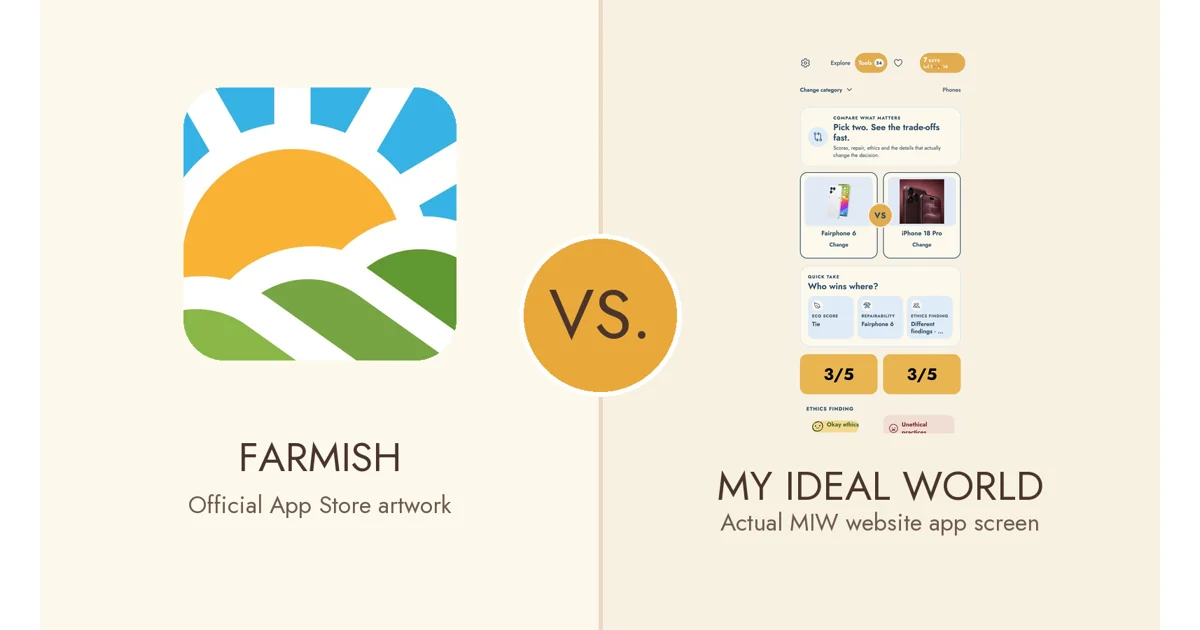
Farmish vs My Ideal World starts with a local food listing. Finding a seller is useful, but I also want to know who grew the food and how to buy it.
A nearby pin does not prove the produce was grown nearby. It also does not establish organic certification, current stock or a selling day.
This comparison looks at discovery features alongside the producer information a buyer can verify. The useful details are a named grower, location, available food and a confirmed selling arrangement.
Directories change, and a seller may stock its own harvest alongside bought in products. Check the exact item and the current listing before making a special journey.
Use the tool that helps you reach the producer, then ask the questions the map cannot answer. That is the practical distinction I make here.
Why Farmish exists and why I still ask another question
Farmish founder Terra Osman told Michigan’s economic development agency that small growers faced barriers to finding buyers. She wanted local people to have access to homegrown food without requiring every farmer to become a marketing expert.
That is a good reason for a marketplace to exist. It is also an important distinction when we compare it with My Ideal World. Farmish is designed to help farmers transact. Our editorial work is designed to investigate claims and keep the information useful beyond a single purchase.
Somebody can sell vegetables grown on their land and also sell imported fruit. The sale itself isn’t the problem. The problem is pretending both have the same origin. Ask which produce was grown there. Then ask what is applied to the crop and who has confirmed it.
Read Osman’s founder story and use our local farm app comparison if you need a tool for the journey.
A listing is a beginning, not an inspection
Farmish is useful because it connects local buyers with producers who might otherwise be difficult to find. That can make a difference for somebody selling eggs, vegetables or seasonal food outside the big supermarket system.
But a marketplace entry is supplied through the marketplace’s own listing process. It is not necessarily an independent audit of pesticides, soil health, wages or certification.
I won’t mark a farm as organic because a photograph looks natural, nor dismiss it as irresponsible because the grower hasn’t uploaded every document.
The producer should be able to say which products are grown on site and which come from elsewhere. If a customer needs a certification, they can ask for the exact scheme and scope.
If a growing method is described informally, report the statement as the farmer’s claim rather than treating it as a legal certification.
That is the gap between a transaction app and a documentary guide. One helps you find the seller.
The other can introduce the land, the grower and the questions that matter when you want to support local food thoughtfully.
How I would use both services without pretending they compete at every task
Start with the Farmish listing and contact the producer about current availability, pickup and growing location. Then look for independent information, the farm’s own records and any relevant local guide.
If the details disagree, contact the farmer rather than awarding a negative result from a guess.
Use My Ideal World’s regional coverage for the deeper story of the area. A county guide might explain why certain crops are grown there, identify relevant producers and connect travellers with related destinations.
Those are editorial functions, not promises of real time stock or direct messaging.
I want readers to support farmers, but I don’t want them misled by the word local. A shop can provide worthwhile regional food without growing every item itself.
The buyer deserves a truthful origin statement.
If the result is incomplete, the correct response is to keep asking. A missing record can be improved.
A fabricated answer can follow a producer around for years.
Farmish and the USDA directory are not the same kind of proof
The USDA’s Local Food Directories are organised around named outlet types such as farmers markets, community supported agriculture and on farm markets. Farmish is a marketplace designed to help local buyers find farms and producers who participate in its platform.
Those two discovery tools can both be useful without being independent audits of every producer’s farming practices. A shop might list food grown on site alongside other regional products.
The buyer still has to ask where each item came from.
I want the farm guide to make that question easy to ask and to retain the grower’s own explanation. A directory pin is useful.
A named producer and a verified origin are worth returning for. The USDA defines its different directory types, while Farmish explains its direct buyer and farmer workflow.
A farmer deserves an accurate description, not just a good pin
Farmish makes discovering individual sellers easier. That’s important for small producers. But I want an article to go one step further and say which vegetables are from the farm, when they can be bought and whether the producer welcomes visits.
Take our Martinique farm and local food reporting. An agricultural address does not automatically mean there is a retail shop at the gate. That’s the kind of detail a traveller could get wrong by trusting a generic directory. My Saint Lucia reporting also shows why the person growing and preparing the food deserves attention.
Use Farmish for the transaction where it serves your area. Use MIW when you want to continue examining the producer, brand and related living choices.
Our score and why this subject is not rated as a product
HTT does not invent a numerical purity rating to fill a blank. A result needs an identifiable item, declared composition, supporting source, coverage and a versioned category rule. This comparison makes those distinctions visible.
| Subject | HTT score | Why | Relevant standard |
|---|---|---|---|
| Farmish and an example producer | Not rated in this article | Farmish is a marketplace, not a food formulation. No named farmer in this article has a verified current HTT purity result. | Direct food provenance checks and product declaration checks answer different questions. |
| My Ideal World | Source-backed reports only | Open a specific brand or product record to see its category, method version, source date and evidence status. | Explore and sign up |
What we deliberately do not score. We do not give a farmer 1/5 because their full agricultural practices are not online. Missing or conflicting declarations stay unresolved. Check the Throne Standard 2.2 and the corrections process.
What the evidence actually compares
Do not collapse different kinds of evidence into one green score. These are the material questions, known sources and remaining uncertainties a reader should understand before making the decision.
| Issue or choice | Evidence to examine | What needs checking |
|---|---|---|
| Map discovery | Farmish | Requires participating producer and local coverage |
| Message a farmer | Farmish | A direct reply can still need independent checking |
| Regional farm-shop guide | My Ideal World | A researched listing may still need opening-hours verification |
| Evidence about farming practices | Farm owner, public documents and original reporting | Do not infer from a badge or image |
What our own score says about food purity
My Ideal World is not scoring food the way a nutrition app scores calories, macronutrients or a general healthy-eating index. We are interested in what a product is made of, the ingredients that have been identified under the relevant category rule and whether a current source backs the conclusion.
A purity preference is a stated standard, not a promise that every whole food is medically suitable for everybody.
Coca-Cola was raised as a 1/5 illustration, but its exact current HTT result was not available in the accessible brand records during this check. I will not turn that example into a verified published 1/5 without a linked product record, ingredient breakdown, calculation date and Standard version.
An ingredient label containing several additions is worth examining against a whole-food rule, but the result must come from the rule, not the reputation of the company.
Chocolate is another useful example of why the underlying sample matters. The Auro Chocolate report distinguishes readable ingredient evidence from supply-chain questions such as grower traceability, monitoring and living income.
The current public page did not expose a reproducible live numerical purity score in this check, so we do not restate an older cached 5/5 as current. An ethical concern is not silently blended into the product’s ingredient number.
We do not infer food safety from the word organic, declare a processed ingredient toxic just because it has a chemical name, or downgrade a brand for an unrelated social-media controversy inside its composition score. The actual product, source and dated rule must do the work. See the current Throne Standard.
Explore My Ideal World and sign up for the underlying research, rather than treating another app’s numerical score as our result.
Android and Apple downloads, what is actually public?
Android downloads are published by Google Play as rounded minimum thresholds; Apple does not publicly provide cumulative app downloads. The Apple figures below are marked undisclosed rather than guessed. These figures do not measure monthly active users, product-scanning accuracy or retention. Checked in November 2026.
| App | Android downloads | Apple iPhone downloads | Source or next step |
|---|---|---|---|
| Farmish | 100K+ | Not publicly disclosed | Google Play installation threshold |
| My Ideal World (MIW) | Not publicly disclosed | Not publicly disclosed | Explore the app and sign up |
Google Play figures are lower-bound installation bands. Apple provides actual download statistics to each publisher through App Store Connect, not as a comparable public leaderboard. An App Store rating count is not a download count.
My Ideal World is listed last because it is our app, and no unverified install figures are claimed. Apple developer explanation of download reports.
What Farmish does better
Its strength is a practical local transaction: locate nearby farms, browse what is listed and arrange pickup or ask a question. The article should state that plainly rather than forcing MIW to win the wrong contest.
The farm shop gap
A store can have attractive wooden crates, signs saying local and a selection of foods from many suppliers. To understand provenance, ask which fields supplied the produce and whether it was grown by the retailer or another producer.
Why I want a deeper trail
On documentary shoots I interview farmers, makers and people working the land. I want that conversation to remain useful after I leave. A country guide, a county guide and a research hub let someone continue the story instead of losing it in a map search.
What a proper comparison would test
Take a real Farmish listing, verify its current produce and compare it with a county entry in Ideal World. The first test is discovery; the second is depth and accuracy of sourcing. Report both, including any missing details.
How to verify the evidence
A useful test should begin with a precisely identified product or place. With permission, contact one farm and ask about crop season, own-grown share, pesticide and soil practices. Use exact responses, dates and linked listing rather than generic founder quotes.
Link manufacturer or regulator records, name the date and geography, reproduce only quotation you can attribute, and keep uncertainty visible. If the original test cannot be completed, describe this as a documented source comparison instead.
How I would use this while travelling and filming. I travel internationally to make documentaries for My Ideal World. The practical questions follow me: where did this come from, what is inside, who is behind it and will the answer still be valid in another country?
Being a purist is useful only when the sources and measurements are as disciplined as the standards I hold people to.
Farmish can find a producer while a documentary can explain them
Farmish is designed to connect people with farms and available local products. Where it operates, that direct discovery and messaging may be exactly what a shopper needs.
My Ideal World is not improved by claiming it is better at that job without evidence. Its opportunity is to make the producer’s story and provenance accessible.
If a farm listing says organic, the reader needs to know whether that is a legal certification claim, a production description or simply a preference. Ask for the certificate and what it covers. If a grower uses no pesticides but lacks certification, report the statement accurately without turning it into the same legal claim.
A real farm visit can document soil, water, crop season, labour, processing and the outlet’s sourcing. Each question deserves an actual conversation and source. Some farmers face drought, pests and thin margins; a ‘clean’ label may not capture their circumstances.
To compare the apps, choose one actual Farmish producer and one related county guide. Record whether each has current hours, products, contacts and evidence of growing practices. An empty field is not an inaccurate field, and a low score is not proof the grower is dishonest.
Does Farmish sell food itself?
Its service connects participating farms and customers; individual listings and transactions depend on the producer.
Further evidence. Farmish official
Farmish is designed to help you find a seller
If the question is where to buy a box of locally grown vegetables this afternoon, Farmish may be a better first stop than a documentary archive. Its marketplace model allows participating growers and sellers to post goods, make themselves discoverable and communicate with customers.
That is a straightforward, useful job. Google Play shows an Android installation threshold above 100,000, but downloads do not reveal whether a producer is active in a particular area.
It would be dishonest for My Ideal World to claim that it is better at Farmish’s specialist job without a comparative coverage test. We can offer a different value: regional guides, interviews, linked research and a composition-focused standard that lets a reader move from a producer’s name to questions about what they grow.
Both services can be useful on the same day.
A farm listing tells you less than a conversation
A seller can describe produce as farm fresh, organic or local. Those words may be accurate, but they need definition. Does the seller grow the produce personally? Which field or orchard supplied it?
Does the label indicate a formal organic certification or simply a description of certain practices? Can the seller document what was applied to crops and when? A map cannot answer all of that by itself.
The most useful comparison records what each app shows and what a grower confirms directly. A business may be honest and still have limited documentation. That is different from proving its claims false. Mark the difference clearly and give the reader the next question to ask rather than an exaggerated score.
A farm shop is not always a farm
A shop attached to a countryside property may source from many growers and wholesalers. That can improve access to fresh food, but it complicates a customer’s attempt to buy directly from the person who produced it.
The correct question concerns the specific item and producer rather than a generic description of the shop. A genuinely local apple and an imported banana might be sold next to each other.
In Ideal World’s regional coverage, I want to link directly to the producer’s own page when possible and make the sourcing transparent. If the map or directory contains a shop that has not been independently verified as a farm, label it accordingly. The reader should not have to discover that distinction after driving an hour.
What a documentary adds that a marketplace cannot promise
The story of a grower includes soil, weather, costs, labour, pests, crop losses and the small decisions that don’t appear on a shop listing. I travel and film because I want to understand those people and their work, not merely collect pins on a map.
A recorded interview can let a farmer explain why they avoid certain inputs, why they chose a crop or how a difficult season affected their choices.
But documentary storytelling carries obligations too. A person speaking warmly about their farm does not independently prove every claim they make. Verify numbers, name the date and keep the speaker’s actual words. That is how the article becomes something a reader can trust and return to, beyond an app list.
Why a purity score can’t replace farming evidence
A fruit can be a single whole food while questions remain about residue, water or labour. An organic certificate describes a production method under a defined regulatory scheme; it is not a laboratory result proving absolute absence of every substance.
A local label describes geography; it doesn’t tell you how the crop was grown. A helpful purity framework keeps those facts separate rather than forcing them all into one number.
That discipline matters when the farmer is someone I have met. It is tempting to trust a person whose story I admire. But a scoring rule should not change according to friendship, and the evidence standard should not be lowered when I like the owner. Fairness runs in both directions.
One real producer comparison is worth ten generic claims
Choose a current Farmish listing and a related county farm-shop guide. Record the listed product, location, contact information, season, pickup conditions and any stated growing practices.
Ask the grower for permission to quote a specific response about origin. Then compare how much useful information a shopper could establish from the marketplace and from linked reporting.
If MIW lacks a detail, say so. If Farmish supplies a faster route to contact the grower, acknowledge it. The strongest call to sign up for MIW is the promise that your interest in local food can lead to a deeper, source-based understanding of the people behind it not a pretend victory over a different kind of app.
Further reading and primary sources
Use My Ideal World for the next step
Use MIW’s local farm-shop articles and regional hubs after locating a producer, especially where you want more than directions. Explore My Ideal World and create an account. Use only the category, hub, research or habit feature relevant to this story, and check current availability before promising an app-store download.
Related Ideal World reporting. best apps to find local farms and farm shops · how to find locally grown food near you
Primary sources
On this story
Comments, questions and answers from signed-in readers. Community contributions are not verified editorial findings.
Contribute evidence
Reviews share first-hand experience. Observations can include opinions and objections. Evidence is checked against its sources before publication. Community contributions do not change MIW scores.
More long reads