
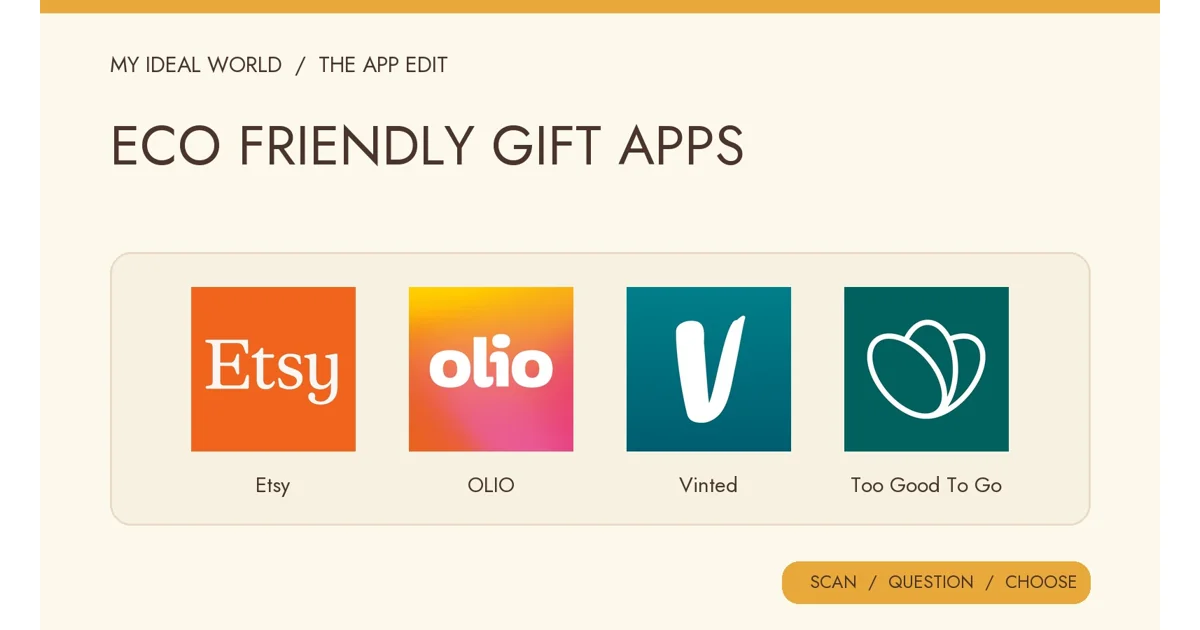
Sustainable gift apps for Christmas 2026 should help you choose something the person wants and will use. A green wrapper cannot do that work for you.
A handmade object can sit forgotten in a cupboard, and an experience can require a journey the recipient never wanted. The description of the gift does not settle whether it fits.
This guide separates planning, product checks and experience discovery. The useful information includes the recipient’s needs, the actual materials or service and the current buying terms.
Stock, access and cancellation arrangements can change. A product record or old offer is not a promise that today’s purchase has the same conditions.
Start with the person and the use, then check the offer. A thoughtful decision can include giving time, choosing an experience or buying nothing new.
Why gift shopping should begin with a question, not a product list
Would a sustainable gift planner save money or just organise more shopping?
The best sustainable gift planner should make it easier to buy less, not create a longer list of supposedly ethical things. I would start with what the person actually wants, what they already own, a real budget and whether repairing or giving an experience would be more thoughtful.
Before getting swept up in Christmas offers, visit the Gift Planner and Cooling-Off List. A useful gift is one someone enjoys after the excitement of unwrapping has passed.
Christmas 2026 falls on 25 December. The calendar makes the problem urgent, but it doesn’t change the decision. Ask the recipient before buying something because the shop says sustainable.
For somebody who cooks plant based food, an actual local grower or a practical kitchen tool may be useful. For someone who films, a repair or accessory that extends the life of existing equipment may be better than a new gadget. For somebody who needs a break, an experience may be welcome if it is genuinely accessible and wanted.
If the gift comes from a farm shop, ask which items are grown locally. If it’s a garment, read the fibre label. Don’t give a brand full marks because its hamper uses a green ribbon.
The Christmas gift that nobody wanted
A gift can arrive with recycled wrapping, a little handmade tag and all the right ethical language. If the person doesn’t need it, the environmental story becomes much less convincing.
The product still had to be made, stored and delivered.
Christmas on 25 December 2026 is a useful deadline for planning, but it shouldn’t turn a gift guide into a race to add links. Ask what the person wants first.
If you don’t know, a repair, a service or something consumable from a genuinely verified producer can make more sense than another object.
An experience may have less physical packaging but a significant travel component. A farm hamper may look local while mixing local and imported products.
A refurbished phone may be a thoughtful choice if its battery and software support are sound. The adjective sustainable has to survive those details.
For me, the best gift is something that fits the way the person actually lives. I would rather buy a useful replacement part for a friend who makes films than choose a new gadget because it carries a recycled materials logo.
What I would check before buying a plant based or local gift
A vegan ingredient declaration doesn’t establish organic growing practices. An organic label doesn’t guarantee a product was made by the farm shop where you bought it.
A handmade tag says something about production method, not automatically about the origin of every input.
Ask who made the product and where. Check the exact ingredients.
If certification is claimed, look for the issuing organisation and scope. If a business advertises local produce, ask which items are actually grown on site.
The same approach works for clothes. Read the fibre composition before trusting a campaign about natural materials.
A top score against a strict natural fibre standard means something narrow and useful. It doesn’t automatically verify the company’s broader labour or environmental performance.
The gift should still be beautiful or useful to the person receiving it. A good sourcing story is something to value, but not an excuse to impose a product they will never use.
An unwanted gift has an actual cost beyond its wrapper
The Royal Voluntary Service published UK survey research in November 2026 estimating that as many as 146 million gifts exchanged at Christmas could be unwanted. That figure is an extrapolation based on responses from 1,000 UK adults, not a physical count of discarded products.
Its scope matters.
The survey is interesting because it challenges the assumption that buying an object with the right green language is automatically the thoughtful choice. A product has to be made and transported even if it never gets used.
A reusable gift may still become waste when the recipient already owns one.
I would rather ask somebody what would improve their daily life and then source it properly. A repair can be useful.
A local food gift is valuable when the provenance is real. A clothing gift should suit the person and disclose its actual fibres.
None of those decisions starts with a decorative sustainable tag. Read the survey’s stated method and limits.
Anna’s old jeans are a better gift lesson than another green badge
At Vana in Bogotá, Anna showed how damaged denim could become another garment. The workshop is no longer operating, but that conversation about using what already exists is still useful when everyone starts buying Christmas presents.
A thoughtfully repaired item or a food gift from a real producer may mean more than a new product advertised as sustainable. The Martinique farm-shop guide explains why local sourcing needs an actual grower, not just a countryside-looking label. Ask the recipient what they will use before collecting the certification badges.
The aim of My Ideal World is to make those decisions easier to research, not to make shopping compulsory.
Our score and why this subject is not rated as a product
HTT does not invent a numerical purity rating to fill a blank. A result needs an identifiable item, declared composition, supporting source, coverage and a versioned category rule. This comparison makes those distinctions visible.
| Subject | HTT score | Why | Relevant standard |
|---|---|---|---|
| A gift without an exact product identity | Not rated in this article | The article compares types of gifts. No individual product, material or producer has been verified for a current HTT result. | A gift might belong to the Textile, Beauty, Food, Articles or Devices category; the criteria cannot be blended. |
| My Ideal World | Source-backed reports only | Open a specific brand or product record to see its category, method version, source date and evidence status. | Explore and sign up |
What we deliberately do not score. We do not score a handmade gift or an experience as 5/5 without documented category evidence. Missing or conflicting declarations stay unresolved. Check the Throne Standard 2.2 and the corrections process.
Which option solves which problem
There is no universal winner. A useful comparison begins by stating what the shopper wants to accomplish and the claim each service can verify.
| Decision | Useful first stop | What the result cannot prove |
|---|---|---|
| Useful second hand | Trusted local resale marketplace | Condition and authenticity need confirmation |
| Experiences | Real destination or local experience directory | Travel, accessibility and cancellation matter |
| Local maker | Verified business and farm-shop directory | Handmade does not prove local materials |
| Ethical product research | MIW, official certification directory | Claims must match the exact product |
What My Ideal World actually scores on clothing
Our score is a test against the Throne Standard, not a prize for whichever app has the most downloads. The relevant published standard is versioned, and category results must keep their own meaning.
An ingredient preference, laboratory result, animal-welfare policy and nutritional profile are not interchangeable evidence.
Picture receives a provisional 1/5 in the live Throne Standard 3.0.0 report checked on 17 November 2026. It has 971 complete declarations from 1,116 eligible products, with 39 missing declarations and 106 technical gaps. Its verified plant evidence is 37.18%, with 87.01% coverage.
Verified plant-evidence credit is 37.18%. This is an evidence-limited result, not a claim that every garment is synthetic or unsafe. Read Picture’s current breakdown.
Gray Label receives a provisional 3/5 in the live report checked on 17 November 2026. It has 305 complete declarations from 394 eligible products, no missing declarations and 89 technical gaps. Verified plant evidence is 85.67%, with 77.41% coverage. The report identifies incomplete coverage rather than a final whole brand assessment. Read Gray Label’s current breakdown
| Brand | HTT score | Composition evidence | Assessment limit |
|---|---|---|---|
| Picture | 1/5 | 37.18% verified plant evidence | 971/1,116 complete; 39 missing declarations; 106 technical gaps; provisional |
| Gray Label | 3/5 | 85.67% verified plant evidence | 305/394 complete; 0 missing declarations; 89 technical gaps; provisional |
The textile scale is plant-fibre composition, not overall sustainability. The current ordinary bands are 1/5 below 40%, 2/5 from 40%, 3/5 from 60%, 4/5 from 90% and 5/5 only at 100% verified plant evidence. Cotton, linen and hemp count as plant fibre.
Wool and silk are natural but animal-derived, so do not meet this plant-only preference; viscose and modal are not counted as eligible plant fibre in this standard. The method has a disclosed animal-material exception.
We do not boost this score because a garment is popular, a celebrity wears it, its packaging is recycled, or an unrelated brand-policy app likes the company.
Labour conditions, dyes, animal welfare, ownership and lifecycle impact remain important, but must be assessed separately with appropriate evidence. A low textile score must never be presented as proof of wrongdoing. Read the live scoring method.
Explore My Ideal World and sign up for the underlying research, rather than treating another app’s numerical score as our result.
Android and Apple downloads, what is actually public?
Android downloads are published by Google Play as rounded minimum thresholds; Apple does not publicly provide cumulative app downloads. The Apple figures below are marked undisclosed rather than guessed. These figures do not measure monthly active users, product-scanning accuracy or retention. Checked in November 2026.
| App | Android downloads | Apple iPhone downloads | Source or next step |
|---|---|---|---|
| Good On You | 100K+ | Not publicly disclosed | Google Play installation threshold |
| Farmish | 100K+ | Not publicly disclosed | Google Play installation threshold |
| Too Good To Go | 50M+ | Not publicly disclosed | Google Play installation threshold |
| My Ideal World (MIW) | Not publicly disclosed | Not publicly disclosed | Explore the app and sign up |
Google Play figures are lower-bound installation bands. Apple provides actual download statistics to each publisher through App Store Connect, not as a comparable public leaderboard. An App Store rating count is not a download count.
My Ideal World is listed last because it is our app, and no unverified install figures are claimed. Apple developer explanation of download reports.
The unwanted-gift cost
The wrapper is not the whole environmental question. If the item is never used, recycled packaging does not turn it into a meaningful present. Ask what the person wants first.
Christmas food is a local sourcing story
A farm-shop hamper can support a producer, but ‘local’ requires knowing the origin of each item. The farm-shop guides are useful starting points, not independent proof every item was grown nearby.
An experience is not automatically sustainable
Flights, access, local ownership and a venue’s environmental practices can change the picture. Our destination and eco-stay investigations are useful where sourced.
How to verify the comparison
The article needs evidence from a real decision. Make three recipient-specific gift briefs: traveller, plant-based cook and repair-minded creative. Compare desired usefulness, sourcing proof, delivery, local alternatives and likely waste.
Record the primary source, date, photographed or written product identifier, location and any contradictory evidence. Do not substitute a made-up benchmark or uncited review quotation.
When a present becomes more waste
I’ve seen beautiful products that nobody needed. A genuinely useful present doesn’t start with a brown paper label or a badge. It starts with the person receiving it. If you don’t know whether they will use it, buying less is the more thoughtful answer.
The green gift that nobody uses is still waste
A beautiful gift is not sustainable simply because the wrapping looks recycled. Ask what the recipient actually wants and will use. A repair, meaningful experience or a carefully sourced second-hand item may be better received than another object bought because it was labelled eco.
An experience gift can involve a flight, venue with poor local practices or an unused voucher. Check where it is, who operates it, transport requirements, cancellation and whether the recipient can attend. Less packaging does not automatically mean less impact.
A farm-shop hamper can support a local business, but not every jam, chocolate or vegetable in it was necessarily grown nearby. Ask which products are on-farm, from neighbouring producers or imported. A real supplier answer makes a far better story than an unverified local badge.
For a phone or laptop gift, refurbishment and repairability are worth checking alongside warranties and software support. The purpose of the app comparison is not to drive every reader towards another purchase. Sometimes it is to find out why the existing device is still enough.
Are experience gifts automatically sustainable?
No. Venue practices, travel, accessibility and actual use matter.
Further evidence. WRAP waste research
The recipient is missing from most sustainable gift lists
A gift can have recycled packaging and a tidy sustainability claim while being something the recipient never wanted. That is still a wasted purchase.
The useful question comes before the product search: what would make this person’s life better, and what will they actually use? A repair voucher, experience, consumable food or second-hand item may each be right in different circumstances.
I don’t want a list that simply attaches the word green to expensive objects. The gift has to fit a person’s habits, access needs, dietary preferences and location. A good app can help you find an option, but no app can know whether a relationship needs another object. Ask the person, or pay attention to what they already value.
A farm-shop hamper needs an origin check
Local shops are wonderful places to meet producers and find seasonal food. But the fact that a hamper is sold in a farm shop doesn’t establish that every item was grown nearby.
The shop might combine local honey or vegetables with imported chocolate, oils or preserves. There’s nothing inherently wrong with that. It becomes misleading only when the whole selection is presented as locally grown without adequate evidence.
Use the existing farm-shop guides to find producers, then ask which products are grown on their land, which come from neighbouring farms and which are sourced through wholesalers. Include the answer and the date in the article. A direct conversation with a grower is more valuable than another stock photograph of a rustic basket.
Experience gifts are not automatically low-impact
An experience voucher avoids manufacturing one more physical item, but its environmental and social context still matters. A destination involving a long flight, a water-intensive attraction or an operation with unresolved local concerns may not fit the recipient’s values.
Check where it takes place, who runs it, whether local people benefit and the conditions for cancellation or resale.
A local workshop with a real maker can be a different story from a mass-market experience marketed as authentic. When I film artisans, the experience of meeting the person and seeing the process is part of the value. That is something an app list can help discover, but the report should carry actual details from the operator rather than a generic promise of meaning.
A sustainable phone may be a refurbished one
Electronic gifts are especially easy to buy under pressure. A phone can advertise recycled aluminium while offering limited repair options or short remaining software support. A professionally refurbished device with an appropriate warranty and healthy battery may be a better fit for someone who needs dependable communication rather than a new model every year.
The comparison needs exact specifications, repair-part availability, operating-system commitments, network compatibility and the recipient’s needs. Giving somebody a repairable laptop they cannot use for their work is not a sustainability victory. Durability has to be measured in practical years of service, not just materials on the manufacturer’s brochure.
What the app comparison should actually help someone choose
A resale marketplace locates used items. A local-producer directory helps you identify a maker. A travel app finds experiences in a place.
A brand-research service investigates environmental and material claims. None replaces the others. The comparison table should lead a reader to the tool that handles their next decision, and MIW should be listed last with a clear disclosure that it is our own project.
A Christmas 2026 article also needs time-sensitive checks before publication: shipping deadlines, operating dates, price changes and voucher conditions. If those aren’t verified, don’t invent them for a seasonal snippet. Readers come back when a practical recommendation is accurate, not merely timely.
Further reading and primary sources
What I would use My Ideal World for
Use MIW’s relevant product or destination research to choose a gift you can explain, not just a green-looking one. Follow the connected research, save the relevant evidence and move to the app function that actually helps here. Explore My Ideal World and create an account.
Check the site for currently available features rather than promising a mobile download prematurely.
Keep reading the connected research. eco friendly labels explained · how to find locally grown food near you
The best sustainable gift app might convince you not to buy
Before buying another discounted gift, compare the real need with the alternatives. Our ethical shopping apps guide and sustainable fashion comparison show why shopping more isn’t always the best outcome.
My Ideal World’s Gift Planner, Should I Buy This and Repair or Replace tools are useful when you want to make a considered decision. A repaired item, something shared or an experience the recipient actually wants may be more thoughtful than an unwanted eco-labelled product.
Evidence and research sources
On this story
Comments, questions and answers from signed-in paid members. The conversation is shared with the app. Community contributions are not verified editorial findings.
Contribute evidence
Reviews share first-hand experience. Observations can include opinions and objections. Evidence is checked against its sources before publication. Community contributions do not change MIW scores.
Article discussions and evidence contributions are for paid members and are shared with the app.
Sign in to contribute or join the discussion Read this next
Best Apps for Black Friday Shopping in 2026
Best apps for Black Friday shopping in 2026: compare prices, check ingredients, verify repairs and spot greenwashing before you buy. Read before checkout.Read the story Keep exploring
Best Eco-Friendly Apps in 2026 and Which Are Worth Using
Best eco-friendly apps in 2026, compared by what they actually do: scan products, assess brands, find local food and support better choices. Compare options.Read the story Keep exploring