

Green heritage stays in the Caribbean keep the land, the buildings and the knowledge in living hands
Heritage is not a four poster bed in an old sugar mill with fairy lights strung across the ruins. Heritage is who still holds the land, who still knows the plants, and who gets paid when you sleep there.
That is how I judged these green heritage stays in the Caribbean. Old buildings kept standing instead of bulldozed. Land kept in a family or a community. Crafts and food traditions still alive in the hands that inherited them. And the hard part, which most heritage hotel lists skip, the honest story of who built these estates and who was never paid.
Two of these families I sat with myself. Lionel and Lorilyn walked me through their garden in Antigua, and Asha and Afiya Frank showed me Frangipani in Barbuda, and every word of theirs here comes from those recordings. The rest is research from each stay’s own history pages and the archives behind them, checked between 30 October and 3 November 2026.
It is a timely week to ask these questions. As I write, Commonwealth leaders are meeting in Antigua and Barbuda, and on 2 November 2026 the chair of the CARICOM Reparations Commission welcomed the UK prime minister’s offer of a structured conversation on reparations. Heritage is not the past. It is on the table right now.
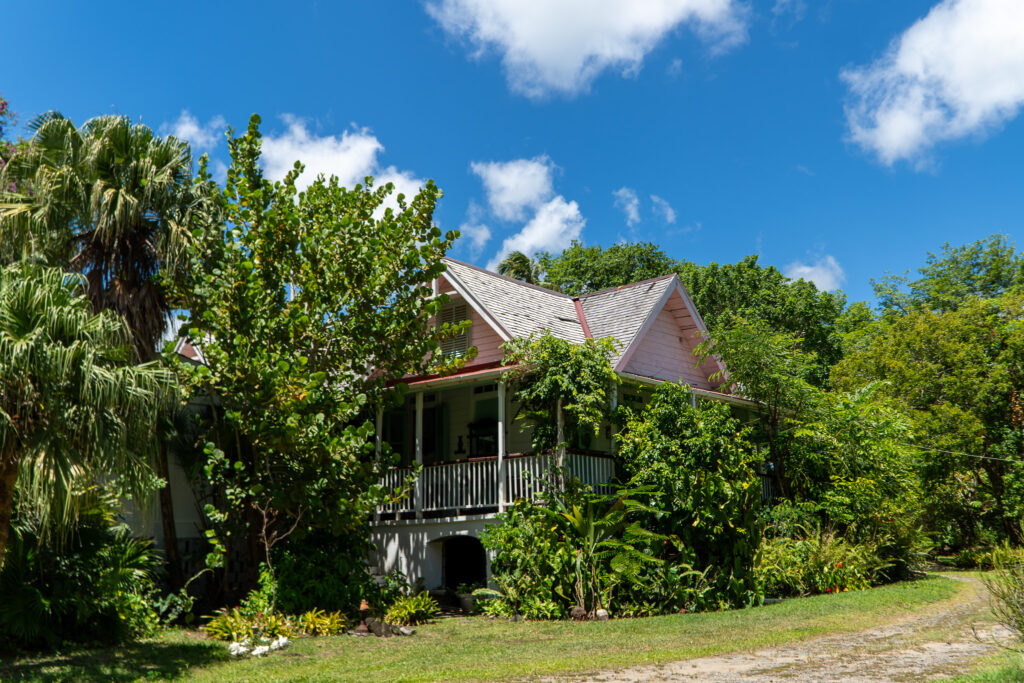
What is a green heritage stay? Five tests decide it
A green heritage stay is a place that keeps its land in a family or local community, reuses its old buildings instead of knocking them down, protects any archaeology or history on the site, keeps a living craft or food tradition going, and lets the local community in. Those are the five columns below.
Notice what is not a test. A grand plantation house. A wedding lawn. A “colonial charm” line in the brochure. Old does not mean heritage, and it certainly does not mean green.
How the Caribbean’s green heritage stays are rated
The Throne Standard is our independent eco score, out of 5, from three passes of research on each stay. Google ratings were checked on 30 October 2026, and every figure links to its source.
| Stay | Throne Standard | Google rating | TripAdvisor rating |
|---|---|---|---|
| Balenbouche Estate | 3.3/5 | 4.9 (67) | 4.7 (166) |
| Fond Doux Eco Resort | 3.4/5 | 4.4 (403) | 4.6 (1,326) |
| Lamblion Apartments | 2.8/5 | 4.6 (49) | Not checked yet |
| Frangipani Eco Lodge | 2.4/5 | 4.9 (19) | Not checked yet |
| Small Hope Bay Lodge | Pending | 4.8 (142) | Listed, score not checked |
Which heritage stays keep their history alive? Every symbol sourced
✓ means the stay clearly does it. ◐ means partly. ✗ means it doesn’t. ○ means it doesn’t say. Tap a symbol to read the source.
| Stay | Family or local ownership | Historic building reused | Archaeology or heritage site protected | Living craft or food tradition | Community access |
|---|---|---|---|---|---|
| Balenbouche Estate | ✓ | ✓ | ✓ | ✓ | ✓ |
| Fond Doux Eco Resort | ✓ | ✓ | ✓ | ✓ | ◐ |
| Lamblion Apartments | ✓ | ✗ | ○ | ✓ | ◐ |
| Frangipani Eco Lodge | ✓ | ✗ | ○ | ◐ | ✓ |
| Small Hope Bay Lodge | ✓ | ◐ | ○ | ✓ | ◐ |
Two stays pass every test or come close, and both are in St. Lucia. Balenbouche and Fond Doux. The other three carry their heritage somewhere other than in old walls, in a garden, on communal land, in a dye bath, and that counts too.
Is it OK to visit or stay on a former plantation? Yes, when the stay tells you whose labour built it
It is OK to stay on a former Caribbean plantation when the stay tells the full story of the people who were enslaved there, keeps the land working for the community today and does not sell the past as a romantic backdrop. If it hides that story, walk away.
One of you wrote this under my video on the strawberry farms in Spain. “Dear god is that still happens sounds like a tale from the time of slavery and plantation.” It does still happen, which is exactly why the word plantation can never be decoration.
Here is what the fine print says about the two St. Lucian estates on this list. When emancipation came in 1834, 166 enslaved people worked the Balenbouche plantation, which was then 587 acres, mostly sugar cane. The village of Piaye, next to the estate, was founded by the people freed from it and still holds a strong African identity. Between 1859 and 1893 about 4,500 indentured labourers came to St. Lucia from India, some of them to Balenbouche, and many settled in the community of Balca to the north.
At Fond Doux in Soufrière, the land holds a different chapter. On 22 April 1795, more than 1,000 British troops marched from Vieux Fort to crush a rebellion and were ambushed at Rabot. The ambush was planned by Flore, a formerly enslaved woman who escaped abuse to join the Armée Française dans les Bois, the army in the woods.
A guesthouse cannot pay a debt that belongs to governments and the families who were compensated. The CARICOM Ten Point Plan for Reparatory Justice, endorsed by Caribbean heads of government in March 2014, puts that responsibility where it sits. What a stay can do is tell the truth on its own land, open that land to the people around it, employ and train locally, lend land to farmers, and buy from them. That is the standard I hold these stays to.
- Ask who owned the estate, and who worked it.
- Ask whether the history is told on site, and whose voices tell it.
- Ask who owns the land today and who works there now.
- Ask whether local people can walk the land without paying for a room.
- Ask where the food and the furniture come from.
Balenbouche Estate in St. Lucia has been in one family since 1964 and is still open to the public
Balenbouche Estate, a former sugar estate near Laborie on St. Lucia’s south coast, has been owned and run by the Lawaetz family since 1964, and Uta, Verena and Anitanja Lawaetz have turned it into a guesthouse and retreat centre that stays open to the public as a national landmark, according to its mission page.
Balenbouche was set up as a sugar and rum plantation in the 1740s. The oldest family name linked to it is Martin, in 1770, and it passed through several owners while the French and the British fought over the island, which changed hands seven times before it was ceded to Britain in 1815. Today the 19th century plantation house and a 200 year old aqueduct still stand, and the family hopes to turn one of the old sugar mill ruins into a small museum and gallery.
The history here is far older than sugar. The Igneri arrived in St. Lucia by dugout canoe almost 2,000 years ago, followed by the Kalinago around 1000 AD, and they left petroglyphs and carved rock basins along the Balenbouche river. Rock cut basins like these were first described on St. Lucia by Reverend Charles Jesse in a 1952 paper in American Antiquity, and the estate says archaeological research on its land is still going.
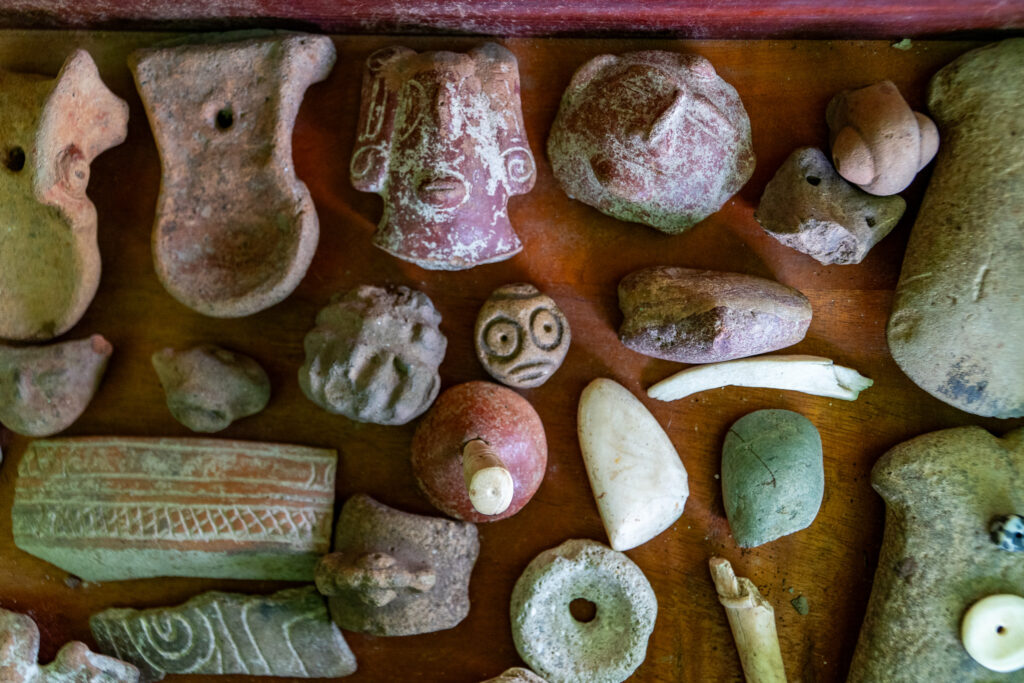
The living part is what earns the green. No chemical fertilisers or pesticides have been used since 1987. The family has arrangements with local people to plant gardens, keep bees, graze cattle and harvest crops, and the estate hosts schools, community groups and cultural exchanges. That is reparative use I can stand behind. Not perfect. Real.
The south is clay country, too. Next door in Choiseul, St. Lucia’s coal pots are still shaped by hand, and I wrote about Irene, who at 70 still gathers her clay and keeps St. Lucia’s pottery tradition alive.
The cottages, the food and the voices of the people who run Balenbouche are in our guide to where to stay in the south of St. Lucia. For the whole island, read where to stay in St. Lucia by area, then check Balenbouche’s dates with the family directly.
Fond Doux in Soufrière is a St. Lucian owned cocoa estate that kept its history standing
Fond Doux Eco Resort, a working cocoa estate in Soufrière run by its St. Lucian owners Eroline and Lyton Lamontagne, restores old colonial buildings salvaged from across the island instead of building replicas, and keeps the site of the 1795 Battle of Rabot as a historical park, according to its about page and FAQ.

The resort calls itself a 250 year old working cocoa plantation, certified organic and a Green Globe member. The cottages are abandoned colonial buildings rescued from around St. Lucia and rebuilt here, then furnished by local artisans. The Lamontagnes say they train and employ St. Lucians. On the Chocolate Heritage Tour you follow the cocoa from the pod to the drying trays to the bar, and the chocolate story ends in a 100% organic chocolate made on the estate.
The Historical Park is why Fond Doux is on this list. You walk the ruins of an 18th century French fortress, a Neg Maron hideout where people who had freed themselves hid in the hills, an interpretation centre and a shrine to those who fought and fell. It is open every day from 8 am to 4 pm, and residents and visitors both pay an admission fee, which is why it gets a half mark for community access.
This is the kind of history I want on a plantation. Not the planter’s dining room. The woman who planned the ambush.
Fond Doux’s plantation to plate kitchen is in our farm to table stays in St. Lucia, and it sits on our list of the best sustainable hotels in St. Lucia. Book Fond Doux and give the park a full morning.
Lamblion in Antigua keeps a family garden tradition that every country child once knew
Lamblion Holiday Apartments in Sea View Farm, Antigua, is owned by Lionel and Lorilyn Walker, an Antiguan husband and wife whose fruit trees and herb beds keep the old country yard garden alive for their guests. The apartments themselves are modern, opened in 2007, and I am not going to pretend they are a heritage building. Lamblion’s heritage is in the soil.
Standing by the cars under the guava tree, I asked Lionel if he would call his garden a typical one. He said no, and explained what typical used to mean.
“A typical backyard garden is where somebody would have beds and they would go maybe three or four or five specific things,” he told me. “Somebody with a lot of land like us would have fruit trees in their backyard, and then they would still have like a section like I used to grow.”
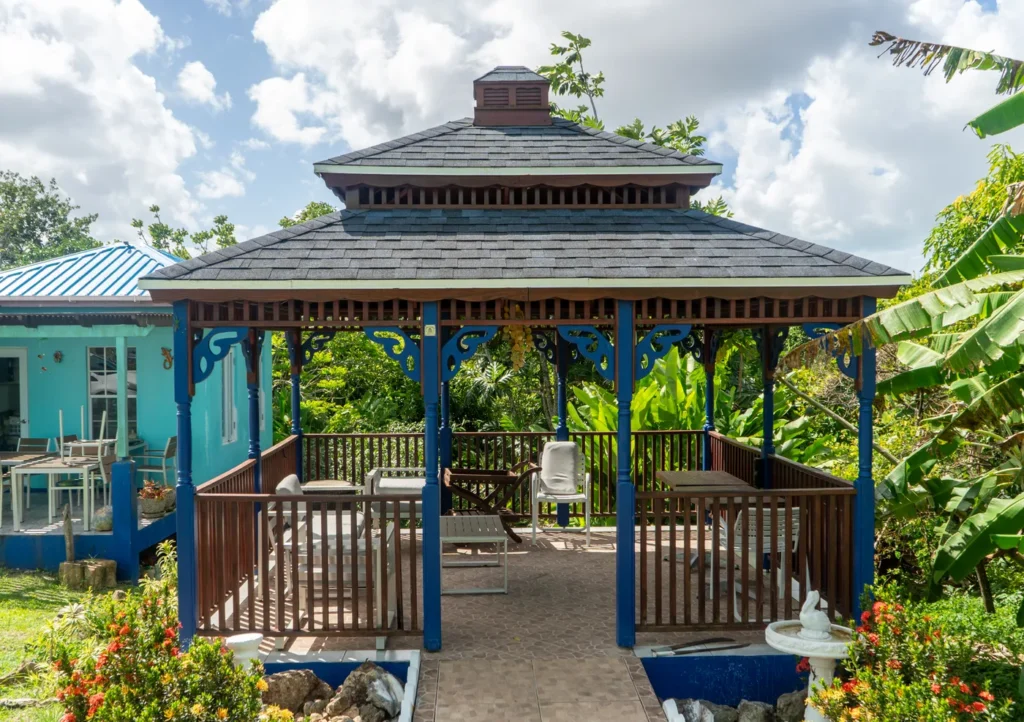
Later, in the herb beds, I asked Lorilyn how it feels to walk outside her door and pick what she needs. “I feel special, but then my grandmother would do something like that.”
Earlier on the tour she had told me how she uses them. “If I feel like if something is coming on, I’ll use just use a bush. You know, a lot of people, something happen. They say, give me a paracetamol. I just try and use a leaf.” That is her own practice, passed down, not medical advice. It is also Caribbean bush medicine, alive in an Antiguan yard, and you can read more about these plants in our medicinal plants guide.
Lamblion is a member of the Antigua and Barbuda Horticultural Society. Lorilyn’s whole story, four generations of it, is in Lorilyn’s Antiguan garden, what you can pick is in the Lamblion harvest guide, and you can watch the garden tour.
Lamblion is in our where to stay in Antigua guide and the apartment with a kitchen pick. Book Lamblion and ask Lorilyn what is ready in the herb beds.
Frangipani Eco Lodge in Barbuda stands on land the law said no one could sell
Frangipani Eco Lodge, two small units on Barbuda’s northeast Atlantic coast, is owned by the sisters Asha and Afiya Frank and stands on land Asha holds through Barbuda’s communal land system, where the island’s land has belonged to Barbudans in common since emancipation in 1834.
Sitting with Asha at the lodge, I asked her if this was her ideal world. “This is my ideal world. Because I control my destiny and the opportunity that I’ve been given because I live in Barbuda is the fact that I own this 15 acres piece of property through our communal land system, which essentially is free land for Barbuda,” she said. “It’s very freeing.”

Barbuda wrote that communal ownership into law in the Barbuda Land Act of 2007, which says “All land in Barbuda shall be owned in common by the people of Barbuda” and “No land in Barbuda shall be sold.” After Hurricane Irma emptied the island in 2017, the national government moved to repeal it, and the House passed the repeal bill on 3 May 2018 with one of its 19 members representing Barbuda. Barbudans took it to court. Human Rights Watch called for the people of Barbuda to be consulted first.
Frangipani itself is new. It was started after Irma and built by local builders to work with Barbuda’s landscape, according to the lodge, so it gets a ✗ for historic buildings. Its heritage is the land under it and the way of life the sisters share, beach picnics, lobster lassoes and a beach where local people still fish. Hear it from the source in the interview on Barbuda’s communal land.
Meet the sisters properly in two sisters made Frangipani a place to slow down, then plan with where to stay in Barbuda and a slow week on Barbuda. Book Frangipani and spend your money with the people whose land it is.
Small Hope Bay Lodge on Andros has been in the Birch family since 1960, and so has Androsia batik
Small Hope Bay Lodge on Andros in The Bahamas has been run by the Birch family since 1960, and the same family created Androsia, the hand dyed Bahamian batik, in 1973. The lodge has welcomed guests for more than 60 years, and its lodge still holds the vintage family photos, the library and a cannon in the fireplace.

Androsia was created by Rosi Birch in 1973, hand dyed cotton with designs taken from the island’s plants and sea and Bahamian culture, and the Androsia Batik Factory is open to visitors. The lodge also writes about the bush of Andros, where plants such as bay geranium are still made into teas and tinctures, and about Androsians’ generations of knowledge in fishing and farming.
The reef side of Small Hope, the blue holes and the rare Bahama Oriole, is in the wildlife eco stays in the Caribbean.
Small Hope Bay is in our where to stay in The Bahamas guide and the best sustainable hotels in The Bahamas. Book Small Hope Bay, or book direct on the lodge’s own site.
Where can you see living Caribbean craft heritage? In the hands of the people still making it
You see living Caribbean craft heritage by going to the makers, not the gift shop. Irene’s coal pots in St. Lucia, the Androsia dye baths on Andros, the cocoa drying trays at Fond Doux and Lorilyn’s herb beds in Antigua are all places where a skill is still being handed on.
Buy direct, pay the asking price and ask questions. A coal pot bought from the woman who dug the clay keeps a tradition alive. A copy made somewhere else and sold at the airport keeps nothing alive. Our week of sea moss, cocoa and Creole St. Lucia itinerary is built around exactly these visits, and the St. Lucia destination guide has the rest.
Your questions about heritage stays in the Caribbean, answered
Is it OK to visit a plantation in the Caribbean?
Yes, it is OK to visit a Caribbean plantation when the site tells the full story of the enslaved people who worked it and benefits the community around it today. Avoid places that sell the plantation as a romantic wedding backdrop and say nothing about who built it.
Can you stay on a former plantation in St. Lucia?
Yes, you can stay on a former plantation in St. Lucia. Balenbouche Estate near Laborie is a former sugar estate run by the Lawaetz family since 1964, and Fond Doux in Soufrière is a working cocoa estate owned by St. Lucians with a historical park on site.
What is a green heritage hotel?
A green heritage hotel keeps its land in local or family hands, reuses old buildings instead of demolishing them, protects the history and archaeology on its site, keeps a craft or food tradition alive and lets the community in. Old walls alone do not make a stay green or heritage.
What are the best historic hotels in the Caribbean for eco travellers?
The best historic stays in the Caribbean for eco travellers are Balenbouche Estate and Fond Doux Eco Resort in St. Lucia, which both keep their buildings and history standing, and Small Hope Bay Lodge on Andros, run by the same family since 1960.
Who owns Balenbouche Estate?
Balenbouche Estate is owned and run by the Lawaetz family, who have held it since 1964. Uta, Verena and Anitanja Lawaetz, a mother and daughters, turned the old sugar estate, once a working farm, into a guesthouse and retreat centre that still uses no pesticides.
Who owns Fond Doux Eco Resort?
Fond Doux Eco Resort is owned by Eroline and Lyton Lamontagne, who are both St. Lucian and run the cocoa estate and resort themselves. They say they train and employ St. Lucians on the estate.
What was the Battle of Rabot?
The Battle of Rabot was an ambush on 22 April 1795 at what is now Fond Doux in Soufrière, during St. Lucia’s fight against slavery. More than 1,000 British troops marched from Vieux Fort to crush the rebellion and were ambushed by the army in the woods.
Who was Flore?
Flore was a formerly enslaved woman in St. Lucia who escaped abuse, joined the Armée Française dans les Bois and masterminded the 1795 ambush at Rabot. Her story is told at the Fond Doux Historical Park.
Are there petroglyphs at Balenbouche?
Yes, Balenbouche Estate has Amerindian petroglyphs and carved rock basins along the Balenbouche river, left by the Igneri and Kalinago peoples who lived on St. Lucia long before Europeans arrived. The estate says archaeological research there is ongoing.
What is communal land in Barbuda?
Communal land in Barbuda means the island’s land belongs to Barbudans in common rather than to individual buyers, a practice dating from emancipation in 1834. The Barbuda Land Act of 2007 wrote it into law and said no land in Barbuda shall be sold.
Can you buy land in Barbuda?
Buying land in Barbuda is contested. The national government passed a repeal of the Barbuda Land Act in 2018 to allow freehold ownership, and Barbudans challenged that repeal in court, so check the current legal position with a local lawyer before you consider it.
What is Androsia batik?
Androsia is a hand dyed Bahamian batik fabric created by Rosi Birch on Andros in 1973, with designs inspired by the island’s environment and Bahamian culture. The Androsia Batik Factory near Small Hope Bay Lodge is open to visitors.
Is Lamblion a heritage property?
Lamblion is not a heritage building, since its holiday apartments opened in 2007. Its heritage is the garden, where Lionel and Lorilyn Walker grow fruit and herbs the way Antiguan families have for generations, and guests can pick from it.
What is the CARICOM Ten Point Plan?
The CARICOM Ten Point Plan for Reparatory Justice is the Caribbean Community’s framework for reparations for slavery and native genocide, endorsed by Caribbean heads of government in March 2014. In November 2026 the commission’s chair welcomed the UK prime minister’s offer of a structured conversation on reparations.
How can travellers support heritage in the Caribbean?
Travellers support Caribbean heritage by staying with local and family owners, paying to visit sites run by the community, buying crafts directly from the people who make them and asking every stay who owned the land and who works it now.
My pick for a green heritage stay in the Caribbean is Balenbouche, with a day at Fond Doux
Balenbouche is my pick because it keeps the land, the buildings and the archaeology together, says it has used no chemicals on the land since 1987 and still lets the community walk in. Then spend a day at Fond Doux and stand where Flore planned her ambush. Between them you get the whole story, the land and the resistance.
Heritage you pay to look at is a museum. Heritage that still feeds, employs and teaches the people around it is alive. Book the living kind.
For the rest of the Caribbean picture, see the best sustainable hotels, eco lodges and resorts in the Caribbean, the best black owned eco stays, the female owned eco stays and the eco stays with gardens. Still choosing an island? Start with where to stay in the Caribbean. And tell me in the comments which family run place you think belongs on this list.