
The Jamaican farm behind a Negril restaurant’s food
Before the cabbage reaches the kitchen, somebody has to plant it, water it, watch it grow, feel when it is ready to harvest, and decide what to do with the leaves left behind. On the farm connected to Charela Inn in Jamaica, I spent time with Muffy, a farmer whose knowledge comes from years of working with the land. What began with a lesson in planting cabbage became a much bigger conversation about local seeds, food, the aftermath of Hurricane Melissa, and the patience required to grow something that will not be ready tomorrow.
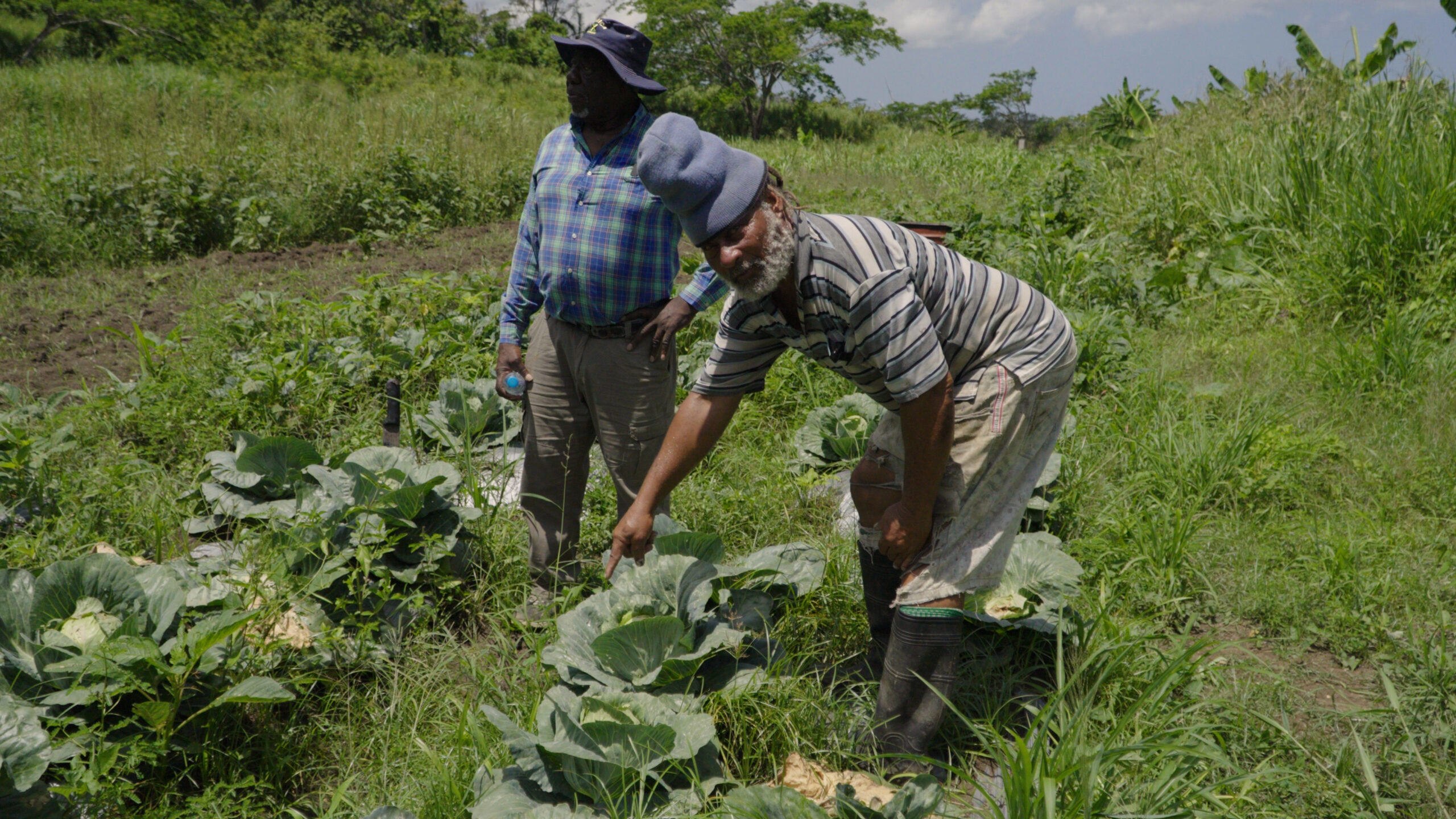
We were in Haddon Hall, Green Island, Jamaica, walking among the crops and stopping whenever something caught my eye. Muffy showed me where cabbage was growing, pointed out callaloo being kept for seed, and explained how the farm had been tending plants damaged by the hurricane. The experience offered a different perspective on the farm-to-table idea. It is easy to admire fresh produce on a menu. It is another thing to spend time with the people responsible for growing it.
Planting cabbage starts with the soil
Our first lesson was wonderfully practical. The ground needed watering before the young cabbage plants could go in. Once the soil was soft, Muffy demonstrated how to make a small hole with a finger, place the plant and cover it. No elaborate explanation was needed. He showed me, and I watched how the work followed the condition of the ground.
“After you water the ground, you’re gonna start plant here with your finger because the ground is soft. So you put it in. And that is it.”
Watering was not simply a matter of giving the plants a drink. Muffy explained that the ground became hot, so watering helped cool it and soften it for planting. After putting the seedlings in, the plants could be watered again.
According to Muffy, the cabbage takes about three months to reach harvest. During that time, the work continues: watering, weeding, spraying where needed and keeping an eye on the plants. He described cabbage as relatively manageable, but not something that could simply be planted and forgotten.
This is one of the details that gets lost when we talk about food as though it appears in a shop or restaurant by magic. Even a crop that grows well still needs attention. The harvest depends on what happens in the weeks before it.
For a general guide to growing cabbage, University of Minnesota Extension explains how cabbage develops and when to harvest it. The advice is useful background, but Muffy’s lesson was rooted in the plants directly in front of us, under the Jamaican sun.
How Muffy knows when cabbage is ready
Looking at a cabbage is not always enough to tell whether it is ready to harvest. When I asked how he knew, Muffy told me to feel the head. A firm, hard cabbage is a sign that it has developed.
“Feel them. Feel it. It’s hard.”
Timing matters, especially when rain is involved. Muffy explained that when the heads are ready and rain arrives, the cabbage can begin to split. Once that happens, the harvest becomes more difficult and some of the produce may no longer be worth keeping for the kitchen.
As we moved through the rows, he pointed out heads that were beginning to split. Some of the smaller ones were not worth harvesting for the restaurant, he explained, and could be put to better use as feed for the animals. The leaves left after harvesting also went to the goats and cows.
It was a small but telling example of how a working farm makes decisions. A crop is not simply labelled a success or a failure. The farmer has to judge what can be served, what can be used elsewhere, and what the next planting needs.
Callaloo, cabbage and the value of saving seeds
Among the cabbage plants, some callaloo had been left standing so its seeds could be collected. That changed the direction of our conversation. Instead of talking only about what the farm could harvest now, we began talking about how to grow the next crop.
“That’s callaloo. Those are there for the seed.”
Muffy explained that saving seed has long mattered to people farming in the countryside. Being able to keep seed from one crop and plant it again offers a degree of independence. But, as he told me, it is becoming more difficult to rely on that practice for every crop.
“We here in the country, people believe in securing their own seeds and not to buy. But it’s getting more and more difficult.”
His concern was practical. He described cases where seeds bought for planting did not produce as expected, and explained that some crops do not reliably give the same results when their seeds are saved. He specifically mentioned corn and, to an extent, string beans.
There is an important distinction here. Saving seed is not the same as expecting every plant grown from it to be identical to the previous crop. With open-pollinated varieties, seeds can often be saved to maintain a variety’s characteristics, provided the plants are grown and selected appropriately. Hybrid seeds can also germinate, but their offspring may not retain the same combination of traits as the original plant. Results depend on the crop and variety, so it would be misleading to say that all purchased seeds fail or that every hybrid seed is incapable of producing another crop.
University of Minnesota Extension’s guide to saving vegetable seeds explains the differences between seed types and why variety matters. For farmers, however, this is not just a gardening question. It touches on the ability to keep planting, the cost of inputs and the practical knowledge needed to produce food season after season.
What stayed with me was the contrast between the plants growing beside us and the uncertainty Muffy described. There was callaloo standing ready to provide seed for a future crop, but that did not mean every crop could be reproduced so easily. Keeping food growing requires more than land. It also requires access to suitable seed and the knowledge to use it.
Growing more in the same space
The farm was not organised as a series of completely separate crops. Callaloo was growing among the cabbage, and when I asked whether planting them together was deliberate, Muffy explained the thinking behind it.
Cabbage grows relatively quickly, he said, and its leaves provide some shade. Growing callaloo alongside it helps make use of the available space rather than leaving every area dedicated to just one crop.
It was a simple illustration of making the land work harder. Different plants have different growing habits, and planting them together can sometimes help farmers use space more efficiently. Whether a particular combination works depends on the crops, their spacing, the season and the conditions on the farm. Muffy’s example was specific to what he was growing there.
He also showed me the soil and talked about the manure from chickens and cows. The ground was rich with organic material, and he pointed to the manure as an important part of growing crops such as callaloo and bananas. Rather than treating animal waste as something separate from the growing operation, the farm could put it to use as a source of nutrients.
That connection between crops, animals and soil was visible in the work itself. The cabbage leaves could feed the goats and cows, while manure could be returned to the land. Not every part of every crop has to end up on a restaurant plate to have a use.
What Hurricane Melissa left behind
Some of the most memorable moments of the walk came when Muffy showed me plants that had been damaged by Hurricane Melissa. The storm had affected trees and crops, but the farm was not simply a picture of destruction. There was also new growth, and a great deal of work involved in helping plants recover.
Muffy pointed to a cedar tree whose top had been damaged during the hurricane. It was beginning to shoot again.
“This was one of my cedar tree that was decapped during the hurricane. But she’s coming back. And see, the plant is shooting up again.”
We saw signs of recovery elsewhere. Muffy described plants that had survived but still needed cleaning up, pruning or other attention. New shoots did not mean the work was finished. Damaged plants needed time, and some needed to be cut back or repositioned to encourage healthier growth.
“The whole of them things have come back, but you have to clean them up and make them come back again. Because you gotta take care of them. The storm damage a lot of things.”
That last part matters. Recovery is not just waiting for nature to do its work. It is also the human effort of tending what remains, working out which plants can recover and giving them the care they need.
When I asked whether damaged plants returned in the same condition, Muffy’s answer was more measured than a simple story of everything bouncing back.
“Maybe they need some time. They need some time to come back again.”
He spoke about removing or repositioning damaged growth and allowing plants to establish themselves again. The farm’s recovery was ongoing, not a neat before-and-after story. Some crops were returning, others needed more time, and the people tending them still had work to do.
In April 2026, the Food and Agriculture Organization reported on support for Jamaican farmers recovering from hurricane damage, including assistance distributed through the Rural Agricultural Development Authority in Hanover. That wider recovery effort provides context for the challenges farmers have faced, although it should not be taken as evidence that this particular farm received that support.
For Muffy, seeing plants return had a meaning beyond the immediate harvest.
“When you see the nature coming back, well, that’s what farming does to you. It teaches you patience. And it shows you also the power of nature, the environment.”
He reflected that people can damage their own lives and surroundings, while nature has its own capacity to recover. It was a striking thought to hear while standing among trees and crops that were still showing the effects of a storm. The recovery was visible, but so was the time and care it required.
Pumpkins, bananas and the logic of a mixed farm
As we moved further around the property, the conversation expanded beyond cabbage and callaloo. Muffy pointed out bananas, pumpkins, papaya and other crops. Some of the plants were producing again after the hurricane; others were part of the next stages of planting.
One example stood out: pumpkins growing through a banana field. Rather than using the area for bananas alone, the farm could allow pumpkins to spread through the space as well. Muffy explained that this meant another crop could be harvested while the bananas continued to grow.
Sometimes, he said, pumpkins grew from seeds that had simply been discarded. When conditions were right, those seeds could take root and produce more pumpkins. The result was a practical lesson in how food can grow beyond the neat rows and planned beds we might imagine when we think about farming.
There were limits, of course. Muffy explained that sweet potatoes did not do well in one area because the soil was too heavy. A crop that thrives in one part of a farm may struggle in another. Knowing what to plant is as much about understanding the land as it is about choosing a vegetable.
He also talked about planting pigeon peas, known locally as gungo peas, because the farm uses them for rice and peas. The crop has a particular place in Jamaican cooking, and Muffy spoke about the difficulty of finding some traditional varieties. He was concerned that seeds selected for higher production do not always allow farmers to reproduce the same results by saving seed from the next crop.
It brought us back to the earlier conversation about seed saving. The question was not simply which crop produces the most. It was also which varieties farmers can keep growing, what people want to eat, and how the farm can supply ingredients that are part of everyday Jamaican food.
Why growing food takes patience
Some crops can be harvested in a matter of months. Trees ask for a different kind of commitment. Muffy pointed to young coconut trees and talked about waiting years before they would produce the coconuts people could drink. In the meantime, other crops could grow around them, including bananas and pumpkins.
It was a recurring theme on the walk. A farmer does not always have the luxury of planting one thing and waiting for a single harvest. The land needs to be used in the meantime, and the farm needs food to grow while longer-term crops establish themselves.
Muffy spoke about the value of planting more fruit trees, including avocado, mango and papaya. He also described the pleasure of eating fruit freshly picked or grown nearby. For him, this was not an abstract argument about eating locally. It was part of the way he thought about food, work and what the land could provide.
He also talked about how people have become accustomed to buying food from supermarkets rather than growing it themselves. Growing a coconut tree, he pointed out, requires a willingness to wait. Not everyone has the space, time or resources to do that, but his point was that some of the things we depend on cannot be rushed into existence.
That patience is particularly meaningful after a hurricane. A tree can be damaged in a moment, while its recovery may take months or years. Seeing new growth is encouraging, but it does not erase the labour or the waiting that came before it.
From the farm to Charela Inn’s restaurant
So where does the food go?
Charela Inn connects its Cocoa Farm with the food served at Le Vendôme restaurant. The hotel’s website describes the farm as spanning 25 acres. During our conversation, Muffy described an area of around 25 acres on one side and another ten acres on the other. Those were the areas being discussed during the walk, rather than a replacement figure for the property’s full acreage.
Muffy told me that cabbage appears on the menu regularly and can be used in different dishes, including salads. It was a satisfying connection to make after learning how the plants were put into the ground and how he judged when their heads were ready to harvest.
“Most of the time we have cabbage. There’s some cabbage in it. We do all kinds of things with cabbage.”
During the walk, Muffy introduced himself as someone who farms tomatoes, cabbage, coconut, bananas and sweet peppers, among other crops. The hotel also describes a broader farm-to-table offering that includes produce such as callaloo, lettuce, okra, string beans and seasonal fruit.
“This is Muffy. I’m doing farming, planting tomato, cabbage, coconut planting, banana, everything. Yes, yes, and sweet pepper.”
That list gives a sense of the variety being grown, but a crop growing on the property is not a guarantee that it will appear on every plate. Harvests change with the season, the weather and what is ready to pick. If you are planning to eat at Le Vendôme, the best approach is to check the restaurant’s information and contact the team to ask what is being served during your stay.
I would also ask separately about visiting the farm. The connection between the farm and restaurant does not automatically mean that guests can arrive at the fields without arranging a visit.
What this farm walk taught me about food
I went looking for cabbage, and I left thinking about how much knowledge sits behind a meal. Muffy could explain why the soil needed watering before planting, how to judge a cabbage by touch, why rain can cause a mature head to split, and how leaves that would not make it to the restaurant could still feed animals.
He also showed me that farming is not only about the harvest in front of you. It is about keeping seeds for another season, choosing crops that suit the soil, making the most of the space, and giving damaged plants time to recover. It is about balancing crops that produce quickly with trees that take years to bear fruit.
After Hurricane Melissa, the sight of new shoots on damaged plants made the idea of patience feel very real. Recovery was not complete simply because something green had appeared again. The plants still needed care, and the people looking after them had to keep working.
That is what I want to know when I think about food and travel: who grows it, what is ready, how it is produced, and what it takes to keep the next harvest coming. A farm-to-table meal becomes more meaningful when you understand something about the hands and the decisions behind it.
If you are staying in Negril and food is part of how you choose a hotel, start with the Jamaica farm-to-table stay guide, then explore the Jamaica hotel guide and the guide to beachfront stays in Jamaica.
You can also check dates and availability for a stay at Charela Inn below.
Thank you for walking the farm with me, my loves. The next time a plate arrives at the table, I hope you think about the people who planted, watered, tended and harvested what you are about to eat. That story starts long before the food reaches the kitchen.