
The best water saving eco stays in the Caribbean know where every drop comes from
Water is the first thing a small island runs short of. And the last thing a hotel brochure explains.
Every eco stay in the Caribbean says it saves water. Low flow showers. A little card asking you to reuse your towel. That is the bare minimum, and you do not get gold medals for saying please and thank you.
The real question is where the water comes from in the first place. Rain off the roof. A river at its source. A well. Or the sea, pushed through a membrane by a plant that runs on electricity, which on most islands means imported diesel. Each one costs the island something different, and almost no hotel tells you which one is coming out of your tap.
I have watched Afiya start the petrol pump on the rain tanks at Frangipani in Barbuda, walked the garden with Lionel at Lamblion in Antigua, and stood beside the river source at Mount Kailash in St. Lucia. The other six stays on this list are research, taken from their own pages, and every symbol in the tables links to its source so you can check it yourself.
The answer, up front. The best water saving eco stay in the Caribbean is Mount Kailash Rejuvenation Centre in St. Lucia, which takes every drop from a river at its source and from the rain, with no connection to the public supply. The other eight are graded below, honestly, silence included.
How do Caribbean islands get fresh water? From rain, the ground and more and more from the sea
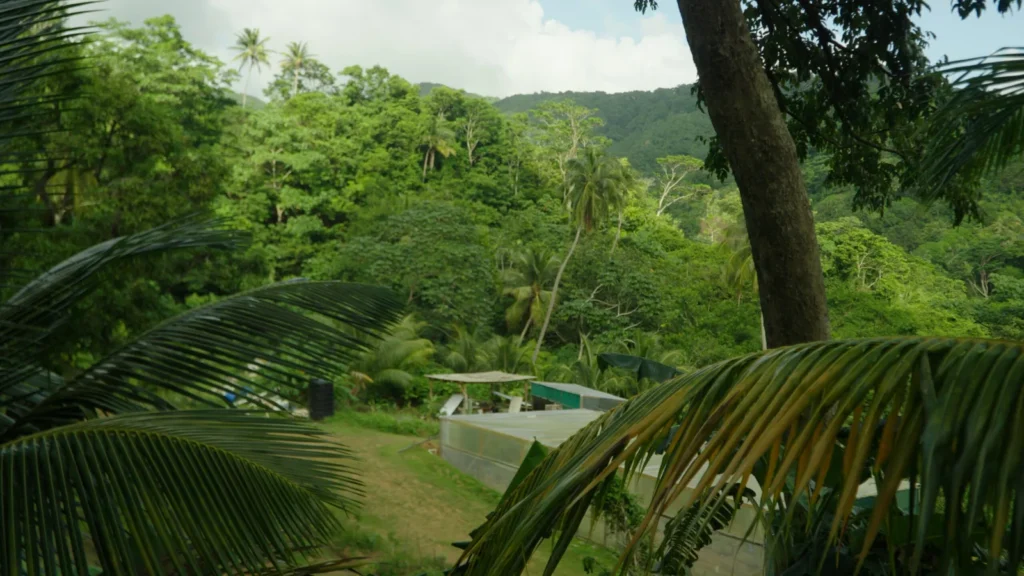
Caribbean islands get their fresh water from rain gathered in ponds and dams, from ground water pulled up through wells, and from the sea, desalinated by reverse osmosis. That is exactly how Antigua’s own utility describes its supply (APUA).
APUA says it uses rain and ground water as much as it can, because they are cheap. Antigua is drought prone, so the island leans on reverse osmosis, which APUA itself calls “a costly venture which requires a large amount of electricity.” Antigua needs about 7 million imperial gallons of water a day. In January 2026 a new plant at Barnacle Point added 2 million gallons a day of desalinated water on its own (Seven Seas Water Group and APUA).
Barbados is drier still. The World Bank calls it one of the most water scarce countries in the world. It takes 86 percent of its water from the ground, is already pulling out nearly as much as can be safely removed each year, and loses about half of everything it produces to leaking pipes, faulty meters and billing gaps (World Bank, May 2026).
St. Lucia has the opposite problem on paper. Up to 4,000 mm of rain falls on its interior rainforest every year (Government of St. Lucia). Yet WASCO, the water company, says the island is 100 percent dependent on rainfall and loses about 47 percent of the water it treats to leaks (St. Lucia Chamber of Commerce, April 2026). In June 2026 Soufrière was on rationed supply (Office of the Prime Minister).
So the rain is there. The pipes are not. And on St. Lucia the farms upstream have been spraying for decades. I laid out the lab numbers on the tap water in my guide to the best wellness retreat in St. Lucia, and they are worth reading before you fill a glass anywhere on that island.
Why does desalination matter when you choose a hotel? Every glass is made with electricity
Desalination matters because seawater reverse osmosis uses about 2.5 to 4 kilowatt hours of electricity for every cubic metre of fresh water, and a working plant uses closer to 3.5 to 4.5 once the pumping and treatment are added (Kim and colleagues, Applied Energy, 2019).
On most islands that electricity comes from imported diesel. So a long shower can burn oil twice, once to make the water and once to heat it. I go through the diesel side, island by island, in the solar powered eco stays in the Caribbean.
Then there is what comes out the other end. Desalination plants around the world discharge about 142 million cubic metres of brine a day, roughly one and a half litres for every litre of fresh water they make (Jones and colleagues, Science of the Total Environment, 2019). Brine is saltier and denser than the sea, so it sinks, and the worry is for the life on the seabed around the pipe. On an island that lives off its reef, that is not an abstract worry.
None of this means you should refuse desalinated water. On a dry island it keeps people alive. It means you should value the stays that do not need it. Rain caught where it falls. A river taken at its source. Water used twice before it leaves.
One rule I hold every stay to. A natural water source means their own river, spring, well or mountain source. A filter fitted to the public supply is not a natural source. It is the public supply with a filter on it.
How are the water saving eco stays in the Caribbean rated?
Mount Kailash in St. Lucia is the highest rated water saving eco stay in the Caribbean, with the highest Throne Standard on this list, 4.8/5. The Throne Standard is our independent eco score out of five, shown next to Google and TripAdvisor. Pending means we do not yet hold enough dated, cited evidence to score the stay, which is not proof of poor performance. I checked these on 3 November 2026, from the My Ideal World listings and the review sites.
| Stay | Island | Throne Standard | Google rating | TripAdvisor rating |
|---|---|---|---|---|
| Mount Kailash | St. Lucia | 4.8/5 | 4.9 (16) | No listing yet |
| Lamblion Apartments | Antigua | 2.8/5 | 4.6 (49) | Not verified |
| Balenbouche Estate | St. Lucia | 3.3/5 | 4.9 (68) | 4.7 (166) |
| Frangipani Eco Lodge | Barbuda | 2.4/5 | 4.9 (19) | Not verified |
| Cooper Island Beach Club | British Virgin Islands | Pending | 4.6 (370) | Not verified |
| Coulibri Ridge | Dominica | Pending | 4.9 (35) | 5.0 (20) |
| Camp Cabarita | Jamaica | Pending | 4.8 (34) | Not verified |
| Small Hope Bay Lodge | Andros, Bahamas | Pending | 4.8 (142) | Travellers’ Choice, 828 reviews |
| Rosalie Bay Eco Resort | Dominica | Pending | 4.5 (175) | 4.0 |
Where does the water come from at each Caribbean eco stay?
Only two of these nine Caribbean eco stays name their own natural water source, Mount Kailash with its river and Frangipani with its own well, and five of them catch the rain. The rest either use the public supply, make water from the sea, or do not say.
✓ means they clearly do it. ◐ means partly. ✗ means they don’t. ○ means they don’t say. With water, silence is an answer too. Every symbol links to its source, so tap it and read it for yourself.
| Stay | Own river, spring or well | Catches rain | Desalination or reverse osmosis | No chlorine in the water you bathe in |
|---|---|---|---|---|
| Mount Kailash | ✓ | ✓ | ✗ | ✓ |
| Frangipani Eco Lodge | ✓ | ✓ | ○ | ○ |
| Lamblion Apartments | ○ | ✓ | ○ | ○ |
| Cooper Island Beach Club | ○ | ○ | ✓ | ○ |
| Coulibri Ridge | ○ | ✓ | ○ | ✓ |
| Camp Cabarita | ◐ | ✓ | ○ | ○ |
| Small Hope Bay Lodge | ○ | ○ | ◐ | ○ |
| Rosalie Bay Eco Resort | ○ | ○ | ○ | ○ |
| Balenbouche Estate | ○ | ○ | ○ | ○ |
How does each Caribbean eco stay save and reuse its water?
Lamblion Apartments in Antigua does the most to save and reuse water of the nine, with wastewater recycling, solar hot water, low flow taps and showerheads, and signs asking guests to conserve. Cooper Island reuses its wastewater on the garden.
| Stay | Reuses greywater or wastewater | Solar hot water | Low flow taps and showers | Asks guests to save water |
|---|---|---|---|---|
| Mount Kailash | ○ | ○ | ○ | ○ |
| Frangipani Eco Lodge | ○ | ○ | ○ | ○ |
| Lamblion Apartments | ✓ | ✓ | ✓ | ✓ |
| Cooper Island Beach Club | ✓ | ○ | ○ | ○ |
| Coulibri Ridge | ○ | ○ | ○ | ○ |
| Camp Cabarita | ○ | ○ | ○ | ○ |
| Small Hope Bay Lodge | ○ | ✓ | ○ | ○ |
| Rosalie Bay Eco Resort | ○ | ○ | ○ | ○ |
| Balenbouche Estate | ○ | ✓ | ○ | ✓ |
Mount Kailash in St. Lucia takes every drop from a river at its source and the rain
Mount Kailash Rejuvenation Centre takes all of its water from the river that rises on its own mountain and from harvested rain, with no connection to St. Lucia’s public supply. It sits on a secluded peak past Marc, toward the centre of the island, above the farms (National Geographic).
That position is everything. The river starts here, so there is nothing upstream to spray it, nothing to drain into it and nothing to treat with chlorine. Two ponds and three baths are fed straight from the source. When I was there, the team was building a new bath beside it.
Lower down, the same rivers run through old banana country. Researchers found the weedkiller paraquat in St. Lucia’s lowland rivers in the 1990s, and the same review found the effects insignificant in the upper reaches (the 2002 review for the UK Department for International Development). Mount Kailash is in the upper reaches.
The power is off grid solar too, which I grade in the solar list. Mount Kailash holds a 4.8/5 Throne Standard, the highest on this page. The food, the bush tea and the healing are all in my Mount Kailash wellness retreat guide, and the island by area is in where to stay in St. Lucia.
Frangipani Eco Lodge in Barbuda catches the rain and pumps it with a petrol generator
Frangipani Eco Lodge on Barbuda’s Atlantic coast catches rain off its roofs, has its own well, and lifts its water with a pump run on a petrol generator that a volunteer set up. Two young Barbudans who live on the island own it, and they started it after Hurricane Irma (Frangipani). They are the sisters Asha and Afiya Frank.

Standing over the tank, Afiya showed me how the whole thing works.
“So this system was set up by a volunteer,” she said. “And a bit worse for wear. Still a good old boy.”
Then the pump. “This is a water pump which is going to suck up the water. And eight, seven times out of ten it works. Okay. Three times out of ten it doesn’t. Okay. And then you just do it again.”
She filled the generator, turned the fuel on and warned me before she started it. “The gas is on. Now I’m going to put it… going to be really loud.”
I would rather hear that engine than read the word eco on a sign. The water at Frangipani is rain and well water, not desalinated sea, on an island where the public supply leans on reverse osmosis. That is the part they get right. The petrol pump is the part to fix, and a solar pump would close the gap.
The cabana’s rain spouting and the rest of the stay are in Two Sisters Made Frangipani a Place to Slow Down, and you can watch the Frangipani tour. For the island itself, see where to stay in Barbuda and a slow week on Barbuda. Frangipani scores 2.4/5 on the Throne Standard, Developing, and that is fair. Check dates at Frangipani if you want to try living on the tank for a week.
Lamblion Apartments in Antigua meets most of its water needs from rain and recycled wastewater
Lamblion Holiday Apartments in Antigua harvests, stores and recycles water to meet most of its own needs, and fits low flow taps and showerheads in its apartments (Lamblion). It is family owned and run by Lionel and Lorilyn Walker, a local Antiguan husband and wife (Visit Antigua and Barbuda).
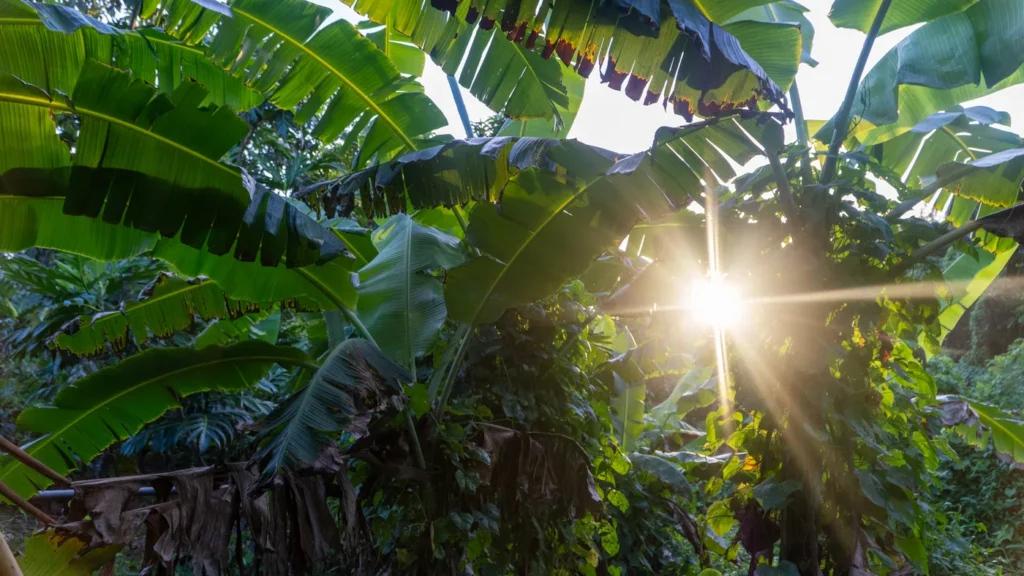
On Antigua that is no small thing. Every gallon the island has to make in a dry spell is made with electricity. Rain caught on Lionel’s roofs is rain Antigua does not have to make.
Walking the garden, Lionel compared this land with the house he and Lorilyn built in 1986. “Well, I don’t know if it’s fertile, but it gets a lot more rainfall than [there]. And the rainfall is everything for the plants to grow.”
I agreed, and he said it again. “Rainfall is everything.”
Lamblion also heats all its hot water with the sun and runs grid tied solar panels, which I grade in the solar list. What you can pick from that rain fed garden is in what you can pick at this Antigua garden stay, and the apartments themselves in Lamblion Apartments for a stay with a kitchen in Antigua. More of the island in where to stay in Antigua. Lamblion holds a 2.8/5 Throne Standard. See dates at Lamblion.
Cooper Island Beach Club makes its own water from the sea on solar power
Cooper Island Beach Club in the British Virgin Islands makes all of its own fresh water and electricity, says it is completely off the grid, and runs on more than 303 solar panels (Cooper Island Beach Club). Guests can tour the solar farm and the water desalination plant (Yacht Warriors).

This is desalination done the least harmful way I have found in the region. The electricity is sun, not diesel. And the wastewater does not go to waste. A bio reactor turns it into irrigation water so the resort can grow more of its own organic produce (Caribbean Journal, 2017). Food waste is collected by farmers to feed their livestock (Cooper Island Beach Club).
What they do not publish is where the brine goes. On a reef island, I would ask.
There is no public ferry. Overnight guests are collected from Road Harbour (JOMA) Marina in Road Town, Tortola, and the hotel is closed for the season from 25 July to 7 November 2026 (Cooper Island Beach Club). For the rest of the islands, see where to stay in the British Virgin Islands and the best nature stays in the BVI.
Coulibri Ridge in Dominica drinks the rain, purified with ultraviolet light and copper
Coulibri Ridge, a 14 suite eco resort on 285 acres near Soufrière in southern Dominica, collects its water mainly from the rain on its roofs, purifies it with ultraviolet light and copper ionisation, and feeds it to the suites and two chlorine free swimming pools (Luxury Travel Magazine).

Coulibri says it was planned from the start as a long term research project in how to build and run a resilient eco resort off the grid, down to “the ways of harvesting pure rainwater” (Coulibri Ridge).
A pool with no chlorine is rare in the Caribbean. If you swim to restore yourself, not just to cool off, it is a different experience, and I would take it over a sea view.
The power story is even stronger, sun and wind, and it is in the solar list. More of the island in where to stay in Dominica and the best off grid stays in Dominica. Check dates at Coulibri Ridge.
Camp Cabarita in Jamaica traps rain for its toilets, its dishes and drinking water for locals
Camp Cabarita, a rural eco lodge near Frome in Westmoreland, Jamaica, traps rain from its hard surfaces in onsite tanks, including a 400 gallon cistern, and uses it for flushing toilets, washing hands, doing dishes and as drinking water for locals (Camp Cabarita).

That last part is the one I like. The rain does not only serve the guests. It serves the neighbours. Camp Cabarita says catching it lowers the tap and river water it has to pump.
It also uses one biodegradable organic soap, Dr. Bronner’s, for shampoo, body wash and face wash, and says that using it in the river does not harm or disturb the river’s ecology. Every raw fruit and vegetable scrap is composted on site.
Solar is still a plan here, not a panel, and I grade that honestly in the solar list. For more of the island, see where to stay in Jamaica and the best farm to table stays in Jamaica. See dates at Camp Cabarita.
Small Hope Bay Lodge on Andros heats its water with the sun and filters what you drink
Small Hope Bay Lodge on Andros in the Bahamas heats all the hot water for its beachfront cabins, kitchen, lounge and hot tub with the sun (Scubaverse), and every cabin has a reverse osmosis water cooler for drinking water (Small Hope Bay Lodge).
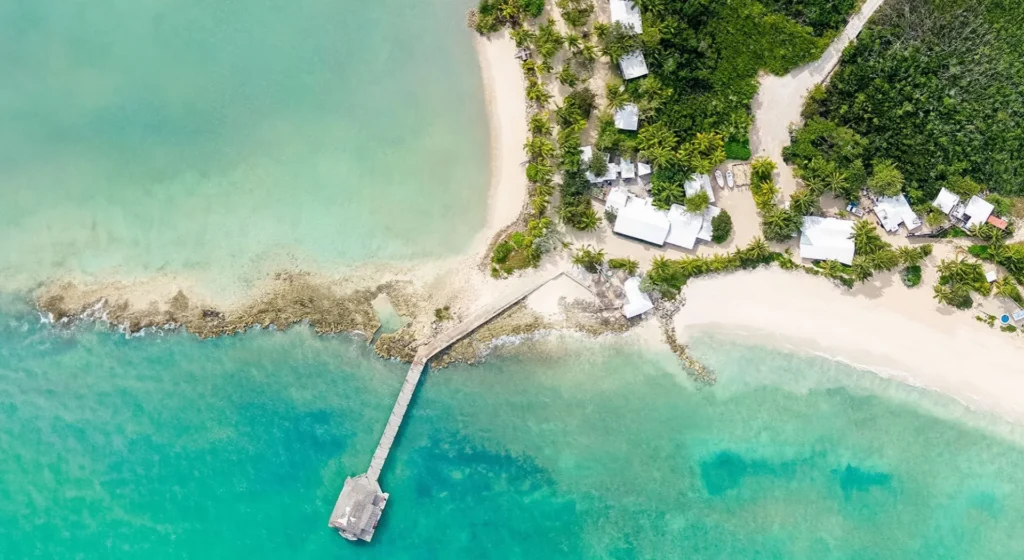
Heating water used to be about half of the lodge’s electricity, out of roughly 192,000 kilowatt hours a year, and all of that power came from diesel on the island (Duke University interns, 2013). Water heating was the biggest single load, so the sun took it.
The cabins were hand built in the 1960s from coral rock and hardy Andros pine (Small Hope Bay Lodge). What I cannot tell you is where the water itself comes from, because the lodge does not say. The coolers clean what you drink. That is good. It is not the same as a natural source.
More of the islands in where to stay in the Bahamas and the best nature stays in the Bahamas. Check dates at Small Hope Bay.
Rosalie Bay in Dominica runs on its river but does not say where your tap water comes from
Rosalie Bay Eco Resort & Spa on Dominica’s Atlantic coast makes all of its electricity from a micro hydro system on the Rosalie River and from solar panels, but it does not publish where its drinking water comes from (Rosalie Bay).

A river turning a turbine is water working without being used up. I love that. It is just a different question from what is in your glass, and on that the resort is silent.
The beach has strong rip currents and the resort says it is not suitable for swimming, so swim in the pool. Endangered sea turtles nest on that beach, and I cover the turtle season in the wildlife eco stays in the Caribbean. See dates at Rosalie Bay.
Balenbouche Estate in St. Lucia heats its water with the sun and asks every guest to save it
Balenbouche Estate, a family run heritage estate near Laborie in the south of St. Lucia, heats its water with solar, line dries its laundry, and reminds guests to conserve water and electricity and to use filtered water and reusable bottles (Balenbouche).

It does not say where the water comes from. On an island where WASCO reported river flows falling as the dry season set in this January (WASCO), a guest who turns the tap off is doing real work, and Balenbouche asks you to.
Balenbouche is the reason to stay in the south. The voices, the pottery and the estate are in where to stay in the south of St. Lucia, its history in the green heritage stays in the Caribbean, and it sits next to Fond Doux and Ladera in the best sustainable hotels in St. Lucia. Book Balenbouche direct with the family.
What should you ask a Caribbean hotel about its water before you book?
Ask a Caribbean hotel where its drinking water comes from, whether it is chlorinated, and what happens in a drought, because those three answers tell you more than any eco badge. These are the questions I send.
- Where does the water in my tap come from? Rain, a river, a well, the public supply or the sea?
- Is it treated with chlorine, ultraviolet light or something else?
- How big is your rain cistern, and what happens when it runs dry?
- If you desalinate, what powers the plant, and where does the brine go?
- Do you reuse greywater or wastewater, and on what?
- Is the pool chlorine, salt or natural?
If they cannot answer, that is an answer. Our free eco living checklist has the same questions for home.
Can you live on rainwater on holiday? For a week, it is a gift
Yes, you can live on rainwater on a Caribbean holiday, and at a stay like Frangipani or Coulibri Ridge you already are. One of you wrote this under one of my posts, and it stayed with me.
“This is why I’m just goin off grid and if the earth doesn’t supply it then I guess I just don’t have it”
That is the whole philosophy of a water saving stay in one line. You shower a little shorter because the tank is the tank. You notice when it rains. You start to feel what the island feels in a dry season.
And water carries where it has been. Rain off a roof and a river at its source reach you having touched sky, leaf and stone. Water pushed through a membrane on diesel power reaches you having touched an oil tanker. You can feel the difference in how you hold every glass.
If you want the full experience, the best off grid eco stays in the Caribbean and the best eco lodges in the Caribbean go further. The full list of sustainable hotels, eco lodges and resorts in the Caribbean puts every island side by side, and the best eco hotels in the Caribbean grades the hotels on everything. Still choosing the island? Start with where to stay in the Caribbean.
Your questions about water at Caribbean eco stays, answered
What is a water saving hotel?
A water saving hotel cuts how much water it takes from the island, by catching rain, using its own river or well, reusing wastewater and fitting low flow taps. The best ones also tell you where the water comes from. A towel card on its own is the bare minimum.
What is the best water saving eco stay in the Caribbean?
Mount Kailash Rejuvenation Centre in St. Lucia is the best water saving eco stay in the Caribbean. It takes every drop from a river at its source and from the rain, with no connection to the public supply, and holds a 4.8/5 Throne Standard.
How do Caribbean islands get fresh water?
Caribbean islands get fresh water from rain gathered in ponds and dams, ground water from wells, and seawater desalinated by reverse osmosis. Drier islands such as Antigua lean on desalination in droughts, and Barbados takes most of its water from the ground.
Can you drink the tap water in the Caribbean?
It depends on the island and on the stay, so ask the hotel where its water comes from and how it is treated. Many stays give guests filtered or reverse osmosis drinking water. Bring a reusable bottle either way.
Can you drink the tap water in St. Lucia?
Not reliably. Most of St. Lucia’s tap water is chlorinated water from lowland dams and rivers, the island loses about 47 percent of what it treats to leaks, and its lowland rivers have a history of pesticide contamination. Stay above the farms, or drink filtered water.
Is desalinated water safe to drink?
Water from a working reverse osmosis plant is clean enough to drink, which is why islands like Antigua rely on it in droughts. The cost sits elsewhere, in the electricity it takes and the brine that goes into the sea.
Is seawater desalination expensive?
Yes. Seawater reverse osmosis uses about 2.5 to 4 kilowatt hours of electricity for every cubic metre of water, and Antigua’s utility calls it a costly venture. On islands that burn diesel for power, that cost is fuel.
What is rainwater harvesting?
Rainwater harvesting means catching rain off roofs and hard surfaces and storing it in tanks or cisterns to use later. Lamblion in Antigua and Camp Cabarita in Jamaica both meet a large share of their needs this way.
Is rainwater safe to drink?
Rain caught off a roof should be filtered and disinfected before you drink it. Coulibri Ridge in Dominica purifies its rainwater with ultraviolet light and copper ionisation before it reaches the suites.
What is a cistern?
A cistern is a tank, often under or beside a building, that stores rainwater for the dry months. Camp Cabarita in Jamaica keeps a 400 gallon rainwater cistern.
What is greywater?
Greywater is the lightly used water from sinks, showers and laundry, which can be treated and used again on gardens. Cooper Island Beach Club turns its wastewater into irrigation water with a bio reactor.
Which Caribbean island has the least water?
Barbados is one of the most water scarce countries in the world, according to the World Bank. It takes 86 percent of its water from the ground and loses about half of what it produces before it reaches anyone.
Why do Caribbean islands run out of water when it rains so much?
Caribbean islands run short because rain falls in seasons, storage is limited and old pipes leak. St. Lucia loses about 47 percent of its treated water and Barbados about half, so a dry spell turns into rationing fast.
Do eco hotels use chlorine in their pools?
Chlorine is the standard pool treatment at most hotels, so ask before you book. Coulibri Ridge in Dominica runs two chlorine free pools on purified rainwater, and the baths at Mount Kailash in St. Lucia are fed straight from the river.
Are off grid eco stays comfortable?
Yes, if you know what to expect. At Frangipani in Barbuda the pump sometimes needs a second pull and the cabana has no mains electricity, and that is exactly why the stars look the way they do.
How can I save water on a Caribbean holiday?
Take short showers, reuse towels, skip the daily laundry, refill a bottle instead of buying plastic, and choose a stay that catches its own rain. In a dry season, ask the hotel if water is being rationed nearby and act like a neighbour.
My pick for water in the Caribbean is the stay that never needs the sea
My pick is Mount Kailash in St. Lucia. Its water rises on its own land, before a single farm, and nobody has to burn diesel to make it.
Then Lamblion, for doing the quiet work properly, rain, recycling and all. Then Frangipani, for being honest about a petrol pump that I hope is a solar one by next season.
A hotel that asks you to reuse your towel while it pumps desalinated water into an infinity pool is not saving water. It is saving laundry. Save the water at its source, or do not call it eco.