
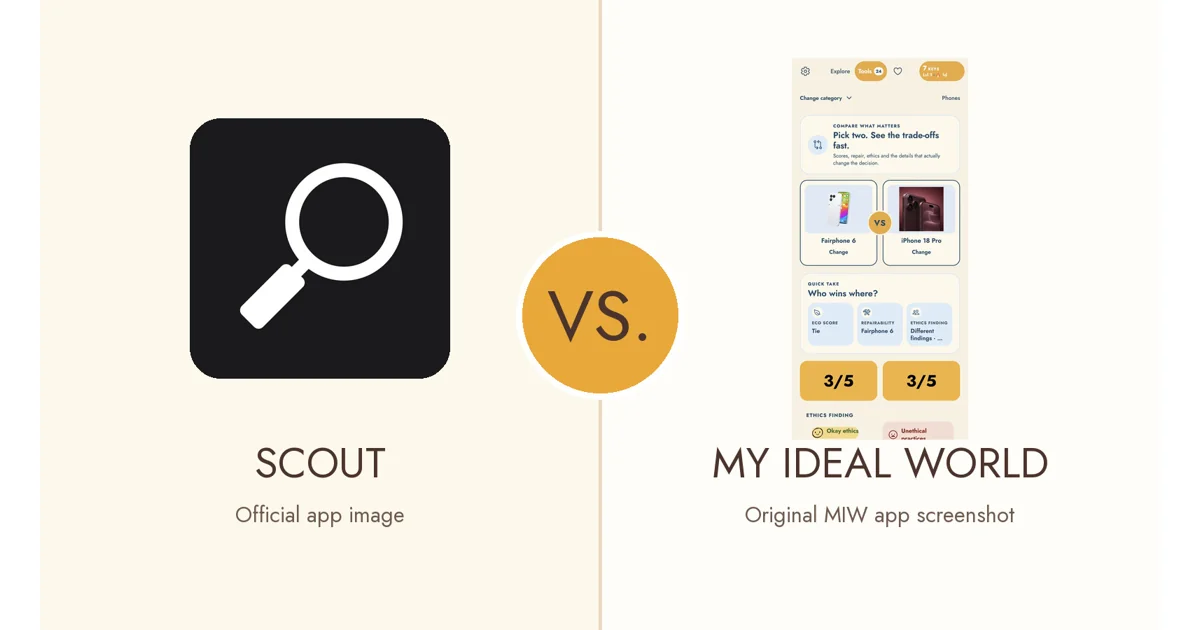
The best Scout alternatives depend on what you need to investigate. A food score, allergy match, cosmetics check and brand report serve different purposes.
A list of scanner names can hide that difference. Switching apps will not help if the replacement answers a question you were never asking.
This guide compares declared functions and the sources behind the results. I start with the product or ingredient question, then look at which service can provide useful information.
Availability, coverage and subscription terms can change. A larger database also does not guarantee that the exact formulation in your hand has a current record.
Choose the job first and the app second. Then use the links here to check the method before relying on a result.
The alternative depends on what disappointed you
If the problem is a subscription, check the current price and exactly what remains free. If the problem is the product database, test the same barcode across services. If you simply disagree with how an app weighs an ingredient, another app with a different policy is not automatically more accurate.
Tallow founder Maddox Schmidlkofer wrote a critical review of Scout in November 2026. He is selling a competing service. That commercial context matters, even where his documented screenshots raise questions worth investigating.
Scout itself says its paid tier is how customers access in app tools. I prefer a clear paid statement to a fake free experience. But I’d still like to see the data, its source date and what happens when a barcode is missing.
When you choose an alternative, don’t pick the biggest score. Pick the one that answers the question you actually have. Then hold the provider to its own stated method.
Why an alternative list can mislead before the first recommendation
Someone who dislikes Scout’s annual subscription might be delighted by a free Yuka scan. Someone whose child has a confirmed food allergy might need a personalised dietary tool instead.
A customer looking for a garment’s fibre composition will gain very little from either. Calling every one of these a direct alternative because it scans a barcode hides the part that matters.
Price, coverage, scope and evidence quality should therefore sit in separate columns. An app can have a million installs and a sparse catalogue for the small shops on a Caribbean island.
Another can have excellent coverage in France and little value in a rural American farm store. The installation number cannot tell you which one recognises the five products you actually buy.
Where an app says it uses laboratory tests, look for the original report rather than assuming the service collected every sample. Published results can come from a manufacturer, a university, an advocacy organisation or a laboratory commissioned by the app.
Funding and method matter. A source should not be hidden behind a generic ‘lab tested’ badge.
I am interested in what happens after the search. Can the reader correct the wrong variant?
Can they see the source date? Can they find the producer?
Do they return to the same evidence a week later? A tool that makes that process possible offers more than another green tick.
The five product test I would keep on my phone
Make the comparison practical. Take a packaged staple with an unambiguous barcode, a regional food product, a cosmetic with a complete ingredient list, an imported product and one item with a changed formulation.
Keep photographs of the actual labels and scan them in each app on the same day.
Record whether the tool finds the exact product, recognises its country, displays the current formulation and explains every warning. A missing result is one type of weakness.
An incorrect match is another. A very low score for a disclosed rule is something different again.
That small test is more useful than awarding trophies based on app store stars. I would rather have a service tell me that three of the five products are unknown than invent the contents of all five.
The same goes for our database. Unknown is an answer that can be improved.
False certainty travels much further.
What I would test before replacing any scanner
I would take the same five physical products and try each service on the same day. One should have an updated formula, another a regional variation, another a full cosmetic declaration. I would photograph the labels so the comparison could be checked later.
A missing product is a coverage issue. A low score under a disclosed purity criterion is a preference decision. A false claim about a laboratory result is an evidence issue. Our Yuka comparison and our Scout comparison deal with different parts of that problem. The best alternative is the one that answers the question you really have.
I wanted MIW to work across countries because the questions follow me when I travel. You can join My Ideal World here and examine the information beyond the first score.
Our score and why this subject is not rated as a product
HTT does not invent a numerical purity rating to fill a blank. A result needs an identifiable item, declared composition, supporting source, coverage and a versioned category rule. This comparison makes those distinctions visible.
| Subject | HTT score | Why | Relevant standard |
|---|---|---|---|
| Scout, Yuka, Fig, Bobby Approved and Tallow | Not rated in this article | None of these apps is a food, textile or cosmetic product. HTT does not assign them an ingredient-purity result. | Use actual products for exact SKU checks and compare each scanner’s rule and provenance independently. |
| My Ideal World | Source-backed reports only | Open a specific brand or product record to see its category, method version, source date and evidence status. | Explore and sign up |
What we deliberately do not score. We do not decide an app’s accuracy from its downloads, its founder or a competing app’s criticism. Missing or conflicting declarations stay unresolved. Check the Throne Standard 2.2 and the corrections process.
What the comparison actually shows
These are different kinds of evidence. Before choosing an app, distinguish a label-derived ingredient, a scoring rule, a measured quantity and a brand policy. The table names the limits rather than declaring an unsupported winner.
| Question | First tool or evidence | Important limit |
|---|---|---|
| Yuka | Rapid food and cosmetic ratings | Does not answer every supplier question |
| Fig | Food restrictions and personal dietary profile | A dietary match is not an ethics audit |
| Bobby Approved | Ingredient-rule shopping | Personal approval rules are not universal risk measurements |
| Good On You | Fashion brand people/planet/animals ratings | Not a direct chemical assay of each garment |
| My Ideal World | Composition plus deeper brand/place research | Current feature and evidence coverage must be checked |
How My Ideal World would score the brands, and what we refuse to score
Our score is a test against the Throne Standard, not a prize for whichever app has the most downloads. The relevant published standard is versioned, and category results must keep their own meaning.
An ingredient preference, laboratory result, animal-welfare policy and nutritional profile are not interchangeable evidence.
The live reports checked on 17 November 2026 show Picture at 1/5 and Gray Label at 3/5 under the report’s Throne Standard 3.0.0 composition assessment. Picture has 37.18% verified plant evidence across 971 complete declarations from 1,116 eligible products, with 39 missing declarations and 106 technical gaps.
Gray Label has 85.67% verified plant evidence across 305 complete declarations from 394 eligible products, with no missing declarations and 89 technical gaps. Coverage is 87.01% for Picture and 77.41% for Gray Label. Both reports describe these as provisional results with incomplete coverage, rather than final whole brand assessments.
These numbers demonstrate our composition method; they are not a head-to-head benchmark against Scout, Oasis, Tallow or Yuka.
| Brand checked in HTT | Current score | Why | Read the evidence |
|---|---|---|---|
| Picture, clothing | 1/5 | 37.18% verified plant evidence; 971 of 1,116 eligible declarations complete. Provisional result with 87.01% coverage. Checked 17 November 2026. | Picture report |
| Gray Label, clothing | 3/5 | 85.67% verified plant evidence; 305 of 394 eligible declarations complete. Provisional result with 77.41% coverage. Checked 17 November 2026. | Gray Label report |
| Coca-Cola, example raised in this comparison | Not verified in the accessible current HTT report | The ingredient declaration can be checked, but it does not establish a current HTT product score. | Awaiting exact report and version |
The Coca-Cola example is unscored here. Its ingredient declaration can support a description of the formula, but this article does not establish a current HTT product result.
We do not award or deduct purity points for downloads, App Store reviews, subscriptions, celebrity endorsements or online arguments. Nor is a composition score a calorie score, a personal medical risk score, a laboratory contaminant test or an automatic judgement on labour conditions.
The current Throne Standard makes different categories and assessment limits explicit. Where no current assessment exists, we say so rather than borrowing another scanner’s score.
Explore My Ideal World and sign up for the underlying research, rather than treating another app’s numerical score as our result.
Android and Apple downloads, what is actually public?
Android downloads are published by Google Play as rounded minimum thresholds; Apple does not publicly provide cumulative app downloads. The Apple figures below are marked undisclosed rather than guessed. These figures do not measure monthly active users, product-scanning accuracy or retention. Checked in November 2026.
| App | Android downloads | Apple iPhone downloads | Source or next step |
|---|---|---|---|
| Scout | 10K+ | Not publicly disclosed | Google Play installation threshold |
| Yuka | 10M+ | Not publicly disclosed | Google Play installation threshold |
| Tallow | 10K+ | Not publicly disclosed | Google Play installation threshold |
| Fig | 500K+ | Not publicly disclosed | Google Play installation threshold |
| Bobby Approved | 1M+ | Not publicly disclosed | Google Play installation threshold |
| My Ideal World (MIW) | Not publicly disclosed | Not publicly disclosed | Explore the app and sign up |
Google Play figures are lower-bound installation bands. Apple provides actual download statistics to each publisher through App Store Connect, not as a comparable public leaderboard. An App Store rating count is not a download count.
My Ideal World is listed last because it is our app, and no unverified install figures are claimed. Apple developer explanation of download reports.
The missing-barcode test
Most lists compare apps from their landing pages. A more useful test takes five real SKUs across a national brand, store brand, imported food, reformulated cosmetic and hard-to-identify item. Record coverage rather than assuming it.
Cost and country matter
An app that works with an American grocery barcode may not work well in a small island shop. Note operating system, free limits, market coverage and correction channels on the day of testing.
Why I need a different kind of tool when travelling
I may find a product but still need its producer, country of origin and environmental claims. My Ideal World belongs in this story where deeper evidence and continuity matter, not as a made-up equivalent to every specialist app.
Where the comparison can go wrong
A useful alternative to Scout should solve the problem that made you look elsewhere. If you need dietary restrictions, check that. If the price bothers you, compare the actual free tools. If the problem is missing source data, ask which competitor provides the ingredient record and correction date.
The alternative I would choose
Use Fig for a personal dietary restriction, a dedicated fashion source for working conditions and the app with the best dated formula record for the food in your hand. Use My Ideal World when you want composition and wider research in one place. A replacement app earns your trust by answering the question the first one left open.
There are two reasons to leave a scanner
One is practical: the product isn’t in the database, the subscription doesn’t fit your budget, or the result comes from the wrong formulation. The other is philosophical: the score puts weight on attributes you do not value, or fails to explain an evidence gap you care about.
A useful alternative article separates those reasons before offering a shortlist.
What public download figures can and cannot establish
Yuka reports 90 million users. Bobby Approved shows at least one million Android downloads and Fig shows at least 500,000, according to the public Google Play listings.
Scout’s Android footprint was around 30,000 in a third-party November snapshot, while Tallow’s Play listing displayed 10,000 or more downloads.
These are incompatible measures: one figure is total reported users, several are rounded Android installation thresholds and another is tracker-estimated installs. None measures which app gives the most accurate ingredient result.
A free scanner can still cost attention
Subscription objections dominate parts of Tallow’s November review of Scout, though its description of individual App Store reviews has not been independently audited here. More broadly, users need to know what remains free when they first download an app, whether cancellation is clear, what premium data adds and what happens if a barcode is missing.
A checkout screenshot checked on a specific date beats an outdated price comparison.
The strongest alternative isn’t necessarily another score
For an allergy, use the latest food packaging and a dietary tool that specifies the restriction. For a fashion brand, start with supplier practices and a dedicated brand-rating method.
For exact materials, inspect the tag and source. For a producer’s story or an eco stay, go to documentary reporting. MIW has a reason to exist when it helps connect these questions and retains the evidence rather than pretending they are interchangeable.
The problem of a missing or wrong product
A barcode database has to match the correct item to the correct packaging and country. A manufacturer may reformulate, alter the size or use different ingredients in another market.
A consumer who sees an old formula may think the scanner is lying when the original problem is the product identifier or update process. A useful tool should show which data came from the label, when it was imported, and how a shopper can submit a correction.
In a rigorous comparison, choose a small published sample before looking at any results: a national-brand food, a regional brand, an imported product, a cosmetic and a recently reformulated item.
Capture all five across Scout, Tallow, Yuka and MIW where the category is supported. Record not found separately from incorrect, and incorrect separately from a different scoring philosophy.
The contaminant issue cannot be solved by more colourful warnings
A scanner that displays laboratory data may have a powerful advantage over a system limited to product labels. But only if the report identifies which batch was tested, the analyte, unit and measurement conditions.
The result cannot automatically tell you the amount a person consumed. A lab panel may justify investigating a concern; the risk conclusion depends on how the number is used and what benchmark applies.
This is the distinction behind the Oasis and LMNT legal dispute. A concentration-per-kilogram report must not be treated as a per-serving dose. Even a perfect ingredient database won’t repair a unit conversion error. Users deserve to see a calculation rather than accept a sensational headline attached to a score.
Where My Ideal World belongs in the alternatives list
I built MIW for the person who wants to inspect composition and then keep investigating. A farmer’s claim about how food was grown, a garment’s fibre blend, a hotel’s water evidence and a brand’s supplier record are different types of information.
They deserve connected hubs, sourced reporting and a transparent, category-specific purity standard not one black-box number that pretends to speak for every ethical question.
I won’t claim MIW has more downloads, better independent accuracy or every feature that its competitors advertise unless we can demonstrate it. Readers can review what is currently available through the sign-up page.
If MIW lacks a record, that should appear as a gap. An honest new app can still compete by being clear about why it exists and letting readers inspect the evidence.
Further reading and primary sources
- Fig Google Play
- Good On You methodology
- Tallow published review
- Yuka press figures
- Scout methodology
- Yuka homepage
- Fig
Most ‘alternatives’ lists answer the wrong question
Someone looking for an alternative to Scout is not necessarily dissatisfied with its ingredient philosophy. They may need more products in their country, a free scan, access to the raw laboratory data, a personal allergy filter or information about a brand’s workers.
The search term doesn’t tell us which problem they have. A useful guide begins by separating those intentions.
This is where a small table of specific jobs is more helpful than a generic top-ten ranking. If the reader wants restaurants, food restrictions, cosmetics or brand ethics, a specialist service can be the best starting point even when it is less broad than Scout.
Yuka is a specialist with a stated scoring formula
Yuka’s food method weights nutrition, additives and recognised organic status. It is easy to understand why a person would use it for quick grocery comparisons. It does not mean a Yuka score reflects a raw ingredient-purity threshold or a company’s supply-chain history.
The company has reported a very large global user base, but adoption is separate from accuracy. If a consumer worries about a duplicated or outdated ingredient record, the relevant feature is how Yuka verifies and corrects the exact package.
Tallow’s philosophy is not a neutral laboratory truth
Tallow publishes comparisons in which its own preference-based criteria can give a product a very different score from Yuka or Oasis. In particular, the treatment of refined seed oils and laboratory findings reflects its chosen model. The founder has been open that he runs a competing scanner.
That disclosure lets readers assess the argument. A person sharing Tallow’s priorities might find it the most useful app. Another may disagree with the premise. The correct question is whether the app’s data and formula are accurately described, not whether every shopper adopts one nutritional worldview.
Fig is built around the person, not a universal food verdict
Fig allows users to create profiles for dietary restrictions and check whether an ingredient fits the selected needs. Its official site says it supports thousands of diets and restrictions and is presently available in the United States. The free version has a limited number of monthly scans, with additional functionality through its paid offering.
A traveller in Europe or the Caribbean should not be told it provides the same geographic coverage without verification. More importantly, someone with a serious allergy should follow current packaging and professional guidance rather than assume a scan guarantees safety.
Bobby Approved turns a familiar creator’s rules into shopping software
Bobby Approved allows people to scan food and find ingredient explanations based on Bobby Parrish’s criteria. The app’s Google Play presence exceeds a million Android downloads. Its US Apple page has a large number of user ratings, but those ratings are not iOS installation totals.
An approved label can be useful if you agree with the rules. It should not be described as independently proving that a product is healthier in every medically relevant way. The decisive question is which ingredient was flagged and why.
EWG is more than a cosmetics app
EWG Healthy Living brings together food, cleaning and personal-care datasets. Its own FAQ says those categories use different rating scales. A food grade and a personal-care hazard score are not the same measure, and neither should be casually compared with a Scout category score.
For a shopper worried about household cleaners or sunscreen, EWG may be the more relevant specialist tool. The good comparison tells the user exactly which product class is covered and links to the published method.
The financial terms change the experience
A service may be free to install but charge for unlimited scans, search filters or deeper history. Another may offer free public product pages but a different mobile subscription. Prices and free limits can vary by platform and region and change rapidly.
A trustworthy article should avoid pretending to know every current checkout price from an old screenshot. Instead explain the user’s free workflow, what prompts a payment and what source confirms the present offer. An undisclosed recurring charge can undermine the trust an app is asking for even when its data is accurate.
The ingredient and contaminant distinction changes the recommendation
An app reading a package’s ingredient list can help identify what the manufacturer declares. It cannot prove the concentration of a heavy metal in a particular batch. An app citing a laboratory assay may provide that kind of evidence for a tested sample, but only when the method, date and units are appropriate.
This is why the Oasis and LMNT litigation matters beyond the companies involved. A public number can become harmful when a measured concentration is incorrectly transformed into an exposure claim. A scanner alternative should be judged on its source traceability and correction process.
Which app should a travelling vegan actually choose
When the immediate problem is finding dinner, HappyCow is a specialist discovery service. When the problem is an unfamiliar packaged food, a dietary tool and the current ingredients label may be most useful.
When the question extends to growers, brand ownership or environmental practices, that is where the research in MIW becomes relevant.
No ethical guide should insist that one software product replaces all the others. Different questions demand different data. The reader should be allowed to move between tools rather than receive a false universal winner.
The honest verdict about Scout alternatives
Scout, Yuka, Fig, Bobby Approved, EWG and Tallow make different choices about the questions they answer. Their public download thresholds can indicate reach but not scientific validity. MIW is the app I built around my own composition-first standards and the research I want with me while travelling.
I would use the specialist app that solves the immediate task and open the broader evidence whenever the label is not enough. A comparative article earns a sign-up by being genuinely helpful first. It should never make an unsupported accuracy claim just to move a reader towards our product.
Look beyond the scan when choosing a Scout alternative
If your concern is ingredient recognition, look at the scanner app comparison. If it is a brand’s wider business practices, use the Brand Check, Greenwashing Checker or Who Profits From Your Purchase tools to form specific questions.
A scanner cannot prove every ethical issue from a barcode. Our ethical shopping apps guide separates product information from the evidence needed for broader company claims.
Use My Ideal World for the next question
Use the brand report to move beyond the scan when the underlying question is about the company or the producer. Take the evidence you can see, note the gap you cannot, and continue through the relevant brand or product research. Explore My Ideal World and create an account.
Continue the investigation. scout vs my ideal world · best brand scanner apps
On this story
Comments, questions and answers from signed-in paid members. The conversation will also be available in the app when it launches. Community contributions are not verified editorial findings.
Contribute evidence
Reviews share first-hand experience. Observations can include opinions and objections. Evidence is checked against its sources before publication. Community contributions do not change MIW scores.
Article discussions and evidence contributions are for paid members. They will also be available in the app when it launches.
Sign in to contribute or join the discussion Read this next
Best Food Scanner Apps in 2026 and What Their Scores Miss
Best food scanner apps in 2026 compared: Yuka, Scout, Oasis, Tallow and MIW. Learn which scores rely on labels, preferences or lab reports. See the evidence.Read the story Keep exploring
Best Apps for Scanning Food Labels in 2026 for Families
Best apps for scanning food labels in 2026: compare dietary restrictions, allergens, ingredients and freshness of product data for families. Check key limits.Read the story Keep exploring