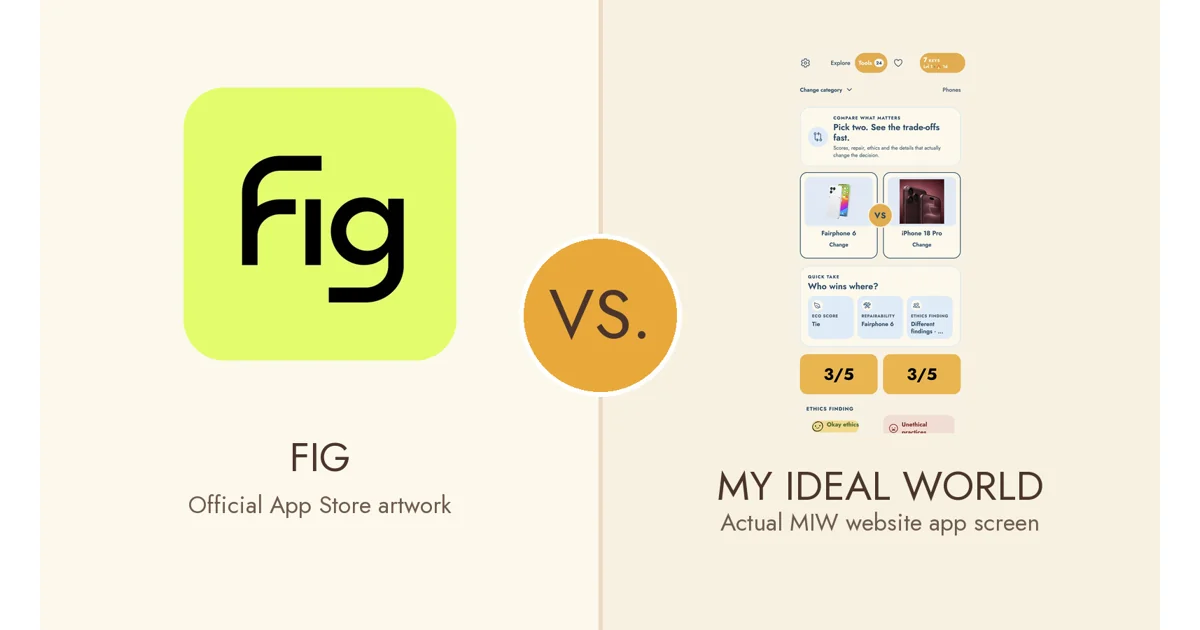
Fig vs My Ideal World depends on whether you need a dietary match or broader food research. Those are different jobs even when both begin with a product label.
A general green score cannot establish that a food suits an individual’s allergy. A plant based preference also needs a different answer from a medically necessary restriction.
I compare the information each service says it uses and the evidence a shopper can check. Product identity, a current ingredient declaration and the tool’s actual purpose come before an attractive result screen.
Barcode records can be incomplete or out of date. For an allergy or another clinical need, check the current pack and appropriate professional advice rather than relying on a general app comparison.
The useful result is knowing which tool fits the question and where you still need to check. This article keeps those boundaries visible.
Fig asks whose diet the food has to fit
Fig is built around personal dietary restrictions. That is very different from ranking every packaged food against one universal idea of healthy. It can be a useful secondary check for the person who knows exactly what they are avoiding.
But the current physical label takes priority. A brand can reformulate, a market can use different ingredients and a barcode database can be out of date. Where cross contact or an allergy matters, check the relevant warnings and seek qualified advice.
My Ideal World has its own place in this decision once food suitability has been addressed. The provenance of the ingredient, the farming method and the business behind the product are important questions. None of those should be hidden inside an allergy green light.
A dietary match is not a promise that a food is safe
Fig is designed for people with specific food restrictions, including people looking for vegan products and those managing ingredient concerns. That’s a specialised task.
A green result based on a personal profile should never be confused with an independent test of a finished food or an allergy guarantee.
Two people can scan the same product and receive legitimately different answers if their restrictions differ. A plant based shopper might need to verify the source of an emulsifier.
Someone with coeliac disease needs reliable gluten and cross contact information. Someone asking about the farming methods behind the cocoa has an entirely different question.
The recipe can change between markets. An imported food sold in the UK may not have the same formulation as a similarly branded product in the United States.
The original physical label and the manufacturer are the higher priority when a dietary restriction carries serious consequences.
An app that fails to recognise a product should say it doesn’t know. A food manufacturer that cannot confirm whether an ambiguous ingredient comes from an animal source should not be awarded a definitive vegan badge through guesswork.
Where the brand investigation begins
Once a food is suitable for the person eating it, I might still ask who grew it and what chemicals were used on the crop. An organic certification answers particular farming questions.
A vegan declaration answers a different set. A corporate report can describe labour policies.
None replaces the others.
That is where My Ideal World’s research belongs. We can investigate composition and sourcing without pretending to perform the same personal dietary risk check as Fig.
If you require an allergen free food, use the current packaging and appropriate professional guidance first.
There is nothing weak about admitting those boundaries. They are what allows a reader to trust a tool.
A purity standard is strict enough already without turning it into an imaginary medical screening programme.
Sesame shows why an allergy list must be treated differently
The FDA recognises nine major food allergens in the United States. Sesame became the ninth after the FASTER Act, and the change to labelling took effect in 2023.
That is an actual legal development with consequences for what somebody can expect to see on a package. It isn’t a personal preference about how processed a food should be.
The agency also explains that allergen cross contact can occur when ingredients are unintentionally introduced through shared equipment or other production conditions. An ingredient list alone may not answer every such question.
A scanner promising to settle allergy safety from a barcode would be making a claim far beyond a general dietary match.
This is why I won’t call My Ideal World’s purity result a substitute for Fig’s dietary features or the latest food label. Our brand research may be valuable after a product has been checked against someone’s dietary needs.
It must never create the impression that a 5/5 composition rating guarantees the absence of a medically significant allergen. The FDA explains the labelling and cross contact distinction.
The vegan decision doesn’t end when the ingredient is suitable
I eat plant based, and when I’m travelling I want to know which ingredients are present before asking the next questions. Is the product suitable for my dietary choices? That is not the same as asking whether the maker pays growers fairly or whether a nearby farm sells its own produce.
The distinction is visible in my Saint Lucia retreat report, where the food, people and land are part of the story. Our local food reporting in Martinique addresses another practical question. Fig does not have to solve those jobs to be useful in its own category.
Once the immediate dietary question is answered, My Ideal World is where I want the wider sourcing and brand evidence kept together. An allergy must still be checked through current labels and appropriate medical guidance.
What we would score and what we would not
The Throne Standard’s Food pack (version 1.0.0 under Standard 2.2) checks a complete, attributable ingredient declaration against explicitly named processing-marker preference rules. A missing, partial or unmatched declaration remains unresolved. This is a composition-preference assessment, not a laboratory health-and-safety verdict.
What we will not score as if it were composition. We do not turn processing markers into claims of poisoning, prove the presence of contaminants from a label, or grade an entire multinational’s labour conduct from one soft drink. Natural flavourings are not proof of purity or danger. We do not score an incomplete ingredient list as zero.
Read the standard version named in the individual report, together with its metric, evidence dates, eligible products and coverage. Category specific methods can answer different questions, and the live report may use a later version than an older explanatory page.
A missing or conflicting declaration is unresolved, not proof of a bad composition. Read the exact standard; challenge an incorrect record.
What the comparison actually shows
These are different kinds of evidence. Before choosing an app, distinguish a label-derived ingredient, a scoring rule, a measured quantity and a brand policy. The table names the limits rather than declaring an unsupported winner.
| Question | First tool or evidence | Important limit |
|---|---|---|
| Fig | Personalised food and dietary restrictions | Check exact label and potential cross-contact |
| My Ideal World | Composition, brands and connected research | Do not claim an allergy-safe certification |
| Packaging | Legally required ingredient and allergen declarations | Country regulations and recipes vary |
How My Ideal World would score the brands, and what we refuse to score
Our score is a test against the Throne Standard, not a prize for whichever app has the most downloads. The relevant published standard is versioned, and category results must keep their own meaning.
An ingredient preference, laboratory result, animal-welfare policy and nutritional profile are not interchangeable evidence.
The live reports checked on 17 November 2026 show Picture at 1/5 and Gray Label at 3/5 under the report’s Throne Standard 3.0.0 composition assessment. Picture has 37.18% verified plant evidence across 971 complete declarations from 1,116 eligible products, with 39 missing declarations and 106 technical gaps.
Gray Label has 85.67% verified plant evidence across 305 complete declarations from 394 eligible products, with no missing declarations and 89 technical gaps. Coverage is 87.01% for Picture and 77.41% for Gray Label. Both reports describe these as provisional results with incomplete coverage, rather than final whole brand assessments.
These numbers demonstrate our composition method; they are not a head-to-head benchmark against Scout, Oasis, Tallow or Yuka.
| Brand checked in HTT | Current score | Why | Read the evidence |
|---|---|---|---|
| Picture, clothing | 1/5 | 37.18% verified plant evidence; 971 of 1,116 eligible declarations complete. Provisional result with 87.01% coverage. Checked 17 November 2026. | Picture report |
| Gray Label, clothing | 3/5 | 85.67% verified plant evidence; 305 of 394 eligible declarations complete. Provisional result with 77.41% coverage. Checked 17 November 2026. | Gray Label report |
| Coca-Cola, example raised in this comparison | Not verified in the accessible current HTT report | The ingredient declaration can be checked, but it does not establish a current HTT product score. | Awaiting exact report and version |
The Coca-Cola example is unscored here. Its ingredient declaration can support a description of the formula, but this article does not establish a current HTT product result.
We do not award or deduct purity points for downloads, App Store reviews, subscriptions, celebrity endorsements or online arguments. Nor is a composition score a calorie score, a personal medical risk score, a laboratory contaminant test or an automatic judgement on labour conditions.
The current Throne Standard makes different categories and assessment limits explicit. Where no current assessment exists, we say so rather than borrowing another scanner’s score.
Explore My Ideal World and sign up for the underlying research, rather than treating another app’s numerical score as our result.
Android and Apple downloads, what is actually public?
Android downloads are published by Google Play as rounded minimum thresholds; Apple does not publicly provide cumulative app downloads. The Apple figures below are marked undisclosed rather than guessed. These figures do not measure monthly active users, product-scanning accuracy or retention. Checked in November 2026.
| App | Android downloads | Apple iPhone downloads | Source or next step |
|---|---|---|---|
| Fig | 500K+ | Not publicly disclosed | Google Play installation threshold |
| My Ideal World (MIW) | Not publicly disclosed | Not publicly disclosed | Explore the app and sign up |
Google Play figures are lower-bound installation bands. Apple provides actual download statistics to each publisher through App Store Connect, not as a comparable public leaderboard. An App Store rating count is not a download count.
My Ideal World is listed last because it is our app, and no unverified install figures are claimed. Apple developer explanation of download reports.
The ingredient that does not answer its own origin
Some emulsifiers can be sourced from animal or plant fats. A chemical name on a label may not identify that origin. A tool should flag uncertainty, not manufacture a definitive vegan answer.
What a dietary profile can and cannot establish
Fig’s profile-based matching is a more relevant specialist use case than an overall ‘healthy food’ number. Verify the exact product, store and formulation.
Where the ethical question begins
After suitability, a reader may ask about labour practices, farming inputs, ownership and packaging. That is the MIW research angle, not an attempt to outcompete allergy software.
Where the comparison can go wrong
Start with the specific dietary restriction and the current package. A vegan ingredient question, an allergy warning and a brand’s environmental practices should appear as separate facts. A single green total cannot responsibly answer them all.
Dietary safety cannot be an app rivalry
Fig’s personalised dietary use case deserves to be judged on its own terms. My Ideal World’s brand and purity research cannot certify food for someone with an allergy. Check the current package first. The wider sourcing question can follow once the immediate safety concern is handled.
Fig has an actual specialist audience
Fig’s Google Play listing shows 500,000 or more Android downloads and describes support for many dietary restrictions, including vegan, gluten-free, low-FODMAP and allergy needs. Those are the publisher’s claims about coverage and Google’s installation threshold.
They are a better reason to consider Fig than claiming it is an ethical-shopping app in the same sense as MIW.
A dietary profile changes the meaning of a warning
Two people may scan the same cereal and need different answers. For someone with coeliac disease, the declared ingredients and contamination warnings are vital.
Someone avoiding animal-derived substances may need the source of an emulsifier. Someone examining organic cultivation or factory labour has a separate concern altogether. A general red or green score cannot settle all three.
The country and recipe problem
A packaged product can have one ingredient list in the UK and another in the US. Manufacturers also reformulate without changing the headline brand name.
A useful scanner must link data to the exact market and barcode, show a date and give the shopper a way to correct it. For serious allergies, the current packaging and qualified advice take priority.
Why dietary suitability and purity shouldn’t be conflated
A vegan sweet can be highly processed; an organic food can contain an ingredient unsuitable for someone’s allergy. Conversely, an animal-derived ingredient does not itself prove that a food is unsafe.
The reader deserves distinct fields rather than a score that mixes a dietary rule, a moral preference and a health warning.
What Fig reviews show about the cost and routine
A February 2026 Google Play reviewer complained that a one-week trial was too short to judge the service for a medical dietary need. Fig replied that grocery search and a limited number of scans remained available without paying and explained how to dismiss the upgrade screen.
Another user praised the community contribution system while noting performance and battery drain. These are specific experiences that show different sides of the product, not a representative quality survey.
A comparison should tell readers which features are free, which require Fig+, and what happens after the trial. It should also explain that subscription pricing can differ by platform and country. Someone scanning one product a month faces a different value calculation from a family managing several diets across dozens of purchases.
Why a brand investigation begins after the dietary decision
Once a product is suitable under the person’s restrictions, the next question can be broader. Was it grown organically under a valid scheme? Is the manufacturer open about its suppliers?
What does the ingredient composition look like against the reader’s own preferences? Can a farm or local producer be identified? These are reasonable questions, but they cannot override the original need for personal safety.
My Ideal World should help with these subsequent questions. It should never promise that a strict purity score is medical advice or a substitute for reading the current allergen label. If I publish a comparison that fails to say this, I would be repeating the same overconfidence that scanner critics are worried about.
A food-label test that shows where certainty stops
Choose a packaged dessert with an emulsifier of potentially variable origin, and another product with a clear major allergen declaration. Record both the label and the manufacturer response.
Check Fig’s user-configured dietary result, then look at MIW’s composition information if the item is covered. One result may be definite about a listed allergen while another remains unknown about the origin of a derivative.
Publish those differences without forcing a winner. If a database is outdated, correct the entry. If a company does not disclose a supply source, report that gap, not an invented explanation. The reader should finish knowing which tool to use for each decision and which questions still require a human answer.
Vegan ingredient research and healthy eating are different questions
Checking whether an ingredient may be animal-derived is not the same as calculating a meal’s nutritional value or proving a product was made without animal testing. The ingredient scanner guide explains why the precise wording matters, while our local food apps comparison covers finding places to eat and buy food.
For declarations and unclear ingredients, My Ideal World’s Food Label Decoder and Ingredient Decoder can support research. Treat unresolved terms as questions to investigate, not automatic proof of an ingredient’s origin.
Further reading and primary sources
Use My Ideal World for the next question
Keep product sourcing and plant-based research connected after checking the immediate dietary need. Take the evidence you can see, note the gap you cannot, and continue through the relevant brand or product research. Explore My Ideal World and create an account.
Continue the investigation. best apps for vegans · how to check if a brand tests on animals
On this story
Comments, questions and answers from signed-in readers. Community contributions are not verified editorial findings.
Contribute evidence
Reviews share first-hand experience. Observations can include opinions and objections. Evidence is checked against its sources before publication. Community contributions do not change MIW scores.
More long reads