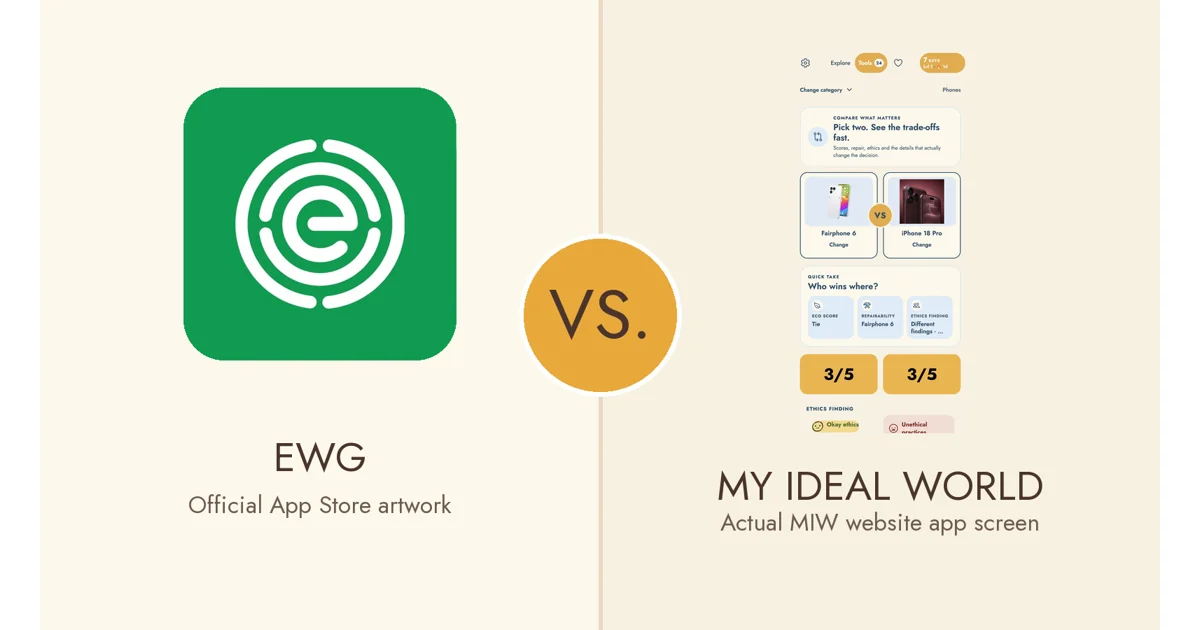
EWG Healthy Living vs My Ideal World is a comparison of methods, not a test of what is in your body. A hazard warning and an actual exposure answer different questions.
A bottle covered in green leaves can still irritate somebody. A warning associated with an ingredient does not by itself establish harm from a finished product used under its instructions.
The records to examine are the ingredient declaration, the scoring method and any relevant test of the actual product. I keep those separate throughout this comparison.
My Ideal World’s composition preferences are also judgements with a stated scope. They cannot supply a missing concentration or turn a label into a personal medical assessment.
Before choosing a product, ask what was measured and what was inferred. A useful app should make that distinction easier to follow.
What EWG can flag and what it cannot measure in your home
EWG publishes ingredient and product concern information. That’s a source to investigate. But a barcode does not measure the air in your bathroom, your skin’s reaction or the quantity inhaled during ordinary use.
The American Chemical Society’s review of ingredient scanners explains why different tools give different conclusions from similar inputs. A hazard classification is not a personal exposure reading, just as a natural origin is not an automatic certificate of safety.
I want a high standard for the things I use in my home. I also want an app honest enough to mark an unknown concentration as unknown. If the product has a safety data sheet, show the relevant warnings. If somebody wants to know the actual air quality, that’s a separate measurement.
The frightening ingredient name is not the finished product
EWG has helped make chemical information accessible to consumers. Its ratings can encourage someone to ask why a substance appears in a product.
That is useful. But a hazard assessment is not the same as measuring the exposure of somebody cleaning a bathroom or applying a cream.
The route matters. A substance taken by mouth, inhaled or applied to intact skin can have different exposure considerations.
The amount matters too. A database might not know exactly how much of an ingredient is used in the finished formula.
It certainly cannot infer the concentration in your home after a particular cleaning routine from a barcode.
Some people prefer ingredients of natural origin, as I do. That choice is not a scientific proof that every natural ingredient is harmless or that every synthetic ingredient is dangerous.
Essential oils, for example, can cause sensitisation in some people. The claim should be about the actual substance and use, not a romantic picture of a plant.
The American Chemical Society has highlighted how ingredient scanning algorithms produce differing ratings. That is why the underlying method belongs next to the score instead of being tucked away where only the most determined reader will find it.
A home needs measurements, not imagined certainty
Where should a home materials audit begin?
I would start with one room. Record the materials you can actually identify, photograph unknown labels and distinguish suspected risks from measured results. A microplastics in home checklist can guide questions, but it cannot measure what you personally breathe or ingest.
Use the Home Materials Audit and Forever Chemicals Checker for materials, while our separate Chemical Exposure map shows dated area-level records where available. Neither is a medical test.
If someone is worried about air quality in a hotel, they need information about ventilation and the actual indoor environment. A cleanser ingredient list cannot tell them whether the room contains mould spores or whether a drinking water source meets applicable standards.
A manufacturer’s safety data sheet can help explain proper handling of a cleaning product. It is not an air sampling report.
A hotel saying it uses natural cleaners isn’t evidence that every room has been tested for relevant contaminants.
I want our app to expose those gaps plainly. When the water analysis is absent, it is absent.
That is not proof the hotel is unhealthy. When an ingredient list contains a substance outside our purity preference, it fails that criterion.
It doesn’t transform the product into a confirmed exposure incident.
The EPA’s Safer Choice label answers a narrower, checkable question
The United States Environmental Protection Agency’s Safer Choice programme has a published standard for ingredients, product performance and other criteria. It is a useful example of what an actual defined assessment looks like.
A label is backed by requirements, not simply an influencer’s preference for ingredients that sound natural.
Even that programme cannot tell you the precise exposure someone receives when a particular cleaner is used in a poorly ventilated room. Ingredient criteria and indoor environmental conditions are different levels of evidence.
I think readers deserve to see those boundaries plainly. An EWG rating may identify a concern worth exploring.
A Safer Choice label may demonstrate that a product met the programme’s defined standard. Our purity criteria answer a different preference question.
None gives an app permission to diagnose somebody’s household as toxic from the product barcode. The EPA publishes the programme standard.
A clean room is something to investigate, not simply smell
When I assess a retreat, I do not want the marketing to tell me how healthy I should feel. I want to know who manages the water, what is grown for the kitchen and which documents actually exist. That’s the standard of questioning in my Saint Lucia wellness investigation.
An ingredient app can show why it dislikes a declared cleaning substance. It cannot tell a traveller what was in the air of one particular room without a relevant measurement. I would rather see a missing-data notice than a confident invented exposure claim. Our transparency principles should apply to our own assessments too.
Use My Ideal World to follow the supported product evidence. For an actual room or water-safety concern, ask the property for current testing records.
Beauty purity is not the same as toxicology
The Beauty pack (1.0.0 under Throne Standard 2.2) tests whether a complete INCI declaration passes the versioned purity-preference list. An unmatched term or incomplete list remains unresolved. It does not measure actual skin exposure or individual tolerability.
What we will not score as if it were composition. We do not call every synthetically produced substance toxic, every natural oil safe, or every fragrance a hazard at any exposure. No person’s skin condition or allergy is diagnosed by a purity score.
Read the standard version named in the individual report, together with its metric, evidence dates, eligible products and coverage. Category specific methods can answer different questions, and the live report may use a later version than an older explanatory page.
A missing or conflicting declaration is unresolved, not proof of a bad composition. Read the exact standard; challenge an incorrect record.
What the comparison actually shows
These are different kinds of evidence. Before choosing an app, distinguish a label-derived ingredient, a scoring rule, a measured quantity and a brand policy. The table names the limits rather than declaring an unsupported winner.
| Question | First tool or evidence | Important limit |
|---|---|---|
| EWG Healthy Living | Published ingredient/product concern methodology | Check score scope and timestamp |
| My Ideal World | Evidence-led product and brand context | Identify direct measurements vs label fields |
| Safety data sheet | Hazard and handling details for chemical products | Does not itself measure home exposure |
What our beauty purity score does, and what it cannot know
The current HTT beauty rule asks which fully assessed product ingredient lists meet its plant-and-mineral composition preference. The published method explains that qualifying plant material must be physically processed, and names particular isolates, polymers and other substances that do not pass.
A known ingredient gets a decision; an unidentified substance stays unresolved rather than being automatically classified as harmful.
One older HTT search snapshot showed Moroccan Beauty Secrets at 5/5, but the current public report did not expose a verified current assessment. We therefore cannot honestly publish that 5/5 as a present rating or invent the percentage of eligible products that pass. Check the live report and its assessment state.
We do not calculate the beauty purity score from how many people like the cream, whether someone had a reaction, an influencer’s recommendation, the brand’s follower count or a supposed universal toxicity ranking. Ingredient concentration, allergy, effectiveness and exposure would need different evidence.
Cruelty-free policy, animal ingredients, worker conditions and environmental impacts can be recorded separately but are not proved by a plant-composition result. Read the current beauty rule.
Explore My Ideal World and sign up for the underlying research, rather than treating another app’s numerical score as our result.
Android and Apple downloads, what is actually public?
Android downloads are published by Google Play as rounded minimum thresholds; Apple does not publicly provide cumulative app downloads. The Apple figures below are marked undisclosed rather than guessed. These figures do not measure monthly active users, product-scanning accuracy or retention. Checked in November 2026.
| App | Android downloads | Apple iPhone downloads | Source or next step |
|---|---|---|---|
| EWG Healthy Living | 1M+ | Not publicly disclosed | Google Play installation threshold |
| My Ideal World (MIW) | Not publicly disclosed | Not publicly disclosed | Explore the app and sign up |
Google Play figures are lower-bound installation bands. Apple provides actual download statistics to each publisher through App Store Connect, not as a comparable public leaderboard. An App Store rating count is not a download count.
My Ideal World is listed last because it is our app, and no unverified install figures are claimed. Apple developer explanation of download reports.
Why the chemical name is not the verdict
Water, vinegar, essential oils and synthetic compounds all have chemical properties. Natural and synthetic are descriptions of origin, not universal safety rankings.
The concentration question
A cleaning product may list a substance without a public percentage. Claims about what the diluted household use means need appropriate evidence.
The environment around the product
For me, filming a wellness stay brings the conversation from cleaning products to ventilation, food, water and environmental exposure. Keep those as separate questions rather than blending them into a single toxicity claim.
Where the comparison can go wrong
Choose one cleaning product with an ingredient declaration and a real safety data sheet. Compare what each app says with the actual source. A risk classification, a natural-origin preference and a measured exposure are three different things.
A bottle is not a room air test
EWG can help identify a substance worth researching. My Ideal World’s formulation preferences can tell you whether a category rule is met. Neither barcode measures a person’s actual exposure in their home. I want the app to admit that before a consumer treats either score like a diagnosis.
EWG and MIW begin from different questions
EWG’s consumer product tools examine ingredients using a hazard-information framework. MIW’s stated centre is purity of composition against explicit category criteria. A chemical concern score and a natural-material threshold do not measure the same thing. The key is to tell the reader which question they are answering before showing either number.
What the American Chemical Society found
A 2026 ACS review examined ingredient scanning services, including EWG Healthy Living, Yuka and Think Dirty. It explained that algorithms draw on different hazard data and weight categories differently, so the same formulation can receive varying results.
That variability matters because consumers naturally read the colour as an objective safety fact. More transparency is needed around scoring choices.
Hazard, risk and personal exposure
A substance’s potential hazard is not the same as the exposure someone gets from an ordinary application. Quantity, frequency, route, formulation and individual sensitivity change the interpretation.
The word natural does not eliminate chemistry, and synthetic does not establish harm. A purity preference can coexist with correct toxicological reasoning if the article keeps them distinct.
A meaningful household test
Use one real cleaner with an accessible label and safety data sheet. Identify the actual ingredient, hazard classification and use instructions, then look at what each app displays.
If no concentration or exposure measurement exists, say so. Do not call a bathroom unsafe from a barcode result; environmental measurements require a different method.
Why different scanners disagree even with the same ingredients
A 2026 American Chemical Society discussion of consumer ingredient scanning services notes that the tools use different databases and weighting rules. That is what shoppers see when one service warns about a product and another gives it an acceptable result.
Before deciding one must be lying, check whether the services are rating hazard, nutritional attributes, processing, packaging, personal restrictions or material origin.
If they are answering different questions, a different score is expected. If they claim to evaluate the same ingredient from the same evidence but report different amounts or product identities, there may be a factual error. An investigation should test that distinction directly instead of comparing large icons and guessing which developer is more honest.
A meaningful cleaner comparison
Find a household cleaner whose ingredient disclosure and safety data sheet are publicly available. Record the precise product variant and market.
Look at the substances identified by EWG and the handling instructions published by the maker. If MIW evaluates the product, check what its composition-purity score includes and where its source data came from.
The two evaluations may differ without either one being a direct exposure measurement.
A safety data sheet is not a sample of the air in a bedroom. If the article discusses indoor-air contamination, it should explain what environmental testing would be needed and avoid pretending it has already been done. An app can guide an investigation; it should not manufacture a diagnosis of a home.
The right promise from MIW
My Ideal World is guided by the composition standard I personally choose. That can make it strict. It is supposed to make ingredients and materials more visible, not to declare a stranger’s home unsafe or a business owner dishonest.
A cleaner with a low purity rating may perform well and comply with applicable standards. A product that passes the purity rule might still irritate someone. Separate those facts in the actual report.
A brand can challenge a wrong product mapping or outdated formula. A reader can inspect what the score does and does not represent. If the publication ever confuses a proprietary criterion with a laboratory finding, the correction should be easy to find. That is how a new scanner earns trust without pretending to be a universal authority.
How is a chemical exposure tool different from a product scanner?
A product scanner can read a disclosed ingredient list, while the Chemical Exposure tool looks at reported environmental measurements for an area, retaining source dates. Those are different datasets and different questions.
If you are trying to reduce unnecessary uncertainty around products in your home, our lower-toxicity home app comparison and Think Dirty alternatives guide show how to question claims without calling every unfamiliar ingredient dangerous.
Further reading and primary sources
- EWG Healthy Living Google Play
- EPA Safer Choice
- ACS ingredient scanner discussion
- EWG Skin Deep
- EPA indoor air guidance
Use My Ideal World for the next question
Keep ingredient and source evidence visible, then navigate to the relevant home or accommodation research. Take the evidence you can see, note the gap you cannot, and continue through the relevant brand or product research. Explore My Ideal World and create an account.
Continue the investigation. apps for low toxicity home · eco hotel health water pesticides checklist
On this story
Comments, questions and answers from signed-in readers. Community contributions are not verified editorial findings.
Contribute evidence
Reviews share first-hand experience. Observations can include opinions and objections. Evidence is checked against its sources before publication. Community contributions do not change MIW scores.
More long reads