
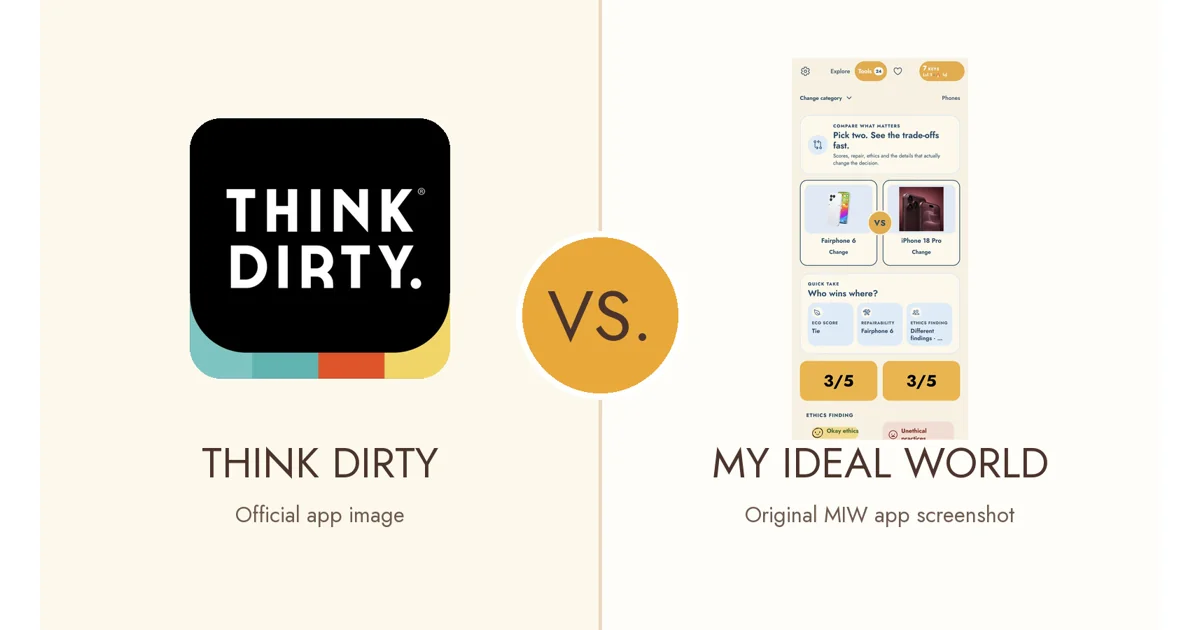
Think Dirty alternatives make sense when you know what you need from a skincare ingredient check. An ingredient name, a hazard classification and a finished product test are different evidence.
A red result does not tell you the concentration you applied or whether the product caused a problem for you. A natural label cannot establish personal suitability either.
The useful comparison follows the ingredient declaration, the service’s method and any source attached to the warning. I look for those records rather than comparing colours alone.
Formulas and product records can change, and an app cannot diagnose a skin reaction. Keep the exact pack and seek appropriate care when a symptom needs assessment.
Use this guide to find the tool that explains the question you have. The source and the limits should remain visible beside the answer.
Why a dirty meter can turn into a scare machine
Think Dirty, Yuka, EWG and other ingredient tools don’t all calculate the same question. An ingredient appearing in a database is not evidence of the dose somebody received, and an INCI declaration usually doesn’t supply the concentration of every component.
The American Chemical Society has written about the limitations of consumer ingredient scoring tools. Different algorithms and databases can produce different ratings. That isn’t permission to dismiss every warning. It is the reason to examine the source and the exact statement behind the number.
I am strict about what I want to use on my body. That is a personal composition standard. It does not give me the right to publish a medical claim I cannot prove, especially about a cosmetic used by thousands of people with different skin and sensitivities.
The ACS analysis is worth reading before you uninstall one scanner because another gave the same moisturiser a better score.
The word dirty hides a very important distinction
Can a skin-safe ingredients checker guarantee that a cream is safe?
No. It can help decode an INCI ingredient list and identify substances you want to research, but not diagnose a skin reaction or establish the safety of every formulation for every person. Concentration, combination and individual sensitivity matter.
Use the Skin-Safe Check and Ingredient Decoder for product research. For symptoms or known allergies, check the actual label and speak with an appropriate clinician.
Think Dirty popularised the idea that a cosmetic’s ingredient list can be reduced to a concern rating. For somebody who wants to examine a formulation instead of trusting a fragrance advert, that is a useful beginning.
The danger is assuming the label itself tells you the exact dose delivered to the skin, the conditions of use or the response of a particular person.
The INCI naming system standardises ingredient names. It does not ordinarily disclose the full quantity of each ingredient.
Two moisturisers can contain a similarly named preservative while using different concentrations and formulations. A scanner that treats the ingredient name as a complete exposure measurement is going further than its evidence permits.
People discussing clean beauty online report scores that don’t match their own experience using a product. A good experience doesn’t prove a product universally safe, and a red icon doesn’t prove the person has been harmed.
Both observations can be true. The serious question is what the app actually measured or inferred.
The American Chemical Society’s published analysis of consumer ingredient scanning notes the differences between scoring systems. That matters when a brand is publicly called toxic because one app dislikes a listed ingredient.
We need the classification, the evidence and the scope before making a statement with that kind of consequence.
Where I draw the line on beauty purity
For the wider question of scanner evidence, see the Yuka comparison. Food scores, cosmetic ingredient references and actual exposure measurements cannot be treated as though they answer the same question.
I prefer a formulation with a clear, complete declaration and ingredients that meet my category standard. That is a preference about composition.
It does not give me permission to tell every consumer that their skin is being damaged by a product I have not tested.
A good beauty investigation asks for the full INCI list, verifies the variant and market, examines the manufacturer’s claims and distinguishes animal testing, labour and packaging from the ingredients themselves. If there is no actual concentration data, we say that.
If a person has repeated irritation, an app is not a substitute for a qualified clinician.
The most interesting part of this story may be the brand that presents itself as natural while the ingredient panel or sourcing record tells a more complicated story. Find the exact inconsistency and publish it.
A headline about an entire cosmetic category being poison would be easier to write. It would also be a worse investigation.
Why the bathroom shelf matters as much as the beauty rating
I am strict about the formulations I use, but I will not say that an app has measured what somebody absorbed through their skin when it has only read an INCI list. If I’m investigating a beauty brand, I want to know the specific product and its full declaration before making a claim that may affect the people behind it.
That is also how I approach a wellness stay. In my Saint Lucia reporting, food, water and the conditions surrounding a guest mattered more than the brochure. A hotel cleaner, a face cream and a room-air measurement are related to how we live, but they are not the same test. The EWG comparison explains that distinction in more detail.
If you want the composition criteria rather than a universal claim of safety, start with My Ideal World.
Beauty purity is not the same as toxicology
The Beauty pack (1.0.0 under Throne Standard 2.2) tests whether a complete INCI declaration passes the versioned purity-preference list. An unmatched term or incomplete list remains unresolved. It does not measure actual skin exposure or individual tolerability.
What we will not score as if it were composition. We do not call every synthetically produced substance toxic, every natural oil safe, or every fragrance a hazard at any exposure. No person’s skin condition or allergy is diagnosed by a purity score.
Read the standard version named in the individual report, together with its metric, evidence dates, eligible products and coverage. Category specific methods can answer different questions, and the live report may use a later version than an older explanatory page.
A missing or conflicting declaration is unresolved, not proof of a bad composition. Read the exact standard; challenge an incorrect record.
What the comparison actually shows
These are different kinds of evidence. Before choosing an app, distinguish a label-derived ingredient, a scoring rule, a measured quantity and a brand policy. The table names the limits rather than declaring an unsupported winner.
| Question | First tool or evidence | Important limit |
|---|---|---|
| Think Dirty | Cosmetic ingredient-focused listings | Check its current evidence and scoring |
| INCI Beauty | Ingredient display and product scoring | Check country and products covered |
| SkinSort | Personalised skincare and comparisons | Not a labour audit |
| Yuka | Cosmetic and food scoring | Check cosmetics rule separately |
| My Ideal World | Link composition to broader brand research | Do not invent dermatological fit ratings |
What our beauty purity score does, and what it cannot know
The current HTT beauty rule asks which fully assessed product ingredient lists meet its plant-and-mineral composition preference. The published method explains that qualifying plant material must be physically processed, and names particular isolates, polymers and other substances that do not pass.
A known ingredient gets a decision; an unidentified substance stays unresolved rather than being automatically classified as harmful.
One older HTT search snapshot showed Moroccan Beauty Secrets at 5/5, but the current public report did not expose a verified current assessment. We therefore cannot honestly publish that 5/5 as a present rating or invent the percentage of eligible products that pass. Check the live report and its assessment state.
We do not calculate the beauty purity score from how many people like the cream, whether someone had a reaction, an influencer’s recommendation, the brand’s follower count or a supposed universal toxicity ranking. Ingredient concentration, allergy, effectiveness and exposure would need different evidence.
Cruelty-free policy, animal ingredients, worker conditions and environmental impacts can be recorded separately but are not proved by a plant-composition result. Read the current beauty rule.
Explore My Ideal World and sign up for the underlying research, rather than treating another app’s numerical score as our result.
Android and Apple downloads, what is actually public?
Android downloads are published by Google Play as rounded minimum thresholds; Apple does not publicly provide cumulative app downloads. The Apple figures below are marked undisclosed rather than guessed. These figures do not measure monthly active users, product-scanning accuracy or retention. Checked in November 2026.
| App | Android downloads | Apple iPhone downloads | Source or next step |
|---|---|---|---|
| Think Dirty | 1M+ | Not publicly disclosed | Google Play installation threshold |
| INCI Beauty | 5M+ | Not publicly disclosed | Google Play installation threshold |
| SkinSort | 50K+ | Not publicly disclosed | Google Play installation threshold |
| Yuka | 10M+ | Not publicly disclosed | Google Play installation threshold |
| EWG Healthy Living | 1M+ | Not publicly disclosed | Google Play installation threshold |
| My Ideal World (MIW) | Not publicly disclosed | Not publicly disclosed | Explore the app and sign up |
Google Play figures are lower-bound installation bands. Apple provides actual download statistics to each publisher through App Store Connect, not as a comparable public leaderboard. An App Store rating count is not a download count.
My Ideal World is listed last because it is our app, and no unverified install figures are claimed. Apple developer explanation of download reports.
The INCI trap
The International Nomenclature of Cosmetic Ingredients gives a standardised list of names, not necessarily quantities. Two formulations using a shared ingredient can perform differently.
What ‘non-toxic’ marketing misses
People may want to avoid an irritating product, animal testing or specific chemicals, but those are different goals. Readers should ask whether a scanner evaluates hazard, exposure or personal skin sensitivity.
A brand with a clean bottle can still hide wider questions
Compare public statements on packaging, suppliers and worker conditions instead of inferring brand ethics from a moisturiser.
Where the comparison can go wrong
Compare the same real cosmetic formula, including country and ingredient list. Then ask whether the score refers to an ingredient hazard, the finished formula or a personal health claim. A red rating is not evidence of an adverse reaction to that product in every user.
Keep the ingredient list, lose the panic
I will look at what a product contains. I will not call a finished cream dangerous merely because a database dislikes one ingredient. The meaningful next step is the formula, the dose where it is available, your own needs and the evidence behind the warning.
The science problem isn’t that consumers ask questions
The American Chemical Society published a 2026 analysis of consumer ingredient scanners explaining that EWG Healthy Living, Yuka and Think Dirty rely on different hazard databases and scoring algorithms. The same product may receive strikingly different ratings.
That is a more useful starting point than the common claim that every ingredient somebody dislikes is toxic.
An ingredient rating is not a dose measurement
If two serums include the same INCI-named ingredient but in different concentrations and formulations, a list-only comparison may not reflect their real-world exposure or performance. The ingredients panel also does not reveal every trade secret or treatment process.
A scanner should say which information it actually has. A consumer with a skin condition may need a dermatologist, not a stronger red warning.
What skincare communities complain about
In clean-beauty forums, people describe duplicate entries, outdated formulas, incomplete catalogues and difficulty understanding why a perfectly tolerated product receives a poor score. Others say a scanner is useful specifically because it draws attention to an ingredient they wish to research further.
These experiences are not a representative survey, but they reveal the practical problems a better product search and correction workflow must solve.
Choosing a replacement for Think Dirty
Think Dirty’s Dirty Meter is an ingredients-focused decision rule. Yuka’s cosmetic method allows the highest-risk ingredient to govern a score band. EWG uses a hazard-data approach.
MIW’s purity-centred category rules are a preference-based standard, not a medical safety score. A comparison table should show their assumptions, not pretend they have measured one objective thing.
INCI Beauty and SkinSort solve different problems
INCI Beauty says it assigns scores only where it knows a full product composition, and its Play listing displays five million-plus Android downloads. That rule about completeness is important.
An absent score can be the honest result when the information is incomplete. SkinSort emphasises product comparison and personal routines, with a smaller public Android band. Neither directly answers how the workers who manufactured the product were treated.
For someone with an established skincare routine, a product history and the ability to compare ingredient lists may be more useful than one absolute risk number. For someone investigating brand integrity, supplier transparency and composition purity are separate needs.
A strong article needs to explain what those tools can do rather than forcing them into a winner-takes-all table.
The natural-ingredient shortcut can become another marketing problem
I prefer products with simple, transparent composition where that is practical. But I also know the word natural is used loosely.
A plant extract may contain multiple compounds and may cause sensitivity. A chemically synthesised substance can have a well-understood safety profile. The origin of a substance does not, by itself, settle how people should use it.
If I give a formula a low purity score under my own strict material preference, that score must be labelled as such.
The right question is what a product claims, what the label reveals, what the scientific evidence says about relevant substances, and whether the manufacturer’s data is current. Do not let a strict personal philosophy drift into an unsupported statement that an ingredient causes disease. That sort of overreach is precisely what makes scanner disputes serious.
What I would actually do with two face creams
Pick two creams sold in the same country. Photograph each complete INCI panel and product identifier. Compare Think Dirty, INCI Beauty, SkinSort, Yuka and MIW only where they recognise that exact item.
In the table, keep separate columns for ingredient-list accuracy, scoring criteria, subscription access, last update and ability to correct a product. Do not invent a shared accuracy grade from five unrelated algorithms.
If one app lists a discontinued formula, point it out. If two disagree over a substance, read what each criterion actually says. If an ingredient has a public safety assessment, look at the exposure scenario rather than a scary-sounding name. That reporting would be valuable even if the final recommendation is that the reader should keep using their existing product.
Further reading and primary sources
- Think Dirty on Google Play
- INCI Beauty on Google Play
- SkinSort on Google Play
- Cleanbeauty scanner discussion
- EU cosmetic ingredient information
- FDA cosmetics ingredients
Users are arguing about the paywall as much as the ingredients
A scanner can have useful ingredient data and still lose trust through its business model. Think Dirty’s August 2026 Google Play review page includes criticism from a long-time user who felt the app had become difficult to use without paid access.
A June reviewer described more of the keyword and barcode experience appearing behind subscription prompts over time.
Think Dirty’s developer has responded that core scanning, searching and rating functions remain free. That answer matters. It means the accurate account is a disagreement about the practical usability and boundaries of free features, not a proven assertion that the entire scanner is paid.
The fairest test is to open the current app on a new account and record exactly what a shopper can do before a subscription prompt appears.
In a January 2025 natural-beauty Reddit discussion, users also discussed subscription expense, regional coverage and the difficulty of applying broad ingredient categories to specific formulations.
Again, those are concerns and experiences, not a clinical verdict. The most useful outcome is a clear table of what the free app shows, what needs payment and what the rating can actually establish.
There is a genuine alternative worth recognising: INCI Beauty’s Google Play listing reports over one million analysed products, a 0-to-20 rating approach, and 5 million or more Android downloads.
It says it rates only products for which full composition is known. That published condition is worth investigating because an app’s decision not to score an incomplete record can be as important as the score it shows.
Review the Think Dirty store page and developer responses, the Reddit conversation and INCI Beauty’s published information. Popularity and user frustration should be presented beside the method, not as substitutes for validating it.
The most useful question about a skincare app is not ‘which is cleanest?’
People have different skin needs, sensitivities, budgets and preferences about ingredients. A universal cosmetics hazard model may be useful for identifying questions, but it is not a diagnosis. A product that triggers irritation for one person may be tolerated by another, and a substance can have different risk implications at different concentrations.
The point of an alternatives guide is to explain which information each app provides: full ingredient list, possible functions, hazard evidence, personalised restrictions, product availability and corrections. The red or green circle comes after that.
Think Dirty’s appeal is immediate ingredient visibility
The app says its database covers hundreds of thousands of cosmetics and personal-care products in the United States and Canada. It shows ingredient information and a Dirty Meter score, with additional personalised filtering through premium features.
That is a concrete shopping task rather than a full scientific safety assessment of an individual’s routine.
Its Play listing shows more than one million Android downloads. This demonstrates substantial adoption but cannot be compared directly with an Apple ratings count or used as proof that every cosmetic classification is correct.
The subscription criticism needs the company’s reply
Some Google Play reviewers complained in 2026 that more of the search experience seemed to require payment. Think Dirty responded publicly that core scans, searches and ratings remained free, while explaining the importance of subscription revenue to the independent team.
Both statements matter. The user described their experience; the company clarified the official feature model. An independent review should test the current free account and document which interactions generate prompts, rather than turning a disagreement about convenience into an unsupported claim of deception.
INCI Beauty treats incomplete composition as a specific limitation
INCI Beauty’s Google Play page reports 1.3 million analysed products, an ingredient database and a rating scale out of twenty. It says only products with complete composition information receive a score.
That published rule is valuable because missing data is one of the hardest problems in an enormous consumer database.
A larger catalogue can still include incomplete or old records. The reviewer should examine whether the exact cosmetic formula is available and how the app handles corrections. The absence of a score can be the most scientifically honest answer.
SkinSort centres the user’s personal routine
SkinSort describes product comparisons, ingredient explanations, routine tracking and user preferences. That differs from presenting one broad hazard score as the final buying verdict. The software may be more relevant to someone exploring compatibility between products and documenting how their routine changes.
But routine-tracking features do not transform the app into a dermatologist, and the results are still dependent on the quality and currency of its ingredient records. The comparison should not claim medical outcomes it has not measured.
EWG’s method uses another set of rating scales
EWG Healthy Living’s FAQ distinguishes its food and household grades from the one-to-ten scoring used for personal care. That is not a cosmetic flaw; the methods evaluate different questions. It does mean a blogger cannot line up the numbers and pretend an 8 from one system is equivalent to 8 from another.
A careful article describes each model’s intended output before recommending a replacement. What matters is whether it gives the reader the specific evidence they need.
Why a fragrance declaration can confuse a barcode scan
A cosmetic label may group fragrance materials under an allowed umbrella declaration, depending on the jurisdiction and product. A scanner cannot identify every undisclosed fragrance constituent from that word alone. That creates a gap for a person managing a specific sensitivity.
An app should not invent the missing formula or guarantee that a product is free of a particular allergen. The appropriate next step may be the maker’s detailed disclosure or professional advice. Fear is not a useful substitute for a source.
What the skincare forums actually reveal
In clean-beauty discussions, users talk about old formulations, duplicate product entries, concern over a single ingredient dominating a score and uncertainty about whether a higher-rated product will suit their skin. These are genuine questions that should appear in a serious guide, but the comments are individual experiences rather than a representative survey.
The lesson is practical: show the reader how to identify the exact product, inspect the scoring rule and request a correction. An app that can explain its limitations may be more trustworthy than one that simply displays the strongest warning.
What should a skincare ingredient scanner actually check?
If you’re comparing the best apps for scanning skincare ingredients, start with the exact product formulation and the source of each warning. A name on a label is not, by itself, a measurement of exposure. Our EWG Healthy Living comparison explains how interpretation differs between tools.
The Ingredient Decoder, Skin-Safe Check and Chemical Exposure tools cover related but distinct questions. In particular, public pollution measurements should never be treated as a personal medical diagnosis.
A ‘natural’ formula can still contain a problem for someone
Plant extracts and essential oils may be attractive to a consumer who prefers natural composition, but that origin does not mean they cannot irritate or cause allergies. Similarly, a synthetic preservative is not automatically unsafe in the circumstances of use. Product formulation is complicated.
My Ideal World’s purity standard is a transparent expression of how I choose to live. It should never be confused with an individual medical safety assessment. A strict label has to carry a precise definition.
The alternative I would recommend depends on what you are trying to avoid
For a particular ingredient, start with a tool that lets you search or filter it and then check the actual INCI label. For product-function comparisons, a routine-focused service may help.
For a broad hazard-database perspective, read the methodology and remember concentration may be missing. For wider company and material questions, MIW’s brand research can add context.
That answer may not produce a single dramatic winner. It is more useful to someone standing in a shop trying to choose a product without being frightened into an unsupported conclusion.
Use My Ideal World for the next question
Inspect the formula and continue to the producer’s broader evidence if it affects your decision. Take the evidence you can see, note the gap you cannot, and continue through the relevant brand or product research. Explore My Ideal World and create an account.
Continue the investigation. how to check if a brand tests on animals · ewg healthy living vs my ideal world
On this story
Comments, questions and answers from signed-in readers. Community contributions are not verified editorial findings.
Contribute evidence
Reviews share first-hand experience. Observations can include opinions and objections. Evidence is checked against its sources before publication. Community contributions do not change MIW scores.
 Read this next
EWG Healthy Living vs My Ideal World
EWG vs MIW: compare ingredient concerns, purity standards and real-world exposure limits. What can a barcode scan actually tell you? See what evidence counts.Read the story Keep exploring
Best Sustainable Gift Apps for Christmas 2026
Plan sustainable Christmas gifts with apps that help you check claims, compare materials and avoid waste. Find a useful gift before buying another object.Read the story Keep exploring