
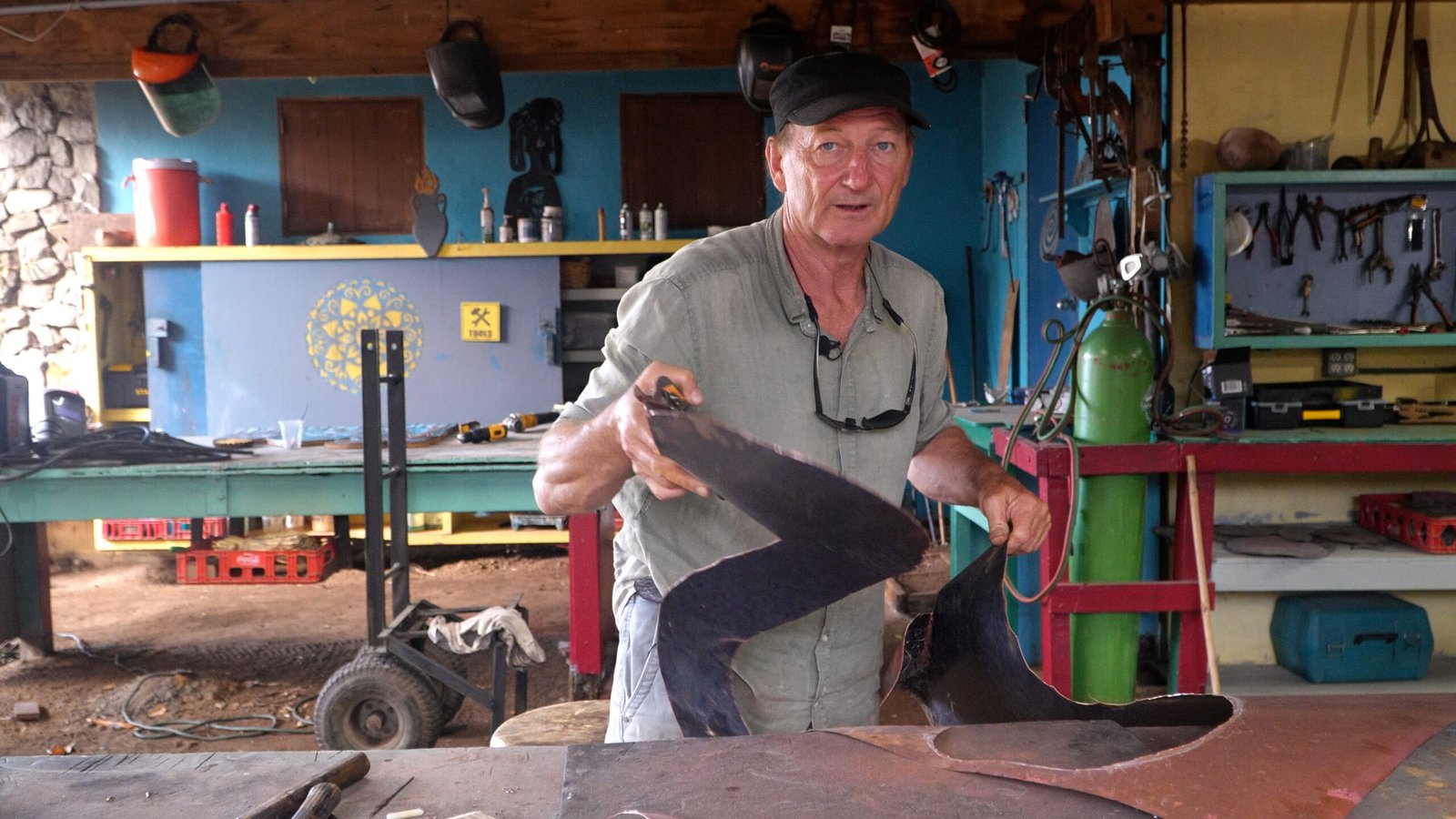
Aragorn admits it quite happily, describing himself as a “total spiral junkie”.
In his British Virgin Islands studio, sculptor Aragorn explains how flamingos, spirals, fire and reclaimed copper come together in work designed to be seen, touched and interpreted from more than one angle.
Aragorn really has a weakness for spirals.
But when Richard Branson commissioned him to make a crown for a building on Necker Island, that particular obsession had to compete with another requirement: flamingos.
The result, as Aragorn tells it, was a meeting of two ideas.
Branson wanted flamingos, reflecting the birds associated with his private island in the British Virgin Islands. Aragorn wanted spirals, a form he considers rich with symbolism. Neither was prepared to abandon their vision, so they worked out a compromise.
It was not a small object to negotiate over. Aragorn describes a crown approximately eight feet across, made for the top of a conical-roofed building he refers to as the Temple of the Elders.
The solution was to design the sculpture for different viewpoints. Look up from the entrance and the flamingos appear. Move to the side and the spirals become visible.
“When you walk in the door and look up at this thing, you’ll see flamingos,” he explained during our conversation in his copper studio. “But when you look at it from the side, you’re going to see spirals. So we balanced it out.”
It is a simple idea with a lot behind it. A sculpture does not have to reveal everything at once. The viewer’s position changes what they see, and the artist can use that movement to tell more than one story.
For Aragorn, the crown was not just a decorative flourish for a Caribbean island. It was an opportunity to work a personal fascination into a commission without losing sight of the person who had asked for it.
Explore more of Aragorn’s metalwork on his copper sculpture portfolio.
A crown built around two competing visions
The flamingos and spirals make a memorable story, but they also reveal something about the practical side of making art for another person.

A commission begins with someone else’s idea. The artist then has to find a way to give that idea physical form while bringing their own imagination to the work. It is a balance between listening and pushing back, between making something that meets a brief and making something that could only have come from a particular artist.
Aragorn’s account of the Necker Island crown is unusually candid about that negotiation. He wanted spirals. Branson wanted flamingos. Rather than choosing one over the other, Aragorn made the design work in two directions.
The crown’s scale mattered. At around eight feet across, it was intended to occupy a prominent position above the building, where its silhouette and details would be experienced from different distances. The view from directly underneath would not be the same as the view from the side.
That distinction is worth remembering when looking at large-scale sculpture. Photographs often flatten an object into a single image, when the actual work has depth, structure and changing relationships between its parts. The viewer has to move around it to understand the decisions the maker has made.
Aragorn’s approach makes that movement part of the experience.
Why Aragorn keeps coming back to spirals
When the conversation turned to spirals, Aragorn was emphatic.
“Symbolism. Everything,” he said, before describing spirals as “super, super significant”.

He did not reduce their significance to one fixed interpretation. Instead, he spoke about the different ways symbols can be used across formats and periods, and about the importance of slipping them into a piece of work.
“Always sneak a little symbol in there,” he said. “Carries the magic.”
That last phrase gets close to the heart of his approach. A symbol can be decorative, but it can also carry a second layer of meaning that is not immediately obvious. A viewer might first notice the shape, then begin to wonder why it is there, what it evokes or whether the artist has left something deliberately concealed.
The spiral is particularly suited to this kind of visual exploration. It draws the eye inward and outward at once, suggesting movement without necessarily showing a beginning or an end. Its appearance in art across different periods and cultures makes it a compelling subject, although its meaning varies with context. There is no single universal interpretation that can be applied to every spiral.
One well-known historical example is the prehistoric monument of Newgrange in Ireland, where carved triple-spiral motifs are among the features associated with the site. Heritage Ireland provides background on the monument and its wider archaeological setting through its Brú na Bóinne visitor information.
Newgrange offers a useful point of comparison, not evidence that Aragorn’s spirals carry the same meaning. The interesting connection is that a shape can outlive the moment in which it was made, inviting later viewers to keep asking questions.
Aragorn approaches symbolism in a personal way. He wants a piece to contain more than its immediate appearance, something that rewards attention rather than announcing its meaning at first glance.
That is also why the crown’s two viewpoints matter. The flamingos are the first surprise for someone looking up. The spirals wait for the viewer who takes the time to look from another angle.
Copper is not just a material. It is part of the process.
Inside Aragorn’s studio, the conversation moves quickly from symbolism to the physical business of making things. There is no separation between the idea and the work required to bring it into being. Copper has to be cut, heated, beaten and shaped. A design might begin as a drawing or a mental picture, but it still has to survive contact with a stubborn sheet of metal.

During our visit, Aragorn demonstrated how he works the material with hammers and chisels to create texture. As he explained, the marks are not necessarily laid out in a precise repeating pattern. In the section we watched, he described the effect as “chaos”, with the irregular hammering helping to give the surface its character.
For the flamingo project, that texture could suggest the detail of feathers. The metal was not being decorated simply to make it look finished. Its surface was being worked to help communicate what the sculpture represented.
The process is physical and sometimes noisy. Copper must be heated when a section needs to become more workable, particularly when shaping three-dimensional forms. Aragorn demonstrated using fire to heat the metal before continuing to beat it into shape.
He also explained that the work can be repetitive. A large sculpture is not made in one dramatic moment. It is built through many smaller actions, each one changing the metal a little at a time.
That is part of the appeal for him. He described copper as raw and natural, but also as a material that demands physical engagement. It has to be persuaded into the form the artist wants.
You can see more examples of his approach in Aragorn’s copper sculpture collection, where the material itself is central to the work.
The colour of copper, and the beauty of letting it change
Copper does not remain visually identical throughout its life. Its surface can darken and develop a patina through exposure to its environment, producing changes in colour and texture.

Aragorn was working with this process in the studio, explaining that he uses a treatment to speed up the ageing of the metal and bring out a particular colour. The word for the surface change is patina. Rather than waiting for the metal to weather naturally, a maker can sometimes encourage a desired appearance through controlled treatment.
This is different from simply painting a sculpture to give it a finished colour. The surface remains closely connected to the material beneath it, and the final appearance depends on how the copper has been treated.
For an artist who values the character of the metal, this is part of the attraction. Copper has its own visual life. Its colour can change, and those changes can become part of the design rather than something to hide.
Aragorn spoke about copper as a material that can outlast its maker. He imagined a piece remaining long into the future, still recognisably itself thousands of years from now. That durability is one reason he returns to copper when asked which material he would choose if he could work with only one for the rest of his life.
His answer was clear: copper.
He also likes steel and recognises its possibilities. But when comparing the two, he returned to the word “magic”. For him, copper has something special that is not simply a matter of strength or usefulness.
A sculptor who refuses to waste the offcuts
Look around the studio and another part of Aragorn’s practice becomes apparent: the value of a material does not end when it is cut into a particular shape.

He keeps scraps of copper, including pieces recovered from roofing and pipes. Some are saved for future projects; others are small enough to become components in a different sculpture. During the conversation, he pointed out little pieces that would eventually become details on the flamingo.
“Everything has a use,” was the principle behind the practice.
That is more than a tidy workshop habit. Copper is expensive, and Aragorn explained that he tries not to throw away even small offcuts. The price of the metal makes recovery practical, but it also encourages a way of thinking in which material remains valuable after its first purpose has ended.
He described his process as a form of upcycling. Salvaged copper is not necessarily returned to its original use. Instead, it can become part of a new object, with the marks and history of the material carried into a different design.
The idea fits naturally with the way he works. A scrap is not simply waste waiting to be cleared away. It is material that has not yet found its next form.
That approach also offers a useful contrast with the assumption that making something new always means starting with new materials. In Aragorn’s studio, the next piece might begin with a sheet of copper bought for a specific commission, a section of old pipe, or a small offcut saved because it could be useful later.
For more on the difference between reusing materials and upcycling them, read What Upcycling Really Is: Jeans Into a Vest at Vana.
What Aragorn learned from metalworkers around the world
Aragorn’s interest in copper did not develop in isolation. During our conversation, he recalled travelling to places where metalworking and other traditional crafts form part of everyday working life.

He spoke about spending time in the souks of Marrakesh, where he worked alongside craftspeople beating copper. He also remembered visiting Bhaktapur, a town near Kathmandu in Nepal, where different craft traditions were concentrated in distinct areas.
As he described it, one district was associated with pottery, another with copper and brass work, and others with woodwork and textiles. He remembered the experience as a chance to move between workshops, see different processes and absorb ideas from the people practising them.
He also recalled visiting a place in the Tibetan Plateau associated with making Buddhist figures for temples, where he spent time with coppersmiths. He described working with copper over a bed of pitch, a material used to support metal during certain kinds of hammering. A supportive surface allows the metalworker to shape and deepen the form without the sheet simply moving away from the force of the tool.
These memories help explain why Aragorn talks about copper as something that connects him to a much longer history of making. The tools may be simple, but the skill lies in knowing how heat, force, support and repeated blows will alter the material.
He is not claiming that every tradition is the same. The places he describes have their own histories and methods. What links them in his account is the opportunity to learn by watching and doing, rather than treating metalwork as an abstract design exercise.
For an artist working in the British Virgin Islands, those encounters also place a local studio within a wider international story of craft. Techniques and ideas travel with people. They are adapted, combined and made personal.
Copper has a history in the British Virgin Islands
Copper may not be the first material that comes to mind when people think about the British Virgin Islands, but Aragorn raised a local connection during our visit: the former copper mine on Virgin Gorda.

He recalled the mine as a short-lived operation, first associated in his telling with Spanish visitors centuries ago and later worked by Cornish miners in the nineteenth century. He contrasted that extractive history with his own practice, in which copper is transformed into sculpture.
The distinction matters. Mining takes material out of the ground; sculpture gives material another form and another life. Both involve copper, but they represent very different relationships with it.
The details of the mine’s history deserve verification against a dedicated heritage source before being presented as established fact. Aragorn’s recollection is valuable as part of the conversation, but it should not be treated as the sole historical authority.
What is clear from the studio visit is that copper has become central to his own creative world. He knows its cost, its physical limits, the way it responds to heat and hammering, and the possibilities it offers when a flat sheet becomes a three-dimensional form.
From copper sheets to three-dimensional creatures
The flamingo crown was not the only large-scale work Aragorn discussed. He also showed us images of a substantial three-dimensional iguana he had made for a recent commission.

He described the project as an interesting challenge, particularly in terms of moving into more fully three-dimensional work. A flat sheet of metal behaves differently once it must form a body, curve around a volume or hold a recognisable silhouette from multiple viewpoints.
The same challenge appears in the crown. It is one thing to draw a spiral or a flamingo. It is another to build those shapes into a structure that can be seen from below, from the side and at a distance.
The studio also contains work made from steel. Aragorn spoke about a large fireball sculpture he had previously made for Branson on Necker Island. He explained that the earlier steel piece had deteriorated after years in its environment, and he was considering a replacement. This is a separate project from the copper crown, but it illustrates another side of his work: outdoor sculpture has to contend with weather, exposure and the passage of time.
Different metals offer different possibilities. Steel has its own strengths, while copper develops a changing surface and can be worked into detailed shapes. Aragorn moves between materials, but his affection for copper was unmistakable during our conversation.
You can explore his studio’s copper sculpture work here.
Art that leaves room for a second look
Near the end of our conversation, we returned to the idea that an artist’s work should reflect the times in which it is made. Aragorn agreed, but his answer also pointed towards something more personal.

He spoke about using different formats and symbols, and about slipping a symbol into a piece of work so that it carries another layer of meaning.
It is an approach that makes sense of the crown. The flamingos give the sculpture a clear relationship with Necker Island and the commission that brought it into being. The spirals make space for Aragorn’s own interests. Neither element has to cancel the other out.
The sculpture can do both jobs at once.
That balance is what makes the story more interesting than a celebrity commission alone. It shows how an artist negotiates a brief, works through a difficult material and finds ways to place personal meaning inside a public object.
It also offers a reminder to look at sculpture in the round. A photograph may show one side. A passing glance may reveal only the obvious detail. But a closer look, from another angle, can uncover the element the artist has quietly tucked away.
Aragorn’s spirals are an invitation to do exactly that.
This feature is based on a recorded conversation with Aragorn in his copper studio in the British Virgin Islands. Historical details and direct quotations should be checked against the original recording and independent sources before publication.
Keep exploring
- Aragorn’s copper sculpture portfolio
- Newgrange and the Brú na Bóinne monuments, Heritage Ireland
- What Upcycling Really Is: Jeans Into a Vest at Vana
- Angie’s self-portrait painting interview
- Where to stay in the British Virgin Islands