

Is Oil Painting Sustainable?
A Dominican Artist Questions the Materials She Loves
I was at Dominican artist Angie’s home documenting her work when our conversation turned to something most people looking at a painting never consider: what it is actually made of.
We were surrounded by the things that make a painting possible: brushes, colour, oil, paper and the works she was in the middle of creating. Angie showed me the paints she uses, explaining that she keeps her palette relatively small. Orange is one of her favourites, both as a colour in its own right and as a base for mixing skin tones.

Then she started questioning the materials in front of us.
Angie loves the glossy finish of oil paint. She also worries about the environmental cost of the materials she buys. She had seen artists and companies experimenting with plant extracts and natural pigments, including colourants for fabric, and wondered whether painting could move in the same direction.
It was not a conversation with someone who had already found an answer. She had not abandoned oil painting or established that a particular alternative was better. She was an artist thinking aloud about a contradiction: how do you keep making work you love while questioning the materials that make it possible?
What Makes Oil Paint Potentially Harmful?
Angie picked up the oil she uses to dilute her paint.
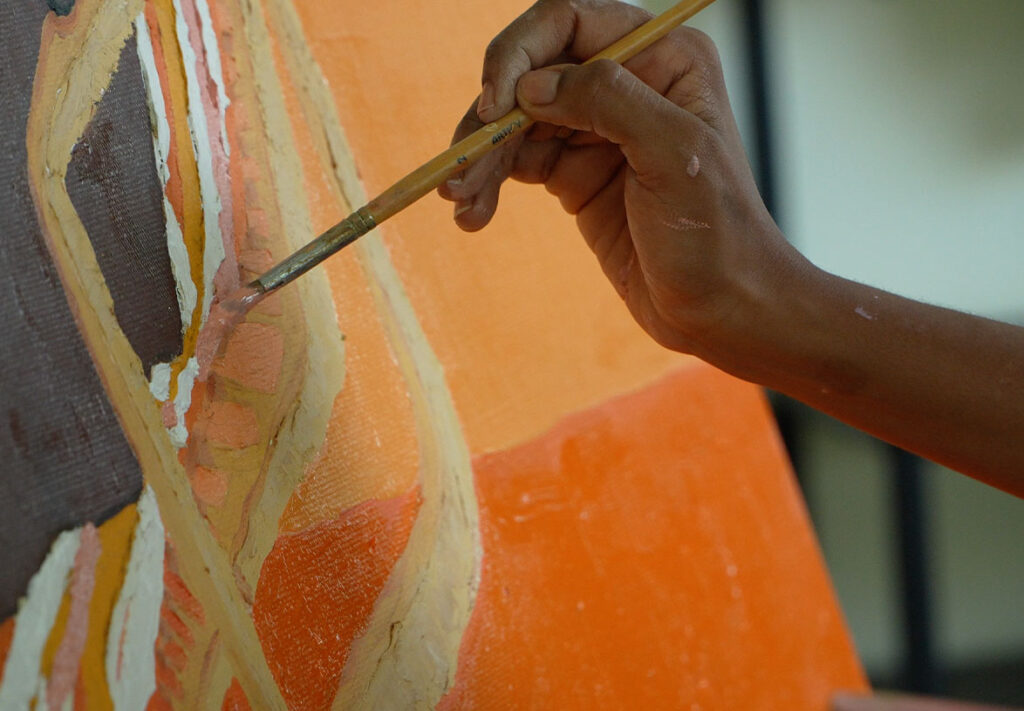
In our conversation, she admitted she had not researched the subject as thoroughly as she felt she should have.
“I don’t read about it as as I should, but I think this is like the most toxic product in terms of the ones that I use.”
That is Angie’s concern, not a laboratory finding. I was there to document her experience, not to test the products in her studio. And the distinction matters because oil painting does not have one universal toxicity profile. The risks depend on the specific paint, its pigments, the oils or mediums added to it, any solvents used, and how the materials are handled and discarded.
Traditional oil paints are made by dispersing pigments in a drying oil, often linseed oil. The pigments provide the colour, but some contain hazardous substances. Certain formulations of cadmium, cobalt, lead and chromium pigments, for example, can present health risks. Other pigments have different hazard profiles. You cannot tell how hazardous a paint is simply by looking at its colour or seeing that it is labelled “oil paint”.
The added liquids in your painting matter too!

Artists may use drying oils, painting mediums, mineral spirits or other solvents to change the consistency of paint, clean brushes or alter drying time. These products are not interchangeable. Some solvents release vapours that can irritate the eyes and respiratory system, and repeated or excessive exposure can carry more serious health risks. A product’s exact hazards depend on its formulation and how it is used.
The UK’s Health and Safety Executive guidance for artists is a useful starting point for understanding risks from art materials. For conservation and material safety, the Canadian government’s Canadian Conservation Institute also publishes technical guidance on caring for collections and working with potentially hazardous materials.
For artists, the practical lesson is not to panic about every tube of paint. It is to identify what is actually in the products being used, read the manufacturer’s safety information, avoid unnecessary exposure and handle waste responsibly. A pigment, a drying oil and a solvent can have very different properties, even when they are all part of the same painting process.
Is the oil itself the problem?
Not necessarily. The word “oil” can mean several different things in an artist’s studio. Linseed oil, for example, is a drying oil used as a binder and painting medium. Mineral spirits are solvents, not the same substance. A paint may also contain pigments with their own hazards.
That is why I would not describe the oil in Angie’s studio as the most toxic product without knowing its exact name and formulation. Her instinct to investigate is sensible, but the next step would be to identify the product, consult its safety data sheet and understand how she uses it. That is a much better basis for a decision than assuming that every oil-based material carries the same risk.
There is also a difference between protecting the artist and protecting the environment. A product with low odour is not necessarily harmless. A material that is safer to handle may still have an environmental footprint linked to its manufacture, packaging, transport or disposal. Both questions deserve attention.
Natural Pigments and Plant-Based Paint
Can Artists Find Better Oil Paint Alternatives?
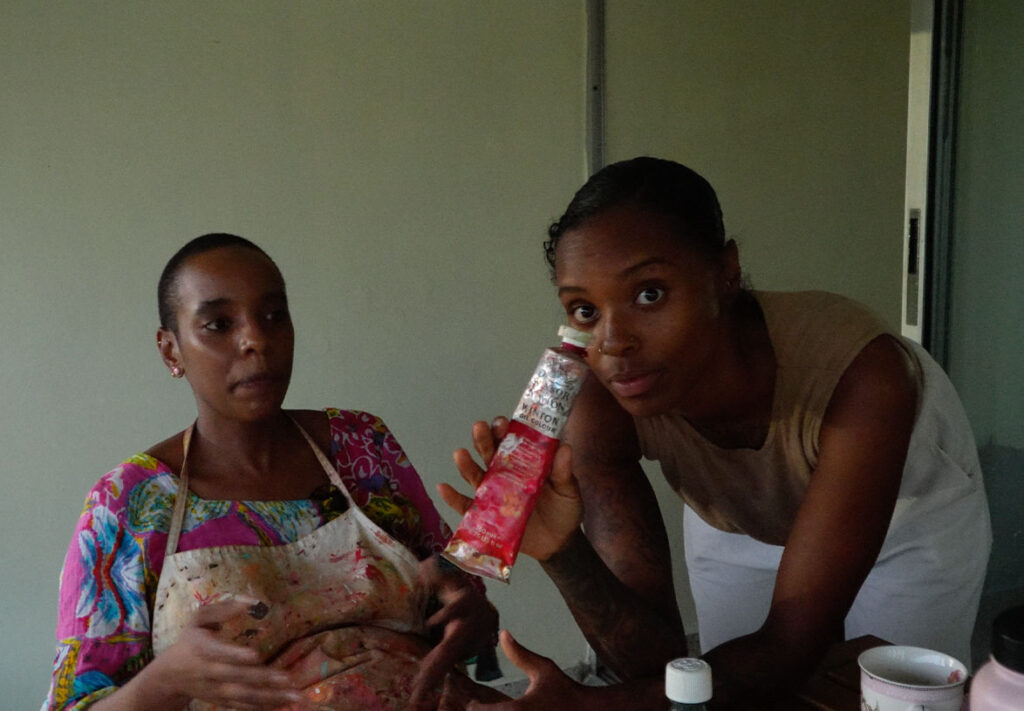
Angie told me she had been watching artists and companies experiment with plant extracts and natural pigments. She had seen colour being developed for textiles and regarded that work as an encouraging step.
“I’m one hundred percent sure that we will be able to have paintings like this without sacrificing so much things of the environment,” she said.
She was imagining what might become possible, not claiming that a ready-made replacement for her oil paints already exists. That distinction is important. Natural dyes and pigments have a long history, and contemporary makers are exploring ways to produce colour from plants, minerals, waste materials and other sources. But a promising colourant is not automatically a suitable artist’s paint.
Textile dyeing and painting on canvas have different technical demands. A colour that works beautifully on fabric may behave differently when mixed into a paint binder. Artists need to consider opacity, lightfastness, drying time, adhesion, texture and how the finished work ages. A pigment that looks vivid today may fade under light or change when mixed with another material.
There is another complication: natural does not automatically mean non-toxic. Some naturally occurring minerals contain hazardous elements, and plant-derived materials can still cause irritation or allergic reactions. The environmental impact also depends on how the raw material is grown or extracted, how much is needed, the processing involved and what happens at the end of its life.
Still, the research and experimentation Angie described point towards an important question for the art world. If colour can be produced from renewable resources, agricultural by-products or materials that would otherwise be discarded, can those approaches eventually deliver the performance artists need with less environmental harm?
The answer will vary by material and application. It needs to be established through testing, not inferred from a label or the word “natural”.
Plant pigments are beautiful in colour, but durability matters
Plant-based colour is not new. Artists, dyers and craftspeople have worked with botanical colourants for centuries. Today, makers continue to experiment with leaves, roots, flowers, bark, food waste and other biological sources. The challenge is to turn that colour into something reliable for a particular use.
For textile artists, that might mean developing a dye that bonds effectively with a fibre and survives washing. For a painter, the question is different: will the colour remain stable on a surface for years, or decades? How does it react to light, humidity and the binder? Does it mix predictably with other pigments?
These are not reasons to dismiss plant pigments. They are the questions that need to be answered if they are to become dependable materials for working artists rather than beautiful experiments.
Angie’s optimism stayed with me because she was not asking artists to stop caring about the work itself. She was imagining a future in which the material could evolve without requiring them to give up the qualities that make painting meaningful to them.
Five Alternatives To Toxic Paint Artists Can Explore Now
There is no single substitute that works for every artist. A painter who loves the depth and gloss of oils has different needs from someone working with quick studies, murals, watercolour or mixed media. The useful question is not simply which material is “greenest”, but which option can meet the artistic brief while reducing avoidable harm.
1. Water-mixable oil paints
Water-mixable oils are designed to be diluted and cleaned up with water rather than requiring conventional oil-paint solvents for every stage of the process. For artists who want to retain the handling and appearance of oil paint, they may be worth testing.
They are not the same as watercolour, and they are not automatically non-toxic or environmentally harmless. They remain oil paints, and the pigments still matter. Artists should check the individual product’s safety information and follow the manufacturer’s instructions rather than assuming that water-mixable means safe to pour down the drain.
For someone like Angie, who values the gloss of oils, this is a practical option to investigate without immediately changing the entire way she works.
2. Solvent-free oil painting methods
Some oil painters reduce or avoid conventional solvent use by working with oils and suitable painting mediums, cleaning brushes with carefully chosen methods and changing how they manage their palette. This is not the same as eliminating every hazard, and it does not make all oil paints safe. But it can reduce reliance on certain volatile solvents.
Artists sharing their own studio methods can be useful here. Community discussions are available through Reddit searches for solvent-free oil painting and discussions in r/oilpainting. These are starting points for first-hand experiences, not verified safety guidance. A painter’s successful technique does not establish that a product is safe for everyone or suitable for every studio.
Whatever method an artist chooses, oily rags need particular care. Drying oils can generate heat as they oxidise, and piles of oil-soaked cloth can pose a fire risk. Follow local fire-safety guidance and the instructions for the specific product being used.
3. Watercolour and gouache
Watercolour and gouache can suit artists who want to work with water-based techniques. They offer different levels of transparency, opacity and surface finish, and they may allow an artist to avoid some of the solvents used in oil painting.
But switching mediums is an artistic decision, not an automatic environmental upgrade. Water-based paints still contain pigments and binders, and some pigments can be hazardous. Packaging, manufacturing and disposal also count. The right comparison is between the actual products and methods, not between broad categories labelled “oil” and “water”.
For Angie, who loves the glossy quality of oils, watercolour may not offer the same result. It could, however, be useful for sketches, studies or experiments that do not need to be completed in her preferred medium.
4. Egg tempera and other traditional binders
Egg tempera is a traditional painting technique that uses egg yolk as a binder for pigment. It behaves differently from oil paint, producing a distinctive surface and encouraging a different approach to layering and brushwork. It is not a drop-in replacement for every oil technique, and the finished appearance is different.
Other traditional binders, including casein, have also been used in painting. Each has its own preparation requirements, working properties and limitations. Artists considering these methods should research their handling, preservation and compatibility with the intended surface.
Traditional does not necessarily mean sustainable, either. The binder is only one part of the material. Pigment sourcing, additives, durability and the long-term preservation of the finished work still matter.
5. Handmade pigments and reclaimed materials
Some artists make their own pigments, experiment with earth colours or reuse materials from other processes. Others incorporate found paper, discarded packaging and reclaimed surfaces into mixed-media work. Angie herself showed me how she collects different papers and textures to experiment with in her art.
Making use of an existing material can be a way to explore colour and texture without buying something new for every experiment. But homemade pigments require care. Dust from grinding materials can be hazardous to inhale, and unknown minerals, old coatings and industrial residues should not be assumed safe because they are found in nature or recovered from waste.
Artists interested in making their own colours can begin by reading about pigment preparation and historical painting techniques, then checking the identity and safety of each material. Online maker communities can provide ideas, but recipes shared by individuals should not replace reliable safety information.
Explore first-hand Reddit discussions about homemade natural pigments and artists experimenting with plant-based colour for examples of what people are trying. These searches lead to community posts, whose results and claims vary. Treat them as inspiration and practical experience, not proof of environmental benefit, permanence or safety.
The Problem With Calling Art Materials “Eco-Friendly”
There is a temptation to look for one label that settles the question: natural, non-toxic, water-based, plant-derived or eco-friendly. None of these words, by itself, tells the whole story.
A plant-derived pigment might require substantial processing or produce a colour that fades quickly. A conventional pigment may be more durable but contain substances that require special handling. A water-based product may reduce the need for some solvents while still containing pigments or binders that should not enter waterways. A handmade material may avoid unnecessary packaging but create dust or other risks during preparation.
Durability matters. A painting that retains its colour for generations may not need to be replaced or restored as frequently as one that fades rapidly. That does not make every traditional material the better choice, but it does mean that performance over time belongs in any serious comparison of environmental impact.
For an artist trying to make a more informed choice, the questions are practical:
- What are the actual ingredients, pigments and binders?
- Does the product require solvents, and what are the exposure risks?
- How much energy, water and processing does its manufacture require?
- Will the colour remain stable under the conditions in which the work will be displayed?
- Can leftover material, wash water and packaging be handled without contaminating drains or the wider environment?
- Is the alternative genuinely better for the intended use, or does it simply have a more reassuring label?
These questions are especially important when artists are working with limited budgets. The most expensive alternative is not automatically the most responsible one, and no individual should have to purchase every new product marketed as sustainable just to prove that they care.
The Guilt of Being an Artist Who Wants to Do Better
What stayed with me about Angie was not just her concern about paint. It was the way she described the pressure of trying to make better choices while carrying on with her life and work in the Caribbean.
“I’m just a little person in the Caribbean that is just trying to do her work,” she said, reflecting on the feeling of being pushed to change her consumption.
It seemed to be like she was caught between the guilt of continuing to use materials she questioned and the reality that her work depends on them. She could wait and watch for better options, or begin looking for alternatives, even if they were expensive or did not perform in the same way.
That tension is familiar far beyond the art world. We are encouraged to make more responsible choices, but the products available to us do not always make those choices simple. Better materials may cost more. Information may be difficult to find. An alternative may work in theory but fail to deliver the result someone needs to earn a living.
Angie did not ask to be presented as an environmental expert. She was a working artist trying to understand her own materials. Her uncertainty is part of what made the conversation worth documenting.
When she asked me about my own approach, I told her that I make strict choices and sometimes miss out because of them. That was my personal response, not a rule Angie had adopted. We talked about taking a step, assessing it and deciding what to do next.
I do not think the answer is to shame artists for using the materials they know. Nor is it to assume that every alternative is better simply because it is newer or described as natural. The useful starting point is to find out what is in the products, understand the risks, reduce avoidable harm and support research into materials that genuinely perform better.
Can We Make Art Without So Much Environmental Sacrifice?
Angie believes we will find ways to make paintings like hers with less environmental sacrifice. She was looking at the experiments already taking place around her and imagining where they might lead.
“I’m one hundred percent sure that we will be able to have paintings like this without sacrificing so much things of the environment,” she told me.
She suggested a horizon of seven to ten years for the kinds of changes she hopes to see. That was her prediction, not a verified scientific forecast. Whether it happens on that timeline depends on research, testing, the availability of materials and whether artists can afford to use them.
There is room for progress in the meantime. Artists can investigate the products already on their shelves, read safety data sheets, explore solvent-reducing techniques, experiment with different media and avoid disposing of paint or solvent waste down household drains. Art schools, suppliers, researchers and manufacturers can help by making ingredient information clearer and developing alternatives that meet artists’ actual needs.
Manufacturers also have a role to play. The burden should not sit entirely with individual artists, especially when product formulations, supply chains and disposal systems are largely outside their control. Better labelling, transparent ingredient information, durable materials and practical take-back or waste-management options would make informed choices easier.
For now, there is no universal answer to which painting medium has the lowest environmental impact. The answer depends on the material, its production, the way it is used and the life of the finished work. That is precisely why independent testing and transparent information matter.
A First-Hand Conversation With Dominican Artist Angie
I was there to document Angie at work, in her home, surrounded by the paintings, sketches, brushes and colours that make up her practice. I did not visit her studio to conduct a chemical assessment, and I would not turn her personal concerns into a claim that one material is definitively the most toxic or that a particular alternative is already the solution.
What I saw was an artist who loves her materials enough to question them. She likes the gloss of oil paint. She has a particular relationship with colour, especially orange, and she is interested in the possibilities of plant-derived pigments. She also recognises that the way we make things has consequences, even when the work itself is deeply personal.
That is where this story begins: not with a perfect artist or a perfect product, but with a question. Can the materials that help us express ourselves evolve alongside our understanding of their impact?
Angie is still painting. She is still exploring. And the alternatives she hopes for will need to prove themselves through more than good intentions. They will need to work, last and become accessible to the people who use them.
For more first-hand conversations with artists and makers, explore our original documentary films coming soon.
Further Reading and Artist Resources
- Angie’s Instagram
- UK Health and Safety Executive: guidance for artists. A starting point for understanding and managing risks associated with art materials.
- Canadian Conservation Institute. Government conservation resources on the care of collections and materials.
- Oil painters discussing solvent-free methods on Reddit. First-hand experiences that can inspire further research, not a substitute for product safety guidance.
- Artists experimenting with homemade natural pigments. Community discussions of techniques and materials, with safety and permanence claims to be checked independently.