
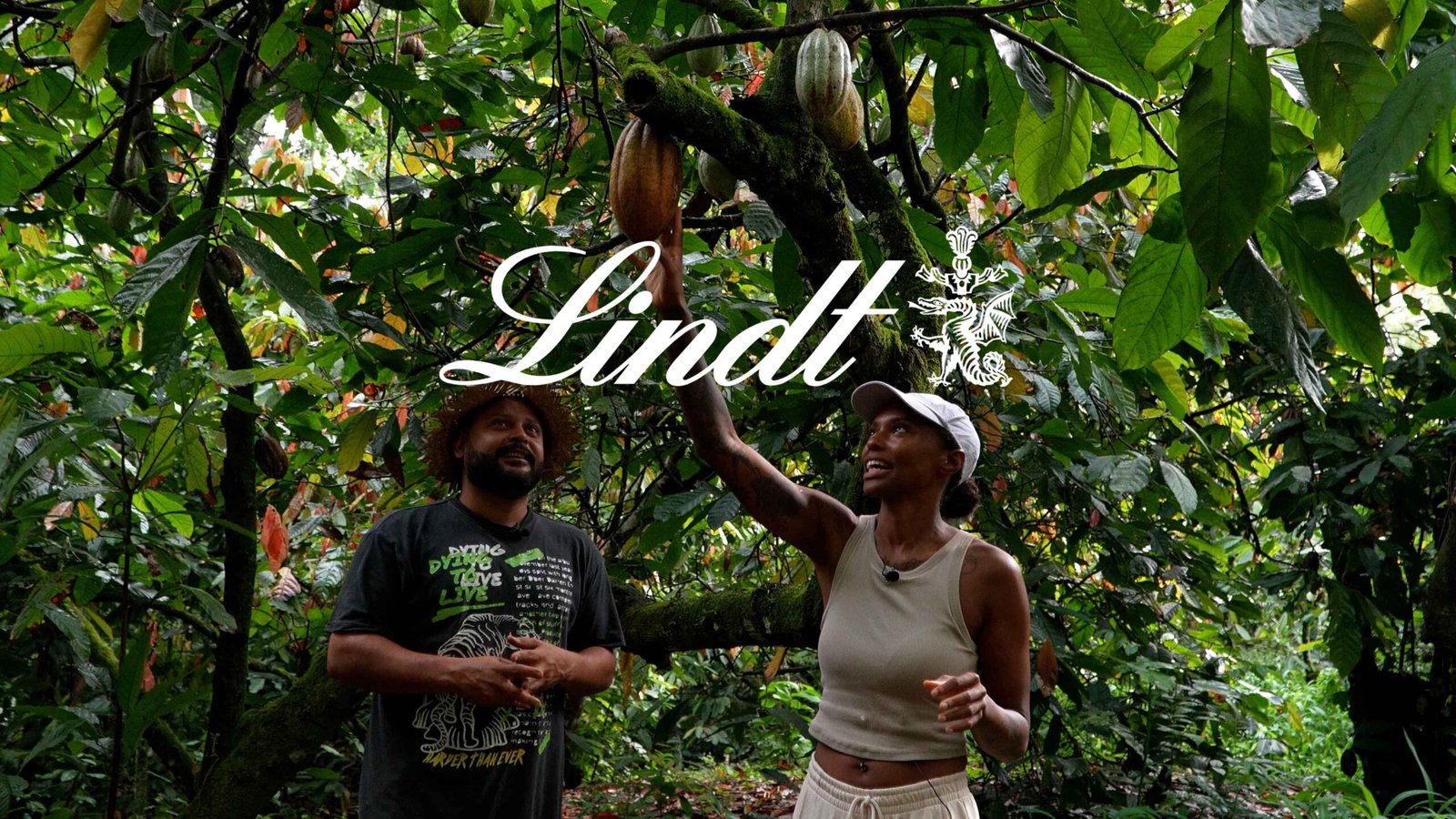
At La Chocolate Jungle in Salcedo, Dominican Republic, Isaias is growing cacao as part of a living ecosystem. His farm supplies Lindt, but that relationship should not be mistaken for an endorsement of the multinational. The real story is the land, the knowledge, the people working with nature, and a way of producing food that should be far more ordinary than it is.
The guardian of the jungle
“I am Isaias. I am the guardian of the jungle.”
That was how Isaias introduced himself when I visited La Chocolate Jungle, an organic cacao farm in Salcedo, in the Dominican Republic. Not as a supplier to a famous chocolate company. Not as a name behind a premium product. Not as a beneficiary of a multinational’s sustainability programme. As the guardian of the jungle.
The distinction matters. The language of modern food marketing often places the brand at the centre of the story. We are encouraged to admire the company that sells the chocolate, while the farmer, the soil, the harvest and the years of knowledge required to produce the ingredient become supporting details. The land is turned into a backdrop. The farmer becomes an image on a wrapper. The company receives the recognition.
At La Chocolate Jungle, I wanted to turn that perspective around.
I wanted to understand what Isaias was doing, why he grew cacao the way he did, and what his farm could teach us about the standards we should expect from the chocolate industry.

During our conversation, Isaias explained that the farm combines cacao with other fruit trees and plants. The goal, as he described it, is not simply to cultivate a crop but to create an ecosystem in which different plants grow together. He explained:
“The approach is not just cultivation. It is agriculture where you can combine crops with other fruit trees and create an ecosystem, where the fruit can grow in a healthy and viable way.”
Isaias, La Chocolate Jungle, Salcedo, Dominican Republic. Translated from Spanish.
This is the point from which the story should begin.
Before the chocolate is packaged, before it crosses an ocean, before a brand puts its name on it, there is a farm making decisions about how to work with the living world. There are people deciding what to plant, how to grow it and what kind of relationship they want to have with the land.
Those people are the butlers of Mother Nature. Their work is not to force the natural world into submission, but to understand it well enough to produce food without treating the ecosystem as disposable. They are not merely growing a commodity. They are maintaining the conditions that allow the commodity to exist.

@qovhttEdit Profile
That is the work I want to recognise. And it is the standard I want more farms, food businesses and consumers to demand.
Cacao did not begin with Lindt
When I asked Isaias what cacao means to the Dominican Republic, he placed it in a history much larger than any individual brand. He explained that, for more than a century, cacao had been among the country’s important export products and had connected the Dominican Republic with the outside world.
“Cacao was a symbol of our exports, our connection with other countries. In our climate, cacao produces twice a year, and we are proud to take what we produce with so much love and care to the world, so people can make their chocolate.”
Isaias, translated from Spanish.
His account places the farm within a wider agricultural history. Cacao is not an imported idea imposed on this landscape by a European chocolate company. It is a crop with a long history in the Americas and a significant place in the Dominican Republic’s agricultural economy.

The International Cocoa Organization (ICCO) publishes international cocoa statistics and information on producing countries, trade and the global market.
Its work is a useful starting point for understanding cacao as an agricultural commodity, rather than seeing it only through the finished products sold in supermarkets. The Dominican Republic’s position in organic cacao is particularly relevant to this story, although any ranking claim, including the assertion that it is the world’s largest producer of organic cacao, should be checked against current, comparable production data before being repeated as a definitive global statistic.
That qualification does not diminish what Isaias told me!!
It makes the reporting more precise. His pride in the country’s cacao is first-hand testimony. A claim about global production rankings is a separate question requiring independently comparable figures.
There is a wider issue here too with the chocolate industry.
Agricultural countries are often discussed as suppliers of raw materials to wealthier markets, while the companies that process, package, market and sell those materials capture much of the public’s attention. But the cacao’s journey begins in the producing country. The knowledge of how to grow it, the land that sustains it and the labour that brings it to harvest are not minor details in the story of chocolate. They are its foundation.
When we talk about chocolate, we should therefore be asking more than which brand tastes best. We should be asking where the cacao grows, how it is cultivated, who produces it, what the farm receives for it and what happens to the landscape after the harvest.
What Isaias means by an ecosystem
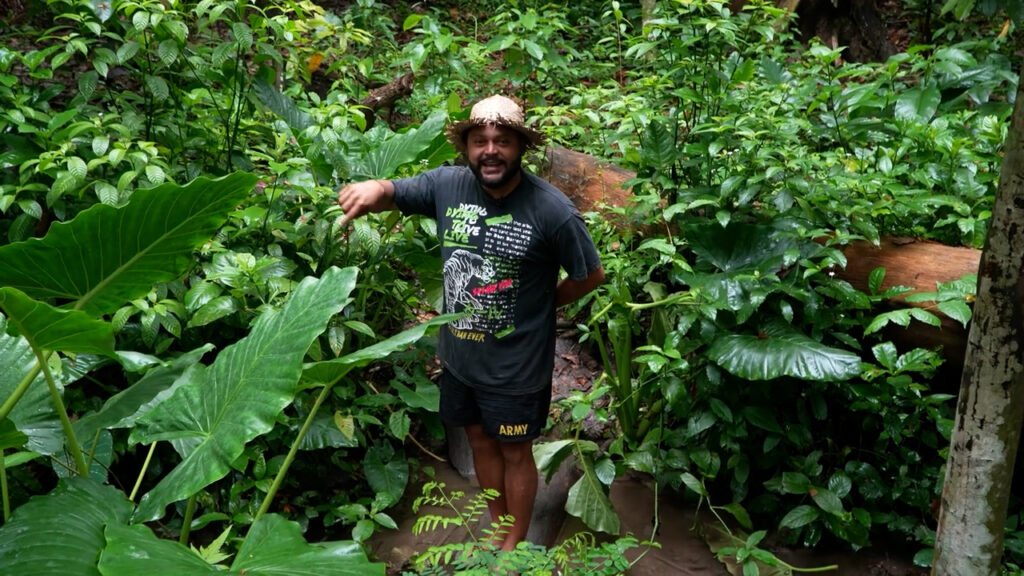
Isaias’s explanation of his farm points towards a different way of thinking about agriculture. Instead of treating land as a blank surface on which to maximise one crop, he described combining cacao with other fruit trees and vegetation. In his account, the growing environment matters to the quality and viability of the harvest.
This approach is often discussed under the broad term agroforestry, which involves integrating trees with crops or livestock.
The details vary by place and farming system, and a farm should not be labelled an agroforestry success simply because trees are present.
But the underlying principle is important: agricultural production can be designed around relationships between plants, soil, water, shade and other parts of an ecosystem, rather than around a single crop in isolation.
The Food and Agriculture Organization of the United Nations’ agroforestry resources describe agroforestry as an approach that integrates trees into agricultural landscapes and can contribute to diversified production, soil protection, biodiversity and resilience when the system is appropriately designed and managed. These benefits are not automatic. They depend on the species, location, management and wider conditions. But the research provides a useful framework for understanding the approach Isaias described.
It also helps explain why the farm deserves attention independently of the company that buys its cacao. If the value of a growing system lies in its relationship with the wider environment, that value cannot be reduced to the name printed on a chocolate bar.
A diversified farm may produce more than one kind of food, support different forms of life and reduce reliance on a single harvest or market.
The exact outcomes need to be assessed on the ground, not assumed from photographs or marketing language. Still, the philosophy matters: the farm is understood as a living place with multiple relationships, not merely a factory without a roof.
This is the sort of agriculture I want to see normalised. Food forest style.
Not because every farm must look identical, or because there is one perfect method for every climate, but because the question should be how to produce food while sustaining the conditions that make production possible.
Organic is not a luxury feature
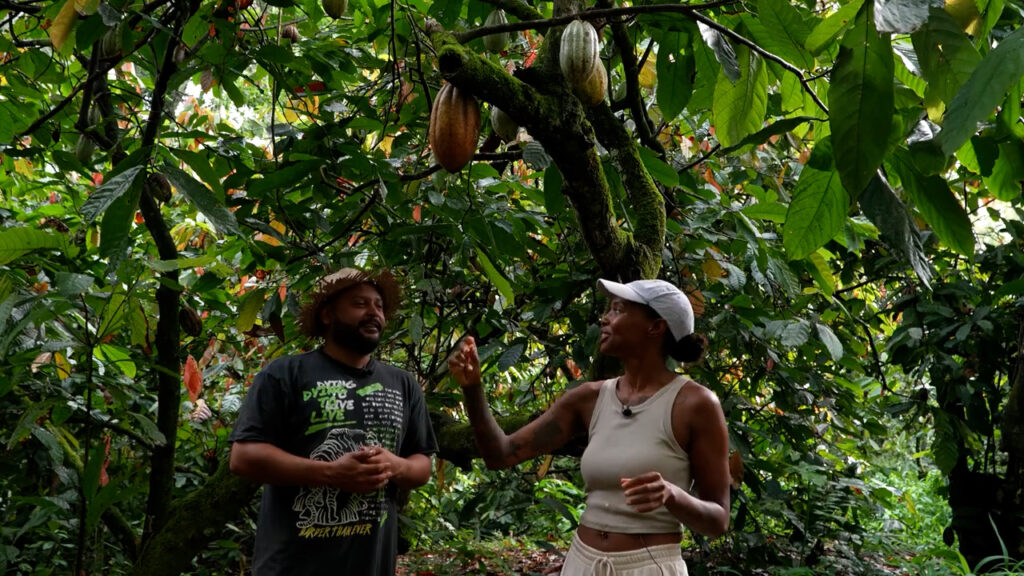
When I asked Isaias about the relationship between his cacao and Lindt, he was clear about the buyer. He described Lindt, based in Switzerland, as the farm’s biggest buyer. Later, when I asked whether the farm supplied other companies, he answered that it supplied Lindt. He also described the relationship as a long contract.
“Our biggest buyer is Lindt in Switzerland.”
Isaias, La Chocolate Jungle, translated from Spanish.
That is a significant relationship for the farm. It is also where the story can easily be misunderstood. The fact that a multinational buys cacao from an organic farm does not make the multinational the source of the farm’s good practices. The farm is doing the growing. The farm is responsible for the methods Isaias described. The buyer purchases the resulting cacao.
During our conversation about the chocolate market, Isaias drew a distinction between the organic cacao from his farm and the broader range of products sold under the Lindt name. When the conversation turned to other chocolate products, he said:
“Only the organic side, because it’s from here.”
Isaias, La Chocolate Jungle, translated from the recorded conversation.
That short sentence deserves to be taken seriously. It is not an endorsement of everything Lindt makes. It is a distinction between a particular organic sourcing relationship and the rest of a large product range. Isaias was talking about the cacao associated with his farm, not certifying the entire company as organic, ethical or sustainable.
Organic production also has a specific meaning. Under the European Union’s organic production rules, organic products are governed by defined requirements and certification controls. The precise rules vary across jurisdictions, and an organic claim should be supported by the relevant certification and scope. Organic is not simply a synonym for natural, wholesome, sustainable or fair.
That distinction is important because organic farming is not a magic word that answers every ethical question. It does not, by itself, prove that farm workers receive a living income, that every trading relationship is fair, that no deforestation has occurred, or that a product has a low environmental footprint at every stage of its life. Those questions need their own evidence.
But the limits of the label do not make organic farming unimportant. They make it one part of a wider standard. A farm can be recognised for its organic practices while still being assessed on labour, land management, biodiversity, commercial terms and transparency.
That is the difference between celebrating a specific practice and giving an entire business a halo. We can support the organic farm without endorsing every product, decision or business practice of the company that buys its cacao.
The contract is not the whole story
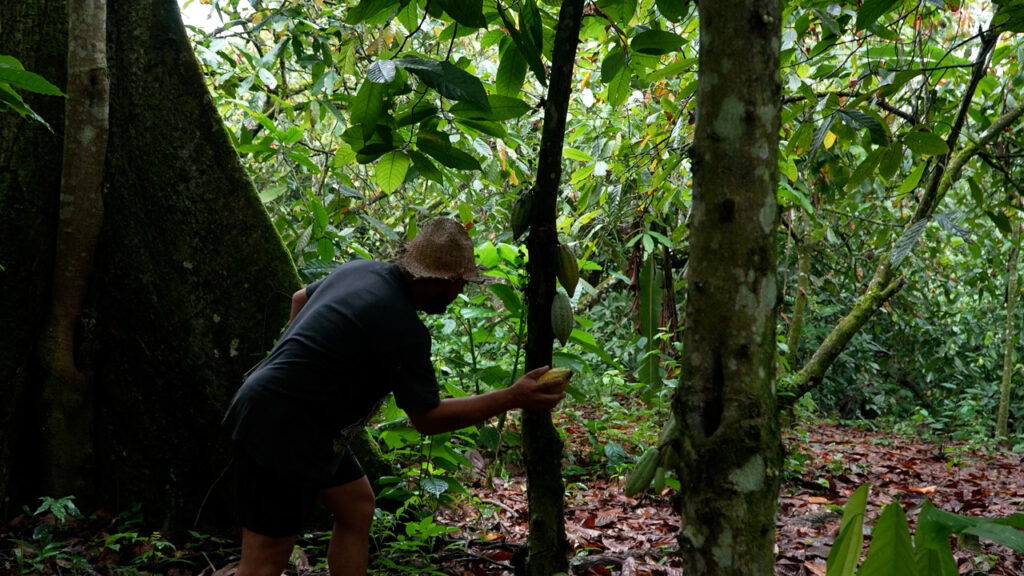
Isaias described a long-term contract with Lindt.
A continuing commercial relationship can matter to a farm because agricultural production requires planning. Cacao trees take time to grow and produce, harvests are subject to conditions on the ground, and producers need some confidence that there will be a market for what they cultivate.
But the existence of a contract does not tell us everything about the relationship.
It does not, on its own, establish the price paid, how the price is set, what volumes are guaranteed, who carries the cost of certification, or how risk is shared when a harvest is affected by weather or disease. Those details matter if we want to understand whether a supply chain is fair, not merely whether it is long-term.
I did not establish all those commercial terms in my interview, so I will not invent them.
Isaias’s account gives us an important starting point: a direct relationship between a named farm and a major buyer. The next step is to ask what that relationship means economically for the producer and the people working with him.
Chocolate, transparency and ethical practices is not a question unique to Lindt alone.
It is a structural question across the chocolate industry.
Cocoa farmers often have far less influence over the final retail price than the companies that manufacture and sell chocolate. The final product may involve processing, branding, distribution, advertising, packaging and retail margins, all of which can separate the value of a finished bar from the value of the crop at the farm gate.
The problems are especially visible in West Africa, which produces a large share of the world’s cocoa. Research commissioned by the United States Department of Labor and conducted by NORC at the University of Chicago examined child labour in cocoa-growing areas of Côte d’Ivoire and Ghana. The findings documented the scale and persistence of hazardous child labour in those regions. Readers can consult the NORC research on child labour in cocoa-growing areas for the scope, methods and findings.
Those findings should not be projected onto Isaias’s farm without evidence.
La Chocolate Jungle is in the Dominican Republic, and the circumstances of one farm cannot be inferred from research conducted in another region. The comparison matters for a different reason: it shows why the word “chocolate” cannot be separated from questions about how cocoa is produced, how much farmers earn and who bears the human cost when supply chains fail.
The Fairtrade discussion of living income explains why a price that covers the cost of production is not necessarily enough for a farmer and household to achieve a decent standard of living. A fair supply chain needs to be examined through actual commercial conditions, not simply through the presence of a sustainability programme or a photograph of a farmer.
The lesson is not that every large buyer is guilty of the same failures.
It is that buyers should be expected to demonstrate how their sourcing relationships work. If a company wants credit for purchasing from a farm that uses organic, ecosystem-based methods, it should also be prepared to explain the scope of the claim and the commercial conditions behind it.
From cacao fruit to chocolate, in the place where it grows
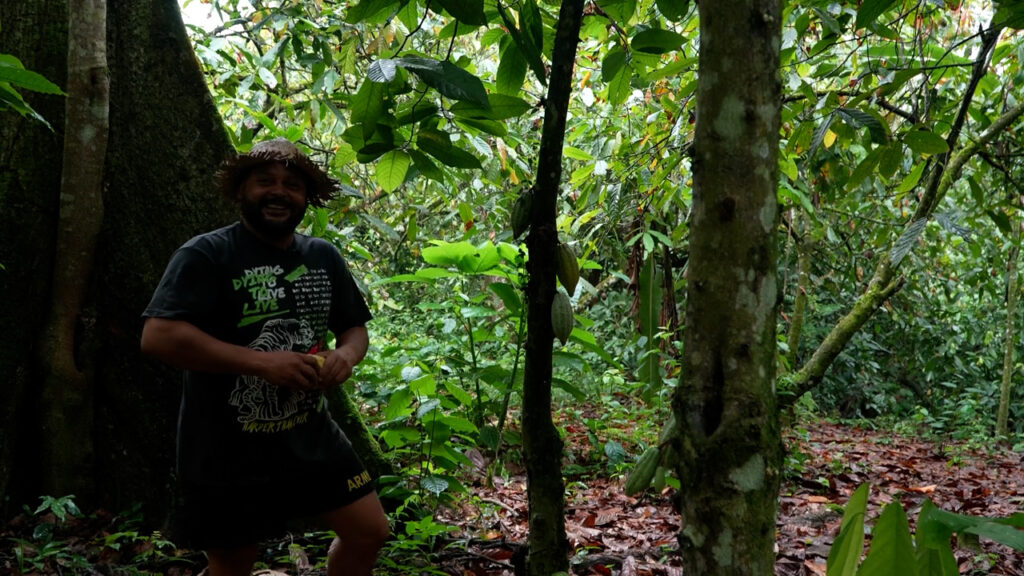
One of the most valuable parts of visiting La Chocolate Jungle was being able to follow cacao beyond the abstract idea of a bean. Isaias introduced the farm as a place where visitors can learn how cacao grows, walk through the plantation, explore its history, and see chocolate made from the raw ingredient.
“Here you can experience being a cacao farmer for one day, or even two or three, if you want. We walk through the plantation, learn how cacao grows in a natural place like a jungle, try different fruits and then learn how chocolate is made from scratch.”
Isaias, from his recorded introduction to La Chocolate Jungle.
He described the process of roasting and breaking down the beans before preparing a drink. Later, he served a simple cacao drink made with water, cacao and a little salt. It was a reminder that chocolate does not have to begin as a sweetened, highly processed product. At the farm, the ingredient could be encountered much closer to its original form.
Isaias also spoke about cacao’s traditional and cultural significance. He described the drink as something with a long history and talked about the importance of the cacao’s fat and flavour. Some of his explanations used the language of medicine and regeneration. Those are his interpretations of cacao, and they are part of how he presents the experience at the farm. They should not be treated as clinical evidence that cacao cures disease or produces a specific medical outcome.
There is, however, established scientific interest in cocoa’s naturally occurring compounds, including flavanols and theobromine.
The European Food Safety Authority has assessed health claims related to cocoa flavanols, including a narrowly defined claim concerning the maintenance of normal endothelium-dependent vasodilation and normal blood flow under specified conditions. That is not the same as evidence that every chocolate product has the same effects, or that cacao is a medicine for a broad range of conditions. See the European Food Safety Authority for its scientific opinions and the specific wording and conditions of assessed claims.
Processing is a serious matter in cacao.
The variety of cacao, fermentation, roasting, ingredients and the amount of sugar and other additions all influence the finished product. A bar made from cacao with a short ingredient list is not nutritionally interchangeable with every product marketed as chocolate.
But neither should “real chocolate” become another unverified marketing label. Consumers deserve to know the ingredients and processing methods, not simply to be told that one product is pure and another is not.
What the farm experience makes clear is that understanding chocolate begins with understanding the cacao itself. You see the plant, encounter the fruit and follow the transformation. That connection is educational, cultural and agricultural. It brings the producer into the story before a brand has the opportunity to take over.
The farm should not have to be exceptional

There is a troubling contradiction in the way food is marketed. When a farm grows organically, integrates different plants, cares for its land and invites people to understand where their food comes from, we often treat it as a special discovery. The language becomes exclusive: a premium origin, a unique experience, a rare supplier, a hidden gem.
But why should organic cocoa practices be unusual?
Why should organic cacao grown within a wider ecosystem be something that makes a product stand out, rather than one of the standards consumers can reasonably expect? Why should transparency about origin be an added attraction instead of a normal part of buying food?
Not every farm can use the same methods. Soil, rainfall, pests, local ecosystems, labour availability and economics all shape what is possible. Organic certification can also involve costs and administrative requirements that are harder for some producers to meet. A fair standard must recognise those realities rather than simply demand a label from farmers without supporting the transition.
Still, the direction should be clear. Food production should be judged not only by the volume of the crop or the profitability of the finished product, but by the health of the land, the quality of the agricultural methods, the conditions of the people doing the work and the transparency of the relationship between producer and buyer.
That is the point of looking closely at La Chocolate Jungle. Isaias’s farm gives us a concrete example of how cacao can be understood as part of a larger growing environment. His explanation of combining crops with fruit trees offers a different frame from the single-crop logic that dominates so much industrial agriculture. It deserves attention in its own right.
We should not have to discover a conscientious farm through a multinational’s premium chocolate line. We should be able to ask for this level of care across the industry, and we should expect companies to show us where they meet that standard and where they do not.
One point for the sourcing relationship. Not an endorsement of Lindt.
Lindt & Sprüngli is a major international confectionery company. It reported sales of CHF 5.47 billion in 2024, with 7.8 percent organic sales growth, according to its 2024 full-year results. In this financial context, “organic growth” refers to growth in sales calculated using the company’s financial reporting methodology. It does not mean that all its chocolate is made from certified-organic ingredients.
The company also reports on its cocoa sourcing through the Lindt & Sprüngli Farming Program. In the figures cited in its 2024 reporting, it said all cocoa beans were purchased through its own programme or other responsible sourcing schemes, and that more than 84 percent of its cocoa was responsibly sourced by the end of 2024. It had set a target of reaching 100 percent responsible sourcing across its cocoa products, including cocoa butter, powder and mass, by the end of 2025.
Those are company-reported sourcing figures. They describe the scope of its programmes and stated progress, but they do not independently establish that every cocoa ingredient is organic, that every farm supplying the company uses the methods Isaias described, or that every social and environmental concern in the supply chain has been resolved. The status of the end-of-2025 target should be checked against the latest reporting before making a claim about whether it was achieved.
That is why the point belongs to the specific farm practices and the cacao sourced from them, not to the Lindt brand as a whole.
Isaias told me about the farm’s relationship with Lindt and described its cacao as organic.
The farm’s ecosystem-based approach is worth recognising. The wider company’s record remains a separate subject requiring its own evidence.
I am not awarding Lindt five points because one of its buyers sources cacao from a farm that I believe deserves recognition. I am not endorsing the company’s entire product range, its business model or every claim it makes about responsible sourcing. Nor am I suggesting that the relationship alone proves the farm receives a fair price. Those are separate questions.
The point is deliberately limited. It recognises the value of a specific organic sourcing relationship as described by the person producing the cacao. It does not allow that fact to be stretched into a conclusion about the whole corporation.
The people who work with nature deserve the credit
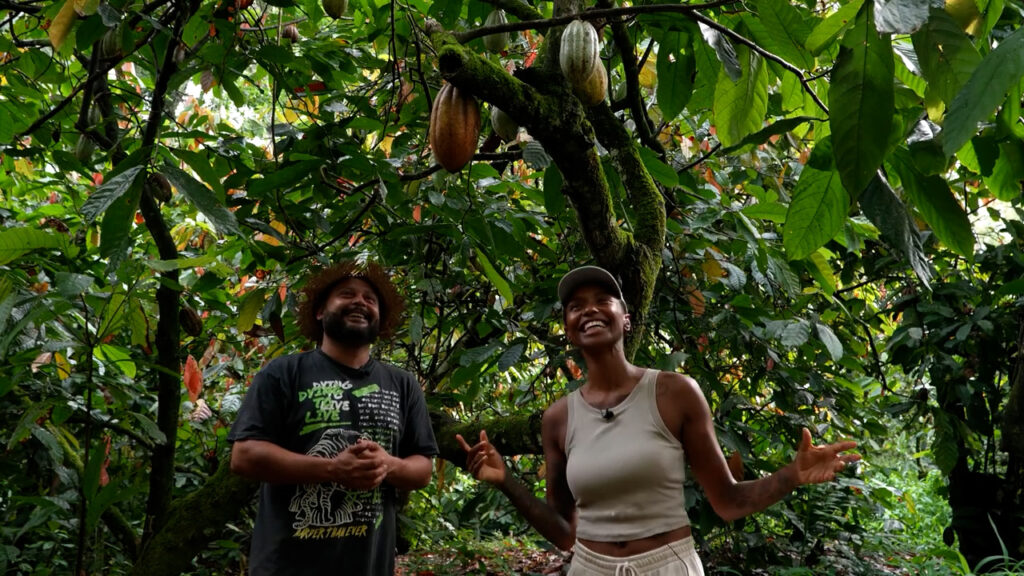
When Isaias speaks about La Chocolate Jungle, the subject is the farm: the cacao, the other plants, the growing environment, the harvest and the experience of following the process from fruit to chocolate. His work existed before I arrived, and it exists beyond the relationship with any one buyer.
That is what I want readers to remember. The farm is not an extension of a chocolate brand. The farmer is not a marketing asset. The ecosystem is not a decorative backdrop. These are the foundations of the product, and the people maintaining them deserve to be recognised as the people creating the value.
We should celebrate producers who take care of the land, who work to grow food in ways that respect the wider environment, and who are willing to let people see how the product is made. We should support organic farming and holistic methods where the evidence and the circumstances support them. We should ask for better terms for producers and greater transparency from buyers. And we should resist the idea that a famous logo deserves the credit for work done on a farm it does not own.
The standard should not be that a multinational occasionally buys something good. The standard should be that good agricultural practices become ordinary, that the people doing the work remain visible, and that every company buying cacao can explain where it came from and how its claims are supported.
Isaias calls himself the guardian of the jungle. That is the kind of role worth honouring. He is the person on the ground, working with the plants and the place where the cacao grows. Lindt is the buyer in this story. It should not be allowed to become the hero simply because its name is more familiar.
We give the point to the organic farm, to the ecosystem, to the knowledge and care behind the cacao. We do not give it to Lindt as a blanket endorsement. This is the kind of agriculture that should be the norm, not a premium exception.
Visit the source. Learn the process.
At La Chocolate Jungle, Isaias invites visitors to walk through the plantation, learn how cacao grows, explore its history and experience the process of making chocolate from scratch. It is an opportunity to encounter the ingredient at its source rather than knowing it only through a finished product.
If you are interested in buying organic cacao directly from the farm, contact Isaias to confirm current availability, certification details, wholesale quantities and shipping arrangements. Ask about the growing methods and the origin of the beans. Those are the details that matter when supporting a producer.
Contact La Chocolate Jungle
Continue exploring:
- From a cacao tree in Salcedo to a Lindt bar
- The people behind the bar: the hands a chocolate label rarely names
- The Cacao Directory
- The Ethical Chocolate List
The question is not whether a famous company deserves our loyalty. It is whether the people growing our food, and the ecosystems that make that food possible, receive the recognition, support and protection they deserve.