
Cabarete Sostenible
I went to Cabarete to eat lunch and I left understanding a whole model for feeding a town. Cabarete Sostenible is a community kitchen, a community garden and a food bank, and it is run by people who decided their neighbours would not go hungry. I spent the day on the ground here with Morena Cappelen, one of the co-founders, and she walked me through every corner of it herself, kitchen, beds and compost.
This is exactly the prep work I tell people about when they ask how I travel and still eat the way I do. When I land somewhere, I find the local farms, gardens and the people doing the real food work before anything else, because almost always they are happy to share. Cabarete Sostenible is that, scaled up into a whole town.
“My name is Morena Cappelen, and I’m one of the co-founders of Cabarete Sostenible. And this is where we are, the community kitchen and community garden.”
That is how she introduced herself, standing in the doorway. Cabarete Sostenible is a non-profit in Cabarete, on the north coast of the Dominican Republic, and Morena Cappelen co-founded it. It addresses food insecurity, and it does it by growing food, cooking food and giving food away.
Everything in this post comes from the tour she gave me that day, plus the gardener Jose Miguel and the co-founder and head coach Tomás Papo Soñé, who I also sat down with. If you only read one piece in this cluster, read this one, then follow the links to the rest.
What is Cabarete Sostenible
“La Cocina Comunitaria is our multi use social enterprise that we’ve created here as a way to generate funds for our mission of food insecurity in Cabarete,” Morena told me. “So the way it works is, first, the kitchen is open for events, for courses, for different activities that the community wants to use the space for. And then we also create some of our own programming.”
The kitchen pays for the mission. That is the engine.
“And then we have the comedor vegetariano, which is a vegetarian Dominican eatery. It operates for lunch during the week, Tuesday through Saturday. And basically we offer Dominican traditional food that is plant based.”
A comedor is a Dominican lunch spot, the everyday place where working people eat their main meal. Hers is vegetarian, which in this country is not the norm at all, and that is the whole point.
This is a Caribbean project, in the Dominican Republic, built on the kind of conscious, plant based thinking we hold to. I have written the vegetarian comedor up on its own in the vegetarian comedor serving ancestral dishes without the meat, because it deserves it.
Why a kitchen feeds a food bank
“The reason why we run a program like sustainable is because we like the town. We really like the community where we live. And we would like to have a better community,” Papo told me later, sitting down after the lunch rush.
“It’s pretty fair that we create this food system and this support for members of these communities that used to work, and nowadays they cannot do it. Unfortunately, because of their age, because maybe they are injured, maybe they are disabled. So yes, it’s a need for the community. To have a better community, we need to support our elders, our disabled. And we’re going to have a better community like that.”
The food bank grew out of the COVID lockdown of 2020, when Cabarete lives on tourism and tourism stopped overnight. The students and athletes of Academia de la Costa, the local jiujitsu academy Papo co-founded, were the first volunteers packing and distributing food. I have written that origin story in full in how UFC fighters built a food bank.
The garden behind the kitchen
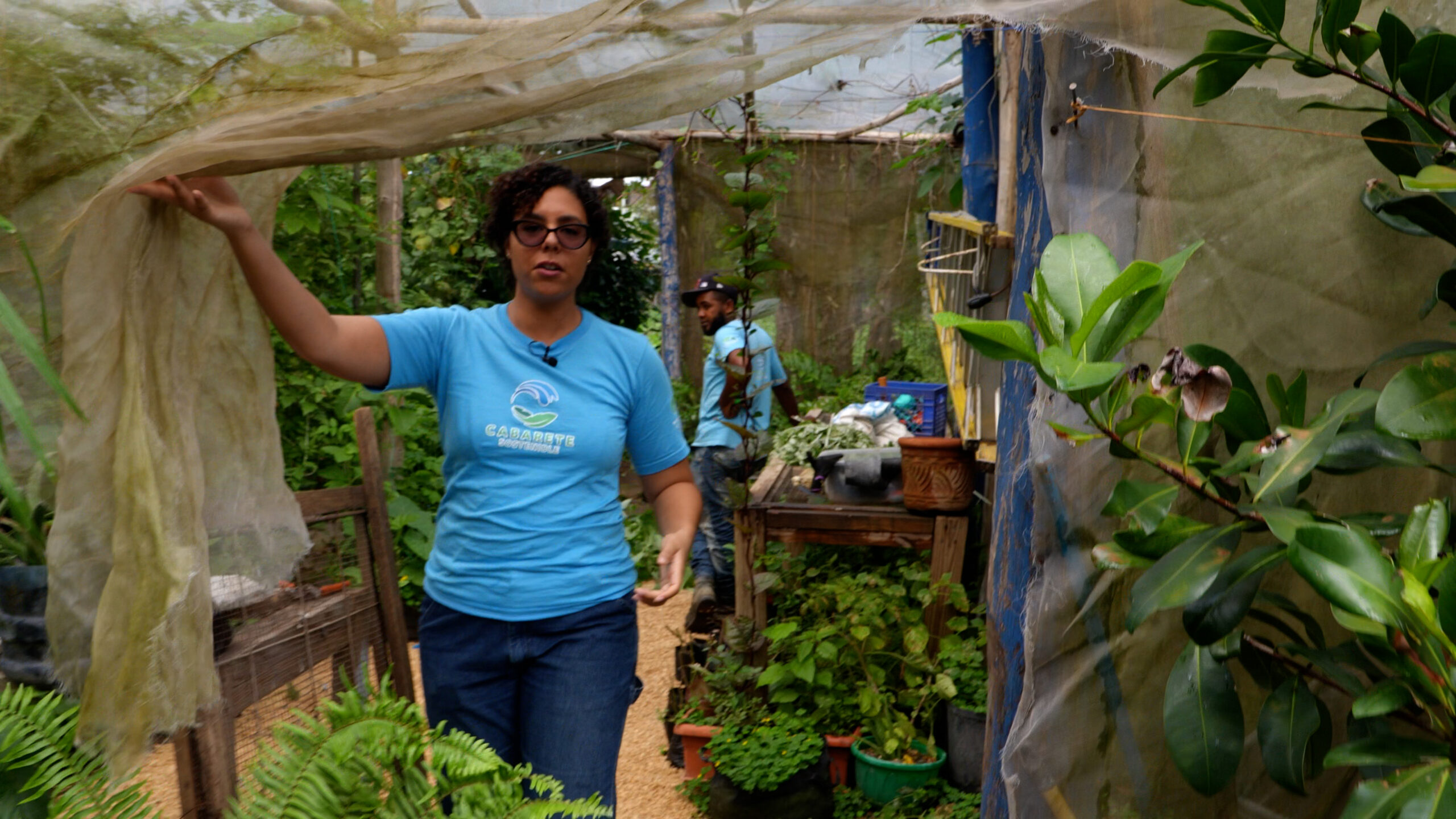
“This actually used to be the dojo of Academia de la Costa,” Morena said, standing in the greenhouse. “During the pandemic, due to the restrictions and the curfew, we had to shut down the dojo here and move it elsewhere. And we converted the structure into the greenhouse.”
The former dojo became a garden space. In Papo’s account, they used the old thatched roof material in making soil; he was not describing a garden built on top of the roof.
“So here we try to grow as much greens, vegetables and herbs as possible that we use in the kitchen and that we add to the food packages.”
Morena described growing greens, vegetables and herbs for the kitchen and food packages, and talked about the methods used in the garden. These were practices she described during the visit, rather than proof of organic certification or a chemical-free operation.
What a food bank means for us when we visit
Here is the reflection I keep coming back to. A community food bank is not a sad place. This one is loud, green, full of empanadas and cherry tomatoes and people who know each other.
When we travel, it takes very little to notice the real thing on the ground. You walk one street back from the beach and you see who is actually struggling, and who is quietly doing the work. Then you check in with them. You eat at their comedor. You volunteer for a morning. You leave a donation. That is conscious travel, the version with substance, not a hashtag.
Cabarete Sostenible runs on exactly that. As Papo put it, “nowadays it’s the whole community that supports this project.”
How to help Cabarete Sostenible
If this moved you, here is how to reach them and help, pulled from their own pages.
Cabarete Sostenible publishes its contact and donation information on its own website. When checked on 13 October 2026, the organisation reported 4,768 family emergency food packages and 1,613 hot meals distributed, and estimated that US$5 could feed one person for a week. These are its reported figures and fundraising estimate, not an independent impact audit. Check its donation page for the current programme.
Thank you for reading all the way to the end, my loves. You came for a place to eat in Cabarete and you found a town feeding itself. That is the good stuff. Go meet them. Eat the lentils, buy a neighbour a lunch, and if you can spare it, send a little to the food bank. See you in the next one.