Destinations › Asia · The Destination Index · Country data, sources and travel context
Maldives.
Southern Asia, group of atolls in the Indian Ocean, south-southwest of India. 298 sq km and 529,676 people, 644 km of coastline, tropical; hot, humid; dry, northeast monsoon (November to March); rainy, southwest monsoon (June to August).
Region · AsiaPopulation · ~529,676Languages · Dhivehi (official), English widely usedEco Index · 47/100 · Bad
The Eco Index across 12 pillars · scored 0 to 5 · World Bank, OWID, WHO/UNICEF JMP, FiBL, Protected Planet, IUCN, UNESCO (2023-24)
Water
Food & farming
Plant-based
Organic
Conservation
Wildlife
Materials
Pollution
Recycling
Energy
Culture
Heritage
The History of the Maldives.
Maldivian culture centres on Dhivehi, the language of the Maldivian people, written in its own Thaana script. Its music and dance show strong influences from East Africa, Arabia and the Indian subcontinent, a living record of the islands' place in Indian Ocean trade.
Where the name comes from
The country is Dhivehi Raajje in Maldivian, also called Dhivehi. In English the Maldives is a shortened form of the Maldive Islands, according to the UK Permanent Committee on Geographical Names.
The land itself: flat coral atolls on the submarine Chagos-Laccadive Ridge, almost none of it more than a couple of metres above the sea. Its high point is a point on Villingili, about 5 m. Source: UK Permanent Committee on Geographical Names toponymic factfile.
Where it starts
Centuries before the sultanate
Radiocarbon dates from Nilandhoo Foamathi put occupation here between AD 249 and 393, and a Buddhist monastery was probably first built at Kuruhinna Tharaagadu on Kaashidhoo between 345 and 604, then rebuilt between 833 and 1023. By 851 Arab traders were naming the islands Dibajat, and by around 950 merchants of Siraf and Oman were trading with these atolls. The islands held their own place in the Indian Ocean economy long before the sultanate.
How it got here
Conversion, copperplates and coral stone
By tradition the Maldives converted to Islam in 1153, when the king commissioned the country's first Friday Mosque in Male, and the Hukuru Miskiiy that stands there today was built in the 1650s. The Isdhoo Loamaafaanu copperplates of the 1190s, the oldest written records found in the Maldives, grant support to a mosque on Isdhoo and record the destruction of Buddhist monuments, while the Dhanbidhoo Loamaafaanu of 1196 records Buddhism being suppressed on that island. Ibn Battuta, visiting in the 1340s, noted that the islands had been exporting dried fish, coir and cowrie shells to Arabia a century before. A queen, Sultana Rehendi, held the throne three separate times in the same century.
The timeline
c. 150
Ptolemy records the islands.
Ptolemy briefly mentions the Maldives in his geography, around AD 150. ↗
249 to 393
The earliest occupation we can date.
Radiocarbon dates from Nilandhoo Foamathi on Faafu Atoll mark the earliest recorded occupation of the islands. ↗
345 to 604
A Buddhist monastery is built.
Probable first building of the Buddhist monastery at Kuruhinna Tharaagadu on Kaashidhoo Island, Kaafu Atoll. ↗
833 to 1023
The monastery is rebuilt.
A second phase of building at Kuruhinna Tharaagadu, so the monastery stood across several centuries. ↗
851
Named in the Indian Ocean trade.
Sulayman al-Tajir gives the earliest Arab reference to trade with Dibajat, a name taken to mean the Maldive and Laccadive islands together. ↗
c. 950
Merchants of Siraf and Oman.
Al-Mas'udi records merchants from Siraf and Oman trading with the islands. ↗
1141 to 1166
The last Buddhist king.
The reign of Sri Bawanaditta, the last Buddhist king of the Maldives, who converted to Islam in 1153 and took the name Sultan Muhammad al-'Adil. ↗
1153
Conversion to Islam.
The Maldivian king is converted to Islam by Shaykh Yusuf Shams al-Din al-Tabrizi, and commissions the country's first Friday Mosque in Male. ↗
1195 to 1196
Copperplate grants.
The Isdhoo Loamaafaanu copperplates record official grants for a new mosque, and also the destruction of Buddhist monuments and the confiscation of temple property. ↗
1343 to 1346
Ibn Battuta visits twice.
The Moroccan traveller Ibn Battuta visits twice and notes that the islands had been exporting dried fish, coir and cowrie shells to Arabia a century earlier. ↗
1347 to 1363
A queen rules.
The reign of Sultana Rehendi, Khadijah Kabadi Kilege, who ruled in her own right and returned to the throne twice more before 1379. ↗
1558 to 1573
Portuguese occupation and expulsion.
Sultan Ali VI is killed defending Male against the Portuguese in 1558. Portuguese rule lasts until Muhammad Bodu Takurufanu leads a force that expels them in 1573. ↗
1887
A British protectorate.
The sultanate becomes a British protectorate, retaining internal self-rule. ↗
1965
Independence.
The Maldives, now independent, joins the United Nations on 21 September 1965. ↗
Terrestrial protected areas were about 3% of the tiny land area in 2024 and formally protected marine areas only about 0.07% of territorial waters in 2021 (World Bank), strikingly low for an ocean nation. UNESCO Biosphere Reserves such as Baa Atoll and a scatter of protected dive sites give real but limited coverage. The Maldives is, however, a national shark sanctuary.
Is wild Maldives protected? 3% of the land is, against a 30% target for 2030
How protected is nature in Maldives?
Forest cover12.5%
Terrestrial protected area3%
Marine protected area0.07%
43 (mammals, birds, fish & plants) listed as threatened.
Found only here. Few terrestrial endemics; endemic reef fish, the Maldivian pond heron and the Maldivian flying fox.
The watchlist
ThreatenedHawksbill (Eretmochelys imbricata)Critically Endangered on the IUCN Red List, and recorded in Maldives in GBIF occurrence data (turtle).
ThreatenedFiddler (Rhynchobatus australiae)Critically Endangered on the IUCN Red List, and recorded in Maldives in GBIF occurrence data (shark or ray).
ThreatenedOrnate eagle ray (Aetomylaeus vespertilio)Critically Endangered on the IUCN Red List, and recorded in Maldives in GBIF occurrence data (shark or ray).
ThreatenedCommon eagle ray (Myliobatis aquila)Critically Endangered on the IUCN Red List, and recorded in Maldives in GBIF occurrence data (shark or ray).
ThreatenedBrown shark (Carcharhinus longimanus)Critically Endangered on the IUCN Red List, and recorded in Maldives in GBIF occurrence data (shark or ray).
ThreatenedGreat hammerhead (Sphyrna mokarran)Critically Endangered on the IUCN Red List, and recorded in Maldives in GBIF occurrence data (shark or ray).
ThreatenedHammerhead Shark (Sphyrna lewini)Critically Endangered on the IUCN Red List, and recorded in Maldives in GBIF occurrence data (shark or ray).
Critically Endangered, the last IUCN category before Extinct in the Wild, and still recorded in Maldives. The stored GBIF snapshot includes 492 occurrence records. This is not a live database total or a population estimate.
Fiddler (Rhynchobatus australiae)
Critically Endangered, the last IUCN category before Extinct in the Wild, and still recorded in Maldives. The stored GBIF snapshot includes 26 occurrence records. This is not a live database total or a population estimate.
Siderastrea siderea
Critically Endangered, the last IUCN category before Extinct in the Wild, and still recorded in Maldives. The stored GBIF snapshot includes 1 occurrence records. This is not a live database total or a population estimate.
Ornate eagle ray (Aetomylaeus vespertilio)
Critically Endangered, the last IUCN category before Extinct in the Wild, and still recorded in Maldives. The stored GBIF snapshot includes 18 occurrence records. This is not a live database total or a population estimate.
Species named here are drawn from GBIF occurrence records for Maldives filtered to the IUCN Red List threatened categories. Species are listed where GBIF holds occurrence records for them in this country. Record counts are not published here because the figure cannot be reproduced from a public GBIF query.
Listed and checked on My Ideal World. Visiting it is the most direct way a visitor funds work on the ground in Maldives.
Water and Ocean in the Maldives.
The Maldives has no rivers or lakes and its shallow freshwater lenses are limited and easily contaminated, so the country depends heavily on desalination and rainwater harvesting. The World Bank and JMP record 99.5% using at least basic drinking water in 2020, but on many islands that supply is desalinated or bottled rather than a secure natural source. Male and the resorts run on energy-intensive, climate-exposed desalination.
Freshwater resources and drinking water
National freshwater totals and withdrawal ratios describe overall resources and use. They do not establish reliable local or year-round access, or whether water is safe to drink. Drinking-water access and quality are measured separately. Freshwater-resource definition · Drinking-water service definitions.
Freshwater resources in the Maldives
Resorts pipe desalinated safe water; local islands are bottled.
Cleanest water: Outer-atoll lagoons and reef channels.
How much fresh water does the Maldives have, per person?
57 m³
Maldives
1,000 m³
the UN “water scarce” line
Maldives withdraws about 5 million cubic metres of fresh water a year (2022). That is 15.7% of the fresh water actually available to it, which FAO counts as low water stress. Of what is taken, farming takes 5%, homes and towns 95%, industry 5%. Source: FAO AQUASTAT.
What are the rules on Maldives beaches?
·Tap water: Varies.
✓Plastic rules: Phased single-use plastic import ban from 2021..
✕Solo travel: rated take care on the record for this destination.
✕Marine protection: 0.07% of the sea is protected. The 30x30 pledge for 2030 is not met yet.
Named on the open map: Artificial Beach, Ashifannu Beach, Bikini Beach, Heart Beach, Kanbihaa Beach, Maradhoo Rashikede Beach, Marcorni Beach, Rujjehere Beach. That is 15 named beaches in the public record for Maldives, each one a place you can look up before you go. OpenStreetMap.
Where does the sewage go?
99.7%
of people have at least basic sanitation
99.7% of people here use at least a basic toilet not shared with other households (2024, World Bank / WHO UNICEF JMP). No figure is published for how much of that waste is safely treated, so the share reaching the ground or the water untreated is unknown.
How is the sea around Maldives doing?
One cross-section, every answer measured.
Surface
What the coast carries
Two monsoons, both short-lived; Nov–Apr is calm and dry, May–Oct rainier.
Nearshore
Protected water
0.07% of territorial waters are protected, against the 30% pledged for 2030 under the Global Biodiversity Framework.
Cleanest
Where the water is cleanest
Outer-atoll lagoons and reef channels..
The record
Measured
The Maldives has no rivers or lakes and its shallow freshwater lenses are limited and easily contaminated, so the country depends heavily on desalination and rainwater harvesting. The World Bank and JMP record 99.5% using at least basic drinking water in 2020, but on many islands that supply is desalinated or bottled rather than a secure natural source.
The Maldives scored 75 out of 100 on the Ocean Health Index in its 2025 assessment, above the global average of 72, and ranked 56th of 220 coastal regions. The index team says it is no longer updating scores, so the 2025 figures may be the last.
Sea protected
0.1%
Against the 30% pledged for 2030 under the Global Biodiversity Framework.
Threatened species
43 (mammals, birds, fish & plants)
Mammals, birds, fish and higher plants on the IUCN list.
Is the tap water safe in Maldives?
In Malé, tap water is made by desalinating salty groundwater and is supplied by the state owned Malé Water and Sewerage Company, which says it tests samples from across the network at least once a day. The 2022 census found that everyone in Malé has access to treated or safe drinking water, yet 72 per cent of Malé residents drink bottled water. On the other islands only 59 per cent have safe drinking water, because 41 per cent drink rainwater from household tanks without boiling, chlorinating or filtering it. Outside Malé, drink bottled water or boil or filter rainwater first.
How hard is the water supply being pushed?
Reported water withdrawals: 15.7% of the freshwater resource measure described in the source below. Withdrawals run at 15.7% of what the Maldives renews internally each year (2022, World Bank / FAO AQUASTAT). That is inside the 25% mark generally treated as water stress, so the supply has headroom.
When is the best time to visit Maldives? Tap your month.
Tap your month.
JanFebMarAprMayJunJulAugSepOctNovDec
.
How much fresh water does Maldives actually have?
Nature renews about 57 cubic metres of fresh water per person per year here. That ranks the Maldives 7 of 208 countries measured, placing it among the 10 driest countries on Earth per person. The UN treats anything under 1,000 cubic metres as water scarce, and this is below that line. World Bank / FAO AQUASTAT.
With only about 4,000 hectares of arable land, the Maldives grows virtually no cereals and imports its rice and wheat. Islanders long relied on fish, coconuts and breadfruit, and a very productive fishery still supplies a good share of the food produced at home.
Where does the food in Maldives come from?
21.2% imported
about US$769m a year
On the plate: Rice, coconut, roshi flatbread, breadfruit, taro, bananas and tropical fruit.
2 of 10
bites are imported
Maldives buys in more food energy than it eats. About US$769m a year leaves the country to pay for it. The green slice is roughly what still grows here.
About 21.2% of everything the Maldives buys in from abroad is food, roughly 2 in every 10 imported items on the dock (2024, World Bank). Farming itself is 4.6% of the economy and 19.8% of the land is agricultural, of which 13.4% is arable. The green slice is roughly what still grows here.
What is killing people in the Maldives? The imported diet.
Cause of death, and the diet behind it.
Non-communicable diseases, all combined77.5%
Diabetes9.5%
Adults living with overweight or obesity. 52.5%.
Can the Maldives feed itself?
13.1%
Arable land
19.8%
Agricultural land
30,786
Farmers
9,884
Arable acres
4.6%
Agriculture, share of GDP
Harvest: Tuna fishing runs year-round; crop harvests are very limited.
Feeding itself
With very little cultivable land and a small farming workforce, the Maldives imports most staple foods, from rice and flour to fruit and vegetables. Domestic production is limited to some coconuts, a few vegetables and, above all, fish.
Certification
There is negligible agricultural land and no meaningful certified organic sector, and the Maldives is not listed in FiBL's organic farmland statistics. Food self-provisioning centres on fishing rather than farming.
Water for crops
The Maldives has no rivers or lakes and its shallow freshwater lenses are limited and easily contaminated, so the country depends heavily on desalination and rainwater harvesting. The World Bank and JMP record 99.5% using at least basic drinking water in 2020, but on many islands that supply is desalinated or bottled rather than a secure natural source.
Why the organic number looks like that. Certified-organic farmland is not separately reported for the Maldives, and that is a certification gap rather than proof nothing is grown cleanly. What the official land record does show: 19.8% of the country is agricultural land and 13.4% is arable (2023, World Bank). Certification is paid for per farm per year by a foreign body, which prices out smallholders, so the organic number reads worse than the practice.
The plant-based kitchen here is not an import. By tonnage, the largest crops grown in Maldives are papayas, bananas and coconuts (FAO, FAOSTAT crop production, 2024). That is what the land itself puts on a plate.
Buy where residents buy: Malé Fish Market, in the heart of the capital, is busiest in the early morning when the boats come in with mackerel and reef fish. Directly across the street, Malé Local Market sells fruit and vegetables, spices, nuts, local snacks and handmade souvenirs.
Not yet checked by us. No fully plant based kitchen is listed publicly in Malé; these list vegan options: High Tide, rooftop hotel restaurant in Malé with a vegan menu section; Seagull Café House, cafe in Malé that adapts dishes for vegans, with plant milks and dhal curry; Khanji Maldives Restaurant, Pakistani fusion restaurant in Malé with vegetarian dishes that can be made vegan; Citron by Lemongrass, waterside restaurant in Malé where several dishes can be made vegan; The Thai Palace, Thai restaurant at Club Blu in Malé, dishes made vegan on request. Tell us how they are.
The Maldives generates the overwhelming majority of its electricity from imported diesel, with renewables supplying only around 8 per cent in 2024 despite abundant sun. Emissions are the highest in this batch at roughly 3.57 tonnes of CO2 per person, driven by fuel imports and a tourism economy. The nation is among the world's most climate vulnerable and has pledged net zero, conditional on international support, alongside plans to scale up solar. For now, near total diesel dependence and modest renewable delivery keep it in the fossil reliant band.
What powers the Maldives?
Renewable 7.1%Fossil 92.9%
Electricity is supplied by state owned companies. STELCO, the State Electric Company, has been 100 per cent owned by the government since it was formed in 1997, and its roots go back to 1949. On 7 September 2026 President Muizzu announced that Fenaka Corporation, the other state utility, would be dissolved and its electricity, water and sewerage services moved to STELCO, as part of a wider shake up of state owned companies that will also cut staff. Handovers had already begun island by island, including K. Huraa in March 2026, and no completion date has been given.
Climate pollution per person
The safe amount, what the planet can absorb
2 tonnes
One person here
3.57 tonnes
The world average, for comparison
4.7 tonnes
The worst it ever got
5.3 tonnes
The grid
The Maldives generates the overwhelming majority of its electricity from imported diesel, with renewables supplying only around 8 per cent in 2024 despite abundant sun. Emissions are the highest in this batch at roughly 3.57 tonnes of CO2 per person, driven by fuel imports and a tourism economy.
Pollution
Annual mean PM2.5 is low, about 37.2 micrograms per cubic metre (University of Chicago AQLI, 2022), close to WHO guidelines. The country has begun phasing out single-use plastics, banning imports of a listed set of items from 2021.
Water stress
The Maldives has no rivers or lakes and its shallow freshwater lenses are limited and easily contaminated, so the country depends heavily on desalination and rainwater harvesting. The World Bank and JMP record 99.5% using at least basic drinking water in 2020, but on many islands that supply is desalinated or bottled rather than a secure natural source.
What pollutes most here
1The gridThe share of electricity still generated from fossil fuel.93%
2IndustryReef dredging and land reclamation, coral and turtle-shell souvenirs, and sand mining; choose reef-safe operators..named
3AirModelled annual mean against a WHO guideline of 5 µg/m³.37.2
4On the recordAnnual mean PM2.5 is low, about 37.2 micrograms per cubic metre (University of Chicago AQLI, 2022), still above the WHO guideline of 5 micrograms, though low by global standards.
What has the Maldives promised on climate?
Net zero, whole economy2030
Electricity renewable today5.8% (2021)
Land protected, against a 30% target3% by 2025
Sea protected, against a 30% target0.1% by 2025
The net-zero target year on file with Climate Watch is 2030, status: in law; in policy document; in political pledge. Measured against it, 5.8% of electricity is already renewable (2021, World Bank), so 94.2% of the grid is still to be converted. The pledge on file is measured here against what has actually been delivered, not taken on its own (UNFCCC NDC Registry, CBD Kunming-Montreal Target 3).
The biggest line item
One return flight against a whole year of living.
A resident's entire year3.57 t CO2e
Safe-climate budget, per year2 t CO2e
Los Angeles return, economy2.81 t CO2e
New York return, economy2.53 t CO2e
Sydney return, economy1.65 t CO2e
London return, economy1.54 t CO2e
Paris return, economy1.49 t CO2e
How much CO2 does flying to the Maldives emit?
Tap where you would fly from. One return flight, economy.
Los AngelesNew YorkSydneyLondonParis
.
Firsts on climate finance. In November 2015 the Green Climate Fund approved a US$23.6 million grant, run by UNDP, to help Maldivian islands cope with water shortages made worse by climate change. The project, worth US$28.2 million in total, aimed to reach about 105,000 people on 111 islands, and reports that it brought safe drinking water to 105,996 people on 29 islands. It is now complete.
Every prompt runs on a machine in a building on somebody’s grid. What that costs the planet depends less on the prompt than on what is burning to power it. Here is what would power one in the Maldives.
Data centres
1
Registered colocation and interconnection facilities, PeeringDB, 2026
Grid renewable
7.1 %
What a machine here runs on.
What powers a data centre in the Maldives?
Almost everything a machine here consumes is burned fossil fuel.
Renewable 7.1%Fossil 92.9%
Cooling water. Every one of those halls runs on the national grid, which is 5.8% renewable today (World Bank). A data centre is only as clean as the electricity behind it, so the same figure that decides this country's climate score also decides the footprint of the AI running inside it. Cooling water use is not separately published by facility, and no operator here reports it.
The rules. Maldives has 1 colocation and interconnection facilities on the public PeeringDB register, concentrated in Male' (1), alongside 1 internet exchange (MVIXP). Named sites include MVIXP Datacenter.
Where the cables land. 17 landing points · Dhangethi, Dhuvaafaru, Eydhafushi, Fuvahmulah
24% residents to 76% visitors across a year. 1,703,000 international arrivals in 2019 against 529,676 people who live here (2025, World Bank / UN Tourism).
Where a visitor dollar goes in Maldives
555k
Visitors a year
1.1
Visitors per resident
How deep in debt is the Maldives?· for every $100 the Maldives earns in a year, it owes…
Pay to the order of: the creditorsmemo · the 2020 peak
$ 156The worst year on the IMF record. The Maldives owed $156 for every $100 it earned.
IMF World Economic Outlook, 2020signed, the creditors
Pay to the order of: the creditorsmemo · today
$ 129What is owed now, for every $100 of national income (2026).
IMF World Economic Outlook, 2026signed, the creditors
Pay to the order of: the creditorsmemo · projected 2031
$ 132The IMF's own forecast has this rising to $132 by 2031.
IMF World Economic Outlook projection, 2031signed, the forecast
For every $100 the Maldives earns in a year, it owes $129 (2026, IMF World Economic Outlook). That is more than a full year of national income, and the interest is paid before anything else.
Where does a tourist dollar actually go in the Maldives?
Play one tourist dollar around the board. Every square is a measured fact from this page.
START!
1
GO: a visitor lands
$100 goes on the table. 1,703,000 international arrivals in 2019 against 529,676 residents, 3.2 visitors for every resident (World Bank / UN Tourism).
$100 in play
2
The bed
Who owns the largest places to stay in the Maldives is not published in the records we can check, so this square is left open rather than guessed. Where a listing names its owner, it is shown in the ownership table below.
not published
3
The plate
Food is 21.2% of everything the Maldives imports (2024, World Bank), so a large part of every restaurant bill is paid to a supplier abroad. Eating what the land here actually grows, fruits, vegetables, nuts, papayas, bananas, tomatoes, maize, pulses, chillies/peppers, keeps that money with the grower.
sails in
4
The power
94.2% of the electricity is fossil (2021, World Bank). Lighting, cooling and hot water are paid for largely in imported fuel.
burns away
5
What actually stays
Of the two parts of a visitor's bill that can be measured here, the plate and the power mostly leave the Maldives. Choosing locally grown food is the part of that a visitor can actually control.
less than you think
6
Pay the bank first
The Maldives owes $129 for every $100 it earns (IMF World Economic Outlook, 2026 projection). The interest is paid before anything else on this board.
$129 per $100
7
No plan B
70.6% of everything the Maldives sells abroad is fish and seafood (2023, UN Comtrade). One market moving takes the whole board with it.
70.6% one export
8
Community chest
Tourism earns 78.9% of everything the Maldives makes from exports (2020, World Bank / UN Tourism). That is how much of the economy depends on the game continuing.
78.9% of exports
9
The flight
Getting here is usually the biggest single line on the bill. From Los Angeles a return economy seat is 2.81 t CO2, on the UK Government's published conversion factors. It is the one part of the trip this board cannot reduce.
2.81 t CO2
10
Back to GO
The economy turns over about US$8 billion a year (IMF World Economic Outlook, 2026 projection). Every lap of this board is a choice about how much of it stays.
US$8bn
GDPUS$7.7bn
Agriculture, share of GDP4.6%
Visitors a year555,000
Visitors per resident1.1
Residents~529,676
Agriculture
Farming is 4.6% of the economy. With very little cultivable land and a small farming workforce, the Maldives imports most staple foods, from rice and flour to fruit and vegetables.
Natural materials
Traditional crafts include coir rope twisted from coconut husk and finely woven thundu kunaa reed mats, both still made on some islands. Cotton weaving and lacquerwork survive as heritage crafts.
Energy
The Maldives generates the overwhelming majority of its electricity from imported diesel, with renewables supplying only around 8 per cent in 2024 despite abundant sun. Emissions are the highest in this batch at roughly 3.57 tonnes of CO2 per person, driven by fuel imports and a tourism economy.
Who owns the biggest hotels in the Maldives?
By rooms · company records and press.
Kudadoo Private Island Maldives · ~15 roomsIndependentnot published
Six Senses Laamu · ~97 roomsCorporatemixed
Anantara Kihavah Maldives Villas · ~80 roomsCorporatenot published
Visitors, over time
20151,234k
20161,286k
20171,390k
20181,484k
20191,703k
2020555k
International tourism receipts run at about US$1.41 billion in 2020 (World Bank / UN Tourism). That is 78.9% of everything the country earns from exports.
How much of your money actually stays here?
Tap the holiday you are planning.
All-inclusive resortForeign-owned hotel and tourist restaurantsLocally owned stay and local restaurantsGuesthouse, markets and public transport
Resort guest, villa renter, family, nomad or backpacker. The honest playbook for each, from the same sourced numbers.
Already booked a resort? · the rescue list
Practical swaps that keep more of your money in the local economy
1. Eat where the country eats Choose kitchens cooking what the land here grows, rice, coconut, roshi flatbread, breadfruit, taro, bananas and tropical fruit, over an imported menu.
2. Book with a local operator Never the lobby desk. The margin on a tour is the part that stays.
3. Stay somewhere locally owned Ownership decides where the room rate books. Eco stays →
4. Use the transport residents use Seaplanes and speedboats to resorts, domestic flights between atolls, and public ferries and dhonis between local islands.
5. Buy the craft, not the souvenir Natural-materials work made here pays the maker directly; imported gifts pay a shipping line.
swipe →
First time here
A low-lying archipelago of coral atolls whose spectacular reefs and marine megafauna sit alongside near-total reliance on imported food, desalinated water and a resort economy.
Best time: Dry north-east monsoon.
Getting around
Seaplanes and speedboats to resorts, domestic flights between atolls, and public ferries and dhonis between local islands.
Transport is where the fare either stays or leaves.
Eating here
The everyday plate that actually grows here is rice, coconut, roshi flatbread, breadfruit, taro, bananas and tropical fruit. Ordering those keeps the money with the grower and cuts the imported share of the meal.
Eating what the country grows is the cheapest way to cut the import bill.
Good to know
USD widely used; cards in resorts. Dress modestly off-resort.
Rate my hotel. Tap yours for the honest verdict.
Ownership from company records and press.
Kudadoo Private Island MaldivesSix Senses LaamuAnantara Kihavah Maldives Villas
.
Who owns the big hotels
Kudadoo Private Island MaldivesIndependent · 15 rooms
Ownership is recorded here from each listing's own filings and company records. 1 of the 3 have a named owner, none of them local. That ownership line is what decides how much of a room rate stays in the country.
Society and Governance in the Maldives.
How well is the Maldives actually run?
Governance, measured · World Bank WGI
Four measured answers, none of them opinion. Averaged across corruption control, delivery and accountability, the Maldives scores 46 out of 100 (2024, World Bank Worldwide Governance Indicators). That matters here because every pledge on this page is only as good as the machinery meant to deliver it.
How well is Maldives run? · each scored out of 100, higher is better
Clean government, scored 41 of 100
Control of corruption scores 41.1 out of 100 (2024, World Bank Worldwide Governance Indicators). That is below the halfway mark of governments measured.
41
Freedom and rights, scored 50 of 100
Voice and accountability, which measures free expression, free media and the ability to choose a government, scores 49.6 out of 100 (2024, World Bank WGI). Citizens have some room to question their government.
50
Government effectiveness, scored 47 of 100
Government effectiveness, which measures the quality of public services and how well policy is actually delivered, scores 47 out of 100 (2024, World Bank WGI). Delivery is rated below average, so a pledge on paper is not the same as a pledge kept.
47
Income equality, scored 29 of 100
The Gini index of income inequality reads 29.3 (2019, World Bank). Zero is perfect equality and 100 is one person holding everything. Below 40 is the level usually treated as manageable, and the Maldives sits inside it.
29
LGBTQ+ status: IllegalSolo female travel: Take care98.2% adult literacyIndustry to avoid: Reef dredging and land reclamation, coral and turtle-shell souvenirs, and sand mining; choose reef-safe operators.
What is daily life in Maldives really like? Measured
Getting around, breathing, throwing away, learning. The honest checklist.
TransportAirWaterWastePower
✓How you get around Seaplanes and speedboats to resorts, domestic flights between atolls, and public ferries and dhonis between local islands.
✓Air quality, measured Modelled annual mean 37.2. The WHO guideline is 5 µg/m³.
✓Where the air is cleanest Outer atolls away from Male and Thilafushi.
✓Tap water Varies
✓What to drink Resorts pipe desalinated safe water; local islands are bottled.
✓Plastic rules Phased single-use plastic import ban from 2021.
✓Sockets and voltage Type A/B/C, 220V (varies)
98.2%
literacy. Public spending on education runs at 5.2% of GDP and 9.6% of all government spending, and secondary enrolment stands at 79.4% gross (UNESCO Institute for Statistics, 2023 to 2025).
Made in the Maldives.
Traditional crafts include coir rope twisted from coconut husk and finely woven thundu kunaa reed mats, both still made on some islands. Cotton weaving and lacquerwork survive as heritage crafts. Every step of processing done at home is value that stops leaving the country.
What Maldives actually sells the world
The single biggest thing Maldives sells the world is fish and seafood, 70.6% of all exports in 2023 (about US$0.11 billion, UN Comtrade). The next four are prepared meat and fish at 23.9%, iron and steel at 2.1%, animal feed residues at 2.1%, copper at 0.8%.
Sells now · 70.6% of exports
Fish and seafood
Fish and seafood is 70.6% of everything Maldives sold abroad in 2023, worth about US$0.11 billion. UN Comtrade.
Sells now · 23.9% of exports
Prepared meat and fish
Prepared meat and fish is 23.9% of everything Maldives sold abroad in 2023, worth about US$0.04 billion. UN Comtrade.
Sells now · 2.1% of exports
Iron and steel
Iron and steel is 2.1% of everything Maldives sold abroad in 2023, worth about US$0.00 billion. UN Comtrade.
Sells now · 2.1% of exports
Animal feed residues
Animal feed residues is 2.1% of everything Maldives sold abroad in 2023, worth about US$0.00 billion. UN Comtrade.
Sells now · 0.8% of exports
Copper
Copper is 0.8% of everything Maldives sold abroad in 2023, worth about US$0.00 billion. UN Comtrade.
Could make · grown here already
Skipjack tuna
Grown in Maldives and mostly sold raw. Processing it here would keep the margin here.
Could make · grown here already
Rice
Grown in Maldives and mostly sold raw. Processing it here would keep the margin here.
Could make · grown here already
Coconut
Grown in Maldives and mostly sold raw. Processing it here would keep the margin here.
The maths for an entrepreneur. the Maldives produces about US$8 billion a year, which is roughly US$14,615 per person (2025, World Bank). Farming is 4.6% of that, while food is 21.2% of everything the country imports. The country buys in more food than its own farms contribute to the economy, and every point of that gap is a business someone could build here rather than ship in. With 13.4% of the land arable, the raw material for that is already in the ground.
Bodu beru means big drums in Dhivehi. Drummers on coconut-wood drums and a lead singer perform at celebrations, festivals and Eid.
Thaara
Thaara jehun is a special form of entertainment kept for national events and celebrations.
Eid
Dhandi jehun
A dance performed across the country to celebrate festivities such as Eid.
Bandiyaa jehun
A dance once performed by all-women groups at cultural ceremonies. It has declined but is being revived.
Does Maldives protect its heritage by law?
Partly, and the gaps say as much as the protections.
What is kept alive. Maldivian culture centres on the Dhivehi language and a vibrant performing tradition. Bodu beru, the big drum music and dance of African influenced origin, is the signature living art and is still performed at gatherings across the islands. Other folk forms such as thaara, dhandi jehun and bandiyaa jehun remain alive, and dhoni boat building keeps a distinctive craft tradition going.
Who it belongs to. Maldivians have a distinct Dhivehi language, Islamic culture and island community traditions, and the growth of guesthouse tourism on inhabited islands since 2009 has spread more income locally. Much of the sector remains the enclave model of one island, one resort, where spending stays inside foreign-owned resorts. Local-island tourism is narrowing that gap slowly.
Only here. Hanifaru Bay, one of the world's largest feeding aggregations of manta rays, in the UNESCO Baa Atoll Biosphere Reserve..
Three futures for the Maldives, every one run forward from measured data.
Where the making actually happens
Named cultural and craft sites on the open map: Thinadhoo Museum Park (Thinadhoo), National Museum (Malé), Maldivian Police Museum (Malé), Maldives Philatelic Museum (Malé). OpenStreetMap.
Every measured trend on one line
Run forward at the pace already recorded.
+1%
Forest cover
1995: 12.4% → 2024: 12.5%
+173%
CO2 per person
1995: 1.31 t → 2024: 3.57 t
+76%
Tourist arrivals
1995: 315k → 2020: 555k
+329%
Protected land
2014: 0.7% → 2025: 3%
-56%
Farm workforce
1995: 25.6% → 2025: 11.3%
-26%
Agricultural land
1995: 26.7% → 2024: 19.8%
+66%
Urban population
1995: 25.5% → 2025: 42.5%
-58%
Air pollution
1995: 26.5 µg/m³ → 2023: 11.2 µg/m³
-51%
Fresh water per person
1995: 117 m³ → 2022: 57.2 m³
+140%
Adult overweight
1995: 21.9% → 2022: 52.5%
+19%
Electricity access
2000: 83.8% → 2024: 100%
+840%
GDP per person
1995: 1,555 → 2025: 14,615
+106%
Population
1995: 257k → 2025: 530k
-64%
Renewable energy use
1995: 3.3% → 2022: 1.2%
+21%
Life expectancy
1995: 67 yrs → 2024: 81.3 yrs
+144%
Cereal yield
1995: 1,000 kg/ha → 2024: 2,442 kg/ha
+1075%
Fertiliser use
2002: 6 kg/ha → 2024: 70.5 kg/ha
-23%
Rural population
1995: 74.5% → 2025: 57.5%
+292%
Water productivity
1995: 312 $/m3 → 2022: 1,220 $/m3
+20%
Health spending
2000: 7.74% → 2023: 9.25%
+0%
Forest area
1995: 37.2 km2 → 2025: 37.2 km2
+500%
Emissions: Building
1999: 0.01 MtCO2e → 2023: 0.06 MtCO2e
+2833%
Emissions: Electricity/Heat
1990: 0.03 MtCO2e → 2023: 0.88 MtCO2e
+1387%
Emissions: Energy
1990: 0.16 MtCO2e → 2023: 2.38 MtCO2e
+1025%
Emissions: Transportation
1990: 0.12 MtCO2e → 2023: 1.35 MtCO2e
+667%
Emissions: Waste
1990: 0.03 MtCO2e → 2023: 0.23 MtCO2e
World Bank open data, recorded series
How much forest is left?
Forest cover moved from 12.4% to 12.5% across 29 recorded years.
World Bank, Forest area (% of land area) (AG.LND.FRST.ZS) https://data.worldbank.org/indicator/AG.LND.FRST.ZS?locations=MV
How much climate pollution per person?
CO2 per person moved from 1.31 t to 3.57 t across 29 recorded years.
World Bank, Carbon dioxide (CO2) emissions excluding LULUCF per capita (t CO2e/capita) (EN.GHG.CO2.PC.CE.AR5) https://data.worldbank.org/indicator/EN.GHG.CO2.PC.CE.AR5?locations=MV
How many people visit?
Tourist arrivals moved from 315k to 555k across 25 recorded years.
World Bank, International tourism, number of arrivals (ST.INT.ARVL) https://data.worldbank.org/indicator/ST.INT.ARVL?locations=MV
How much land is protected?
Protected land moved from 0.7% to 3% across 11 recorded years.
World Bank, Terrestrial protected areas (% of total land area) (ER.LND.PTLD.ZS) https://data.worldbank.org/indicator/ER.LND.PTLD.ZS?locations=MV
How many people still farm?
Farm workforce moved from 25.6% to 11.3% across 30 recorded years.
World Bank, Employment in agriculture (% of total employment) (modeled ILO estimate) (SL.AGR.EMPL.ZS) https://data.worldbank.org/indicator/SL.AGR.EMPL.ZS?locations=MV
How much land is farmed?
Agricultural land moved from 26.7% to 19.8% across 29 recorded years.
World Bank, Agricultural land (% of land area) (AG.LND.AGRI.ZS) https://data.worldbank.org/indicator/AG.LND.AGRI.ZS?locations=MV
How fast is it urbanising?
Urban population moved from 25.5% to 42.5% across 30 recorded years.
World Bank, Urban population (% of total population) (SP.URB.TOTL.IN.ZS) https://data.worldbank.org/indicator/SP.URB.TOTL.IN.ZS?locations=MV
Is the air getting cleaner?
Air pollution moved from 26.5 µg/m³ to 11.2 µg/m³ across 28 recorded years.
World Bank, PM2.5 air pollution, mean annual exposure (micrograms per cubic meter) (EN.ATM.PM25.MC.M3) https://data.worldbank.org/indicator/EN.ATM.PM25.MC.M3?locations=MV
Is water getting scarcer?
Fresh water per person moved from 117 m³ to 57.2 m³ across 27 recorded years.
World Bank, Renewable internal freshwater resources per capita (cubic meters) (ER.H2O.INTR.PC) https://data.worldbank.org/indicator/ER.H2O.INTR.PC?locations=MV
Is diet-related disease rising?
Adult overweight moved from 21.9% to 52.5% across 27 recorded years.
World Bank, Prevalence of overweight (% of adults) (SH.STA.OWAD.ZS) https://data.worldbank.org/indicator/SH.STA.OWAD.ZS?locations=MV
Who has power?
Electricity access moved from 83.8% to 100% across 24 recorded years.
World Bank, Access to electricity (% of population) (EG.ELC.ACCS.ZS) https://data.worldbank.org/indicator/EG.ELC.ACCS.ZS?locations=MV
Is income rising?
GDP per person moved from 1,555 to 14,615 across 30 recorded years.
World Bank, GDP per capita (current US$) (NY.GDP.PCAP.CD) https://data.worldbank.org/indicator/NY.GDP.PCAP.CD?locations=MV
How fast is it growing?
Population moved from 257k to 530k across 30 recorded years.
World Bank, Population, total (SP.POP.TOTL) https://data.worldbank.org/indicator/SP.POP.TOTL?locations=MV
What share of all energy is renewable?
Renewable energy use moved from 3.3% to 1.2% across 27 recorded years.
World Bank, Renewable energy consumption (% of total final energy consumption) (EG.FEC.RNEW.ZS) https://data.worldbank.org/indicator/EG.FEC.RNEW.ZS?locations=MV
How long do people live?
Life expectancy moved from 67 yrs to 81.3 yrs across 29 recorded years.
World Bank, Life expectancy at birth, total (years) (SP.DYN.LE00.IN) https://data.worldbank.org/indicator/SP.DYN.LE00.IN?locations=MV
How much does a hectare of cereal produce?
Cereal yield moved from 1,000 kg/ha to 2,442 kg/ha across 29 recorded years.
World Bank, Cereal yield (kg per hectare) (AG.YLD.CREL.KG) https://data.worldbank.org/indicator/AG.YLD.CREL.KG?locations=MV
How much fertiliser goes on the land?
Fertiliser use moved from 6 kg/ha to 70.5 kg/ha across 22 recorded years.
World Bank, Fertilizer consumption (kilograms per hectare of arable land) (AG.CON.FERT.ZS) https://data.worldbank.org/indicator/AG.CON.FERT.ZS?locations=MV
How many people still live rurally?
Rural population moved from 74.5% to 57.5% across 30 recorded years.
World Bank, Rural population (% of total population) (SP.RUR.TOTL.ZS) https://data.worldbank.org/indicator/SP.RUR.TOTL.ZS?locations=MV
How much value per cubic metre of water?
Water productivity moved from 312 $/m3 to 1,220 $/m3 across 27 recorded years.
World Bank, Water productivity, total (constant 2015 US$ GDP per cubic meter of total freshwater withdrawal) (ER.GDP.FWTL.M3.KD) https://data.worldbank.org/indicator/ER.GDP.FWTL.M3.KD?locations=MV
How much goes on health?
Health spending moved from 7.74% to 9.25% across 23 recorded years.
World Bank, Current health expenditure (% of GDP) (SH.XPD.CHEX.GD.ZS) https://data.worldbank.org/indicator/SH.XPD.CHEX.GD.ZS?locations=MV
How much forest is there in total?
Forest area moved from 37.2 km2 to 37.2 km2 across 30 recorded years.
World Bank, Forest area (sq. km) (AG.LND.FRST.K2) https://data.worldbank.org/indicator/AG.LND.FRST.K2?locations=MV
How have building emissions moved?
Building emissions moved from 0.01 to 0.06 MtCO2e across 24 recorded years.
Climate Watch (WRI), historical emissions
How have electricity/heat emissions moved?
Electricity/Heat emissions moved from 0.03 to 0.88 MtCO2e across 33 recorded years.
Climate Watch (WRI), historical emissions
How have energy emissions moved?
Energy emissions moved from 0.16 to 2.38 MtCO2e across 33 recorded years.
Climate Watch (WRI), historical emissions
How have transportation emissions moved?
Transportation emissions moved from 0.12 to 1.35 MtCO2e across 33 recorded years.
Climate Watch (WRI), historical emissions
How have waste emissions moved?
Waste emissions moved from 0.03 to 0.23 MtCO2e across 33 recorded years.
Climate Watch (WRI), historical emissions
Worst caseCurrent pathBest case
Worst case
Every measured decline continues at the pace already recorded. The weakest pillar, organic farming at 1/5, is the one that gives way first.
Computed from: recorded series extended with no policy change
Current path
Every line above is a recorded World Bank series for this country. The current path is simply those series continuing at the pace already measured.
Computed from: recorded series, no policy change assumed
Best case
The pledges are met on their own stated timetables and the weakest pillars are lifted to match the strongest. Maldives already shows it can do this: water scores 5/5.
Computed from: each published target delivered on its own date
What the best case actually asks for
Lift organic farming
It scores 1 out of 5 today, among the weakest parts of Maldives's record. There is negligible agricultural land and no meaningful certified organic sector, and the Maldives is not listed in FiBL's organic farmland statistics. Food self-provisioning centres on fishing rather than farming. Scored as minimal on documented grounds.
measured each year
Costs: spending and enforcement, not new technology
Lift conservation
It scores 1 out of 5 today, among the weakest parts of Maldives's record. Terrestrial protected areas were about 3% of the tiny land area in 2024 and formally protected marine areas only about 0.07% of territorial waters in 2021 (World Bank), strikingly low for an ocean nation.
measured each year
Costs: spending and enforcement, not new technology
Lift recycling
It scores 1 out of 5 today, among the weakest parts of Maldives's record. There is no reliable national recycling rate and waste is largely landfilled, dumped or burned, with Thilafushi the emblem of the problem. Some resorts run their own recycling and glass reuse. Scored from documented reality rather than a published rate.
measured each year
Costs: spending and enforcement, not new technology
Government and Goals in the Maldives.
Who is in charge of Maldives now · Office-holders from the UN Protocol and Liaison Service public list of Heads of State and Heads of Government, 20 October 2026. Legislature and election dates from IFES ElectionGuide. Constitution dates from the Constitute Project. Governance scores from the World Bank Worldwide Governance Indicators 2024.
Mohamed Muizzu
President
Mohamed Muizzu is the head of government of Maldives, in office since 17 November 2023. Every climate, protection and energy pledge on this page is delivered, or not, under this administration.
Public opinion, measured
Voice and accountability, the freedom to question government scores 49.3 out of 100 in 2025. On this World Bank scale, 100 is the strongest governance measured. Down from 50.9 in 2024. World Bank Worldwide Governance Indicators, 2025 data (updated 25 September 2026) https://www.worldbank.org/en/publication/worldwide-governance-indicators
Control of corruption scores 41.3 out of 100 in 2025. On this World Bank scale, 100 is the strongest governance measured. Up from 40.8 in 2024. World Bank Worldwide Governance Indicators, 2025 data (updated 25 September 2026) https://www.worldbank.org/en/publication/worldwide-governance-indicators
Political stability and absence of violence scores 67.0 out of 100 in 2025. On this World Bank scale, 100 is the strongest governance measured. Up from 65.9 in 2024. World Bank Worldwide Governance Indicators, 2025 data (updated 25 September 2026) https://www.worldbank.org/en/publication/worldwide-governance-indicators
Rule of law scores 58.5 out of 100 in 2025. On this World Bank scale, 100 is the strongest governance measured. Down from 60.5 in 2024. World Bank Worldwide Governance Indicators, 2025 data (updated 25 September 2026) https://www.worldbank.org/en/publication/worldwide-governance-indicators
Regulatory quality scores 48.7 out of 100 in 2025. On this World Bank scale, 100 is the strongest governance measured. Down from 50.3 in 2024. World Bank Worldwide Governance Indicators, 2025 data (updated 25 September 2026) https://www.worldbank.org/en/publication/worldwide-governance-indicators
Mohamed MuizzuPresident
People's Majlis (Majlis)Legislature, unicameral
Last election21 April 2024
Constitution2008
Government typepresidential republic
Maldives national goals: climate commitments on record · as recorded by Climate Watch, World Resources Institute
2030
Net zero
In Law<br>In Policy Document<br>In Political Pledge
Net-zero target as recorded by Climate Watch. Status: In Law (4/29/2021) In Policy Document (12/28/2020) In Political Pledge (12/12/2020) ↗
The questions people actually type, answered in full sentences from the sourced data above.
swipe →
Is Maldives sustainable?
Maldives scores 47 out of 100 on the Throne Eco Index, across twelve equally weighted pillars. A low-lying archipelago of coral atolls whose spectacular reefs and marine megafauna sit alongside near-total reliance on imported food, desalinated water and a resort economy.
Is the water in Maldives safe and plentiful?
The Maldives has no rivers or lakes and its shallow freshwater lenses are limited and easily contaminated, so the country depends heavily on desalination and rainwater harvesting. The World Bank and JMP record 99.5% using at least basic drinking water in 2020, but on many islands that supply is desalinated or bottled rather than a secure natural source. Male and the resorts run on energy-intensive, climate-exposed desalination.
Can Maldives feed itself?
With very little cultivable land and a small farming workforce, the Maldives imports most staple foods, from rice and flour to fruit and vegetables. Domestic production is limited to some coconuts, a few vegetables and, above all, fish. Reef and tuna fisheries are the main local food source.
Is it easy to eat plant-based in Maldives?
The traditional diet is dominated by tuna, rice and coconut, with fresh vegetables and fruit largely imported and comparatively expensive. Plant-based eating is possible in Male and at resorts but is not the everyday local pattern. Local plant staples are mostly coconut-based.
How much of Maldives is actually protected?
Terrestrial protected areas were about 3% of the tiny land area in 2024 and formally protected marine areas only about 0.07% of territorial waters in 2021 (World Bank), strikingly low for an ocean nation. UNESCO Biosphere Reserves such as Baa Atoll and a scatter of protected dive sites give real but limited coverage. The Maldives is, however, a national shark sanctuary.
What wildlife is left in Maldives?
Maldivian reefs support well over a thousand fish species and world-class aggregations of manta rays and whale sharks, notably at Hanifaru Bay in Baa Atoll. Terrestrial endemism is low, but the marine life is genuinely exceptional. Coral bleaching, severe in 2016, is a growing threat.
Is Maldives on clean energy?
The Maldives generates the overwhelming majority of its electricity from imported diesel, with renewables supplying only around 8 per cent in 2024 despite abundant sun. Emissions are the highest in this batch at roughly 3.57 tonnes of CO2 per person, driven by fuel imports and a tourism economy. The nation is among the world's most climate vulnerable and has pledged net zero, conditional on international support, alongside plans to scale up solar.
How polluted is Maldives?
Annual mean PM2.5 is low, about 37.2 micrograms per cubic metre (University of Chicago AQLI, 2022), close to WHO guidelines. The country has begun phasing out single-use plastics, banning imports of a listed set of items from 2021. Waste management is the weak point, with the artificial island of Thilafushi a notorious rubbish dump where waste is openly burned.
Does recycling work in Maldives?
There is no reliable national recycling rate and waste is largely landfilled, dumped or burned, with Thilafushi the emblem of the problem. Some resorts run their own recycling and glass reuse. Scored from documented reality rather than a published rate.
Is the farming in Maldives organic?
There is negligible agricultural land and no meaningful certified organic sector, and the Maldives is not listed in FiBL's organic farmland statistics. Food self-provisioning centres on fishing rather than farming. Scored as minimal on documented grounds.
Are there natural materials and craft in Maldives?
Traditional crafts include coir rope twisted from coconut husk and finely woven thundu kunaa reed mats, both still made on some islands. Cotton weaving and lacquerwork survive as heritage crafts. Natural-materials traditions persist but have narrowed as imported plastics have spread.
Is there living culture in Maldives?
Maldivians have a distinct Dhivehi language, Islamic culture and island community traditions, and the growth of guesthouse tourism on inhabited islands since 2009 has spread more income locally. Much of the sector remains the enclave model of one island, one resort, where spending stays inside foreign-owned resorts. Local-island tourism is narrowing that gap slowly.
What heritage does Maldives keep alive?
Maldivian culture centres on the Dhivehi language and a vibrant performing tradition. Bodu beru, the big drum music and dance of African influenced origin, is the signature living art and is still performed at gatherings across the islands. Other folk forms such as thaara, dhandi jehun and bandiyaa jehun remain alive, and dhoni boat building keeps a distinctive craft tradition going.
So is the Maldives actually green? The measured answer
What is working: the record is thin on the headline measures, and the sourced numbers below say why.
What is not: land protected at 3% against a 30% mark, sea protected at 0.1% against a 30% mark, renewable electricity at 5.8% against a 100% mark.
Maldives sits 76 of 77 at 47/100. Every name links to its own destination page, built exactly like this one. The full ranking →
What is Maldives particularly good at?
✓Water, scored 5/5. The Maldives has no rivers or lakes and its shallow freshwater lenses are limited and easily contaminated, so the country depends heavily on desalination and rainwater harvesting. The World Bank and JMP record 99.5% using at least basic drinking water in 2020, but on many islands that supply is desalinated or bottled rather than a secure natural source. Male and the resorts run on energy-intensive, climate-exposed desalination.
✓Heritage, scored 4/5. Maldivian culture centres on the Dhivehi language and a vibrant performing tradition. Bodu beru, the big drum music and dance of African influenced origin, is the signature living art and is still performed at gatherings across the islands. Other folk forms such as thaara, dhandi jehun and bandiyaa jehun remain alive, and dhoni boat building keeps a distinctive craft tradition going. The living heritage is strong in music and dance but narrow in breadth and largely shaped by Islam and modern tourism.
✓Wildlife, scored 3/5. Maldivian reefs support well over a thousand fish species and world-class aggregations of manta rays and whale sharks, notably at Hanifaru Bay in Baa Atoll. Terrestrial endemism is low, but the marine life is genuinely exceptional. Coral bleaching, severe in 2016, is a growing threat.
Where does Maldives score worst?
✕Organic farming, scored 1/5. There is negligible agricultural land and no meaningful certified organic sector, and the Maldives is not listed in FiBL's organic farmland statistics. Food self-provisioning centres on fishing rather than farming. Scored as minimal on documented grounds.
✕Conservation, scored 1/5. Terrestrial protected areas were about 3% of the tiny land area in 2024 and formally protected marine areas only about 0.07% of territorial waters in 2021 (World Bank), strikingly low for an ocean nation. UNESCO Biosphere Reserves such as Baa Atoll and a scatter of protected dive sites give real but limited coverage. The Maldives is, however, a national shark sanctuary.
✕Recycling, scored 1/5. There is no reliable national recycling rate and waste is largely landfilled, dumped or burned, with Thilafushi the emblem of the problem. Some resorts run their own recycling and glass reuse. Scored from documented reality rather than a published rate.
Similar countries doing it better and worse
Sri LankaScored on the same twelve pillars as Maldives.65
IndiaScored on the same twelve pillars as Maldives.67
ThailandScored on the same twelve pillars as Maldives.62
PhilippinesScored on the same twelve pillars as Maldives.57
MongoliaScored on the same twelve pillars as Maldives.58
JordanScored on the same twelve pillars as Maldives.50
A note from the lens of mother natureswipe →
Organic farming, 1/5
There is negligible agricultural land and no meaningful certified organic sector, and the Maldives is not listed in FiBL's organic farmland statistics. Food self-provisioning centres on fishing rather than farming. Scored as minimal on documented grounds.
Consequence: It is the lowest-scoring part of Maldives's record, so it is where the score moves first.
Conservation, 1/5
Terrestrial protected areas were about 3% of the tiny land area in 2024 and formally protected marine areas only about 0.07% of territorial waters in 2021 (World Bank), strikingly low for an ocean nation. UNESCO Biosphere Reserves such as Baa Atoll and a scatter of protected dive sites give real but limited coverage.
Recycling, 1/5
There is no reliable national recycling rate and waste is largely landfilled, dumped or burned, with Thilafushi the emblem of the problem. Some resorts run their own recycling and glass reuse. Scored from documented reality rather than a published rate.
The Maldives Directory.
Everything on My Ideal World that sits in Maldives, checked and listed.
How the rest of the world scores Maldives
Independent global indices, for calibration.
Forest cover
12.5
World Bank, 2024.
Protected land
3.0
World Bank, 2025.
Protected sea
0.1
World Bank, 2025.
Renewable grid
5.8
World Bank, 2021.
CO2 per person
3.6 t (2024)
World Bank, 2024.
Threatened species
43 (mammals, birds, fish & plants)
Recorded figure, sourced on this page.
Control of corruption
41.3 / 100
World Bank Worldwide Governance Indicators, 2025. Score from 0 to 100, where 100 is the strongest governance.
Government effectiveness
47.4 / 100
World Bank Worldwide Governance Indicators, 2025. Score from 0 to 100, where 100 is the strongest governance.
Rule of law
58.5 / 100
World Bank Worldwide Governance Indicators, 2025. Score from 0 to 100, where 100 is the strongest governance.
Political stability
67.0 / 100
World Bank Worldwide Governance Indicators, 2025. Score from 0 to 100, where 100 is the strongest governance.
Voice and accountability
49.3 / 100
World Bank Worldwide Governance Indicators, 2025. Score from 0 to 100, where 100 is the strongest governance.
Environmental Performance Index
25.1 / 100 · 171 of 177
Yale Environmental Performance Index 2026, ranked 171 of 177 countries assessed.
Ecosystem vitality
23.2 / 100 · 170 of 177
Yale Environmental Performance Index 2026, ranked 170 of 177 countries assessed.
Biodiversity and habitat
6.3 / 100 · 176 of 177
Yale Environmental Performance Index 2026, ranked 176 of 177 countries assessed.
Air quality
48.0 / 100 · 63 of 177
Yale Environmental Performance Index 2026, ranked 63 of 177 countries assessed.
Terrestrial biomes protected
5.6 / 100 · 169 of 177
Yale Environmental Performance Index 2026, ranked 169 of 177 countries assessed.
Marine habitat protected
1.4 / 100 · 95 of 111
Yale Environmental Performance Index 2026, ranked 95 of 111 countries assessed.
Where the numbers come from.
The institutions above are the ones cited on this page, ranked by how many of its figures they carry. Read the full methodology
Every figure on this page, and where it came from: 70 sources across 30 institutions
World Bank16 FIGURES
Forest area (% of land area) AG.LND.FRST.ZS, Maldives 2.7% (2021) View source
Terrestrial protected areas ER.LND.PTLD.ZS, Maldives about 3% (2024) View source
Maldives CO2 emissions per capita (2022) View source
Threatened species (mammals EN.MAM.THRD.NO, birds EN.BIR.THRD.NO, fish EN.FSH.THRD.NO, higher plants EN.HPT.THRD.NO), 2022 View source
Renewable electricity output (% of total) EG.ELC.RNEW.ZS, 2021 View source
GDP (current US$) NY.GDP.MKTP.CD, 2025 View source
International tourist arrivals ST.INT.ARVL, 2020 View source
Agricultural land (% of land area) AG.LND.AGRI.ZS, 2023 View source
Arable land (% of land area) AG.LND.ARBL.ZS, 2023 View source
Agriculture, value added (% of GDP) NV.AGR.TOTL.ZS, 2025 View source
What a Waste 2.0 country-level dataset View source
GBIF occurrence search5 FIGURES
Critically Endangered species recorded in Maldives, Critically Endangered on the IUCN Red List, and recorded in Maldives in GBIF occurrence data (shark or ray). View source
Critically Endangered species recorded in Maldives View source
Critically Endangered species recorded in Maldives View source
Critically Endangered species recorded in Maldives View source
Critically Endangered species recorded in Maldives View source
Maldives Protected Areas portal5 FIGURES
Ministry of Climate Change, Environment and Energy, UNESCO Biosphere Reserves such as Baa Atoll and a scatter of protected dive sites give real but limited covera View source
Ministry of Climate Change, Environment and Energy View source
Ministry of Climate Change, Environment and Energy View source
Ministry of Climate Change, Environment and Energy View source
Ministry of Climate Change, Environment and Energy View source
Armstrong AO4 FIGURES
Stevens GMW, Townsend KA et al. (2021), 'Reef manta rays forage on tidally driven, high density zooplankton patches in Hanifaru Bay, Maldives', PeerJ 9:e11992, Hanifaru Bay, one of the world's largest feeding aggregations of manta rays, in the UNESCO Baa Atoll Biosphere View source
Stevens GMW, Townsend KA et al. (2021), 'Reef manta rays forage on tidally driven, high density zooplankton patches in Hanifaru Bay, Maldives', PeerJ 9:e11992 View source
Stevens GMW, Townsend KA et al. (2021), 'Reef manta rays forage on tidally driven, high density zooplankton patches in Hanifaru Bay, Maldives', PeerJ 9:e11992 View source
Stevens GMW, Townsend KA et al. (2021), 'Reef manta rays forage on tidally driven, high density zooplankton patches in Hanifaru Bay, Maldives', PeerJ 9:e11992 View source
Update of Nationally Determined Contribution of Maldives4 FIGURES
Ministry of Environment, 2020, submitted to the UNFCCC, The nation is among the world's most climate vulnerable and has pledged net zero, conditional on international View source
Ministry of Environment, 2020, submitted to the UNFCCC View source
Ministry of Environment, 2020, submitted to the UNFCCC View source
Ministry of Environment, 2020, submitted to the UNFCCC View source
FAOSTAT Production, Crops and Livestock Products (QCL), Asia bulk file, released 31 December 2025, By tonnage, the largest crops grown in Maldives are papayas, bananas and coconuts (FAO, FAOSTAT crop productio View source
FAOSTAT Production, Crops and Livestock Products (QCL), Asia bulk file, released 31 December 2025 View source
Other published sources3 FIGURES
GBIF occurrence search, Eretmochelys imbricata (hawksbill turtle) in Maldives; IUCN Red List category via GBIF, Critically Endangered on the IUCN Red List, and recorded in Maldives in GBIF occurrence data (turtle). View source
GBIF occurrence search, Eretmochelys imbricata (hawksbill turtle) in Maldives; IUCN Red List category via GBIF View source
GBIF occurrence search, Eretmochelys imbricata (hawksbill turtle) in Maldives; IUCN Red List category via GBIF View source
UNESCO Institute for Statistics3 FIGURES
public data API, indicator XGDP.FSGOV, government expenditure on education as a percentage of GDP, Maldives, Public spending on education runs at 5.2% of GDP and 9.6% of all government spending, and secondary enrolment View source
public data API, indicator XGDP.FSGOV, government expenditure on education as a percentage of GDP, Maldives View source
public data API, indicator XGDP.FSGOV, government expenditure on education as a percentage of GDP, Maldives View source
BirdLife International, IUCN and UNEP-WCMC2 FIGURES
UN SDG Global Database, terrestrial Key Biodiversity Areas covered by protected areas (%) ER_PTD_TERR, Maldives, 2025 (0%), country-reported View source
UN SDG Global Database, marine Key Biodiversity Areas covered by protected areas (%) ER_MRN_MPA, Maldives, 2025 (0%), country-reported View source
FAO, Global Forest Resources Assessment2 FIGURES
UN SDG Global Database, forest area (% of land area) AG_LND_FRST, Maldives, 2025 (12.5%), country-reported View source
UN SDG Global Database, forest area inside legally established protected areas (%) AG_LND_FRSTPRCT, Maldives, 2025 (0.81%), country-reported View source
IUCN2 FIGURES
The IUCN Red List of Threatened Species, conservation tool page, Critically Endangered, the last IUCN category before Extinct in the Wild, and still recorded in Maldives. View source
The IUCN Red List of Threatened Species, conservation tool page View source
Low Carbon Power2 FIGURES
Maldives electricity mix, about 7% solar and over 90% fossil (2023) View source
Kunming-Montreal Global Biodiversity Framework, Target 3, The 30x30 target is 30% by 2030, so 29.9 percentage points are still to be designated. View source
Corals of the World (Veron et al.1 FIGURE
Australian Institute of Marine Science), Siderastrea siderea distribution, Siderastrea siderea range View source
One of several surviving copperplate grants1 FIGURE
the Gamu plates of 1194/95 being earlier still and Maldivian writing going back to 6th century coral stone inscriptions; the Isdhoo grant went to a mosque on Isdhoo island, and it is the Dhanbidhoo plates that record a monastery removed for a mosque View source
Tied lowest1 FIGURE
water scores 1 out of 5 as well as food and farming View source
UN Protocol and Liaison Service1 FIGURE
Heads of State, Heads of Government and Ministers for Foreign Affairs, public list dated 20 October 2026 View source
UN Statistics Division, Energy Balances1 FIGURE
UN SDG Global Database, renewable share of total final energy consumption (%) EG_FEC_RNEW, Maldives, 2024 (1.4%), modelled estimate View source
University of Chicago EPIC1 FIGURE
Air Quality Life Index, annual mean PM2.5 View source
WHO/UNICEF JMP1 FIGURE
World Bank, At least basic drinking water SH.H2O.BASW.ZS, Maldives 99.5% (2020) View source
World Bank and UNEP-WCMC1 FIGURE
Marine protected areas ER.MRN.PTMR.ZS, Maldives 0.068% (2021) View source
World Bank Open Data1 FIGURE
indicator EN.GHG.CO2.PC.CE.AR5, Carbon dioxide (CO2) emissions excluding LULUCF per capita, Maldives, Emissions are the highest in this batch at roughly 3.57 tonnes of CO2 per person, driven by fuel imports and a View source

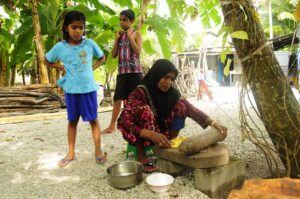
 Sri LankaScored on the same twelve pillars as Maldives.65
 IndiaScored on the same twelve pillars as Maldives.67
 ThailandScored on the same twelve pillars as Maldives.62
 PhilippinesScored on the same twelve pillars as Maldives.57
 MongoliaScored on the same twelve pillars as Maldives.58
 JordanScored on the same twelve pillars as Maldives.50