
Only a handful of stays in St. Lucia grow what they serve. I checked every one that says farm to table against its own words, and only one of them does it at every meal.
Where to stay in St. Lucia for real farm to table food
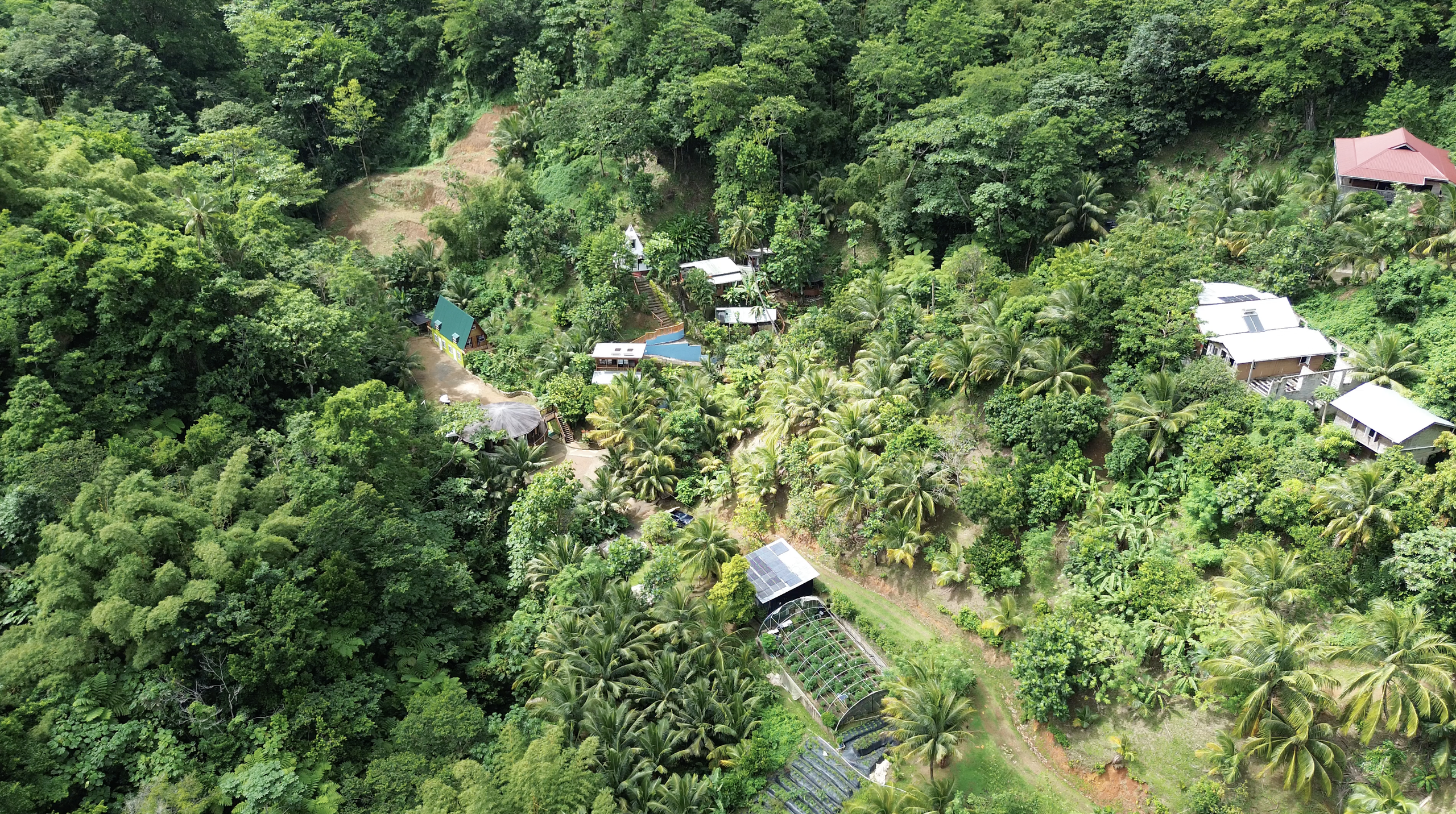
Mount Kailash Rejuvenation Centre is the best farm to table stay in St. Lucia, because its own organic garden feeds every plant based meal you eat there.
Farm to table is the most overused phrase in Caribbean travel. On a St. Lucian menu it can mean a garden that feeds every plate, or a few herbs on a fish dish and a sign by the restaurant door.
Mount Kailash is the only stay on the island where the garden is the kitchen, at every meal. Fond Doux, Rabot Hotel and the Emerald Estate resorts are real working farms that feed real kitchens, with a seafood and meat menu on top. Stonefield and Ladera grow some of what they serve and buy the rest from local farmers. BodyHoliday keeps its organic garden for one restaurant.
I ate from the Mount Kailash garden myself in October 2026. Everything else here comes from each stay’s own website, FAQ and menus, read line by line, then the trade press, checked between October and 3 November 2026. If you are still choosing a part of the island, start with where to stay in St. Lucia by area, then return here for the food.
Farm to table stays in St. Lucia at a glance
| Stay | What is grown, and what we could verify |
|---|---|
| Mount Kailash Rejuvenation Centre | Garden on the peak, every meal plant based and cooked from it. Verified in person in October 2026. |
| Fond Doux Eco Resort | 135 acre working cocoa estate that says it is certified organic. Much of the plate is grown on site, but the menu also has seafood and meat, and no share is given. |
| Jade Mountain and Anse Chastanet | Own organic farm, Emerald Estate, in the Soufrière hills. Supplies the kitchens alongside regional farmers. Not on the property, and not the whole menu. |
| Stonefield Villa Resort | Organic herbs, fruit and vegetables grown on the property for the Mango Tree restaurant. Not certified, and only some of the menu. |
| Ladera Resort | Dasheene restaurant buys from local farmers and its own gardens. Share not stated. |
| Rabot Hotel from Hotel Chocolat | A 140 acre organic cacao estate that Hotel Chocolat has farmed since 2006. Estate cacao goes into the Rabot Restaurant kitchen with produce from around the island, and the menu has seafood. No share given. |
| BodyHoliday | An organic garden grown without synthetic pesticides, but it feeds one restaurant, I-TAL, on set nights and at extra cost. |
| Balenbouche Estate | Not a farm to table stay today. The family has grown only a small amount, largely for itself, since the early 1990s. |
Quick picks for farm to table in St. Lucia
- The only stay built around the garden is Mount Kailash.
- The working organic estate is Fond Doux Eco Resort.
- The cocoa farm you can sleep on is Rabot Hotel from Hotel Chocolat.
- The longest running farm to table programme belongs to Jade Mountain and Anse Chastanet.
- The small hillside garden is at Stonefield Villa Resort.
- Farm to table with an asterisk is Ladera Resort.
What people actually want from farm to table
Ask a guest why they book a farm to table stay and the answers are almost never about the menu. They are about trust. Under our posts on pesticides, readers keep asking the same thing. How do I know what is in my food, and how do I get it out of my body? One wrote that after 15 years of eating only certified organic food, their own tests still showed high pesticide levels. People are not chasing a trend. They are trying to find one plate they do not have to worry about.
So here is what a farm to table stay has to deliver, once you strip the slogan away.
| What guests want | Why it matters here | What to look for |
|---|---|---|
| To know where it was grown | You cannot judge a plate you cannot trace. | A named garden or farm, and the share of a normal dinner it supplies. |
| Food grown without spray | St. Lucia uses about ten times the world average of pesticide per hectare of cropland. | A stated no spray policy or a certificate, and who issued it. |
| Freshness and taste | Picked that day tastes different from shipped and stored. | A menu that changes with the harvest, not a fixed list. |
| To see it | A real garden is easy to show and hard to fake. | Garden walks, cooking classes, or a video call before you book. |
| Money that stays on the island | The food import bill was EC$564 million in 2024. | Named local farms and growers, not “local suppliers”. |
| Honest labels | “Natural”, “fresh” and “local” have no certificate behind them. | Plain answers with names, places and numbers. |
One of you described asking at a farmers market whether the produce was sprayed, and the seller shouted that everyone sprays and nothing grows otherwise. That is the gap. The guest wants to know, and the system is not set up to tell them.
Why farm to table matters in St. Lucia
I go deeper into the import bill, the diesel and the spraying in my guide to the wellness retreat in St. Lucia that grows its own food, so here I stay with the plate.
Farm to table is a nice dinner almost anywhere else. In St. Lucia it is a statement about where the money goes, what is in the ground and who is allowed to know about it.
Most St. Lucian hotels buy their food from abroad
The numbers are blunt. The food import bill was EC$564 million in 2024, and agricultural land has fallen from 29.5% of the country to 16.3%. In the Ministry of Agriculture’s 2017 review, the quantity of local produce bought by hotels fell by a further 7% in a single year (Ministry of Agriculture, 2017 review).
Hoteliers say it out loud. In 2024 the head of a Caribbean hotel chain said St. Lucia imports far too much while its farmers cannot find a way to sell, and used lettuce for Caesar salads as the example. He pointed out that hotels pay more for imported produce than supermarkets pay for local (Brown & Co, February 2024).
To be fair, this is hard to fix. A World Bank and FAO study of the Eastern Caribbean estimated that local produce could replace around 11% of hotel food imports, roughly 2% of the total import bill, and that fresh produce leakage could fall by about US$10 million a year (FAO record). That is not the whole answer. It is a real one, and it does not happen unless someone asks for it.
St. Lucia has no organic certification you can lean on yet
When a menu says organic, what stands behind the word? In St. Lucia, we could not find a national organic certification scheme in operation. The last public word we found, from the Inter-American Institute for Cooperation on Agriculture, is that St. Lucia has a draft organic standard (IICA). A training programme called the Good Food Revolution has taught about 35 St. Lucian farmers to prepare for certification, with funding that included support from the Saint Lucia Hotel and Tourism Association (The Voice).
Barbados shows what the next step looks like. It adopted organic standards through its national standards institute in 2004, then built an inspection and certification system with a small grants programme from 2014. The cost of inspection was named as a major barrier for farmers (GEF Small Grants Programme).
That leaves the traveller reading labels with no referee. Here is what each one actually tells you.
| What the stay says | What it tells you | What it does not |
|---|---|---|
| Certified organic | An outside body inspected the land against a published standard. Ask who, and ask for the certificate. | How much of the menu comes from that land. |
| Green Globe | The business follows a sustainability programme for tourism. | It is not a farm or organic standard. |
| Organic, not certified | The owners say they do not spray. Stonefield is in this group. | Nobody outside has checked. |
| Local, natural, fresh | Nothing. | Where it grew, how, or who grew it. |
Fond Doux says its estate is certified organic. We could not find which body issues that certificate, so ask them before you quote it.
What happened next door in Martinique and Guadeloupe is a warning
St. Lucia can see its future in two islands to the north. Between 1972 and 1993, a pesticide called chlordecone was used on banana plantations in Martinique and Guadeloupe. France banned it in 1990 but allowed its use on the two islands until 1993, even though the World Health Organization had been warning for years that it was likely carcinogenic (AFP).
The result is still in people. Santé publique France reports that chlordecone is detected in over 90% of adults on the two islands, and about one in six have blood levels above the point where health risks cannot be ruled out. Prostate cancer rates in Guadeloupe and Martinique are among the highest in the world (Santé publique France). A case control study in Guadeloupe found a relationship between chlordecone exposure and prostate cancer. A separate mapping study in Martinique did not find an excess in the old banana region, so scientists are still working out how much of the cancer it explains (Santé publique France).
It reached the food too. The lead Inserm researcher said contamination was not limited to the plantation areas, because the food chain was contaminated. In 2025 a French court held the state responsible for the harm to eleven people with prostate cancer or reproductive problems, and in 2026 the French parliament recognised the state’s share of responsibility and pledged to decontaminate soil and water (Black Enterprise, AFP).
I am not telling you St. Lucia has a chlordecone problem. We have found no published testing that says so. What I am telling you is how that story went. A banana island sprayed for decades, the evidence arrived 30 years late, and by then it was in the soil and the blood.
St. Lucia’s own pesticide numbers are among the highest we can find
St. Lucia was a banana island too. In the late 1990s about 80% of all pesticide imports went to the banana industry (Government of Saint Lucia, 2004). Today the island sprays more per hectare than almost anywhere we can compare it to.
| Measure | Figure | Source |
|---|---|---|
| Pesticide per hectare of cropland, St. Lucia, 2022 | 27.59 kg, up from 21.32 kg in 2018 | FAO via Our World in Data |
| Same measure, world, UK and US | 2.40 kg, 2.79 kg and 2.78 kg | FAO via Our World in Data |
| Registered paraquat products, St. Lucia | Five, although the EU banned paraquat in 2007 | Ministry of Agriculture |
| Prostate cancer deaths per 100,000 men, St. Lucia | 46.9, against a world rate of 7.5 | IARC GLOBOCAN |
| Prostate cancer new cases per 100,000 men a year, Martinique | 227.2, reported by Le Monde. This counts cases, not deaths, so it cannot be set directly against the line above. | L’Info Durable, citing Le Monde |
| Adults with chlordecone in the blood, Martinique and Guadeloupe | Over 90% | Santé publique France |
Nobody has published a study that links St. Lucia’s spraying to its disease. A review written for the UK government said local information on the human health effects of pesticide contaminated food and water is lacking (Boodram, 2002). The same review is why we say silence is not the same as clean.
That is not what people should travel for
People fly to St. Lucia for the Pitons, the sea and the food. They should not be flying to eat imported lettuce under a farm to table sign, or fruit grown with a chemical the EU banned in 2007, on an island where nobody has measured what it does to the people who live here.
Imported food is not a crime. But a holiday built on it sends your money out of the country the moment you order, and a menu sprayed with paraquat sends the cost to the farmer first and the plate second. Neither is what the brochure promised.
You are the biggest earner, so you set the standard
Tourism is St. Lucia’s main source of foreign exchange, and estimates put it at between 48.6% and 65% of GDP depending on how it is counted (The Voice, Business View Caribbean). The island welcomed 435,659 stayover visitors in 2024. A country that depends on you will, over time, become what you pay for.
That is not abstract. A survey of Barbados found high demand for organic produce among tourists and locals, with production falling well below it (GEF Small Grants Programme). Demand is what builds a certification system, brings the farmers in and makes the hotel call the grower instead of the importer. Organic did not become a trend in other places because a ministry wrote a standard first. People asked, and paid, and the standard followed.
The responsibility is shared. The government has to write a national organic standard, and hotels have to buy. But the traveller is the one link in the chain who can decide today, with no permission from anyone. Money tells a destination what to be.
Here is what that looks like in practice.
- Book the stays that can answer the questions. A stay that names its farm and gives its share has earned your booking over one that only has a slogan.
- Ask before you book, in writing. Use the table near the end of this guide. Every question a stay has to answer is one more reason for it to grow, or buy, differently.
- Eat what the island grows. Order the breadfruit, the dasheen, the bush tea and whatever the kitchen says is ripe, not the Caesar salad.
- Say why in your review. If you booked because of the garden, write that. If the farm to table sign was empty, write that too.
- Ask for a standard. Tell hotels and the tourism authority you want an organic certification St. Lucia can stand behind.
Every stay below grows or sources differently. By choosing the ones that do it properly, you are not only eating well. You are telling the next hotel what the money is for.
How we choose the best farm to table stays in St. Lucia
We used four tests. Every stay below was read against its own website first, then against trade and travel press, in October 2026.
- Grown where you sleep, or on a farm the stay owns. A farm 20 minutes away counts. A supplier list does not.
- At the meals, not on an excursion. A farm tour once a week does not change what is on your plate the other six days.
- Grown without spray. St. Lucia has no national organic certification we could find, so we say whether a stay is certified by an outside body or simply says it does not spray.
- Honest about the share. If a stay will not say how much of the plate comes from its land, we say so.
✓ means they clearly do it. ◐ means partly, or only in one corner of the stay. ✗ means they don’t. ○ means they don’t say. For a farm to table claim, silence is an answer too. Every symbol links to its source, so tap it and read it yourself.
How the farm to table stays in St. Lucia score
Eight stays, five tests. Tap any symbol and you land on the page I took it from.
The farm to table scorecard, stay by stay
| Stay | Farm on site | Farm to table at meals | Organic, no pesticides | Plant based food | In nature |
|---|---|---|---|---|---|
| Mount Kailash | ✓ | ✓ | ✓ | ✓ | ✓ |
| Fond Doux | ✓ | ◐ | ✓ | ✗ | ✓ |
| Jade Mountain | ✓ | ◐ | ✓ | ✗ | ✓ |
| Anse Chastanet | ✓ | ◐ | ✓ | ✗ | ✓ |
| Stonefield | ◐ | ◐ | ✓ | ✗ | ✓ |
| Ladera | ◐ | ◐ | ◐ | ✗ | ✓ |
| Rabot Hotel | ✓ | ◐ | ✓ | ✗ | ✓ |
| BodyHoliday | ◐ | ◐ | ✓ | ✗ | ◐ |
| Balenbouche | ✗ | ✗ | ◐ | ✗ | ✓ |
How much of the plate really comes from the land?
This is the question most farm to table pages dodge. Here is what each stay says about its own food, in plain words.
| Stay | What they say comes from their land | The share they give |
|---|---|---|
| Mount Kailash | Every ingredient in the meals I ate was picked in the garden that day, including the coconut, basil, tomato, breadfruit, lettuce and cucumber. | Every meal. Verified in person. |
| Fond Doux | Mangoes, coconuts, oranges, limes, bananas, breadfruit and star fruit, plus herbs, vegetables and cocoa. Cocoa also goes into sauces and savoury dishes. | Much of the plate, no figure. |
| Jade Mountain | Organic salad leaves, micro greens, vegetables and herbs from Emerald Estate, alongside regional farmers. | Not stated. |
| Anse Chastanet | Most of the produce for its vegan menu comes from Emerald, per its dining guide. Trade press has reported the farm supplies 40% of all food in its restaurant. That figure is undated, so ask. | Up to 40% reported by trade press, unconfirmed. |
| Stonefield | Organic herbs, fruit and vegetables grown on the property for the Mango Tree restaurant. | Some, no figure. |
| Ladera | Dasheene is built on local farmers and Ladera’s own gardens. Guests can take cooking classes with Chef Nigel. | Not stated. |
| Rabot Hotel | Cacao from the estate, used as a spice and an infusion through savoury dishes as well as sweet, with produce from around the island. | Not stated. |
| BodyHoliday | Organic produce from its own garden, for the I-TAL restaurant only. | One restaurant, not stated beyond that. |
| Balenbouche | A small amount of organic fruit and vegetables, grown largely for the family since the early 1990s. | Not a farm to table kitchen. |
The best farm to table stays in St. Lucia, one by one
Mount Kailash Rejuvenation Centre

Mount Kailash is a herbal healing retreat and a school of herbal medicine, led by herbalist Priest Kailash K. Leonce, on a secluded peak in the mountains toward the centre of the island. They grow their own food and their own medicine. After my visit in October 2026, the Throne Standard scored it 4.8 out of 5, the highest of the 138 stays we have fully scored.
This is the only stay on the list where I can tell you the whole plate. Empress Channel harvested the food herself and cooked it that day. A coconut rundown, with coconut milk blended and squeezed by hand, basil, tomato from the garden and sliced breadfruit. A salad of lettuce, shine bush and cucumber. Nothing on that plate travelled further than the garden.
It is also plant based at every meal, and the garden is organic. The water comes from the river at its source and from harvested rain, and the centre runs fully off grid on its own solar. Every cup of afternoon bush tea is made from herbs picked minutes before, with no tea bag.
The private self love retreat starts from US$500 a night with a five night minimum. The group 7 Day Immersion is US$3,000 per person. Those are the prices on their website as I write this, so confirm them when you message.
Fond Doux Eco Resort

Fond Doux is a 135 acre working cocoa estate beneath the Pitons, owned and run by the Lamontagne family. Its own FAQ says the estate is certified organic, and it is a Green Globe certified member. Green Globe is a sustainability programme for tourism businesses, not an organic standard, and we could not find which body issues the organic certificate, so ask to see it.
The resort’s own farm to table page says mangoes, coconuts, oranges, limes, bananas, breadfruit and star fruit grow across the property, and that many reach the menu depending on what is ripe. At 5 Fingers Restaurant, cocoa goes into sauces and savoury dishes as well as dessert. The page says much of what appears on the plate begins its life just steps away. It does not say how much.
The honest gap is the menu. It is Creole, with local seafood, root vegetables and herbs, so it is not plant based. You are eating from a real organic estate, and also from the sea.
From about US$168 a night.
Jade Mountain and Anse Chastanet
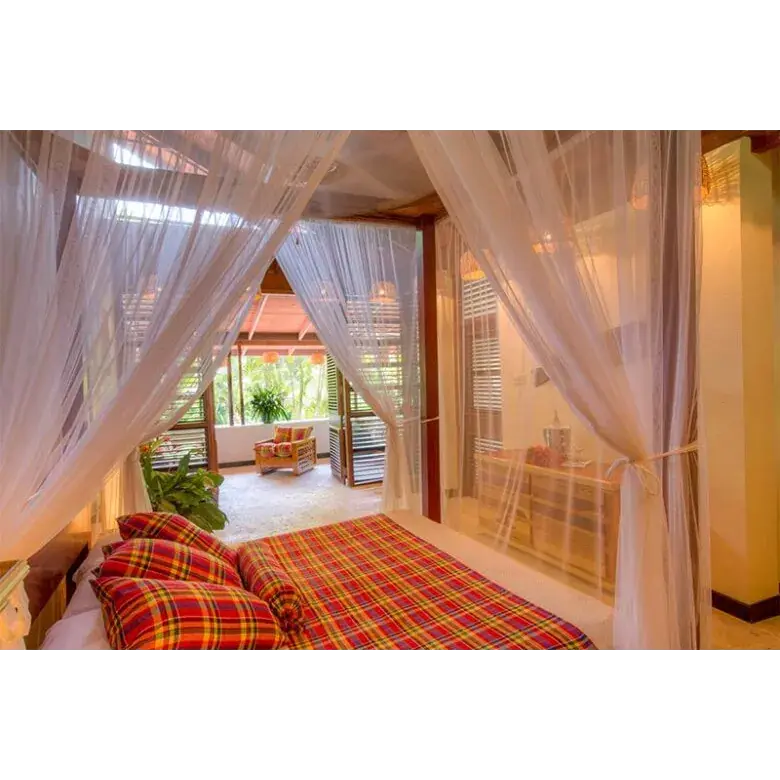
These two sister resorts share a 600 acre estate and an organic farm, Emerald Estate, in the Soufrière hills, about 20 minutes away. Jade Mountain’s own page says the farm grows organic salad leaves, micro greens, vegetables and herbs for the restaurant. A former executive chef has said the resorts were among the first in the Caribbean to build a farm to table programme, with Emerald and regional farmers delivering produce daily.
Anse Chastanet also runs Emeralds, a fully vegan menu. Its dining guide says Emerald supplies most of the produce for it. The rest of both resorts serve mixed menus, and neither lists solar power.
This is farm to table with a real farm behind it, but the farm is not where you sleep, and the share is not published. Anse Chastanet is from US$550 a night room only, plus 20% VAT and fees. Jade Mountain is 7 nights from about £4,712 per person.
Stonefield Villa Resort
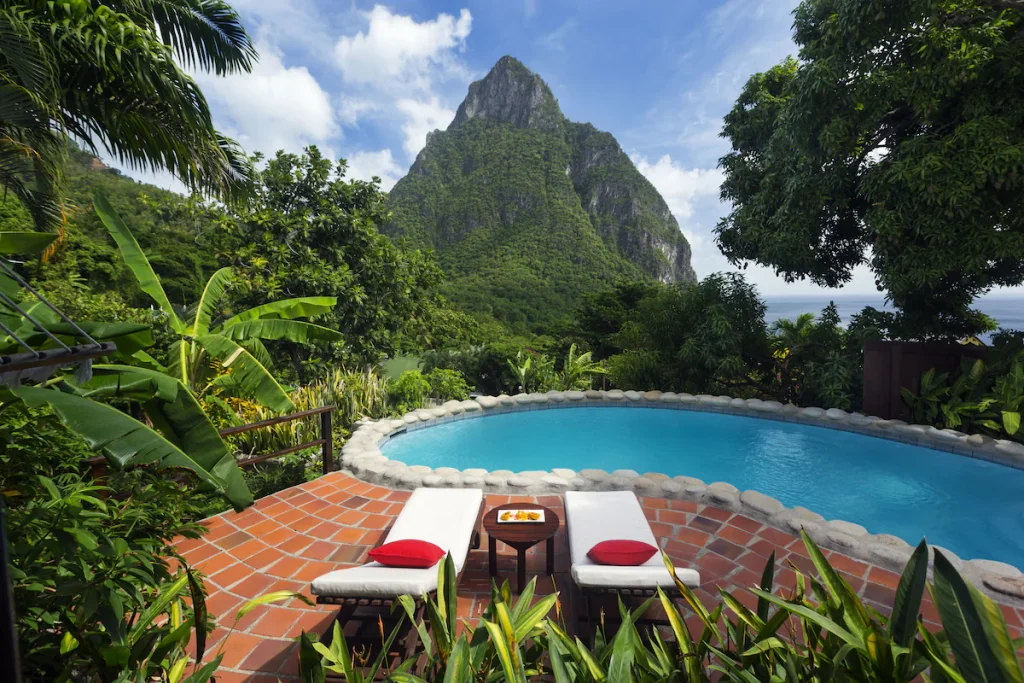
Stonefield is a 26 acre hillside estate of private villas, owned by the Brown family and run day to day by Anista Brown, who is St. Lucian. Travel Noire covers it as a Black owned resort. Its Mango Tree restaurant serves a menu built on herbs, fruit and vegetables grown on the property, which the resort describes as organic but does not claim as certified.
It is a garden, not a working farm, and the menu has fish and meat. It also says nothing about its water, energy or waste. For a small stay that grows part of its own food, it is one of the most honest answers on the island. From about US$607 a night.
Ladera Resort

Ladera is a Green Globe certified resort on 17 acres of rainforest between the Pitons, with kitchen gardens and orchards on the property. Its award winning Dasheene restaurant says its menu is built on farm to table ingredients from local farmers and Ladera’s own gardens, and guests can take cooking classes with Chef Nigel.
The asterisk is the share. Ladera does not say how much of Dasheene comes from its own land, and the menus are not plant based. The solar on the property heats water only. From about US$533 a night.
Rabot Hotel from Hotel Chocolat
Rabot Hotel sits on Rabot Estate, a 140 acre cacao farm in the rainforest above Soufrière that Hotel Chocolat bought in 2006. In the company’s own words the land was tired and overgrown, and it has worked it into an organic, sustainable cacao farm (Hotel Chocolat, gentle farming). Travel writers date the estate to 1745 (Uncommon Caribbean).
The part I respect most is not the hotel. It is the Island Growers’ Programme. Hotel Chocolat gives small cocoa farmers across the island subsidised seedlings, guarantees them a market and buys their cacao wet, taking some of the labour off the farmer. That is money staying with St. Lucian growers, and it is more than most resorts on this list can show.
At the table it is cacao in everything. The Rabot Restaurant uses estate cacao as a light spice and as an infusion, and reminds you that cacao was a savoury ingredient for over 3,000 years before it was a sweet one (Rabot Restaurant). But the menu has seafood and meat, no share of the plate is published, and its own pages name no solar or water source.
One more receipt. Hotel Chocolat has been an affiliate of Mars, the American confectionery giant, since January 2024 (ConfectioneryNews). The Throne Standard scores Rabot 2.7 out of 5. If you love chocolate and want to see where it starts, this is the stay. If you want your whole plate from the land you sleep on, it is not.
BodyHoliday
BodyHoliday is a wellness resort at Cap Estate in the north of St. Lucia, and it keeps an organic garden that its own green page says is grown without synthetic pesticides (BodyHoliday green initiatives). The garden feeds I-TAL, a Rastafarian inspired plant based restaurant where guests learn the philosophy, walk the garden and cook their own lunch (I-TAL).
That is real. It is also one restaurant. When we checked on 29 October 2026, I-TAL ran three nights a week at US$75 to 90 extra, and the rest of the resort serves meat and fish beside a vegan menu. BodyHoliday has photovoltaic panels and says it is pursuing Green Globe, not that it holds it. The Throne Standard scores it 3.3 out of 5.
Ital is the Rastafari way of eating, food kept natural and alive. If that is what calls you, read how a former Michelin chef is cooking reservations only Ital dinners from a bungalow in Antigua.
Is Balenbouche Estate farm to table?
Not any more, and it says so itself
Balenbouche Estate is not a farm to table stay today. Its own FAQ says that since the early 1990s the family has kept some livestock and grown a small amount of organic vegetables and fruit, largely for its own table (Balenbouche FAQ).
I still love it, for other reasons. No chemical fertilisers or pesticides have touched the land since 1987 (Balenbouche mission), the hot water is solar, the cottages are open to the breeze and the estate keeps its Amerindian petroglyphs and an old aqueduct from the sugar years. Breakfast is US$15 and dinner is cooked two to four nights a week, with vegan meals on request.
Grade what is true now. A farm that became a family plot is not a farm to table kitchen. It is a beautiful heritage stay near Laborie, and I wrote it up properly in where to stay in the south of St. Lucia.
Cocoa is the oldest farm to table story in St. Lucia
Cocoa is the crop St. Lucia’s old estates have grown, fermented, dried and drunk on the same land for centuries, and three stays on this list still live from it.
Fond Doux has grown cocoa for around 250 years and is still a working, certified organic estate, owned by Eroline and Lyton Lamontagne, who are both St. Lucian (Fond Doux, about). On the plantation tour you can climb barefoot into the beans for the cocoa dance, which polishes them before they dry in the sun (Food Chain Magazine).
Emerald Estate, the farm behind Jade Mountain and Anse Chastanet, has grown organic produce for the resort kitchens since 2007, and its more than 1,000 cocoa trees go into the resorts’ own chocolate (Jade Mountain, Emerald Farm).
And cocoa tea is how St. Lucia has always drunk it. In 2009 Islands magazine described vendors at the Castries market steeping bay leaves, cinnamon, nutmeg and grated cocoa sticks in huge pots all day, with the sticks sold in calabash bowls to brew at home (Islands). It is usually made with milk, so ask for it with water or coconut milk if you are plant based.
Where can you eat local food in St. Lucia outside your hotel?
You can eat local food in St. Lucia at the Castries Central Market, at the Friday night street food in Anse La Raye and Gros Islet, and on the farm to table tastings the island’s tourism authority lists. Even if your stay grows everything, go. The market is where the island’s food actually changes hands.
Castries Central Market has fed the capital since 1894
Castries Central Market opened on 2 July 1894 and today has more than 300 regular vendors, with a hundred or more extra sellers on market days (Castries Market).
Go early. Buy what is piled highest, because what is abundant is what is in season. Then ask the vendor where it grew, and whether it was sprayed. Remember the seller who told one of you that everyone sprays. Ask anyway. Every question is a vote for the farmer who can answer it.
Fish Friday in Anse La Raye and the Gros Islet street party are fish first
Anse La Raye on the west coast holds a seafood night on Fridays (Frommer’s), and Gros Islet in the north has thrown a Friday street party every week for more than 50 years, taking only Good Friday off (the tourism authority).
Both are fish, chicken and pork on the grill. If you eat plant based, go for the music and the people, and eat before you leave. I would rather tell you that than send you hungry.
The tourism authority lists farm to table tastings with women farmers
The tourism authority’s farm to table page points visitors to Rabot Estate and to a community led initiative that connects visitors with women farmers, with sea moss demonstrations, farm visits and seasonal tastings (farm to table tastings). Choose the community led one. That is where your money goes furthest.
What should you eat in St. Lucia if you are plant based?
Plant based travellers eat best in St. Lucia on ground provisions and fruit, breadfruit, green fig, dasheen and plantain, with cocoa tea, bush tea and sea moss, as long as you ask for the meat and saltfish to be left out.
Green fig and saltfish is the national dish, so order the figs
Green fig and saltfish is the national dish of St. Lucia, green bananas, which St. Lucians call figs, boiled and served with salted cod (The Voice). Ask for the figs with the seasoning and vegetables and leave the saltfish off. On a banana island, green fig is the food that never had to travel.
Breadfruit came to the Caribbean to feed enslaved people
Breadfruit came to the Caribbean in 1793, when Captain William Bligh landed several hundred saplings at Kingstown in St. Vincent to feed enslaved people on British plantations cheaply. A 2023 DNA study found that five of the breadfruit lineages growing in the Caribbean today most likely descend from that one voyage (Northwestern University).
So eat it with your eyes open. It was planted to keep people working for nothing, and the islands made it their own anyway. At Mount Kailash it was picked off the slope and roasted on the wood fire while I watched.

Bush tea and sea moss come from the land and the sea around you
Bush tea is the island’s first medicine. At Mount Kailash it is brewed every afternoon from herbs picked minutes before, and I wrote about every cup in the St. Lucia healing retreat post.
Sea moss is farmed on lines in the bays of the south east. A 2026 climate workshop with sea moss farmers in Vieux Fort set out how rising sea temperatures, changing rain, stronger storm surges and sargassum are already hitting their growth and their income (Darwin Initiative). Buy it from them, not from a jar flown in. Our week of sea moss, cocoa and Creole St. Lucia takes you to the sea moss lines at Praslin Bay.
Bouyon is a one pot soup, and the pot was once made of clay
Bouyon is St. Lucia’s one pot soup of ground provisions, dumplings and usually meat, and many local restaurants cook it on set days of the week. Ask for a vegetable bouyon. If you want to see how this food was cooked for generations, it was on a clay coal pot, the stove Irene still shapes by hand at 70 in St. Lucia’s pottery tradition.
Questions to ask before you book a farm to table stay
Ask by email, so you have the answers in writing. A real farm to table stay answers every one of these plainly, with names, places and numbers.
| Ask this | A real answer sounds like | Walk away if |
|---|---|---|
| Is the food grown here, or on a farm you own? | “Most of what you eat comes from our garden. Here is what is in season while you are here.” | “We use fresh local ingredients” and nothing more. |
| What share of a normal dinner comes from your own land? | A figure, or a straight “less than half, and here is what is not ours”. | They cannot give one. |
| If it is not yours, which farms, and how far away? | Farm names, the village, how often they buy. | They cannot name a single farm. |
| Is it organic? If not certified, what do the farms spray? | “Our growers don’t spray”, or the honest names of what is used. | “It’s natural” with no detail. |
| Is farm to table every meal, or one restaurant? | “Every meal, every day.” | It is an add on, or a weekly dinner. |
| Can I see the garden before I book? | “Of course, here is a video.” | Only photos of the pool. |
Is it okay to choose a stay that is only partly farm to table?
Yes, as long as you know what you are choosing. A resort that buys from local farmers and grows some herbs is doing real, useful work.
But if the reason you are going is the food, the standard is the whole plate, from soil you can walk to. Mount Kailash is the only stay we found that meets it at every meal. Fond Doux, Rabot and the Emerald Estate resorts are the strongest of the rest. For the wider picture, see our guide to the best farm to table eco stays across the Caribbean.
For the full sustainability grading of every stay here, from water and energy to who owns it, read the best sustainable hotels and eco resorts in St. Lucia. For a whole week built around the island’s food, follow our St. Lucia itinerary, and the St. Lucia destination guide has the practical side.
Other islands do it differently. Compare the farm to table stays in Jamaica, Dominica, Grenada and Antigua, walk the farm behind Charela Inn’s restaurant in Negril, or see every stay we rate across the region in the best sustainable hotels in the Caribbean.
My pick
Mount Kailash. Not because it is the fanciest, because it is the only one where I could follow my lunch from the soil to the pot with my own eyes. Everywhere else, ask, and keep asking. A farm to table sign is a promise. The garden is the proof.
Your questions about farm to table stays in St. Lucia, answered
What is the best farm to table stay in St. Lucia?
Mount Kailash Rejuvenation Centre is the best farm to table stay in St. Lucia. Its garden feeds every plant based meal, the water comes from its own river source, and it scores 4.8 out of 5 on the Throne Standard after an in person visit in October 2026.
Which St. Lucia resorts have their own farm?
Fond Doux Eco Resort is a working cocoa estate that says it is certified organic, and Rabot Hotel sits on Hotel Chocolat’s 140 acre organic cacao estate. Jade Mountain and Anse Chastanet share Emerald Estate, an organic farm in the Soufrière hills. Mount Kailash grows food on its own peak.
Is Fond Doux farm to table?
Fond Doux is partly farm to table, and genuinely so. It is a working cocoa estate with fruit, herbs and vegetables that reach the menu, and it says it is certified organic. It does not say what share of the plate that is, and the menu includes seafood and meat.
Is Ladera farm to table?
Ladera says its Dasheene restaurant is built on ingredients from local farmers and its own gardens. It does not say how much comes from its own land, and the menus are not plant based.
Is there a fully plant based farm to table stay in St. Lucia?
Mount Kailash serves fully plant based meals from its own garden. Anse Chastanet has a fully vegan menu at Emeralds, supplied by its organic farm, but the resort around it serves meat and fish.
Is food in St. Lucia sprayed with pesticides?
Often. St. Lucia used 27.59 kg of pesticide per hectare of cropland in 2022, against a world average of 2.40, and five paraquat products are still on the official register. That is why a stay that grows its own food, without spray, matters here.
Why does farm to table matter in St. Lucia?
Farm to table matters in St. Lucia because most of the island’s food is imported. The food import bill was EC$564 million in 2024, hotels bought less local produce in the Ministry of Agriculture’s 2017 review, and farmland has shrunk to 16.3% of the country. A stay that grows its own food keeps the money, and the demand, on the island.
Is there organic certification in St. Lucia?
We could not find a national organic certification scheme in operation. The last public word we found, from IICA, is that St. Lucia has a draft organic standard. A stay that says organic should be able to show who certified it, or explain how it grows without spray.
What happened in Martinique and Guadeloupe?
Chlordecone, a pesticide linked to prostate cancer, was used on banana plantations there from 1972 to 1993. Santé publique France reports it is detected in over 90% of adults today. We have found no published testing that shows the same problem in St. Lucia, but the story is a warning about spraying for decades without measuring.
How can travellers encourage farm to table in St. Lucia?
Book stays that name their farms and give a share, ask for answers in writing, eat what the island grows, and say why in your reviews. Tourism is the island’s main source of foreign exchange, so where visitors spend shapes what hotels do.
How do I check that a farm to table claim is real?
Ask where the food is grown, what share of a normal dinner it is, and what the farms spray. A real answer has names and numbers. If you get a slogan, you have your answer.
What is the national dish of St. Lucia?
Green fig and saltfish is the national dish of St. Lucia, green bananas boiled and served with salted cod. If you eat plant based, ask for the figs with the seasoning and vegetables and leave the saltfish off.
What food is St. Lucia known for?
St. Lucia is known for green fig and saltfish, bouyon, breadfruit, cocoa tea and fresh fish on Friday nights in Anse La Raye and Gros Islet. For plant based eaters the best of it is in the ground provisions, the fruit and the cocoa.
Can you visit a cocoa farm in St. Lucia?
Yes. Fond Doux and Rabot Estate both show guests how cocoa is grown and processed, and Jade Mountain and Anse Chastanet guests can visit Emerald Estate, the resorts’ organic farm about 20 minutes away in the Soufrière hills.
Is BodyHoliday farm to table?
BodyHoliday is farm to table in one restaurant only. Its organic garden supplies I-TAL, a Rastafarian inspired plant based restaurant that ran three nights a week at extra cost when we checked. The rest of the resort serves meat and fish.
Is Balenbouche Estate a working farm?
No. Balenbouche says that since the early 1990s it has kept some livestock and grown a small amount of organic food, largely for the family. It is a heritage stay with solar hot water and no chemicals on the land since 1987, not a farm to table kitchen.
Where can I buy fresh local produce in St. Lucia?
Castries Central Market is the main place, with more than 300 regular vendors and many more sellers on market days. Ask each vendor where the food grew and whether it was sprayed.
Is there vegan food in St. Lucia?
Yes, but you have to look for it. Mount Kailash serves fully plant based meals from its own garden, Anse Chastanet has a fully vegan menu at Emeralds and BodyHoliday has I-TAL. Elsewhere, ask for provisions, breadfruit and vegetables without the meat or saltfish.
What is Fish Friday in St. Lucia?
Fish Friday is the weekly seafood night in Anse La Raye on the west coast. Gros Islet in the north holds its own Friday street party, which the tourism authority says has run every week for more than 50 years.
What is cocoa tea?
Cocoa tea is St. Lucia’s traditional breakfast drink, grated local cocoa sticks steeped with bay leaf, cinnamon and nutmeg. It is usually made with milk, so ask for it with water or coconut milk if you eat plant based.