
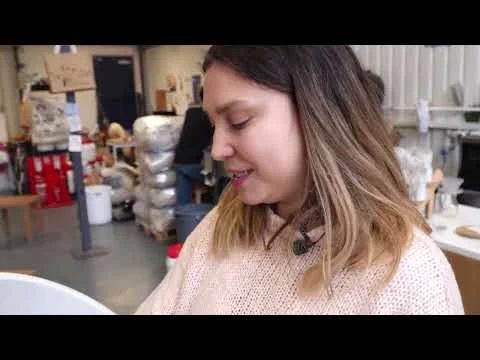
Dora on the drum, the browning stage and the moment she finishes a roast
Dora showed me the turning drum at La Tostadora. I wanted to know how the hard green beans became the coffee she served.
How does Dora use the drum roaster at La Tostadora?
The drum was already turning while Dora explained the heat underneath it.
Why did Dora prefer a gas drum coffee roaster?
This one is called the drum roaster, which means it has a drum inside. It has two heating elements. We use gas, but you can use electric roasters as well. But I prefer gas.
As for cooking, you can control temperature a lot more. It reacts very, very quickly and that’s what we need for roasting.
There’s a drum inside. You can see that it’s turning around. And maybe if you can get a shot from underneath, it’s kind of like a washing machine.
Dora was describing her equipment and preference. Her route into roasting began with learning in Colombia.
What did Dora want to keep consistent during a coffee roast?
An even roast mattered to Dora, along with keeping enough heat moving through the process.
When we’re roasting coffee, the most important thing is to roast it very, very consistently.
We’re just heating it up at the moment. So once it reaches for us in our machine a bit over 200 degrees, then we will drop the coffee.
That temperature belongs to the machine she was showing. A 2024 UC Davis roasting study recorded both temperature and time when comparing roast profiles, rather than treating one temperature as a whole recipe.
How did Dora describe the drying and browning of coffee beans?
The beans lost moisture and changed colour as Dora described the early stages of her roast.
What did Dora call the drying stage in coffee roasting?
The first phase of roasting, it’s called the drying phase.
So as I said, currently the beans have about ten percent water inside when we receive it. And then once it’s roasted it has around one point five percent water inside.
Those were Dora’s figures for the coffee she handled. UC Davis’s explanation of roasting describes moisture loss and chemical changes as beans are heated.
Why did Dora want to prolong the browning phase of her coffee roast?
Sweeter notes were Dora’s aim when she extended the stage she called the Maillard phase.
If you slowly, gradually get through the caramelization phase, and this is when the beans as well turn from yellowy color to more of a cinnamon color to a very light brown color. And we try to prolong that, because if we don’t prolong it, it’s going to be less sweeter.
If you prolong it too much, then it can get to the other side. It can get like very baked, like when you’re baking a bread, that taste. So it’s very hard to kind of like hit that right spot in between.
The stage names help describe a roast, but the chemistry overlaps. The UC Davis study notes that Maillard reactions continue after first crack. Dora’s account explains how she aimed for her preferred taste on her roaster.
How did Dora decide when to finish a coffee roast?
First crack marked the start of what Dora called development. The finish depended on the coffee and the roast she wanted.
What did first crack tell Dora about the coffee roast?
If you look at the beans of a green bean and a roasted bean, the roast is a lot bigger in size as it expands. So this is when we mark the development phase starting point.
The development phase is, I think, the point when things can go wrong with roasting more often than in the other phases, because that’s a little bit harder to control the temperature in this phase.
You really need that experience with your beans, and everything is different as well.
The audible first crack accompanies expansion during heating, as UC Davis explains. Dora used that marker while watching her own roast.
How did Dora distinguish her espresso and filter roast times?
Dora gave different total times for her espresso and filter roasts, then discussed the smaller difference in development.
Espresso roast for us, it’s around eleven minutes, ten, eleven minutes. And then filter roasts are more around eight, nine minutes long.
There’s not a big difference between them. So on our machine with our roasting, it’s about twenty seconds difference, twenty, thirty seconds difference. And temperature wise it’s just a few degrees difference.
The shorter comparison concerned development, not the total roast. These were Dora’s timings, rather than a set of instructions for every roaster.
Dora came back to tasting when judging the result. The SCA’s sensory assessment separates descriptions of aroma, flavour and texture from a taster’s preference.
Ask the roaster what they wanted to bring out of your coffee, my loves. Meet more makers in our food stories, or Explore My Ideal World
On this story
Comments, questions and answers from signed-in paid members. The conversation will also be available in the app when it launches. Community contributions are not verified editorial findings.
Contribute evidence
Reviews share first-hand experience. Observations can include opinions and objections. Evidence is checked against its sources before publication. Community contributions do not change MIW scores.
Article discussions and evidence contributions are for paid members. They will also be available in the app when it launches.
Sign in to contribute or join the discussion Read this next
La Tostadora, the London Roaster Who Learned in Colombia
Dora shares how Colombian farm visits shaped La Tostadora in London, why she tells growers’ stories and how she checks new harvests, in her interview words.Read the storyKeep exploringDora’s Farm Visits and the Organic Coffee Certificate
Dora describes Colombian coffee farms she visited and certification concerns, with UK sources explaining what organic certification and import checks require.Read the story Keep exploring