

Upcycled Cottages, Big Trees and Beach Access That Feels Private
Balenbouche Estate is where I would stay in southern Saint Lucia if you want old trees, a veranda, your own kitchen and a walk to a black-sand beach that is not lined with loungers. It is a family-run estate with six self-catering cottages on the south-west coast, between Laborie and Choiseul, roughly halfway between Hewanorra airport and Soufrière.
I will say this early, because it decides whether you will love it or not. There is no air conditioning, the cottages are open-air, and the beaches are wild public beaches, not managed resort sand. If that sounds like your kind of holiday, keep reading. If you want a pool bar and room service, the north or one of the Soufrière resorts will suit you better.
In this guide: north or south, the areas of the south, the Pitons and Soufrière, which cottage to choose, the beaches, food and how to book.
Should you stay in the north or the south of Saint Lucia?
Choosing between north and south Saint Lucia is a bit like choosing between Negril and Montego Bay. One side is the busier resort side, with parties, buffet breakfasts and pizza. The other is slower, with a local rhythm, Creole and soca on the radio, and breadfruit, avocado and okra on your plate. It is your holiday, so choose the side that fits how you actually like to travel.
The Saint Lucia Tourism Authority describes the south as a quieter, more authentic side of the island, centred around Vieux Fort and Hewanorra International Airport, with wide open landscapes, coastal views and a slower island rhythm. The north is where you find the Friday night street party in Gros Islet and the busier resort strip around Rodney Bay.
Two practical things before you decide. Saint Lucia is small, but the south is not a walking destination. The tourism authority says distances in the south are larger and the area is best explored by car or guided tour. It also lists December to May as the best time for clear views and drier hiking, and weekdays as the quieter time at the Soufrière attractions (SLTA, South Island).
Most people come to Saint Lucia to relax, see the Pitons and enjoy the Creole culture, and you can reach all of it from the south without long transfers. From Balenbouche, the estate’s own directions put Hewanorra airport at around 20 minutes, Soufrière at around 35 and Laborie or Choiseul at under ten (Balenbouche contact page). The tourism authority gives a wider range of roughly 10 to 45 minutes from the airport to places across the south.
The areas of southern Saint Lucia, and what each is like
“Southern Saint Lucia” covers a few very different places.
Where you sleep changes your whole trip, so here is how I would break it down.
| Area | What it is like | Best for |
|---|---|---|
| Soufrière and the Pitons | The island’s most dramatic scenery and its busiest sightseeing base. The tourism authority lists Soufrière among Saint Lucia’s popular places, and it is the starting point for the Pitons and Sulphur Springs. | First-timers who want Piton views and the widest choice of places to stay, from Ladera and Anse Chastanet to Stonefield and Fond Doux. |
| Laborie | A traditional fishing village. Laborie Beach is described as calm and swimmable, and Rudy John Beach Park has open space and a laid-back local feel. | A slower, local base on the south coast, with Balenbouche a short drive away. |
| Choiseul | A rural stretch of coast beside Laborie. The estate’s directions put both villages at under ten minutes from Balenbouche. | Guests who want village life and nature rather than a resort strip. |
| Vieux Fort | The southern gateway, home to Hewanorra airport, a town and market, the Moule à Chique lighthouse viewpoint and Anse des Sables. Sandy Beach is one of the longest beaches in Saint Lucia, with steady winds and kite surfers. | Short transfers, early flights, wind sports and space to walk. |
Balenbouche sits in the middle of that map, which is why I like it as a base. You are close enough to Laborie and Choiseul for groceries and village life, and not far from either the airport or the Pitons.
The Pitons and Soufrière: what to know before you book in the south
The Pitons are the reason many people book the south in the first place. The Pitons Management Area was inscribed as a UNESCO World Heritage Site in 2004 and covers 2,909 hectares of land and sea around Gros Piton and Petit Piton, close to Soufrière (IUCN World Heritage Outlook). It is the only World Heritage Site in Saint Lucia.
That protected status is part of why where you stay matters. IUCN’s World Heritage Outlook lists the construction of vacation homes and resorts as a very high threat to the site. A small estate that has kept its buildings and trees is a very different choice from another large development nearby.
For things to do, the tourism authority has pages on the Piton climbs and on Sulphur Springs, the volcanic site near Soufrière that is often called the drive-in volcano. Both are an easy day trip from Balenbouche, as long as you plan the drive and book guides in advance.
But first, a few other places to stay in southern Saint Lucia
Travellers looking for a high quality wellness retreat surrounded by nature and farm to table food would book a self love retreat at Mount Kailash Rejuvenation Centre. For Piton views and open-sided suites, compare Ladera; for beachfront nature and diving, Anse Chastanet; for private-pool villas, Stonefield Villa Resort; and for a cocoa-estate setting, Fond Doux Eco Resort.
Each offers a different style, setting and price point. If food is your priority, my guide to the best farm to table stays in Saint Lucia checks each one against its own wording. For a wider, first-hand comparison across the region, read my peaceful, sustainable eco stays in the Caribbean guide.
Saint Lucia has a wide range of places to stay, and Balenbouche Estate in the south is one option among them.
This guide looks specifically at Balenbouche Estate.
Set on Saint Lucia’s south-west coast near Laborie and Choiseul, the family-run estate has six self-catering cottages, historic buildings, gardens and walking paths leading to two nearby public black-sand beaches.
The appeal is a slower, more independent kind of stay.
You can cook for yourself, spend time outdoors and explore the estate’s history.
It is not a traditional resort, and that is the point.
The cottages rely on natural ventilation rather than air conditioning and the adjoining beaches are wild coastal areas rather than managed swimming beaches.
If you read my review of the Oliver Messel villas in Mustique, the open-sided, windowless design will feel familiar.
Balenbouche Estate at a glance
- Location: South-west Saint Lucia, near Laborie and Choiseul.
- Accommodation: Six named cottages, including Moringa, which can be booked as two separate studios or as one cottage.
- Published base rates: US$160 to US$250 per night for up to two adults, according to the rates supplied for this guide and checked on 2 October 2026. Confirm the current price directly.
- Style: Self-catering cottages with natural ventilation, fans and mosquito nets. There is no air conditioning.
- Coast: Paths lead to Anse Balenbouche and Middle Beach, both public beaches.
- Official information: Compare the cottages and check current rates.
What is it like to stay at Balenbouche?
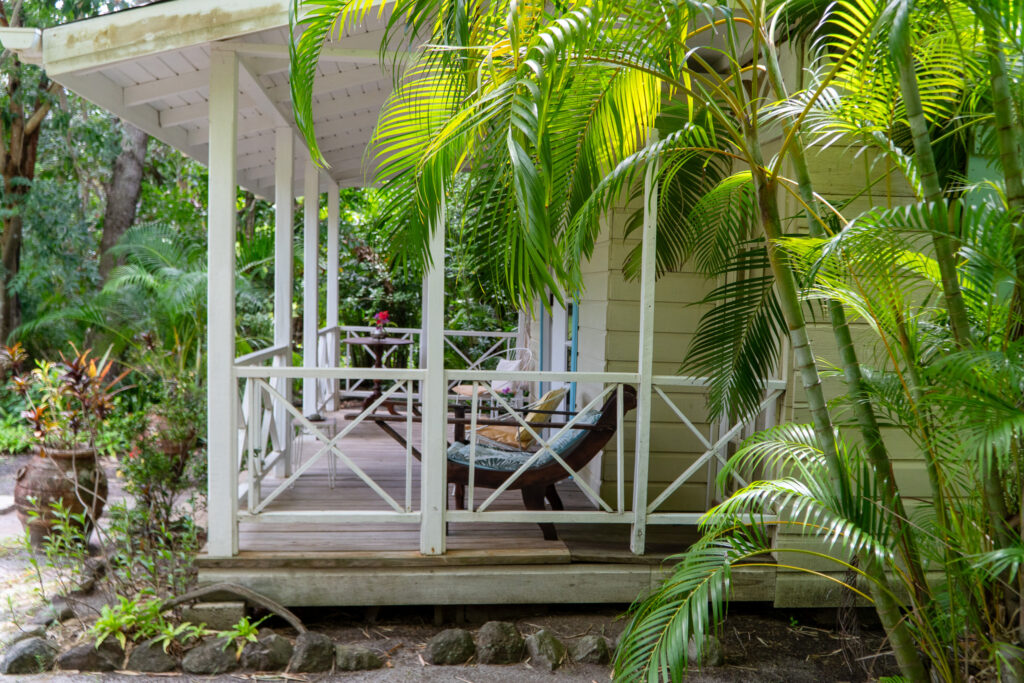


Balenbouche feels more like staying on a historic family estate than checking into a hotel.
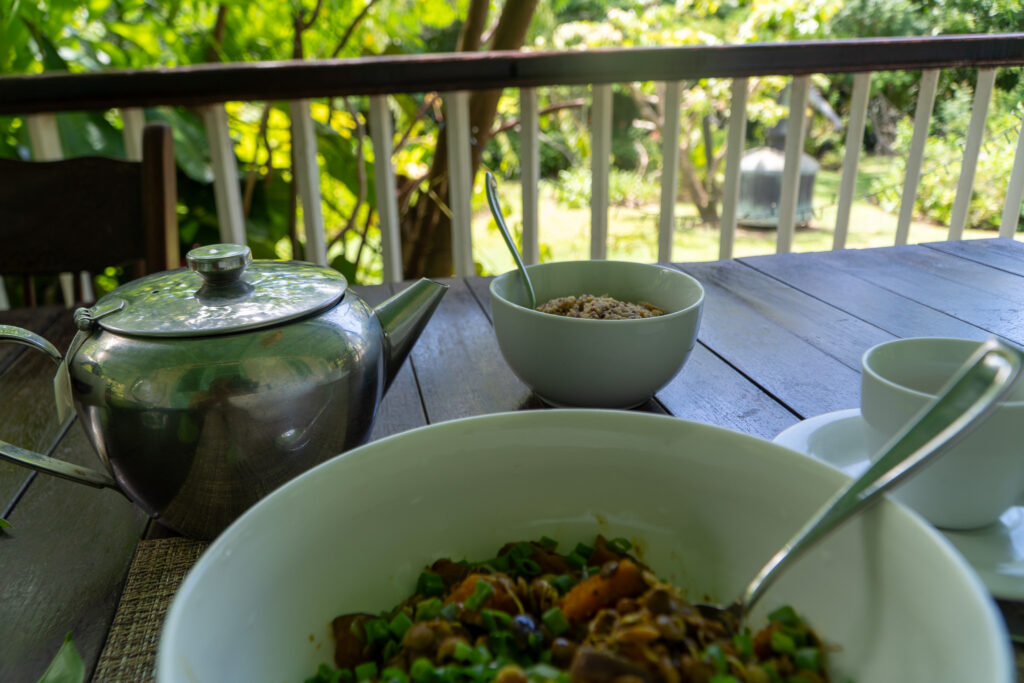
The cottages sit among mature trees and old agricultural buildings, with verandas that invite you to linger over breakfast, read in the shade or relax after a day out.
The open-air design is part of the experience.
Rooms use natural ventilation, fans and mosquito nets rather than air conditioning or screened windows. That will suit guests who enjoy tropical outdoor living, but it may not be comfortable for everyone, particularly anyone who prefers a sealed, climate-controlled room.
To see the different layouts and facilities, visit Balenbouche’s cottage listings.
Where is Balenbouche Estate?
The estate is on Saint Lucia’s south-west coast, between Hewanorra International Airport (UVF) and Soufrière, and near the communities of Piaye, Laborie and Choiseul. It is a practical base for exploring the south, although travellers planning frequent trips to the north of the island should factor in the extra driving.

The estate’s published directions estimate around 20 to 25 minutes by car from Hewanorra International Airport, less than about ten minutes to Laborie or Choiseul, and roughly 35 minutes to Soufrière. These are estimates, not guaranteed journey times. Road conditions, traffic and the exact destination can affect the trip.
A rental car is useful for grocery runs and independent excursions. An arranged driver is another option if you would rather not drive, and the tourism authority has a getting around guide for options across the island. When asking about transfers, specify whether you are arriving at UVF or George F. L. Charles Airport (SLU), as they are different airports. For current directions and transport arrangements, use the estate’s official contact page.
Which cottage should you choose?
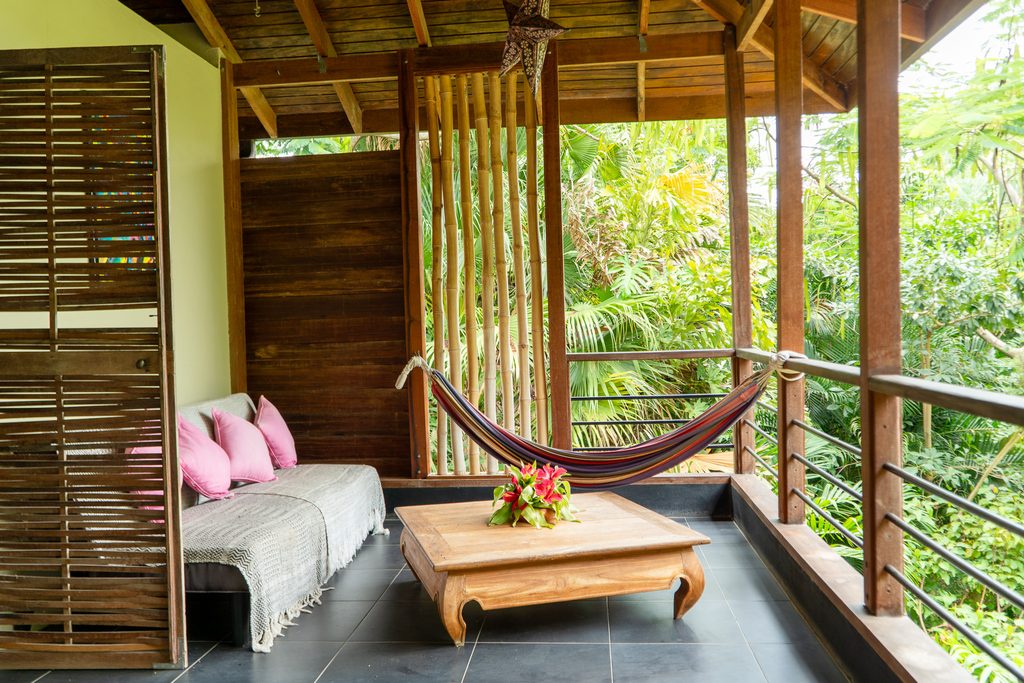
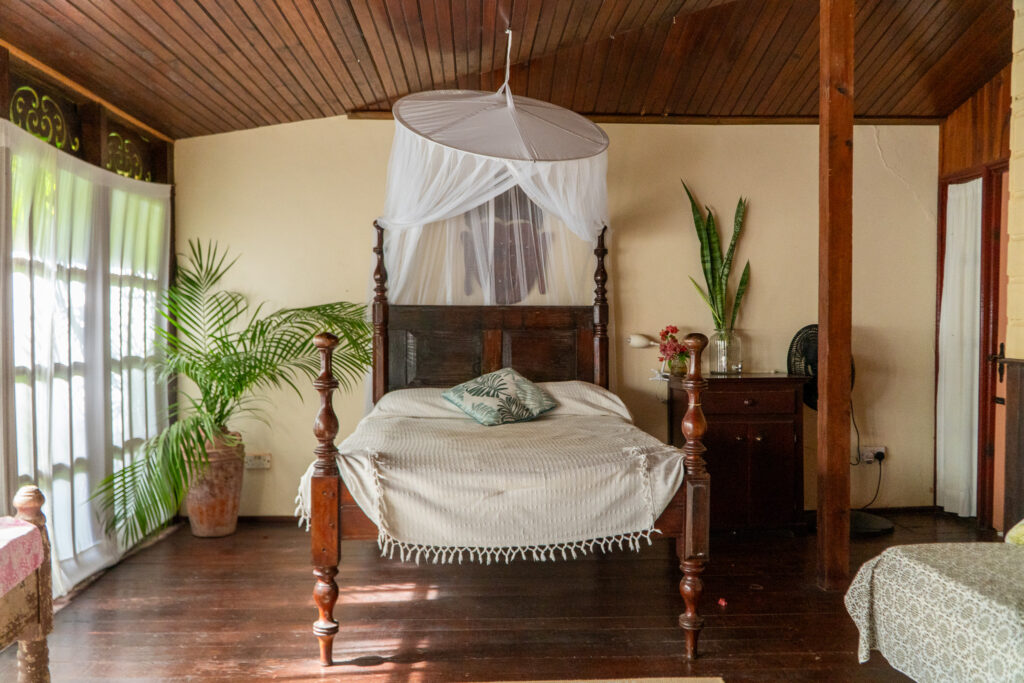


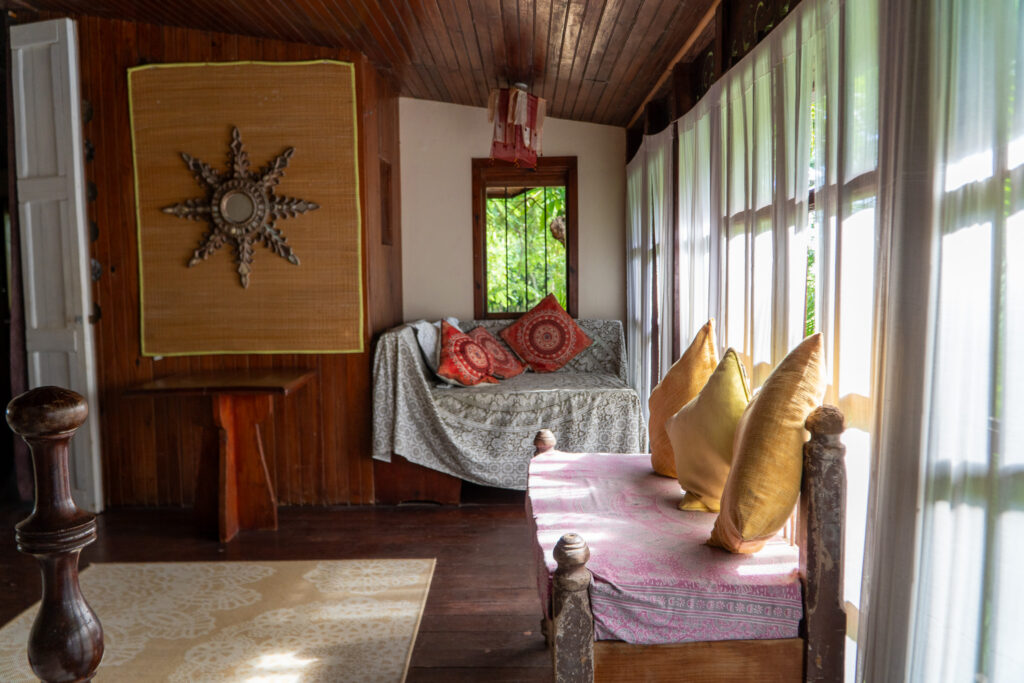
The cottages differ in size, privacy and kitchen facilities, so it is worth comparing the actual layout rather than choosing by price alone. The rates below are the published base rates supplied for this guide, checked on 2 October 2026. They are not a live availability check.
| Cottage | Sleeping arrangement | Published base rate (US$/night) |
|---|---|---|
| Moringa | Up to 5 people; two studio apartments | 250 |
| Almond | Up to 4 people, with a baby cot by arrangement | 200 |
| Banyan | Up to 6 people; adjoining sleeping areas | 200 |
| Waterlily | 1 to 2 adults; adults only | 220 |
| Frangipani | 1 to 2 adults and one child | 180 |
| Calabash | 1 to 2 adults and one child | 160 |
About the rates
The figures are base rates for up to two adults, not necessarily the total for a larger group. The published information lists an additional-adult supplement of US$25 per night, subject to each cottage’s capacity. Ask the estate for a written quote covering your dates, party size and any extras before making payment.
Moringa Cottage has two studios for families or friends
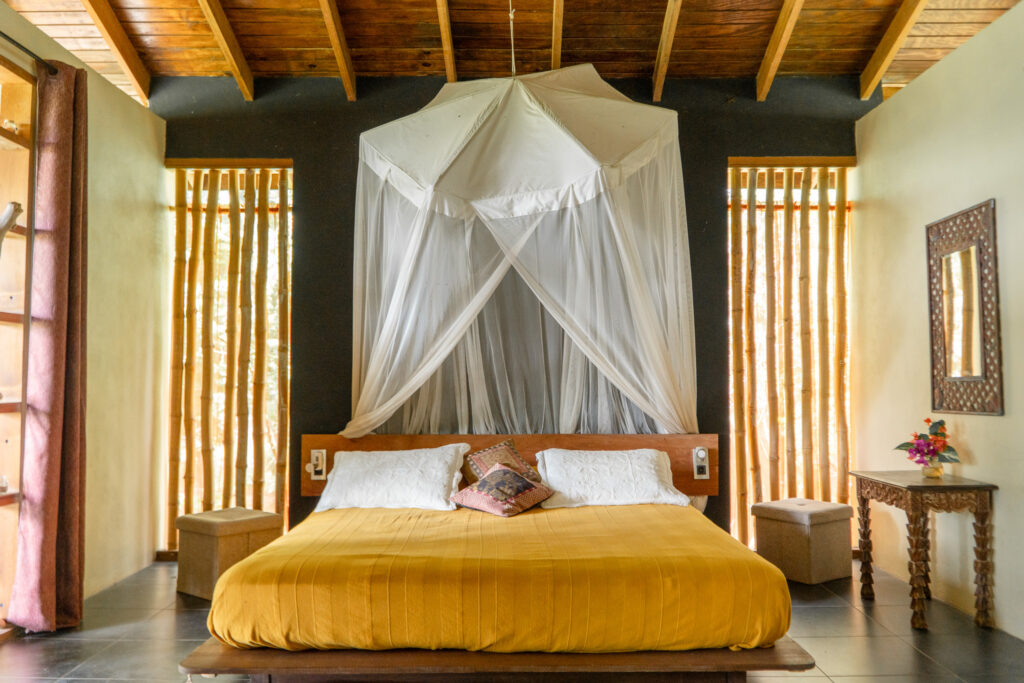
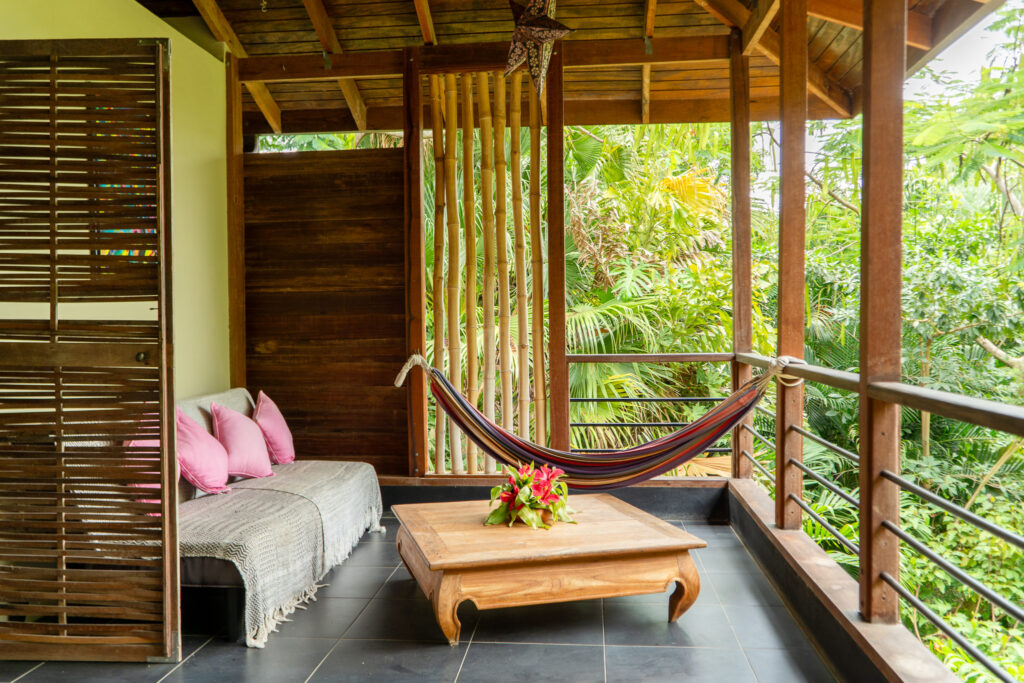


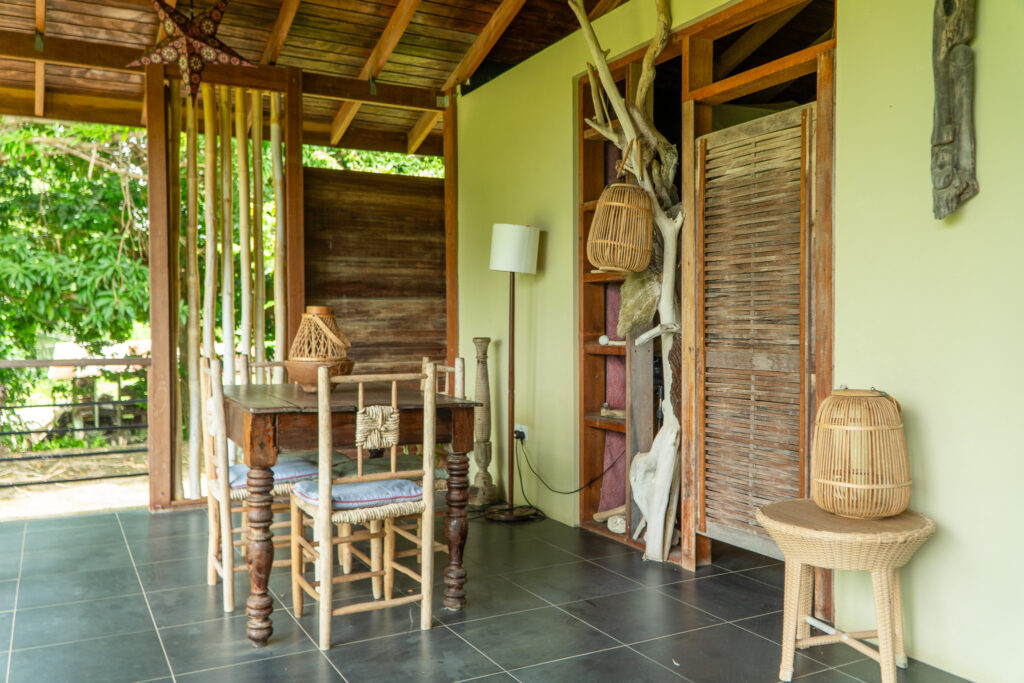


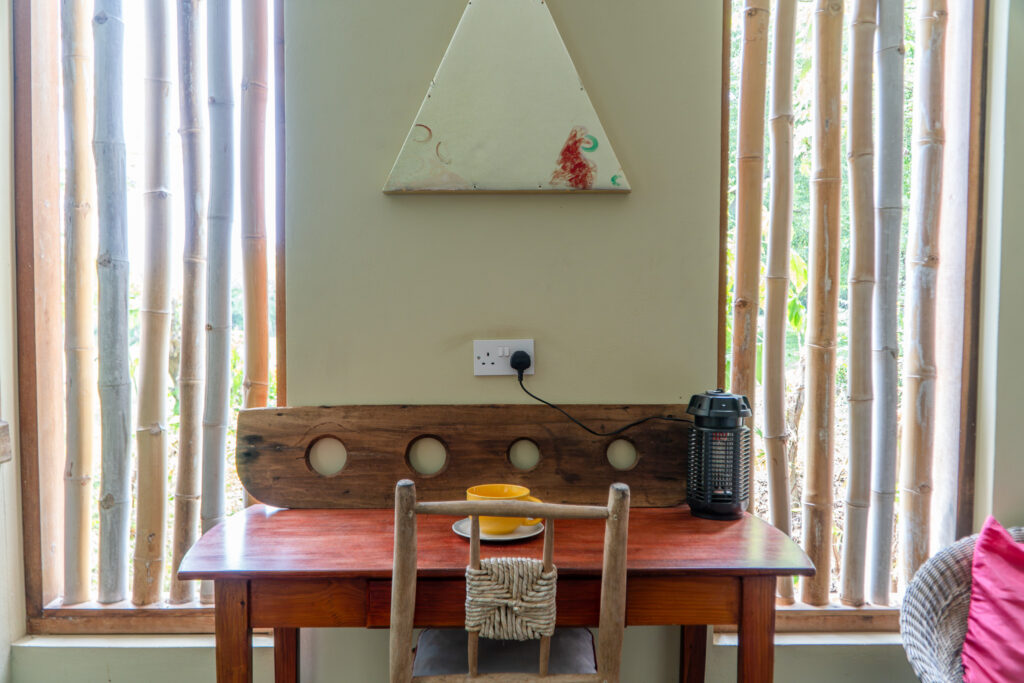
Moringa Cottage accommodates up to five people across two studios, with two king beds and a single bed. Each studio has its own bathroom and kitchen, which gives a group room to spend time together without sharing every space.
The downstairs studio has the larger kitchen and an outdoor shower; the upstairs studio has its own veranda. You can enquire about booking the whole cottage or one studio separately.
Almond Cottage has two bedrooms and a full kitchen
Almond Cottage has a king bedroom, a twin bedroom, two bathrooms and a covered veranda near the main house. Its full kitchen includes a fridge, gas stove and oven, making it a practical choice for guests planning to prepare proper meals rather than rely on a kitchenette.
The listed arrangement suits up to four adults or children, with a baby cot available by arrangement. Check the sleeping setup and cot availability directly with the estate.
Banyan Cottage has more room for a group
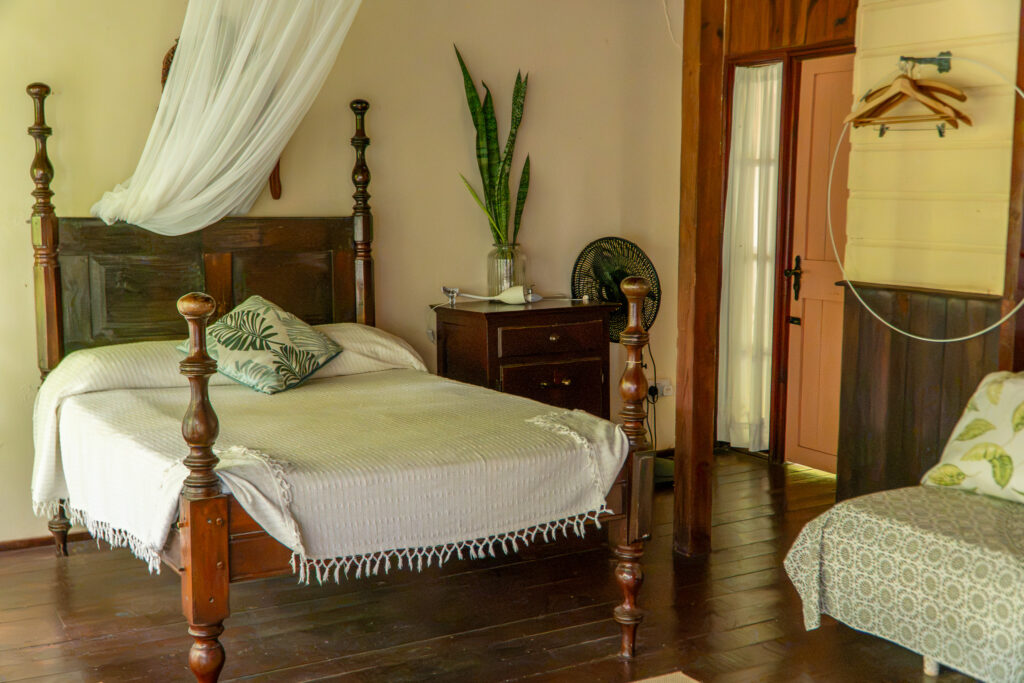


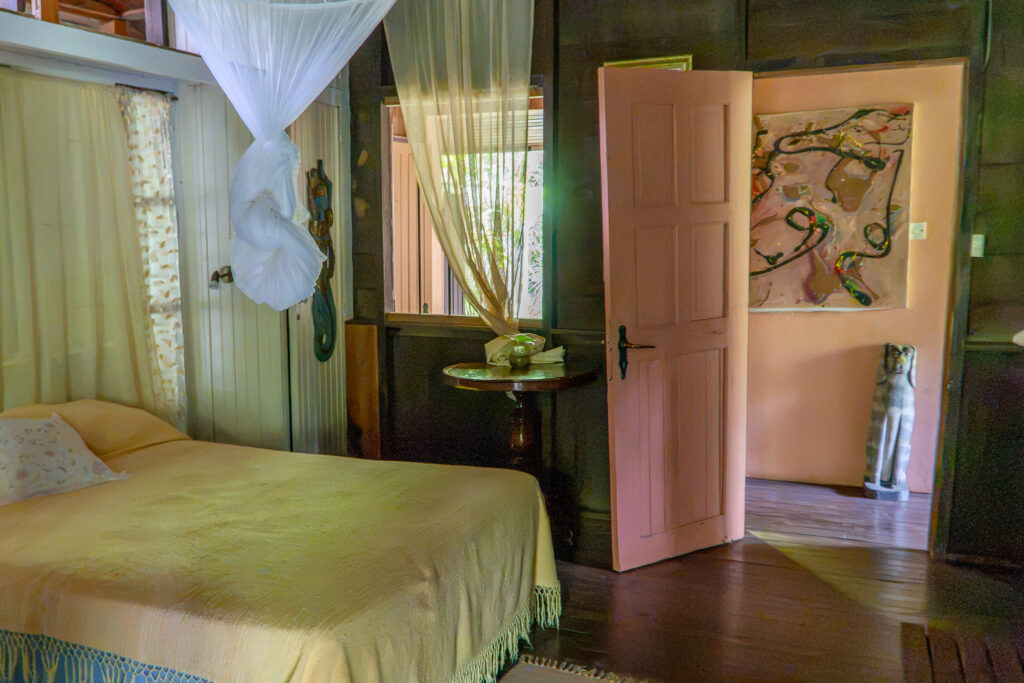
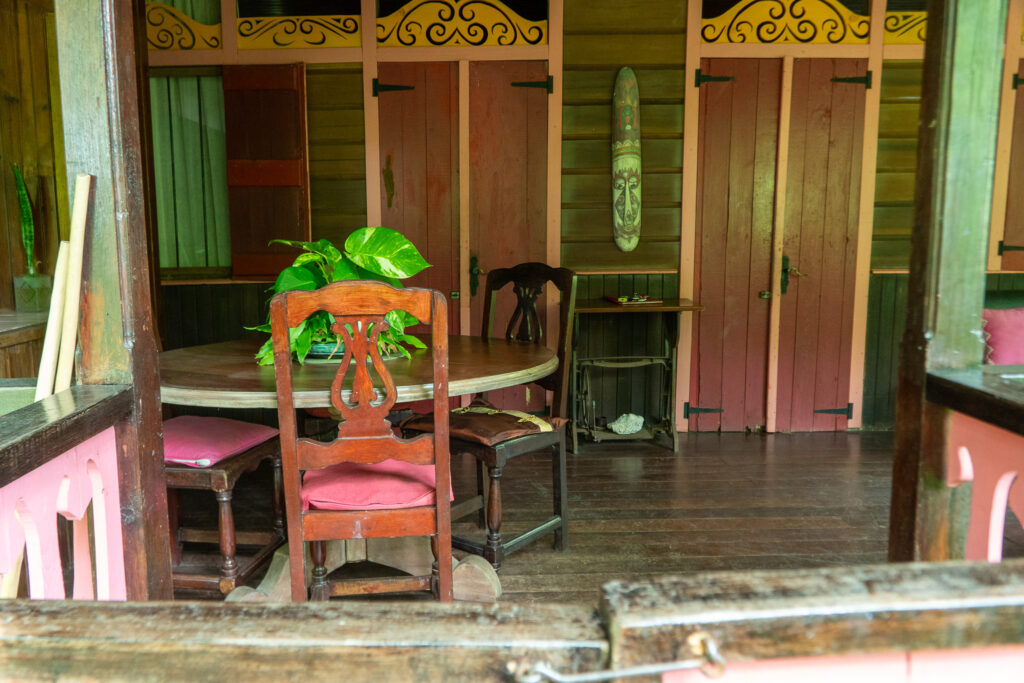
Banyan Cottage sleeps up to six in a historic timber building. Its listed beds are a king, a queen and two singles. The living area can be used as a third bedroom, but the adjoining layout means it is worth discussing privacy and room arrangements before booking.
Banyan has a full kitchen, a veranda dining table, an indoor shower, a separate half bathroom and an outdoor shower.
Waterlily Cottage is an adults-only cottage
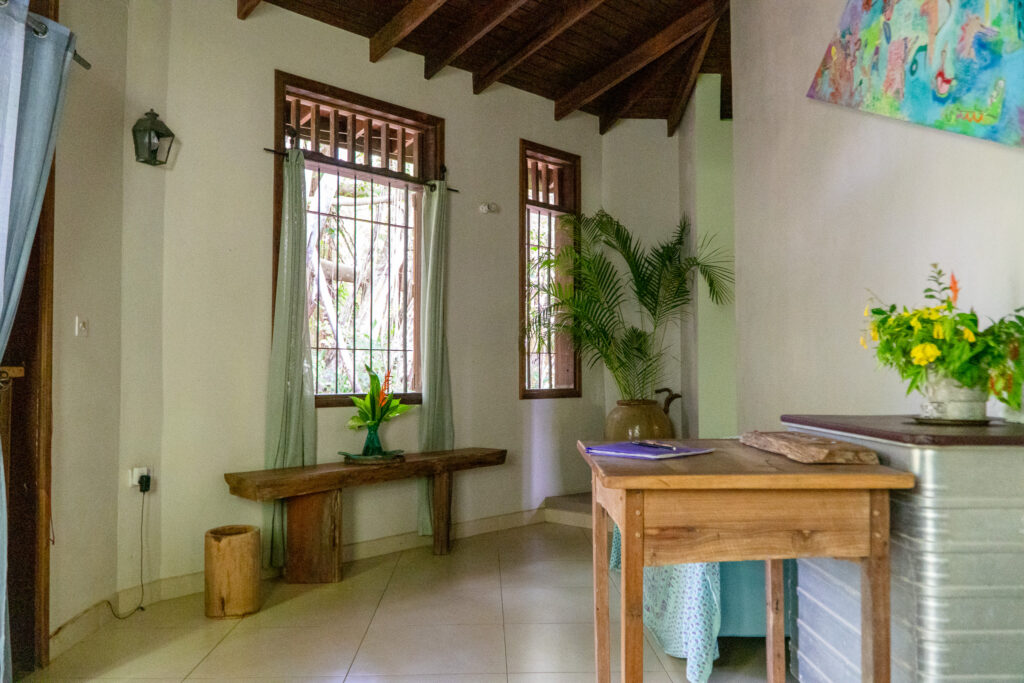
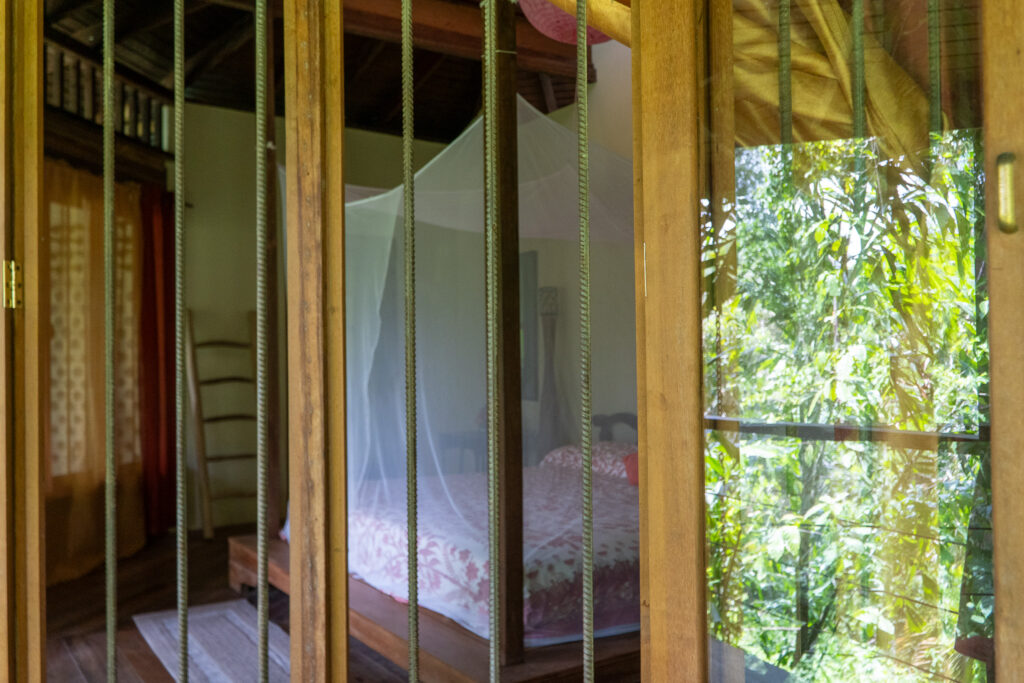


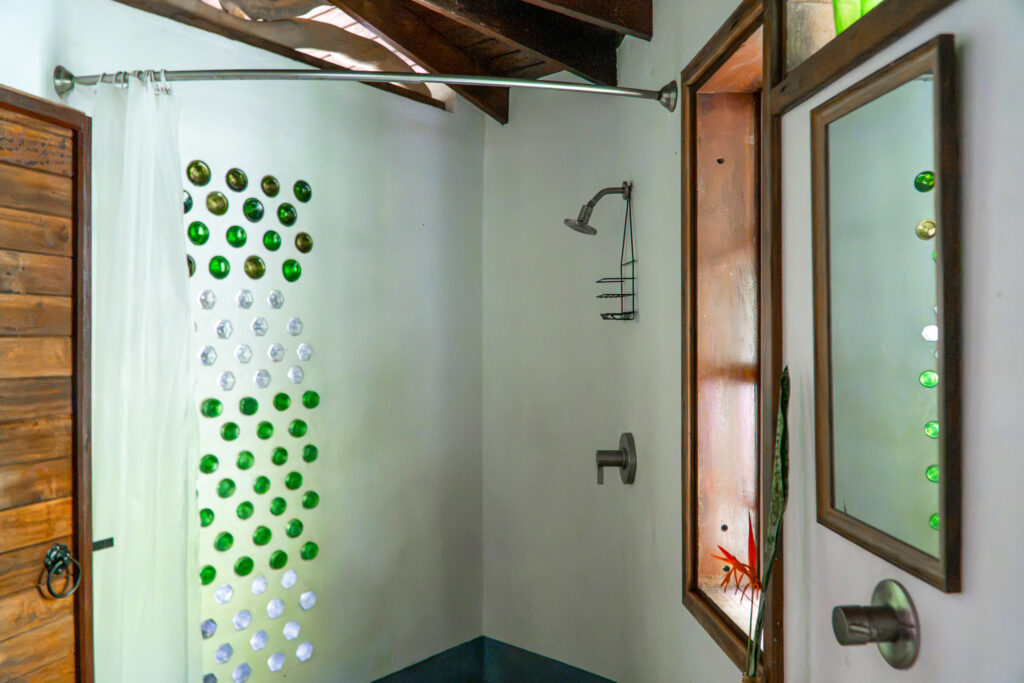
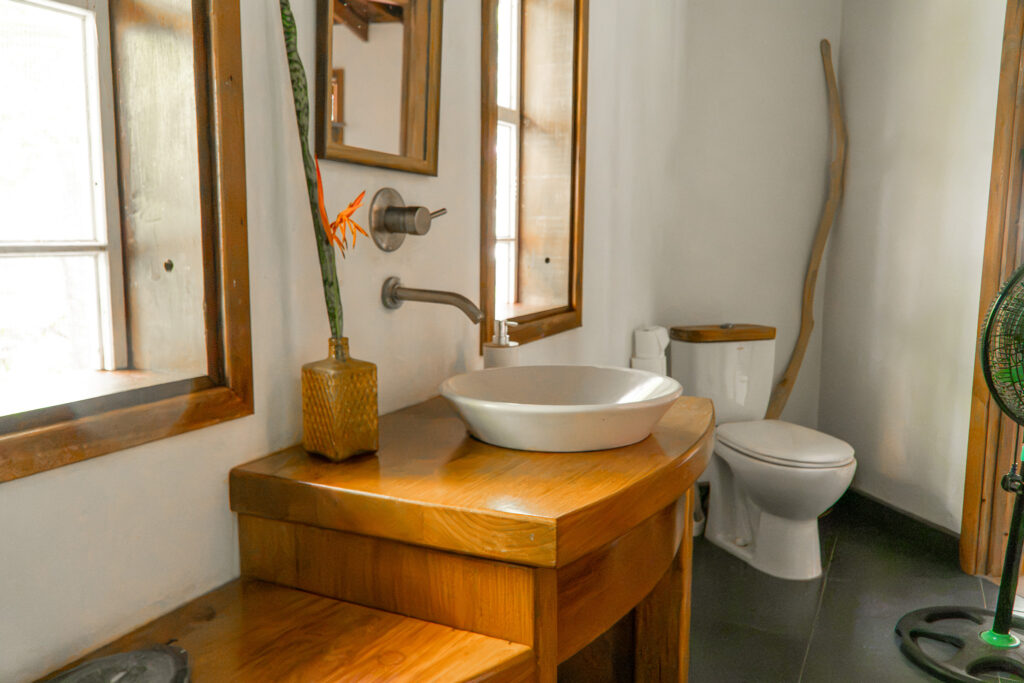

Waterlily Cottage is for one or two adults and does not accommodate children. The elevated, octagonal cottage has a king bed, kitchen and wraparound veranda overlooking the trees and valley. Its position may appeal to couples or solo travellers looking for a little more privacy.
High ceilings and open sides help with ventilation, and reclaimed hardwood gives the interior its character. As with the other cottages, this is an open tropical setting rather than an air-conditioned suite.
Frangipani Cottage is a romantic compact cottage for couples
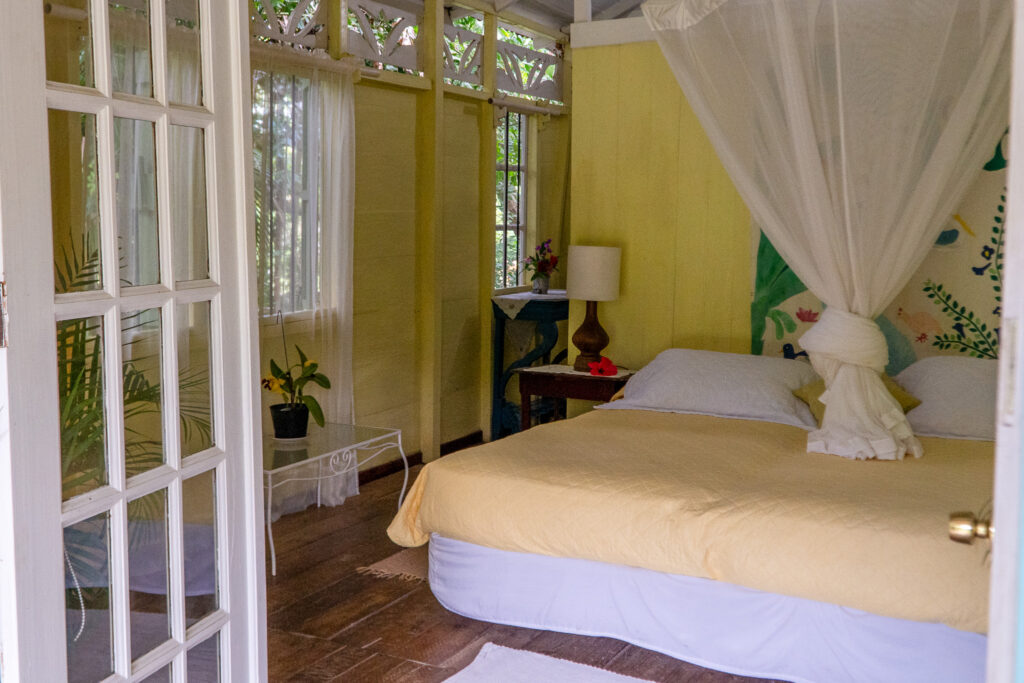
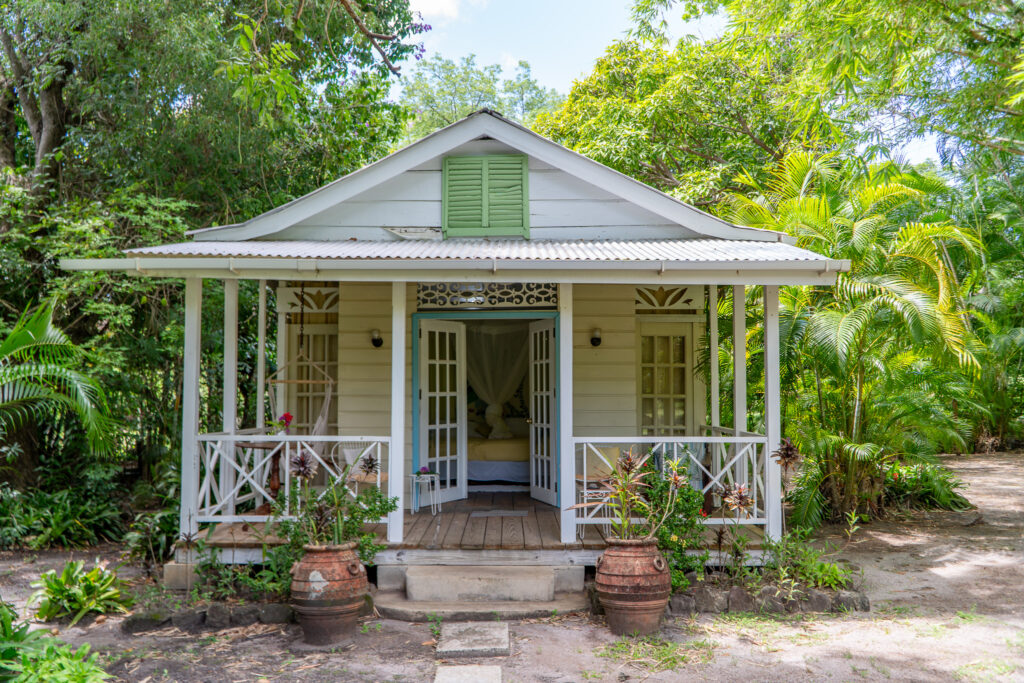
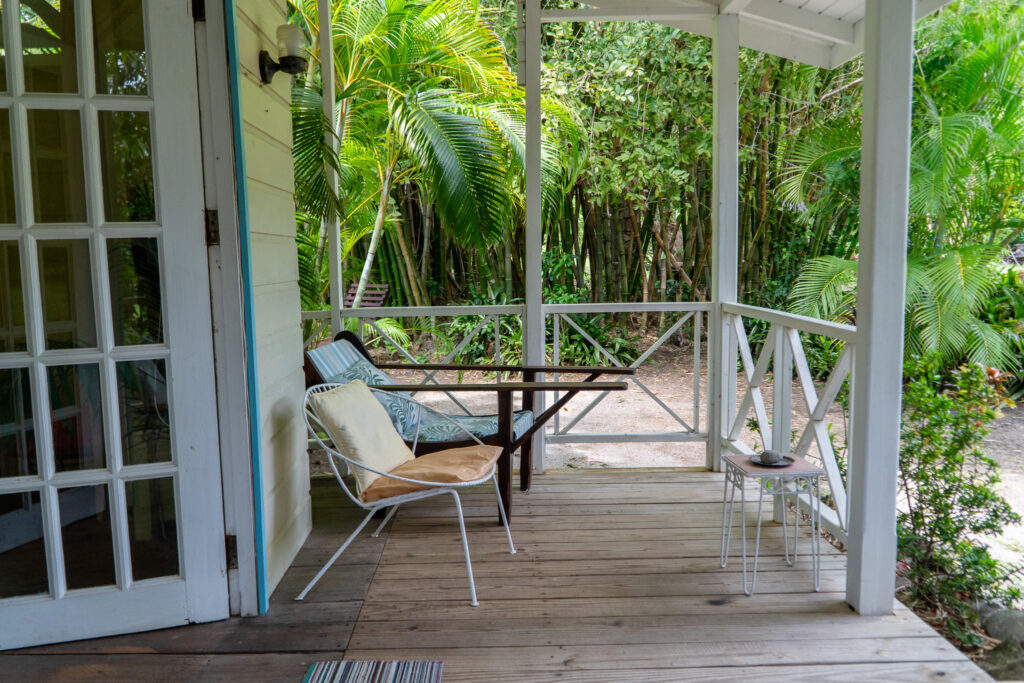


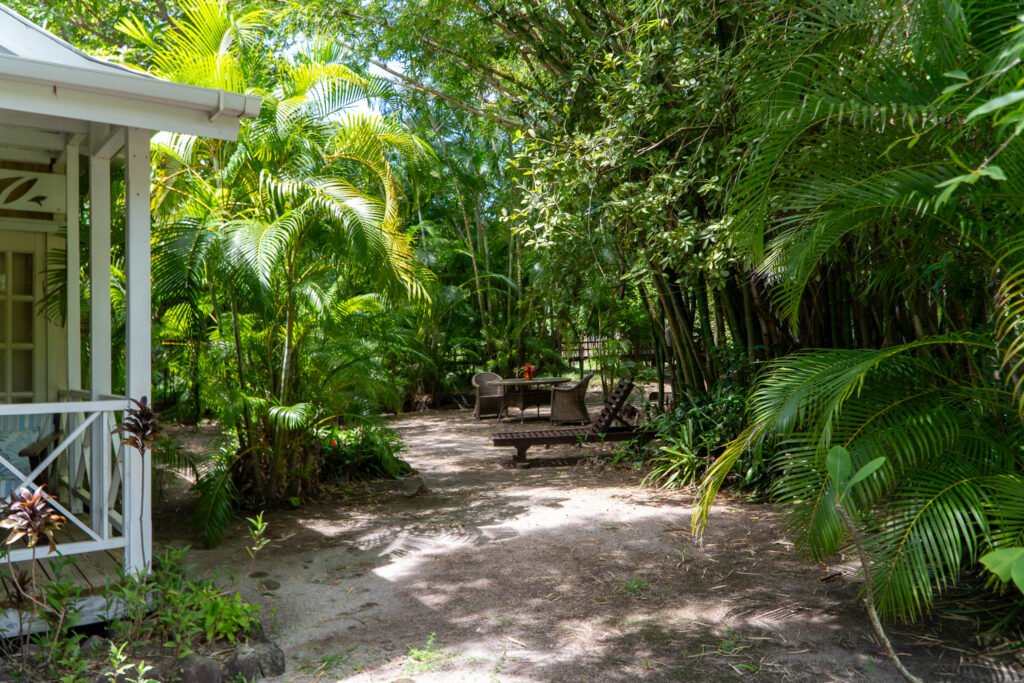

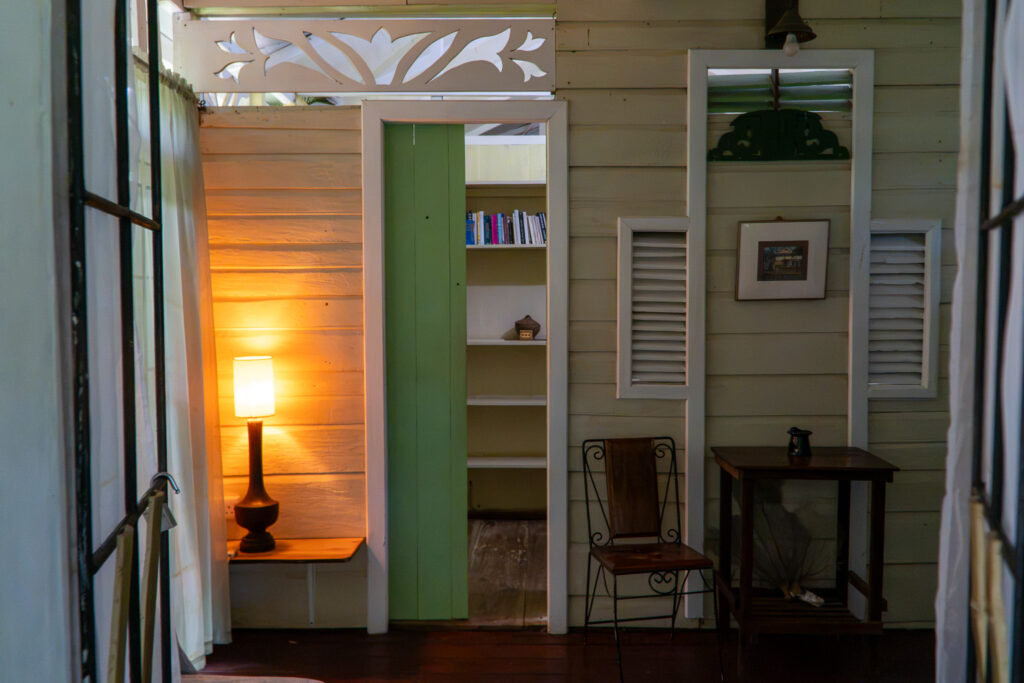
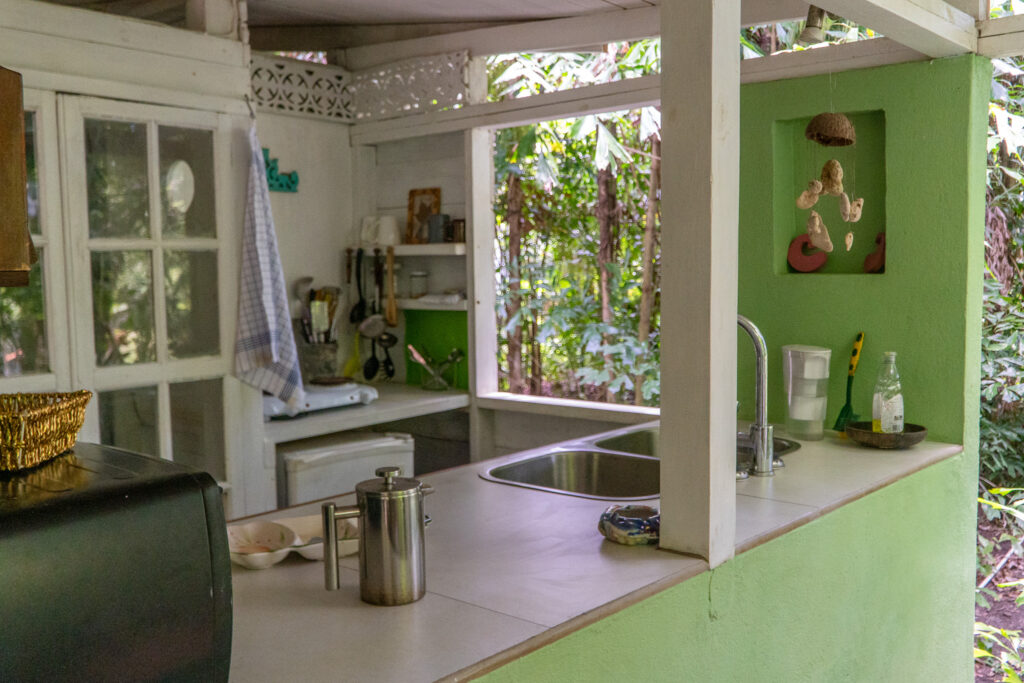
Frangipani Cottage combines a king bedroom with a kitchenette and outdoor space facing the garden. Reclaimed timber, salvaged architectural details and a natural-stone shower give it a distinct character.
The kitchenette has an under-counter fridge and a two-burner hotplate. The listed layout allows one child in addition to one or two adults, although families needing separate bedrooms may prefer Almond, Banyan or Moringa.
Calabash Cottage is a smaller self-catering option


Calabash Cottage has a queen bed, a single daybed and an open-air kitchenette on its covered deck. It is listed for one or two adults and one child. The cottage is close to Almond and the main house, so it may feel less secluded than some of the other options.
One detail to consider before sharing the space is that there is no door between the bedroom and en-suite bathroom. Check the layout against your needs before booking.
What does beach access mean at Balenbouche?

There are paths from the estate to two adjoining public beaches which feel private since Balenbouche provides the access. The two beaches are called Anse Balenbouche and Middle Beach.
These beaches are natural coastal areas, not private beaches with lifeguards, loungers or resort facilities.
The estate describes the walk as about five minutes. Anse Balenbouche is the rockier bay near the river mouth, while Middle Beach has a sandy shore reached by steep hillside steps. Access and conditions may not suit everyone.
Beach access does not mean swimming is always safe.
Waves and currents can be strong, and conditions change. Ask the estate about the conditions on the day, follow local advice and do not enter the water when it is unsafe. Children should be supervised near the shore and on the paths. For more detail, see Balenbouche’s guide to the nearby black-sand beaches. The Saint Lucia Tourism Authority also publishes pages on black-sand beaches and beach safety and swimming tips.
The estate’s history and heritage
Balenbouche is a guesthouse on a historic plantation landscape.
Its old buildings and sugar-mill remains reflect the island’s agricultural past, including the colonial plantation economy and the forced labour of enslaved people. The site’s history should be understood in that context, not reduced to picturesque ruins. The estate’s historical account also discusses evidence of Indigenous life predating the plantation. Speak to the owners and ask them to guide you through the tour of the estate and its history.
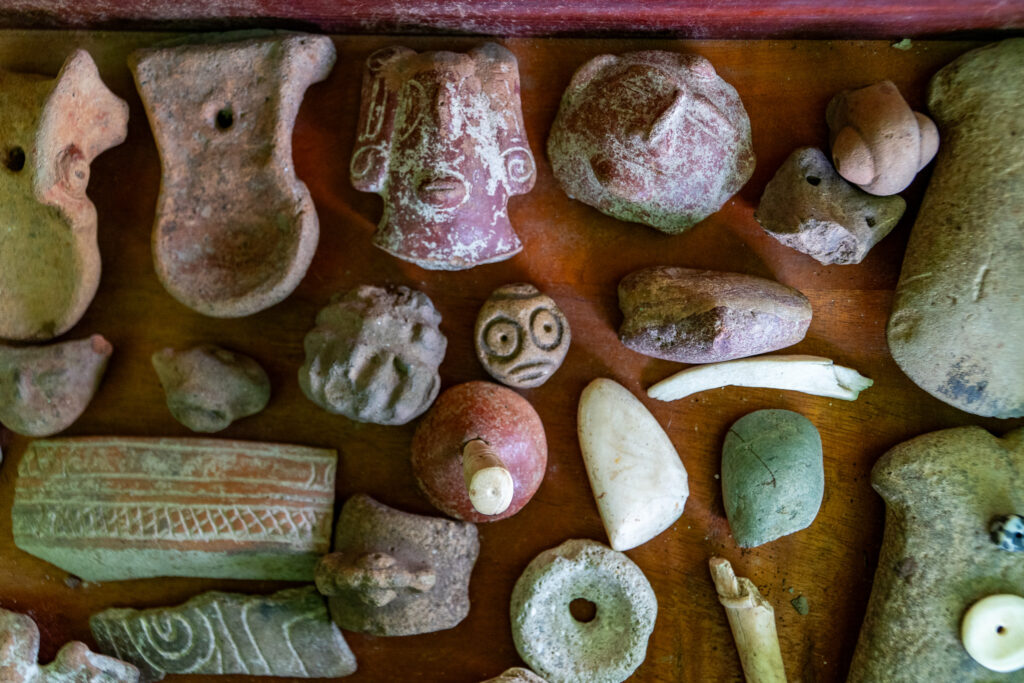
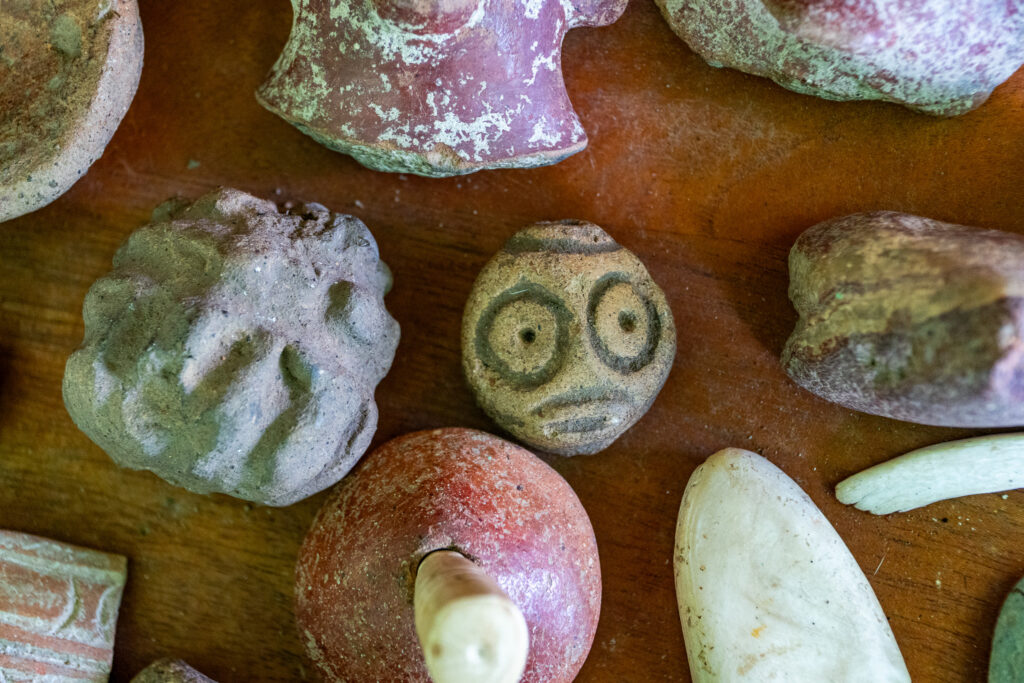
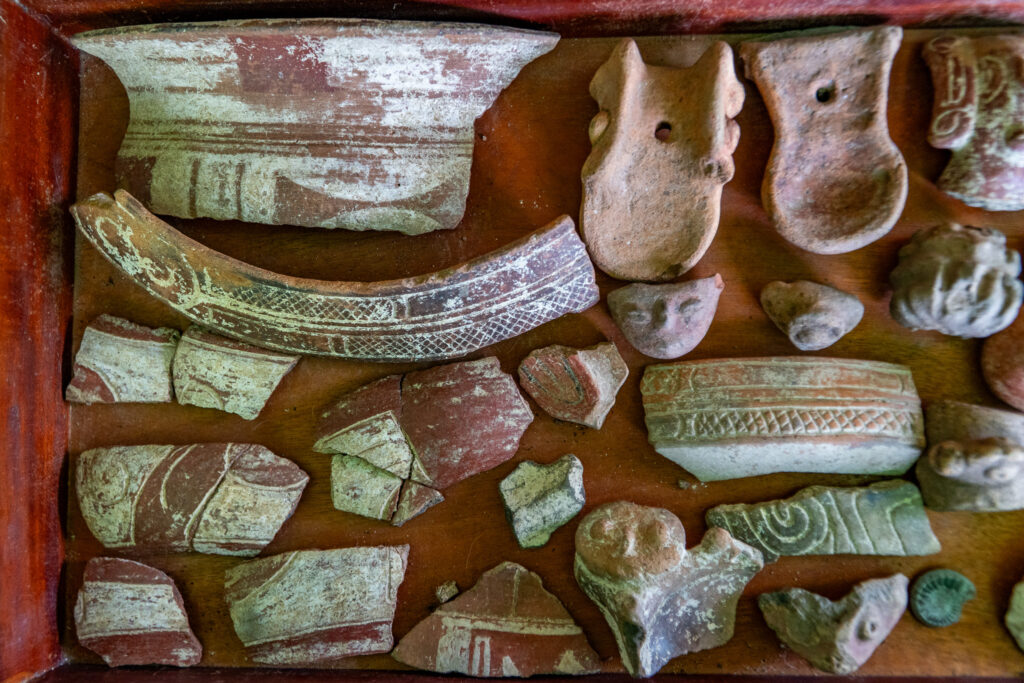
The Lawaetz family has maintained the estate and adapted its historic buildings for continued use. Their work has involved restoring historic structures and adapting them for new uses. The result is a family home and guesthouse, not a recreation of plantation-era life. The family shares more about this work on the Lawaetz family page.
Guided heritage tours can provide additional context. The estate’s tours page describes visits of around 30 to 40 minutes; confirm the current schedule and make arrangements in advance.
A visit can also be a reason to learn about other heritage sites and communities across Saint Lucia. No single property represents the island’s full history, and a heritage setting should not be treated as proof of environmental sustainability on its own.
Yoga, wellness and retreats

The estate has a rustic yoga barn with mats and blocks for personal practice. Classes may be arranged in advance, but they are not automatically included with a cottage stay. Check availability and any fees with the team through Balenbouche’s yoga and wellness page.
Hosted retreats are separate from ordinary accommodation bookings. Dates, teachers, meals and other inclusions vary, and a retreat may use several cottages at once. Check the programme before booking a stay around a particular event. Massage and other wellness services should also be arranged in advance; do not assume they are available on demand.
Food, kitchens and dining
All six cottages have cooking facilities, although the setup varies. Almond and Banyan have larger kitchens, while Calabash and Frangipani have more compact arrangements. If you plan to cook most of your meals, check the facilities in the specific cottage before booking.
Piaye has a produce stand and convenience shop within walking distance, according to the estate information supplied for this guide. The Massy supermarket near Choiseul is a short drive away. If you arrive late, it is sensible to arrange a grocery stop beforehand rather than assume shops will still be open.
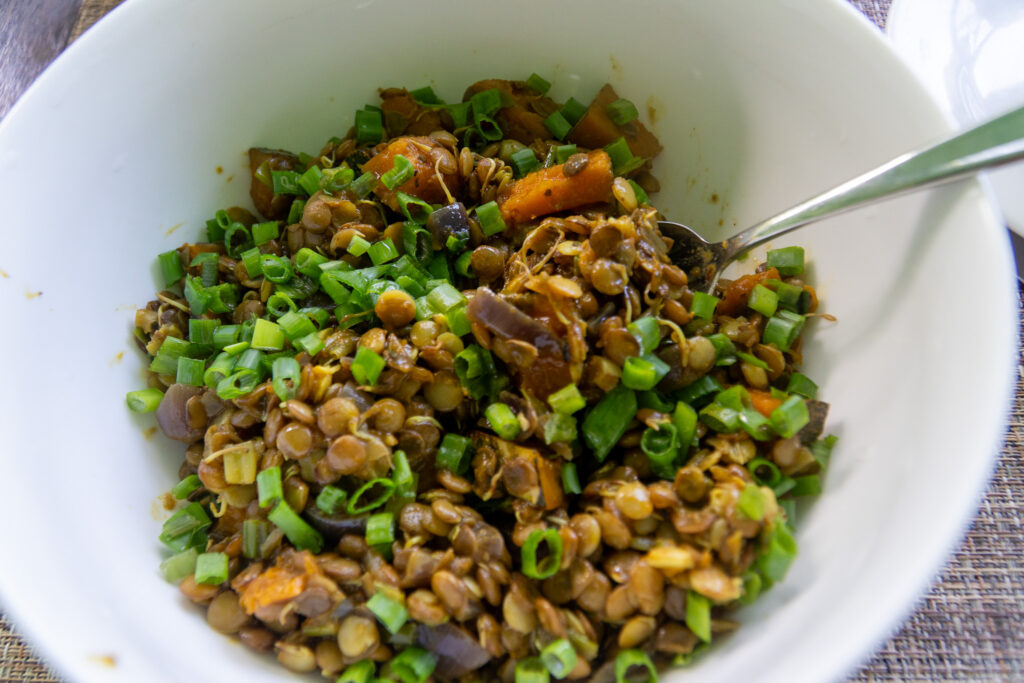
Meals can also be arranged with the estate. Its published dining information describes a menu with Creole, Asian and international influences, with some ingredients sourced from the grounds. Vegan, vegetarian, gluten-free and dairy-free meals can be requested in advance.
The dining page listed breakfast at US$15 and sample dinner specials at US$25 to US$30 when checked on 2 October 2026. These prices and services may change, and dinner is not necessarily available every day. Confirm the current menu, dietary requirements, availability and total cost through the estate’s dining page.
Ask how food is grown rather than assuming it is organic
Food grown locally is not automatically organic or pesticide-free. Saint Lucia has a varied agricultural sector, and growing methods differ between farms. If food sourcing is important to you, ask where particular ingredients come from and how they are grown rather than assuming that local produce is certified organic.
For national context, the Food and Agriculture Organization reported work to strengthen pesticide regulation in Saint Lucia in 2022. This is background on regulation, not evidence that all local produce is unsafe or grown in the same way.
What sustainability practices does the estate describe?

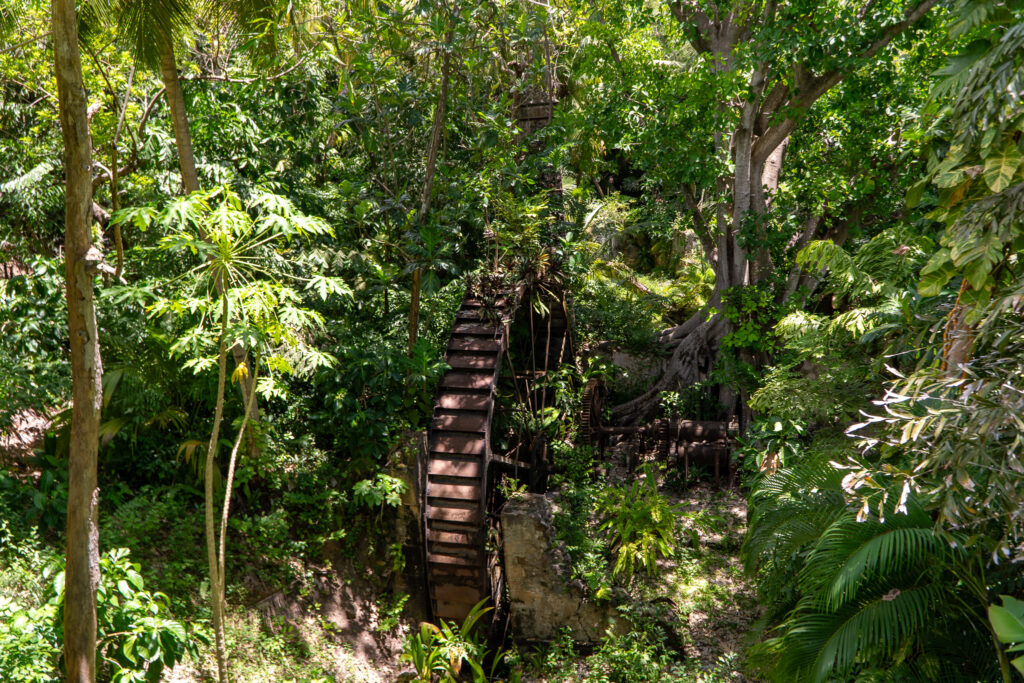

The estate describes its approach in practical terms.
Natural ventilation, solar hot water, LED lighting, line-dried laundry, reuse of building materials and composting. These measures can reduce some resource use, but they should not be confused with proof that a property is carbon-neutral, entirely renewable-powered or independently certified.
Natural ventilation and lower energy demand
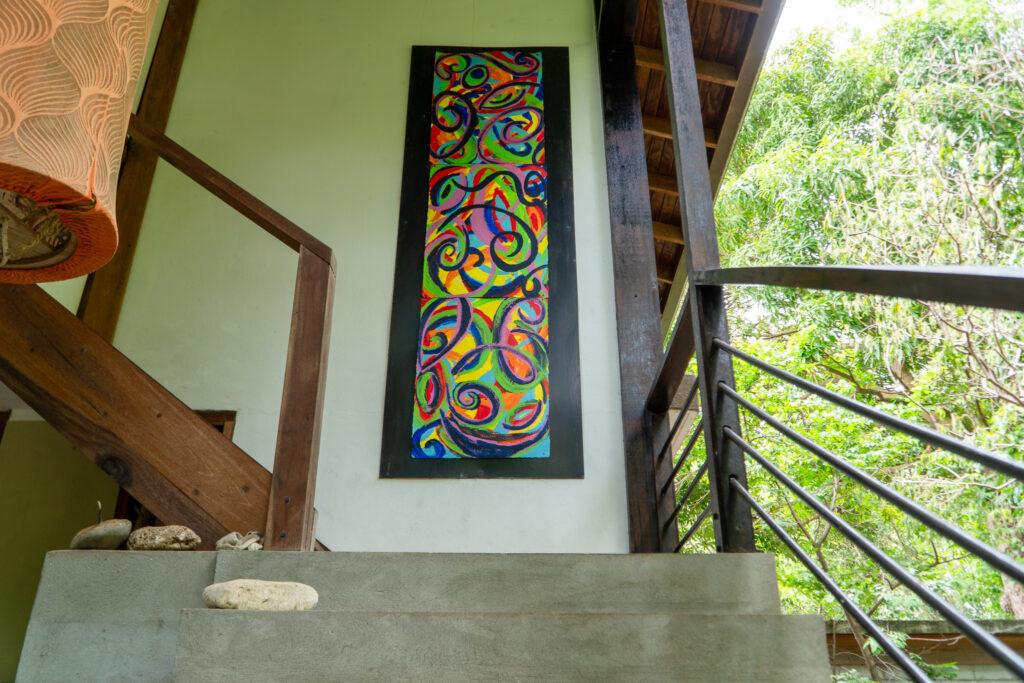

The cottages are designed for open-air living and do not use air conditioning. Guest information also describes solar hot-water systems, LED lighting, a limited range of appliances and laundry dried on lines. These are specific operating choices; the estate’s published information does not provide an independently audited energy-reduction figure.
Guests can help avoid unnecessary energy use by switching off lights and fans when leaving their cottage, while following any guidance from the team.
Local purchasing and community connections

Buying from nearby farms, shops and independent producers can help visitors direct some of their spending towards the surrounding community. Ideal World has not independently verified what proportion of Balenbouche Estate’s revenue is retained locally, so no local-retention figure is claimed here.
Travellers can also direct spending towards local guides, food businesses, makers and producers. Ask the estate for current recommendations and support businesses in nearby communities during your stay.
Reuse, restoration and composting
Restored structures and salvaged materials feature in the estate’s development, including in cottages such as Frangipani. Its published mission describes composting organic waste and cultivation practices that avoid chemical fertilisers and pesticides. That statement concerns the estate’s cultivation approach; it does not certify every ingredient served to guests or establish that every form of pest management across the property is chemical-free.
Ask the team how to separate waste during your stay and follow the arrangements currently available. Recycling services can change, so avoid assuming that every material can be collected locally.
Responsible travel in Saint Lucia
A property’s environmental practices are only part of the picture. Waste collection, water infrastructure and coastal protection also affect the places people visit. The points below offer wider context, but they should not be taken as evidence that every community or accommodation provider faces identical conditions.
Recycling services vary by location and material
It would be inaccurate to say that Saint Lucia has no recycling activity. For example, a government report describes a collection event in Anse La Raye in March 2026, involving Greening the Caribbean and the Solid Waste Management Authority.
Recycling access varies by location and material in Saint Lucia. Guests should check the arrangements available during their stay and avoid assuming that every material can be collected or processed locally.
Water supply depends on rainfall and infrastructure
WASCO reported declining river flows during dry-season conditions in January 2026. Separately, a government update in August 2026 described work on a northern pipeline to address ageing infrastructure and leaks. These reports concern different parts of the water system and do not show that all parts of the island experience the same conditions.
Use water thoughtfully, report leaks and follow current advice from your host and the water authority. If reliable water access is essential to your plans, ask the accommodation about current conditions before travelling.
Respect coastal habitats and wildlife
The Ministry of Agriculture has reported illegal sand mining and damage to nesting habitat at Grande Anse. Grande Anse is a separate location, not one of the beaches beside Balenbouche. The report is a reminder of the pressures coastal habitats can face, rather than evidence of the same problem at every beach.
Leave wildlife, shells and nesting areas undisturbed, follow local guidance and give animals space. When booking wildlife activities, choose responsible operators and follow site-specific instructions.
Things to do near Balenbouche Estate
Balenbouche works well for a south-focused trip with time to enjoy the estate itself. Rather than trying to cross the island every day, choose one main outing and leave room for meals, travel and a slower afternoon.
Explore Laborie, Choiseul and nearby communities
Laborie and Choiseul are close enough for shorter outings. Ask locally about places to eat, craftspeople, village events and suitable beaches. Opening times and events can change, so check current details rather than relying on a fixed timetable.
The tourism authority points to Laborie Beach, a calm and swimmable beach beside a traditional fishing village, and to Rudy John Beach Park in Laborie. Further along, Vieux Fort has a town and market, the Moule à Chique lighthouse viewpoint, and Sandy Beach, one of the longest beaches on the island, where you can watch kite surfers.
You could combine a grocery run with a meal in the area or a visit to a local maker. It is an easy way to experience more of the island beyond your accommodation.
Use Soufrière as a base for southern excursions
Soufrière is a starting point for outings to the Pitons, waterfalls, hot springs and hiking areas. Choose activities that suit your interests and fitness, and check access, transport and guide requirements before setting off. The tourism authority’s pages on Piton climbs and Sulphur Springs are a good place to start.
For snorkelling, choose a suitable location and check conditions with a local operator. The wave-exposed beaches beside Balenbouche should not automatically be treated as safe snorkelling spots.
Leave time to enjoy the estate
One day might be enough for a heritage visit and time on the grounds; another could be spent exploring the south. Keep some time free for a slow breakfast, reading on the veranda, cooking with ingredients bought locally or practising yoga. The point of staying in a cottage is that not every hour needs to be planned.
Who is Balenbouche best suited to?

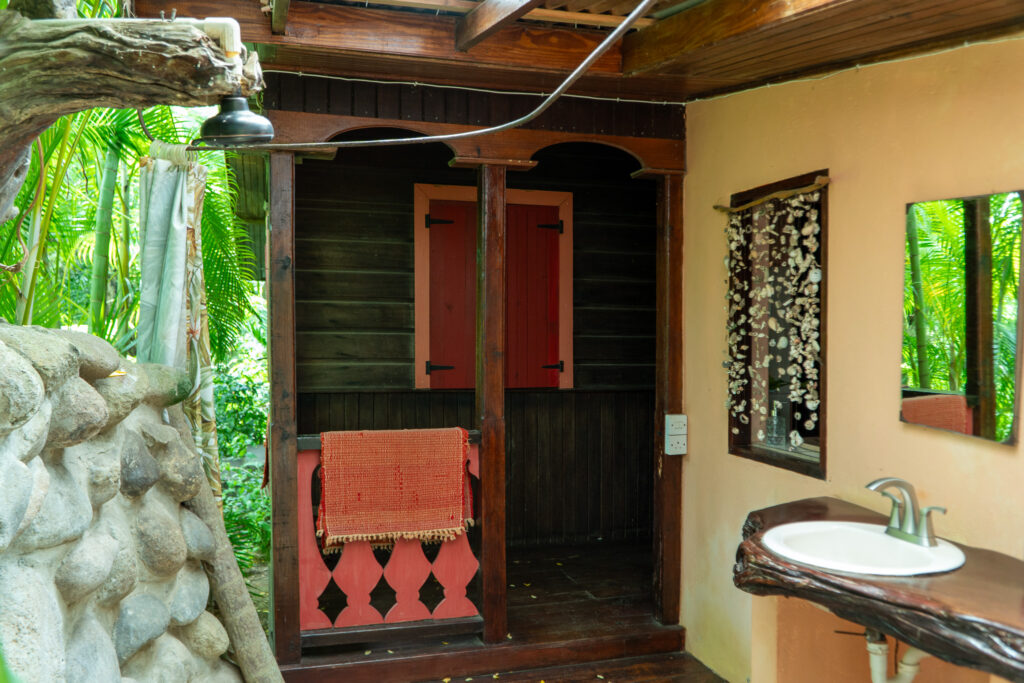

The estate is a good fit for independent travellers who value historic surroundings, nature, self-catering and a less scheduled pace. Couples and solo travellers may prefer the smaller cottages, while families and groups should compare the sleeping arrangements in Almond, Banyan and Moringa carefully.
It may be less suitable if you want air conditioning, screened windows, a supervised swimming beach, all-inclusive dining or extensive resort facilities. The grounds include historic structures and uneven paths, so anyone with mobility requirements should discuss access with the estate before booking.
Choosing the right cottage depends on more than the maximum number of guests. Consider how much privacy you need, whether the kitchen suits your plans, how the beds are arranged and whether an open-air setting will be comfortable for you.
How to book and prepare for your stay
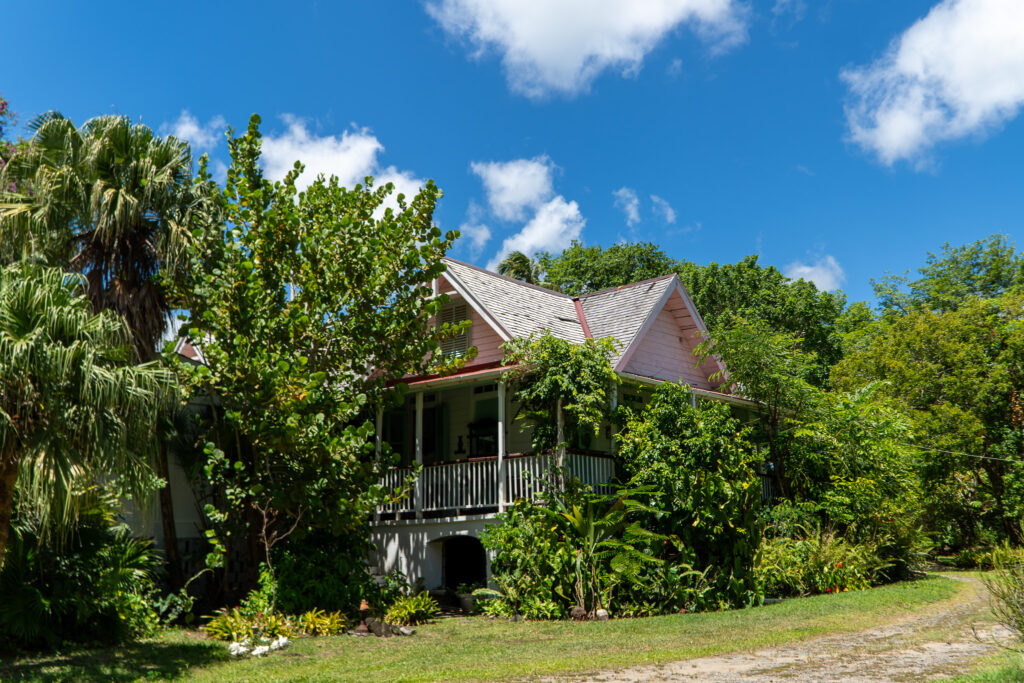
When contacting the estate, include your dates, the number of adults and children, your preferred cottage and any flexibility. Mention dietary requests, transport arrangements and accessibility needs early so the team can tell you what is possible.
You can email info@balenbouche.com or use the official Balenbouche contact page.
Cottage pages include enquiry or reservation forms, but submitting an enquiry does not mean the booking is confirmed. Review the written quote and booking terms before paying.
The estate’s general FAQ lists check-in after 3 pm and check-out around noon, with exceptions by arrangement, and a usual minimum stay of two nights. Confirm the arrangements for your specific booking. Wi-Fi is listed for the cottages, but ask about current service if you need it for work. The property uses 240V power and UK-style three-pin sockets.
The historic grounds are not fully wheelchair-accessible. If you need step-free access or other adaptations, describe your requirements before reserving. The official guest FAQ has further practical information.
Comfortable shoes are useful for the estate paths, along with light clothing, a reusable water bottle and the right charging adapters. Use mosquito nets as instructed and follow the team’s guidance on food storage and waste. If you expect to arrive late, arrange your transfer and first meal or grocery stop ahead of time.
Frequently asked questions
Where is the best area to stay in southern Saint Lucia?
It depends on what you want. Soufrière is the busiest base for the Pitons and has the widest choice of places to stay. Laborie and Choiseul suit a slower, village-based trip, and Vieux Fort is practical for the airport, Sandy Beach and wind sports. Balenbouche Estate sits between Laborie and Choiseul, around 35 minutes from Soufrière by the estate’s own estimate.
Is south Saint Lucia better than the north?
Neither is better. The tourism authority describes the south as quieter, with wide open landscapes and a slower rhythm, while the north has the busier resort strip and the Friday night street party in Gros Islet. Choose the side that matches how you like to travel, and remember that distances in the south are larger and a car or driver helps.
Where should I stay in Saint Lucia for nature and beach access?
Balenbouche Estate offers self-catering cottages on the south-west coast, with historic grounds and paths to two public black-sand beaches. It is best for guests comfortable with open-air accommodation and a natural, rather than serviced, beach setting.
How far is Balenbouche from Hewanorra Airport and Soufrière?
The estate’s published estimates are around 20 to 25 minutes by car from Hewanorra International Airport (UVF) and about 35 minutes from Soufrière. Treat these as estimates, as road and traffic conditions can change travel time.
How much do the cottages cost?
The rates supplied for this guide and checked on 2 October 2026 ranged from US$160 to US$250 per night for up to two adults. Rates may change, so ask the estate for a written quote for your dates and group.
Which cottage is adults-only?
Waterlily Cottage is listed for one or two adults and does not accommodate children. It has a king bed, kitchen and veranda overlooking the valley.
Which cottages are suitable for families or groups?
Banyan is listed for up to six guests, Moringa for up to five, and Almond for up to four, with a baby cot by arrangement. Check the bed layout, stairs and privacy before choosing.
Can I cook my own meals?
Yes. All six cottages have a kitchen or kitchenette, but the facilities differ. Check the individual cottage descriptions if you plan to cook regularly.
Can the estate cater for vegan or other dietary requirements?
The published dining information lists vegan, vegetarian, gluten-free and dairy-free options by prior request. Confirm the menu, price and availability before arrival, especially if you would like dinner.
Do the cottages have air conditioning?
No. The cottages rely on natural ventilation, fans and mosquito nets rather than air conditioning or screened windows. If you need an enclosed, climate-controlled room, this may not be the right fit.
Are the beaches private, and is swimming safe?
The adjoining beaches are public. Waves, currents and steep access can be concerns, and swimming conditions vary. Ask locally and do not assume that beach access means the water is safe.
Do I need to hire a car?
Not necessarily. A rental car gives you more flexibility for excursions and shopping, while an arranged driver may work well for a shorter or more estate-focused stay. Decide based on the places you want to visit and confirm transport arrangements in advance.
Can I practise yoga without joining a retreat?
The estate’s yoga barn is available for personal practice, with mats and blocks listed among the facilities. Classes and wellness services need to be arranged separately. Check the current details on the yoga and wellness page.
Does the estate have a regular recycling service?
Recycling arrangements can change. Confirm directly with the estate which materials can currently be separated, collected or taken to a local drop-off point.
Is local food in Saint Lucia certified organic?
No, the food is not organic in St. Lucia. Local origin and organic certification are different claims.
For farm to table stays in St. Lucia please check our Farm to Table guide to St Lucia.
When food shopping in St. Lucia, ask about the source and growing methods of specific ingredients rather than assuming that local produce is certified or pesticide-free.