

St. Lucia pottery is still made by hand, from clay dug out of the island
St. Lucia pottery is not a souvenir. It is a cooking pot, a coal stove and a flower pot, dug from the island’s own clay, pounded, coiled and fired in an open fire by women who learned it from their mothers. No wheel. No kiln. No factory.
I spent a day in the yard of one of those women, Miss Irene Alphonse, watching her pound clay under the mango tree she planted, with St. Vincent sitting clear on the horizon. She is 70. She has done this since she was a child. Everything below comes from that day, from the film we made, and from the people who have studied this craft for decades.
She introduced herself the way she does everything, plainly.
“My name is Irene Alphonse and I live in Martin. I was born and raised at Montreal. I married, and I come to live here with my husband.”
I asked her what she does.
“Pottery, flower pots. Name it, I do everything.”
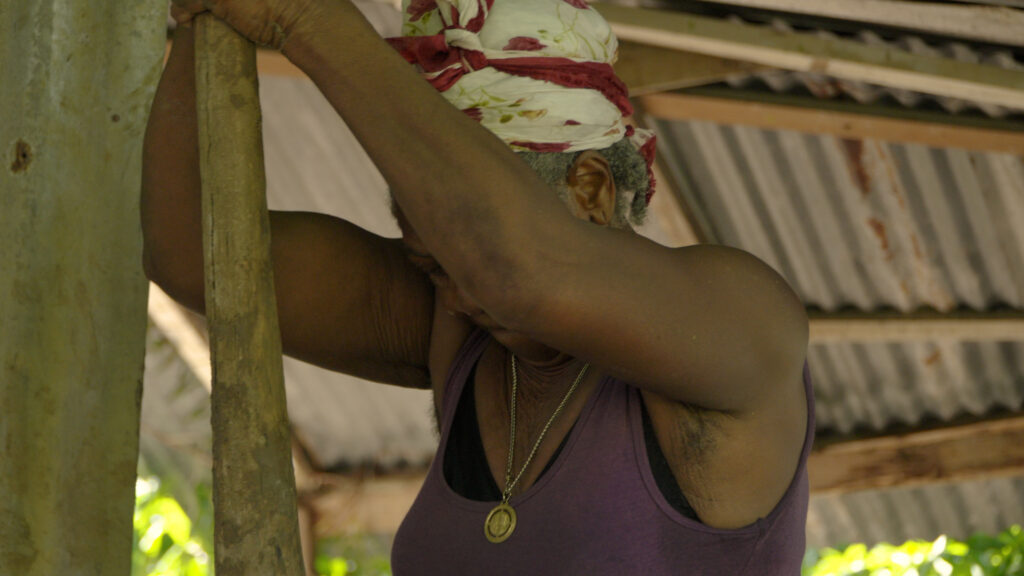
Irene learned pottery from her mother at nine, the way St. Lucian potters always have
St. Lucian pottery passes from mother to daughter, and Irene learned it exactly that way. Daughters in Choiseul learn the craft at home through childhood, and many enter a more focused apprenticeship at fifteen, after secondary school (Tihara Smith on the crafts of Choiseul). Irene’s life follows that line to the year.
“I started with my mother at the age of nine. When I was 15, I went to the craft centre to train, I learned, and I’ve been mostly.”
Her first job, as a little girl, was not shaping pots. It was cleaning the clay.
“I used to clean the clay for [her] like this. [She] did win it, and I did cleaning. That’s what you start out.”
Then the training took her across the islands, Anguilla first, then Martinique, Dominica and Guadeloupe. The French Creole islands, the same Kwéyòl family as St. Lucia.
“My first train was Anguilla. Twice I went Martinique. Dominica, Guadeloupe. Long time I travelling.”
There is a detail I am still chewing on. Professor Patricia Fay of Florida Gulf Coast University spent twenty five years researching Caribbean potters for her book Creole Clay, and on her International Ceramics Festival lecture page she lists an Irena Alphonse of Choiseul. Same surname, same craft, same district.

Where does St. Lucia pottery come from? African hands and Kalinago land
St. Lucia pottery has its roots in both Africa and the first peoples of the island. The Folk Research Centre describes the ceramics as a tradition handed down from the Amerindians, still practised mainly in Choiseul, where the right clay is found. Caribbean Beat traces the potters of La Pointe Caribe to a Kalinago settlement, and notes that the women potters, like the Amerindian potters before them, made a cassava griddle called the platin until the 1960s.
The African line is just as strong, and in the hands it is stronger. Professor Fay writes that the coil building used by the women potters of Choiseul is indistinguishable from that of the Bafia people of Cameroon, and that their self sufficient Creole way of life grew after emancipation, using methods inherited from Africa (The Voice). Clay cookstoves from Nigeria and Cameroon look remarkably like the Caribbean coal pot (Tihara Smith).
So when you hold a coal pot from Choiseul, you are holding Kalinago clay knowledge and West African hands, meeting on a plantation island. The history of the south is written into the land too. At Balenbouche Estate, a few minutes away, Kalinago pottery, carved rock basins and petroglyphs still lie along the river (Balenbouche history).
And the same pottery reaches further than St. Lucia. Caribbean Beat names similar sturdy, open fired pots from Sea View Farm in Antigua, the village where I stayed at Lamblion and picked my breakfast off the trees.
How is St. Lucia pottery made? Pound, clean, coil, smooth, dry and fire
St. Lucia pottery is made in six steps, and Irene does every one of them by hand. Here is her order, in her words, with what each step is for.
| Step | What Irene does | Why it matters |
|---|---|---|
| 1. Dig | Takes clay from the land up the road, and tests every new patch by making a piece and firing it first | Bad clay bursts in the fire |
| 2. Pound | Pounds the clay with a wooden pounder until it is soft and holds together | Raw clay cannot be worked as it comes out of the ground |
| 3. Clean | Picks out the stones, the lumps and the hard pieces by hand | A stone left in the wall cracks the pot when it is fired |
| 4. Coil | Builds the pot up in rings of clay, walking round it on a turntable for the big ones | Coiling is how the pot rises without a wheel |
| 5. Smooth and design | Leaves it overnight, then smooths and decorates it the next day | Clay that is too soft sags, too hard cannot be shaped |
| 6. Dry and fire | Dries the pots, then fires them in an open fire | Fired pots turn brown and become hard enough to cook on (Folk Research Centre) |
Pounding the clay comes first, and it takes strength
I watched her pound for most of the morning. I told her that was why her arms were so strong.
“You can’t use it as it comes. As it is there underneath the thing, you can’t take it and put it there and work. It is not good. You have to mix it together so that it stays together. You get a smooth clay to work and from there you have to clean it.”
“This is not for the weak. Not for one day. People who are not strong cannot do this. Oh, no no no no no.”

Cleaning out the stones saves the pot from bursting
“I cleaning the clay just to remove the stones and the hard pieces. You cannot put it inside of it because when you fire it, it will break. If the clay not good. You just have pop, pop, pop, pop. You will get nothing in the fire.”
So she tests. Every new patch of clay gets a trial piece and a trial firing before she trusts it.
“Before you use the clay you take, you test this. You take it and then make something and then fire it to see how it coming out.”
Coiling builds the pot, on the lap or on a turntable
I asked her why she kept going round and round.
“To build it up. You circle, you have to go to build it up. But before we used to do it on our laps. But as I am doing the big ones, I cannot put it on my lap. So we have to have the turntable, or you walk around.”
The turntable is an old wheel, there to give the pot height, not to spin it like a potter’s wheel. The shaping is all hands and walking.
Watch the whole day above, from the first pound to the coils rising, and you will see why a pot from her yard costs what it costs.
What is a coal pot? A clay stove for charcoal, still used in St. Lucian kitchens
A coal pot is a portable clay stove that burns charcoal, used for grilling and slow stewing, and it is still used in many St. Lucian kitchens alongside gas and electric stoves (Choiseul District). Caribbean Beat calls the St. Lucian version unique, and gives its Kwéyòl name, the teso. The canari, or canawí, is the round bottomed clay cooking pot, and in St. Lucia canawí is also the word for pottery itself (Tihara Smith).
Here are the pots you will meet, what they are for and where to find them.
| Pot | What it is used for | Kwéyòl name | Where to see or buy |
|---|---|---|---|
| Coal pot | A charcoal stove for grilling and slow stewing | Teso (Caribbean Beat) | Order from Irene, the Choiseul Arts and Crafts Centre, La Pointe and Morne Sion potters |
| Cooking pot | Soups, callaloo, beans and one pot meals | Kannawi or canawí (Tihara Smith) | Choiseul potters, made to order |
| Casserole | A saucepan shape with French roots | Le kastol (Caribbean Beat) | Choiseul potters, ask for it |
| Water jug | Keeping drinking water cool | Le krish (Caribbean Beat) | Choiseul potters, ask for it |
| Cassava griddle | Baking cassava bread and flour over stones | Platin, made until the 1960s (Caribbean Beat) | Rare now, ask at the Folk Research Centre |
| Flower pot | Gardens and hotel grounds, a form that grew with tourism | Flower pot | Irene makes them to order, including for Ladera |
| Clay pounder | The pestle that softens the clay | Mach te (Caribbean Beat) | You will see it in every potter’s yard |

Irene still cooks in clay. Beans especially.
“The best to cook is the clay pot. But you have to do it on a fire, the taste, the smoky. I like to make beans. For me, it has to be on a big fire. But I put it on the stove too, if you want to know. Boiling on the stove.”
Tihara Smith writes that many older St. Lucians say callaloo, pumpkin soup and one pot dishes taste better in a seasoned clay pot. I believe them. Food cooked slowly in the earth it grew in carries a different energy than food boiled in aluminium. That is my belief, not a lab result, and I will stand on it.
Where there was a calabash tree, there were potters
Calabash trees once marked the homes of St. Lucian potters, because the hard calabash shell was cut into the tools that shape the pot. Irene told me this standing by the calabash tree in her own yard, and I had never heard it before.
“Long ago, when you see where you get a calabash tree, that’s the people who are making pottery there, because they need the calabash to make the tools for the pot. All the tools now we get in plastic, you take the plastic, you cut it and you’re making it too.”
The calabash was the plate and the cup too. I told her I only eat from calabash and drink from coconut, because I do not want plastic in my food. She laughed and told me how they used the inside.
“When we have flu, we boil the inside and we drink it.”
That is her family’s remedy, passed down, not medical advice. It belongs to the Caribbean bush medicine tradition we cover in our medicinal plants guide. What is not a belief is the plastic. A 2024 study in the Journal of Exposure Science and Environmental Epidemiology found 3,601 food contact chemicals in human bodies, from blood to breast milk. The calabash and the clay pot never put a single one there.
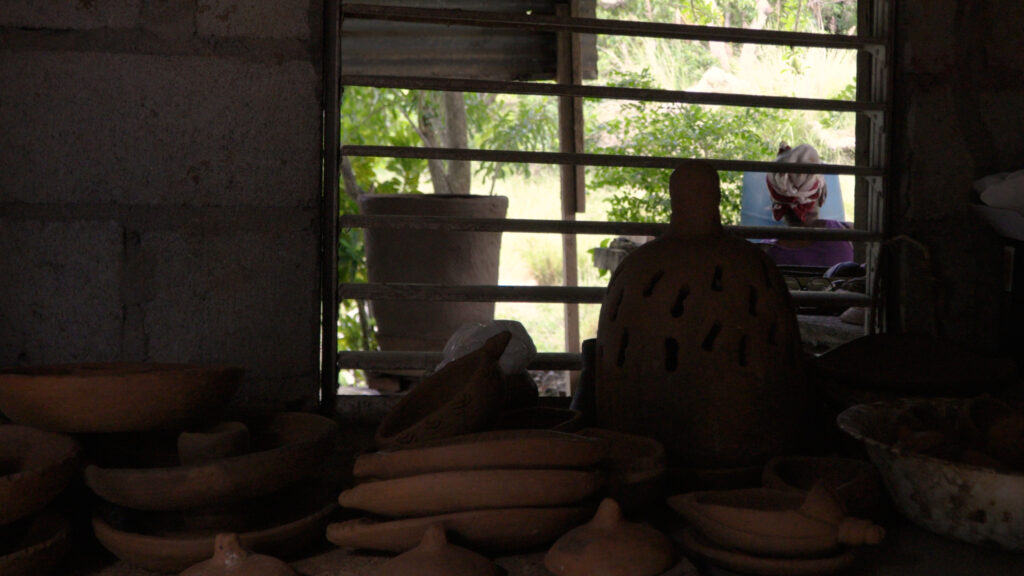
Is clay better than plastic? Plastic replaced the calabash and the clay pot in one generation
Plastic replaced the calabash and the clay pot in St. Lucian homes within Irene’s own lifetime. She grew up eating from calabash. I asked her why they stopped.
“Because of the plastic. Where things go, comes new things. Every year things change.”
The Folk Research Centre says the gas stove and the gas cooker cut demand for the coal pot, and the potters moved towards flower pots, vases and small sculptures to survive. Tourism did the rest. From the 1960s, potters began making ashtrays for visitors and big flower pots for hotels (Tihara Smith).
Convenience is not the same as progress. A plastic tub is made in seconds by a machine somewhere you will never see, and it outlives everyone who used it. A clay pot is made by a woman you can meet, from earth you can stand on, and when it breaks it returns to the ground. If it can’t rot, it’s not sustainable.
The craft centre closed, and the machine that softened the clay went to the rubbish
The government craft centre where Irene trained and later worked had a machine that prepared the clay for her. When the centre closed, it was thrown away. Now she does it all with the pounder.
“When I used to work at the craft centre, we used to have a plunger. You pour it out to dry and I will just push it in, and then it turns and then the clay come out smooth and then we work. But as we don’t have it there, we use the mortar.”
“We had everything. But when they send us home, they dump everything. They closed down the centre. So the thing stayed there, and we ourselves was at our home working. So they send it to the rubbish.”
I asked her straight. If somebody gave you a machine, would you take it?
“Yeah, I would like it.”
She is not the only one asking. In 2023, the Choiseul crafters were pleading for the return of the craft centre so they could train young people and sell to visitors. The government had already announced a revival of the Choiseul craft sector in 2011. And in October 2025, the Choiseul Arts and Crafts Centre was officially opened again. Good. Now put a clay mixer in it, and in the yards of the women who still do the work.
Would you pay a little more for a pot if it meant the potter got a machine? Tell me in the comments.

Irene taught children through the government, and she does not know who will carry it on
Irene taught pottery to children at the craft centre through a government programme, alongside her own work on Fridays and Saturdays.
“I used to teach them through government, the children. Very tiny things. Like small plates, things like that.”
I asked if the young ones still want it.
“Those that want to do it, they’re trying. They trying their best.”
Her son carries the clay for her now and helps with the heavy pieces. Her granddaughter sits beside her and plays with the scraps. When I asked if the family will carry it on, she was honest.
“I don’t know. Tell you the truth, I don’t know.”
That is how a craft dies. Not with a bang, with a shrug. The Choiseul Arts, Craft and Tourism Heritage Association told The Voice that they want young crafters to earn a living from it, and that the local market alone cannot carry them. That is where you come in.
There are more customers than pots, and Irene raised her children on this work
Irene has more orders than she can make, which tells you this is not a dying market. It is a dying workforce.
“There is customers. People who want. I cannot even give them what they want.”
When I was there she was working on an order of flower pots for Ladera, the resort on the ridge between the Pitons, which I look at in my guide to farm to table stays in St. Lucia.
“If you have a big order, for example, like Ladera, I do. I have 12, 12, 24 flower pots to do. But my son helped me in the clay.”
Twenty four pots, one or two a day, between weeks and a month. Every one coiled by hand. And this work fed and schooled her whole family.
“I raised my children on it. Send them to school. Everything. I didn’t have any other work. Everything with it.”
“I didn’t have something, I could not feed my children. Whenever I sit down and then I take a piece of clay and I do something, God send somebody to buy it.”
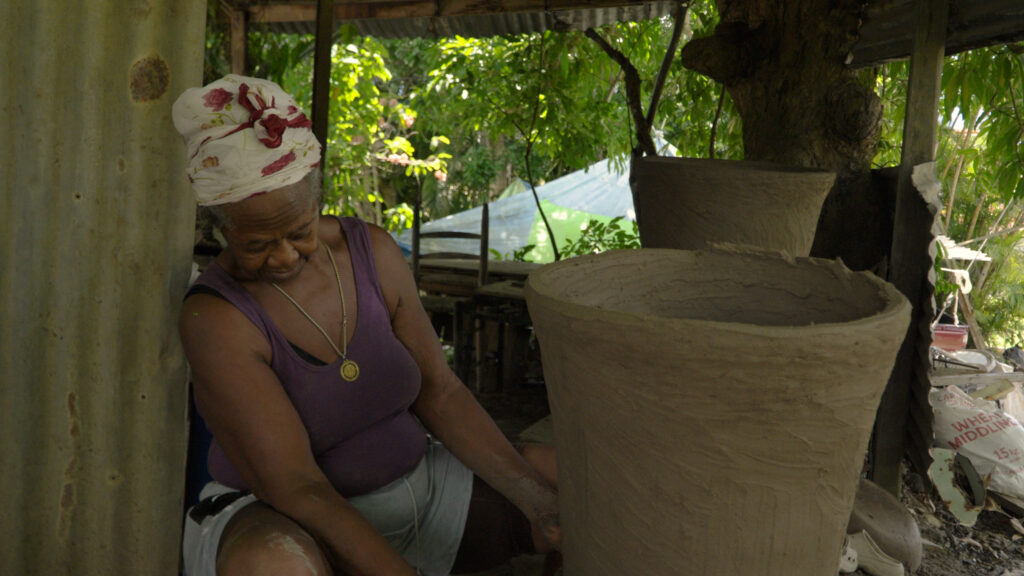
At 70, Irene says she is living in her ideal world
Irene says she is living in her ideal world, at 70, in her yard with her clay. Our show is called My Ideal World, so I asked her the question we ask everyone.
“Yes, I’m living in an ideal world. Beautiful landscape. No bad smell. The environment is very clear and clean.”
“I am 70 years now. Proud to be 70. Because to me, I’ve worked from time, I’m working up to now. And God have me standing there. Not much sickness.”
She works under a shelter she built against the mango tree, because inside was too hot. Her secret, in her words, is to eat, drink, never starve herself and never overeat, and warm water with lemon when she feels run down. That is her habit, not a prescription. But look at her pound that clay and tell me it is not working.
Her faith carries her as much as her arms do. While we were talking about it, a car pulled up and somebody bought a pot. I am not making that up. It is in the film.

Where to buy St. Lucia pottery and a real coal pot
Buy St. Lucia pottery from the potters of Choiseul, in person or by order. Irene works to order, and people find her by asking for her. In her words, everybody knows the pottery woman. The Choiseul Arts and Crafts Centre sells the work of the district’s crafters, and Caribbean Beat points visitors to the workshops of La Pointe Caribe, below Gros Piton, and to the Castries craft market if you are only passing through.
The best time to see it all in use is Jounen Kwéyòl, St. Lucia’s Creole Day, held on the last Sunday of October, when families cook the old food in the old pots. Irene told me that is when everybody wants a coal pot.
Three rules from me. Buy from the hands that made it. Pay the price without bargaining. And use it, because a pot on a shelf keeps nobody’s craft alive.
Where to stay in St. Lucia to meet the potters of the south
To meet the potters, stay in the south of St. Lucia, between Laborie and Choiseul. My pick is Balenbouche Estate and the quiet south, minutes from the craft villages, with your own kitchen to cook in your new pot. For the whole island by area, read where to stay in St. Lucia, and for a week that strings the south together with sea moss, cocoa and Creole food, follow my St. Lucia itinerary.
The St. Lucia destination guide has the practical basics, and my sustainable hotels in St. Lucia list scores where to sleep. If old crafts and family land are what move you, read green heritage stays in the Caribbean and the story of an Antiguan garden that connects four generations. Irene is not the only one holding a whole tradition in two hands. The wood fired bakery in Antigua is another.
My pick, and what we stand to lose
Miss Irene does not need to be a symbol. She needs a clay mixer, a full order book and a young person beside her who wants to learn.
St. Lucia pottery is not heritage behind glass. It is beans on a fire, callaloo in a canari, a coal pot on the step at Jounen Kwéyòl. Every pot she sells is one more year the knowledge stays alive. Every plastic tub we buy instead is one less.
Buy the pot. Cook in it. Tell the potter you came because of her.
Your questions about St. Lucia pottery and coal pots, answered
What is St. Lucia pottery?
St. Lucia pottery is traditional hand built earthenware made from local clay, mainly by women potters in the Choiseul district. The pots are coiled by hand, smoothed, dried and fired in an open fire, without a wheel or a kiln.
Where is pottery made in St. Lucia?
Pottery in St. Lucia is made mainly in the Choiseul district on the south west coast, in villages such as La Pointe and Morne Sion, where the right clay is found. The St. Lucia tourism authority calls Choiseul the cradle of craft.
What is a coal pot?
A coal pot is a portable clay stove that burns charcoal, used for grilling and slow stewing. It is still used in many St. Lucian kitchens alongside gas and electric stoves, and its Kwéyòl name is the teso.
How do you use a coal pot?
You fill the top bowl of a coal pot with lit charcoal and set your pot or grill on top, with air drawn in through the opening at the base. Use it outdoors or in a well aired space, never in a closed room.
What is a canari or canawí?
A canari, or canawí, is the traditional round bottomed clay cooking pot of St. Lucia. In St. Lucian Kwéyòl, canawí is also used as the word for pottery in general.
Is St. Lucian pottery Amerindian or African?
St. Lucian pottery is both. The Folk Research Centre traces the tradition to the Amerindians, while ceramics researcher Patricia Fay found the coil building of the Choiseul potters identical to that of the Bafia people of Cameroon.
Who is Irene Alphonse?
Irene Alphonse is a St. Lucian potter, 70 years old, who learned the craft from her mother at nine and trained at a government craft centre at fifteen. She makes coal pots, cooking pots and flower pots by hand, to order.
Where can I buy a coal pot in St. Lucia?
You can buy a coal pot from the potters of Choiseul, at the Choiseul Arts and Crafts Centre, from the workshops of La Pointe, or at the Castries craft market. Potters like Irene also make them to order.
How is the clay prepared for St. Lucia pottery?
The clay is dug locally, pounded with a wooden pounder until smooth, and cleaned by hand of stones and hard pieces. Potters test fire each new batch, because stones or bad clay make the pot burst in the fire.
Does food taste better cooked in a clay pot?
Many older St. Lucians say callaloo, pumpkin soup and one pot dishes taste better in a seasoned clay pot, and Irene prefers clay for beans cooked on a wood fire. Clay also keeps plastic and its chemicals out of your food.
What is Jounen Kwéyòl?
Jounen Kwéyòl is St. Lucia’s Creole Day, held on the last Sunday of October at the end of Creole Heritage Month. Families cook traditional food, often in clay pots, and Choiseul’s crafts are on show.
Can I watch potters at work in St. Lucia?
Yes, you can watch potters in the Choiseul district, and Caribbean Beat recommends the workshops of La Pointe Caribe below Gros Piton. Ask in the village or at the Choiseul Arts and Crafts Centre, and always ask before filming.
Is Choiseul worth visiting?
Yes, Choiseul is worth a day for its potters, basket weavers and furniture makers, the Saltibus waterfalls and the quiet coast. It sits between Soufrière and Laborie, close to Balenbouche Estate.